Leaves on a StreamEmotional Fitness · ~3 min
About this template · Updated September 2026
Psychologist Kevin Polk developed the ACT Matrix together with Jerold Hambright and Mark Webster, and the Association for Contextual Behavioral Science describes it as a way of thinking about and building psychological flexibility. The method is set out step by step in The Essential Guide to the ACT Matrix by Polk, Benjamin Schoendorff, Mark Webster and Fabian Olaz. What you are using here is our own practice sheet, built separately: none of those authors, and not ACBS, made it, reviewed it or endorse it.
The matrix itself is two lines crossing on a page, small enough to carry in your head. Once it is there, you start seeing your day through it.
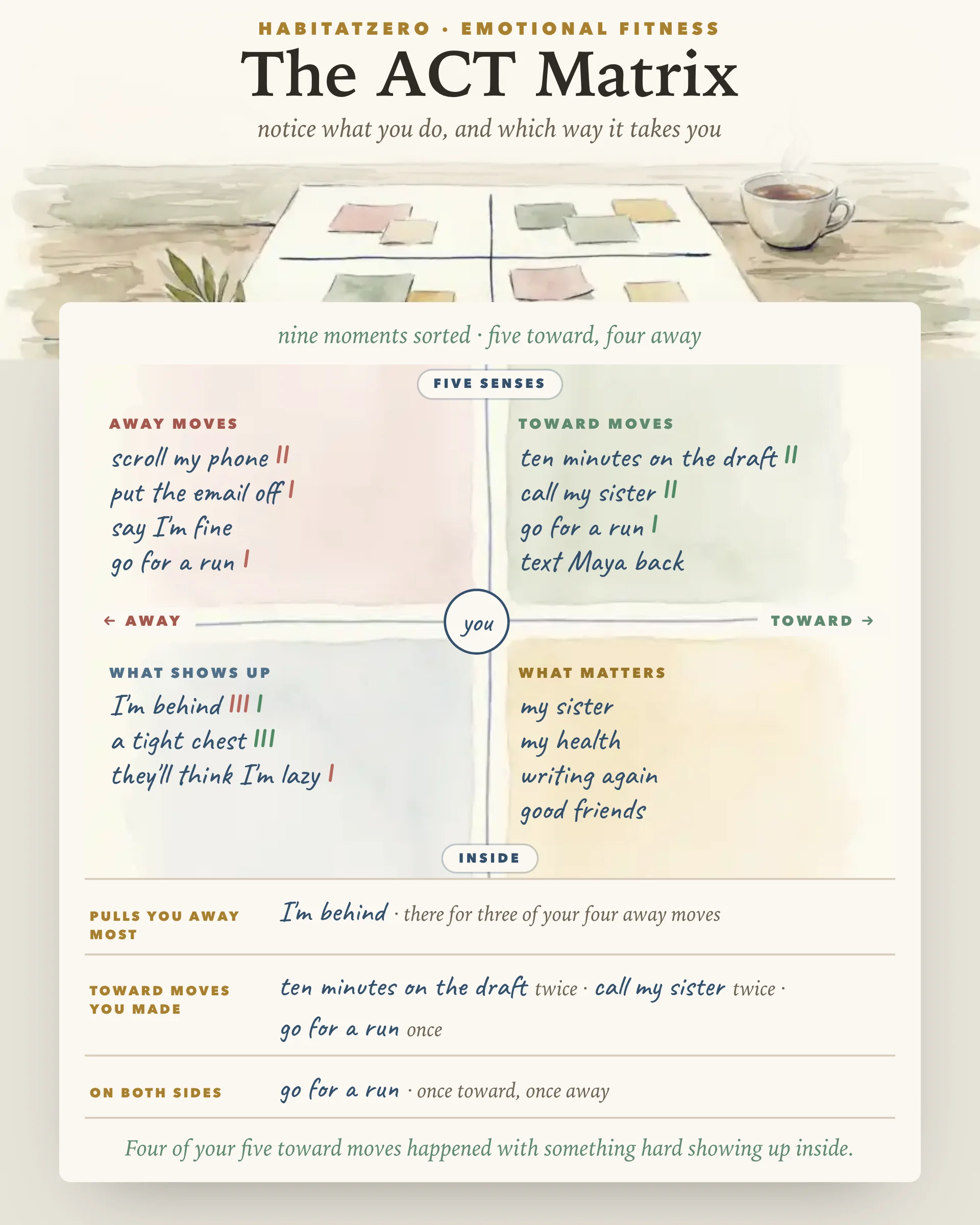
The vertical line splits experience in two. Above it is what you do with your body, the part anyone could see or hear if they were in the room. Below it is what happens inside you: thoughts, feelings, memories, sensations, urges. The horizontal line splits behavior by direction. Moves to the left take you away from unwanted inner experience. Moves to the right take you toward the people and things you care about. In the middle sits you, the one noticing all of it.
The corners hold four questions, usually answered in this order:
Beginning with what matters changes how the hard corner reads. The dread and the self-criticism in the lower left tend to show up exactly where something in the lower right is at stake.
First you draw your matrix: tap suggestions or write your own, up to five per corner so it stays readable at a glance.
Then you use it, which is where a screen beats paper. When you catch yourself mid-move, open sort a moment: pick what you just did, note what was showing up inside if anything was, and tap away or toward. That tap is the whole practice. It leaves a small tally mark on your matrix, rose for away and green for toward, beside the move and beside the inner experience that came with it.
After three sorts, the sheet starts reading your marks back to you. It names the inner experience that most often pulls you away, lists the toward moves you have actually made along with the ones still waiting, and points out any move that has landed on both sides of the line. It also counts the toward moves you made while something hard was showing up inside.
The matrix does not sort behavior into good and bad. The book frames actions as workable or unworkable: does this move help you build the life in the lower right, or does it only buy relief? Plenty of away moves are sensible. Scrolling for five minutes after a brutal meeting is not a character flaw. The trouble starts when the same away move becomes the only move, and the relief it buys keeps getting more expensive.
That is also why the sheet lets one move sit in both top corners. A run can be a toward move for your health on Tuesday and a way to outrun a thought on Thursday. The action looks identical; the direction depends on what it was for, and only you can tell.
ACT as a whole is well studied. A review of twenty meta-analyses, covering more than twelve thousand participants, found it effective for anxiety, depression, substance use and pain, and generally ahead of waitlists, usual care and most other active treatments, with cognitive behavioral therapy the exception. The matrix on its own has far less research behind it. One small Korean pilot trial gave nineteen college students with emotional dysregulation either a single fifty-minute matrix session or education about emotion regulation, and the matrix group reported less dysregulation and depression and more psychological flexibility afterward. With a sample that small, read it as a promising start rather than proof.
This sheet is self-help practice drawn from acceptance and commitment therapy, not treatment. If what shows up in your lower left is heavy or relentless, a therapist trained in ACT can work through the matrix with you and take it further than any worksheet.
Draw your matrix once, on a calm day. Then keep it close in ordinary life: after an evening disappears into your phone, or after a conversation you handled the way you wanted to. A few sorts a week is enough for a pattern to form.
If the thing that most often pulls you away is a thought on repeat, Leaves on a Stream practices letting it pass without obeying it. If the lower right corner felt hard to fill, the ACT Values Worksheet spends longer on what matters. And if your away moves tend to start as a strong urge, Urge Surfing helps you ride one out.
It is a diagram from acceptance and commitment therapy built from two crossing lines. The vertical line separates what you do, which anyone nearby could see, from what goes on inside you, and the horizontal line separates moves away from unwanted inner experience from moves toward who and what you care about.
Who and what is important to you? What shows up inside you and gets in the way? What do you do to move away from that inner stuff? What do you do, or could you do, to move toward who and what matters? Most people answer them starting at the lower right corner and finishing at the upper right.
Psychologist Kevin Polk developed it with Jerold Hambright and Mark Webster, and the method is laid out in The Essential Guide to the ACT Matrix by Polk, Benjamin Schoendorff, Mark Webster and Fabian Olaz. This worksheet was built on its own and has no tie to those authors or to ACBS, and none of them endorse it.
No. Away moves are an ordinary response to discomfort, and many of them bring real relief in the moment. The matrix asks what a move does for you over time, which is why the same action, such as a run, can land toward on one day and away on another.
You do not need a file. The filled example here shows a matrix after nine sorted moments; drawing your own corners and sorting your days into them starts once you personalize the sheet in HabitatZero, which costs nothing.
By the team behind Fabulous, the science-based self-care app used by over 30 million people.