
The Overwhelm Recovery ProtocolWellness & Routines · ~5 min
About this template · Updated November 2026
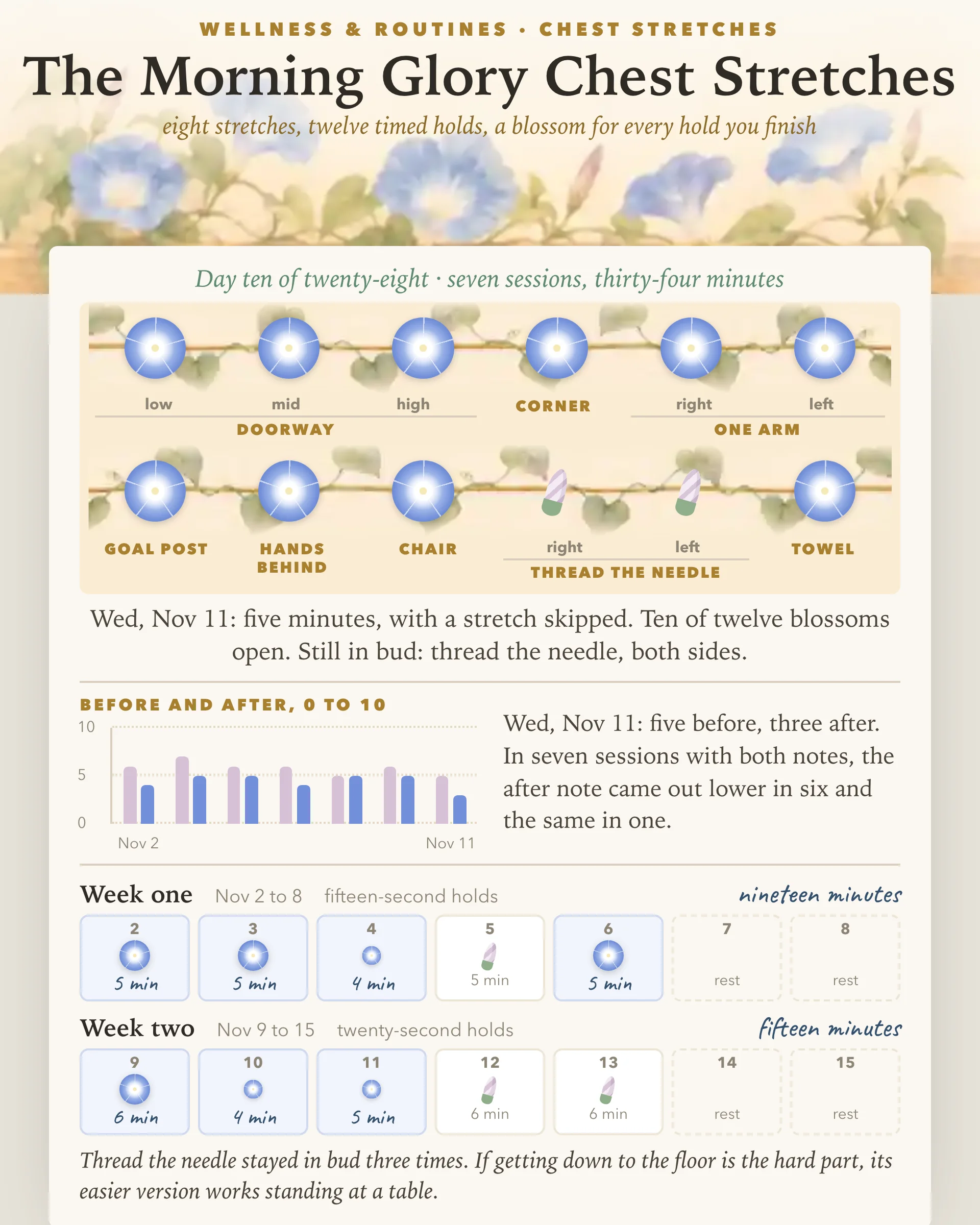
A morning glory opens with the first light and folds shut by late afternoon. Your chest behaves a little like that: stretching opens it, and a day bent toward a desk, a steering wheel or a phone draws it closed. These chest stretches are a short daily practice, not a cure, and the page keeps it honest: a blossom on the vine opens only when a hold has run its whole time.
Pain, pressure, heaviness or discomfort in the chest, above all with shortness of breath, sweating for no clear reason, or pain spreading to an arm, the back, the neck or the jaw, can be a heart attack. The National Heart, Lung, and Blood Institute's page on heart attack symptoms says to call 911 whenever you think you might be having one, even if you are unsure. Do that instead of stretching. A chest tight from sitting pulls across the front as you open your arms, and eases as you move.
The session goes from standing to sitting to the floor, so you get down only once.
Each starts on an easier version. Palms replace forearms in the doorway and the corner, a towel held wide stands in for clasped hands, thread the needle moves to a tabletop, and the rolled towel goes onto your bed. Switch a stretch to standard once the easier one is no more than a gentle pull.
A session holds twelve buds: three for the doorway's heights, two each for the one-sided stretches, one for each of the rest. The timer talks you through getting set and counts each hold down in true time, even if your phone locks. A hold that runs to its end opens its bud into a blue blossom. A skipped stretch keeps its buds closed and its seconds uncounted, and an early end keeps whole minutes only.
Tap how tight your chest feels from 0 to 10 before you begin and again after. The pair lands on a chart beside your own earlier pairs and nothing else: no average, no band, no verdict. The reading below names any stretch that keeps staying in bud, with its easier way back in.
Five days of stretching and two of rest, four weeks running. Holds grow by five seconds a week, from fifteen to thirty, so a session takes five minutes in week one and eight by week four.
Regular stretching does widen how far a joint can move. A 2024 meta-analysis of 77 studies by sport scientists in Austria and Canada pooled programs of two weeks or longer and found a moderate gain in range of motion, with static holds like these among the stronger methods. Its 3,870 participants were healthy and averaged 27 years old, the studies varied widely, and positive results looked likelier to have been published.
Whether stretching changes posture is far less settled. A 2010 review by an exercise researcher in Melbourne found a handful of studies in which stretching the front of the chest, alone or with strengthening, shifted where rounded shoulder blades sat at rest, and asked for much better studies. In a six-week trial by physical therapists in Brazil and the US, 50 adults stretched the small muscle beneath the chest every day. It did not measurably lengthen and their shoulder blades moved no better, though the 25 who began with shoulder pain reported less pain and easier use of the arm.
So use this routine to feel more open after long sitting, judged against your own notes. It will not straighten rounded shoulders by itself.
Ask a doctor or physical therapist before starting if you have had shoulder surgery or a dislocation, if a shoulder slips or catches, or if you live with osteoporosis, a heart condition, or pain, numbness or tingling running down an arm. Stretch to a gentle pull, never into pain, and lower your arms right away if a hand tingles in the doorway.
The Neck and Shoulder Yoke loosens the neck and the tops of the shoulders, with the doorway as its one chest opener; this page builds a whole session around opening the chest. For the strength work that belongs beside it, The Plumb Line Posture Plan pairs one chest stretch with wall angels and band pull-aparts, and The Upper Back Dovecote spends six weeks on the muscles that hold a rounded upper back up.
Ones you can do standing and stop at a gentle pull: a doorway stretch with your palms on the frame, a corner stretch from a long step back, and a palm on the wall as you turn away. Here every stretch starts on its easier version, including thread the needle at a table and the rolled towel on your bed.
This plan begins at fifteen seconds a hold in week one and adds five seconds each week, reaching thirty in week four. Ease in and keep breathing; if a physical therapist has given you other timings for your shoulder, follow theirs.
Not on their own, as far as the research goes. Stretching for a few weeks does widen how far a joint moves, but studies of chest stretching and shoulder position are few and small, and a six-week trial of daily stretching did not lengthen the muscle or improve how the shoulder blade moved. Strength work for the upper back belongs alongside it.
A tight muscle pulls when you open your arms and eases as you move. Pain, pressure or heaviness in the chest, especially with shortness of breath, sweating, or pain spreading to an arm, the back, the neck or the jaw, can be a heart attack, so call 911 even if you are not sure.
No. You should feel a gentle pull across the front of your chest or shoulder and nothing sharp. Stop if a stretch turns painful, and lower your arms at once if a hand tingles or goes numb, which can happen with the arms held high in a doorway.
By the team behind Fabulous, the science-based self-care app used by over 30 million people.


