
The Overwhelm Recovery ProtocolWellness & Routines · ~5 min
About this template · Updated September 2026
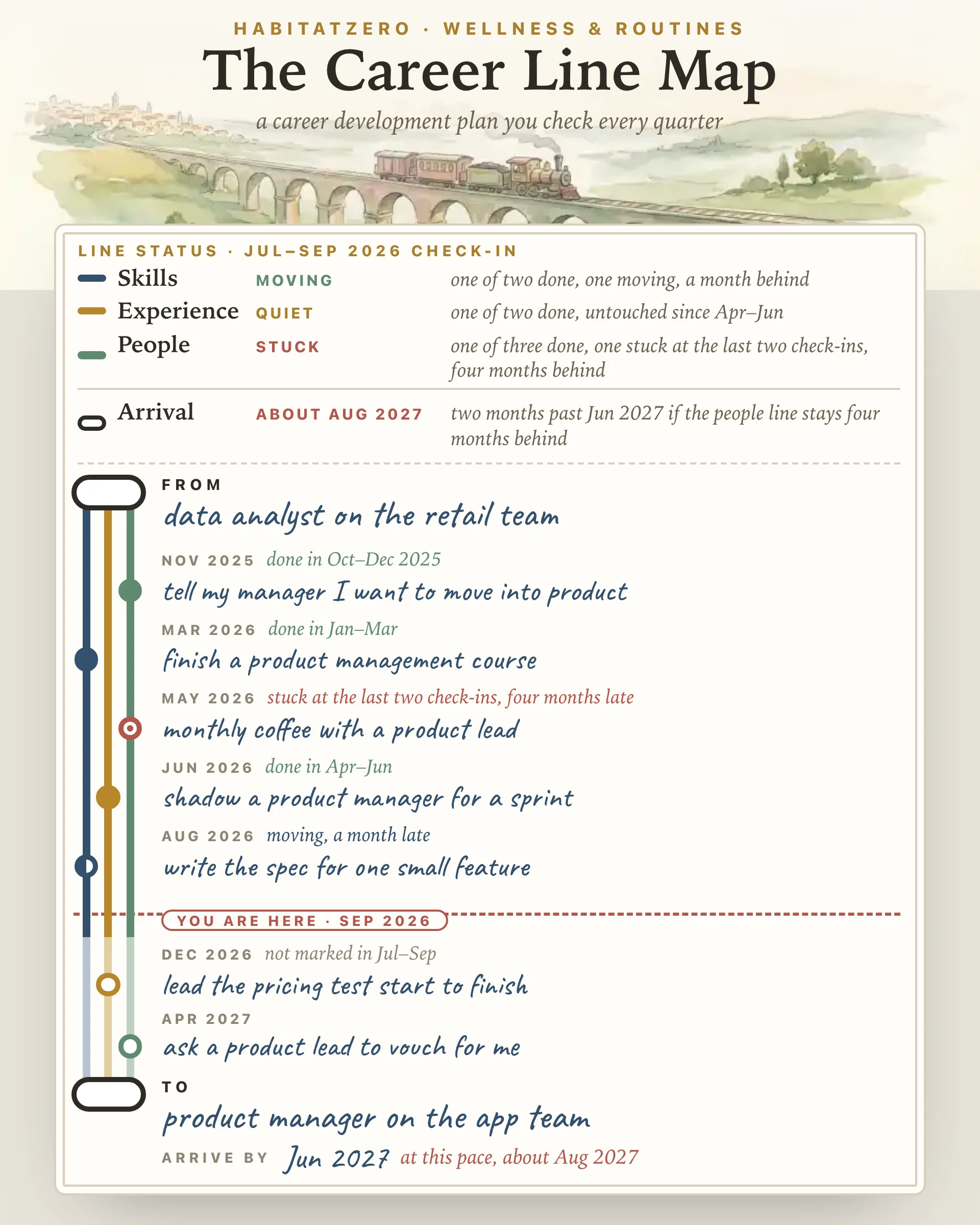
Most career development plans get written once, for a review, and then filed. Six months later, nothing on the page tells you which part of the plan actually moved. This page draws the plan as a transit line map instead: a From stop for the work you do now, a To stop for where you are heading, and three colored lines between them. Check the lines once a quarter and the map reads back which one is running, which has sat untouched, and what that means for your arrival date.
Employers, universities and research labs often call it an individual development plan, or IDP. Either way, the useful ones hold five things:
Start at the top: write your current role in a few words, then tap up to three strengths and three gaps. At the bottom, name where you are heading and step the arrival date to somewhere one to three years away.
Three lines run between the two ends. The skills line holds what you learn, such as a course or a certificate. The experience line holds what you do, such as leading a small project or shadowing someone in the role. The people line holds relationships, such as telling your manager where you want to go or finding a mentor. Each stop gets a due month, someone who can help and the proof you will have once it is done. A line holds four stops, so plan the next one or two on each, not the whole route.
The stops sit on the map in date order, with a dashed “you are here” cut at the current month. Everything above the cut should be done or under way.
At the end of each quarter, mark every open stop done, moving or stuck. The marks stay in that quarter’s check-in as history; a new quarter opens a fresh one, and a stop finished last quarter stays finished.
The line status at the top does the reading. A line is moving when something on it was marked done or moving at the latest check-in, stuck when its stop was marked stuck, and quiet when nothing on it was marked at all. It also counts how long a stop has been stuck and how far each line runs behind its own dates.
That lateness feeds the arrival. A late stop pushes back the stops after it on its line, so a people line four months behind, with its last stop due in April, lands in August. If that is later than your date, the map names the line setting the pace and shows the new estimate at the To stop; if a late line still has slack, it says that too.
The three lines echo the 70-20-10 rule from the Center for Creative Leadership, which says leaders learn roughly 70 percent from challenging assignments, 20 percent from developmental relationships and 10 percent from coursework. Treat the split as a rule of thumb. A review of the research behind it found the evidence for the 70 percent figure is weak and argued it should be set aside. The mix matters more than the ratio: a plan made only of courses misses most of how people grow at work.
The people line earns its place. A meta-analysis of mentoring studies found that mentored employees generally had better career outcomes than those without mentors, such as greater career satisfaction, though the differences in pay and promotion were small. A plan is only as good as the talks around it. In a survey of 183 postdoctoral researchers, 54 percent had completed an IDP and 38 percent of those found it helpful, and the ones who found it useful tended to have a good relationship with their advisor.
None of those studies tested this page, and a map cannot make a stop move. It can show you plainly which ones have not, while there is still time to change the plan.
Draw the map before a development talk with your manager, at the start of a year, or whenever you want a different job but have no route to it. Unsure of your strengths and gaps? Weigh them first with The Sailboat SWOT. If your goals reach past work into health, learning or money, The Growth File is built for a personal development plan. When the To stop turns into a job search, track the applications with The Job Hunt Card File.
Then come back each quarter. Marking the open stops takes a few minutes, and those marks turn a plan into a record of where your career is actually going.
It is a written route from the job you have to the one you want next, usually one to three years out. It records your current strengths and gaps, the direction, and the specific actions that close the gaps, each with a date, a person who can help and a way to show progress.
Nearly. Employers, universities and research labs tend to say individual development plan, or IDP, for the version you agree with a manager or advisor, while career development plan is the everyday name. Both hold goals, actions, support, target dates and a regular review, so this map works for either.
Five things: where you are now, where you are heading and by when, the skills, experiences and relationships that bridge the two, who can help with each and what will count as proof, and a review on a fixed schedule. Plans without the review are the ones that end up forgotten in a drawer.
The sample on this page follows a data analyst aiming to become a product manager within about twenty months. A talk with the manager, a course and a sprint shadowing a product manager are done, a first feature spec is moving, and a monthly coffee with a product lead has been stuck at two check-ins, which pushes the arrival two months past the planned June.
What you see here is a filled-in sample to look through. Personalize it in HabitatZero to draw your own lines, add stops with dates and helpers, and record a check-in each quarter. It costs nothing.
By the team behind Fabulous, the science-based self-care app used by over 30 million people.


