ADHD Daily Task OrganizerFocus & ADHD · ~10 min
About this template · Updated September 2026
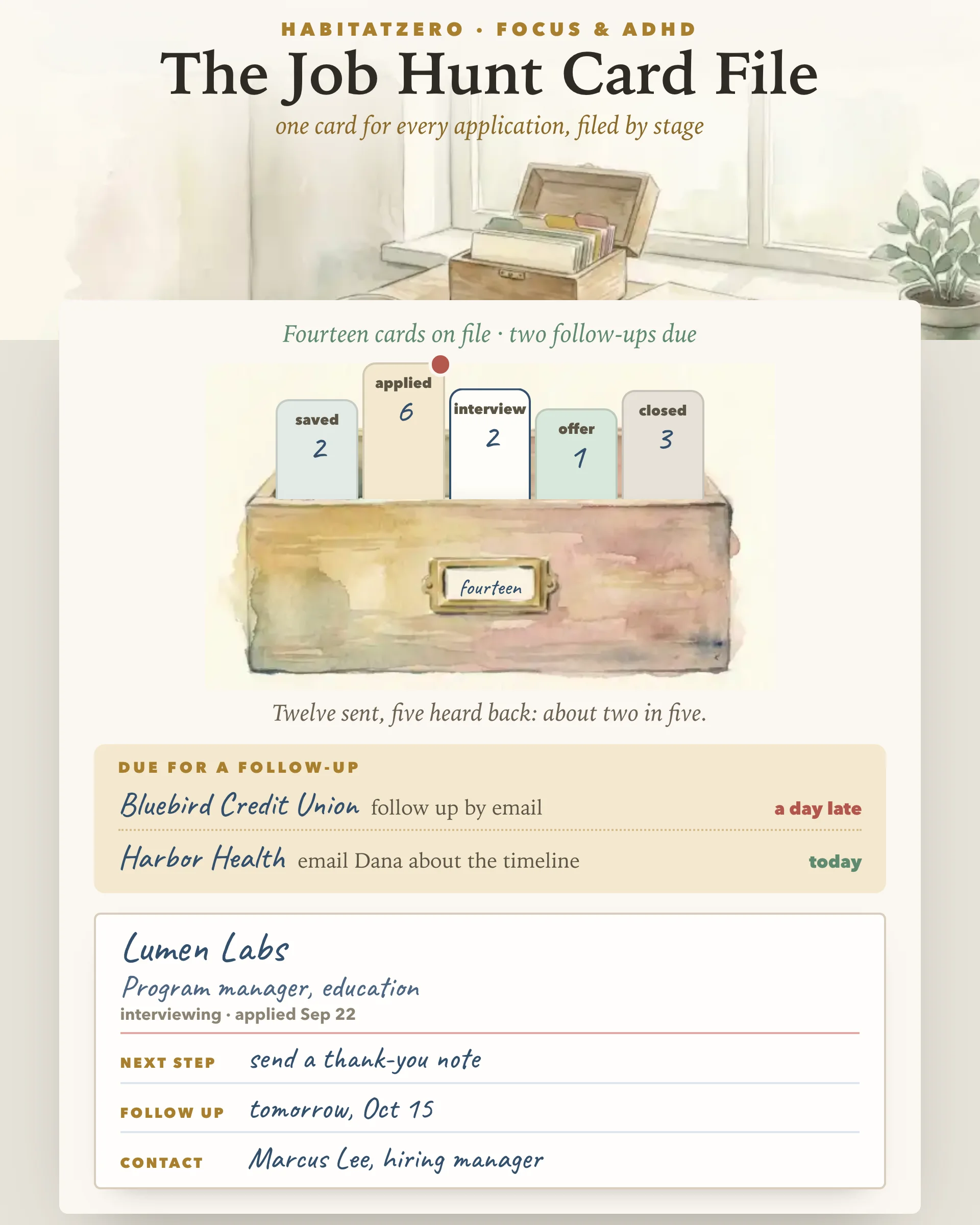
A job search scatters fast: one application in a company portal, another in a recruiter's inbox, a third in a calendar invite, and the posting you meant to finish on Sunday lost among forty open tabs. By the tenth application, memory is no longer a safe place to keep any of it. The University of Arizona's career center names the moment to avoid: after all that effort, a call about a position you do not remember applying to. A job application tracker exists so that call finds you ready, with the role, the date and a name already in front of you.
Every application gets one index card, and each card holds seven things:
That is deliberately less than a spreadsheet with twenty columns. A tracker you update in ten seconds is one you will still be using in week six.
The page is a wooden card box with five dividers. You write the company and role on the blank card, set the day you sent it, and file it behind whichever tab is open. Each divider counts the cards behind it and stands taller as its stage fills, so the shape of your search is visible at a glance. A tall Applied tab beside a short Interview tab tells a different story than the reverse. A red dot on a divider means a card behind it has a follow-up due.
Under the box, a strip lists what is due today, the most overdue first, with a button for done and one for a week more. Below it, a single line reads your response rate: how many cards you have sent, how many have heard back and roughly what share that is. A card counts as heard back once it reaches an interview, or when it closes because the employer said no, since a rejection is still a reply.
Closing a card asks one question: they said no, never heard back, or you said no. That small step keeps the rate honest. The box holds forty cards; when it is full, pull a closed card to make room. The file does not connect to job boards or email, and what you write stays in your own copy.
Career centers give similar windows. UNLV Career Services suggests waiting about seven to ten days after you apply unless the posting states its own timeline, sending a thank-you note within twenty-four hours of an interview, and checking in once more if seven to ten business days pass without news. Arizona's advice for messaging a recruiter is to wait two weeks, and to ask for feedback when a no arrives. UNLV's guide adds a note of restraint: one polite follow-up is usually enough. The chips on each card match those windows, with tomorrow reserved for thank-you notes.
Writing progress down is not busywork. A meta-analysis of 138 experiments found that monitoring progress toward a goal helped people reach it, and the effect was larger when the progress was physically recorded or shared. A card file is a recorded form of that monitoring.
Research on job seekers adds a useful caveat. A 2021 review pooling 378 samples found that more search effort predicted more interviews and more offers but did not predict better jobs. The two things that predicted both kinds of success, the counts and the quality of the job, were self-regulation, meaning planning, watching results and adjusting, and the quality of the search itself.
So the evidence supports keeping a record and acting on what it shows. It does not promise that any tracker gets you hired, and it gives no universal response rate to aim for, because replies vary by field, level and fit. Your own rate over a few weeks is the number that matters. If it stays low, the usual fix is better-aimed applications or a referral, not a bigger pile.
Students hunting for an internship tracker can use the same box. Internship postings tend to close on fixed dates, often in the fall, so file each one under Saved with its deadline as the follow-up day, then move it to Applied the day you submit.
Open it each morning for the due strip, and look at the dividers once a week to see where cards are piling up. If you are still choosing a direction, a younger job seeker can start with The Signpost. To turn a vague plan into a weekly target, such as five tailored applications, write it with the SMART Goals Worksheet, and if the search has a start date to work back from, lay out the milestones in the Goal Planner.
Seven things cover most searches: the company, the role, the day you applied, where it stands, your next step, the day you will follow up and a person to contact. Each card in this file holds exactly those, so nothing important lives only in your inbox.
Most employer portals reveal very little, so record what you learn yourself. Move a card the day something changes, such as an interview request or a rejection email, and read silence after one polite follow-up as information, not as a verdict on you.
University career centers commonly suggest waiting one to two weeks after you apply unless the posting names its own timeline, and sending a thank-you note within a day of an interview. One courteous follow-up is usually plenty.
Yes. Internship postings often close on fixed dates, so file each one under Saved with its deadline as the follow-up day, then move it to Applied the day you submit. The same five tabs work for co-ops, fellowships and summer programs.
No single honest benchmark exists, because replies swing with the field, the seniority of the role and how closely each application fits the posting. Watch your own rate over a few weeks instead. If very few cards hear back, put more care into each application or ask for referrals before sending more.
By the team behind Fabulous, the science-based self-care app used by over 30 million people.