
The Overwhelm Recovery ProtocolWellness & Routines · ~5 min
About this template · Updated November 2026
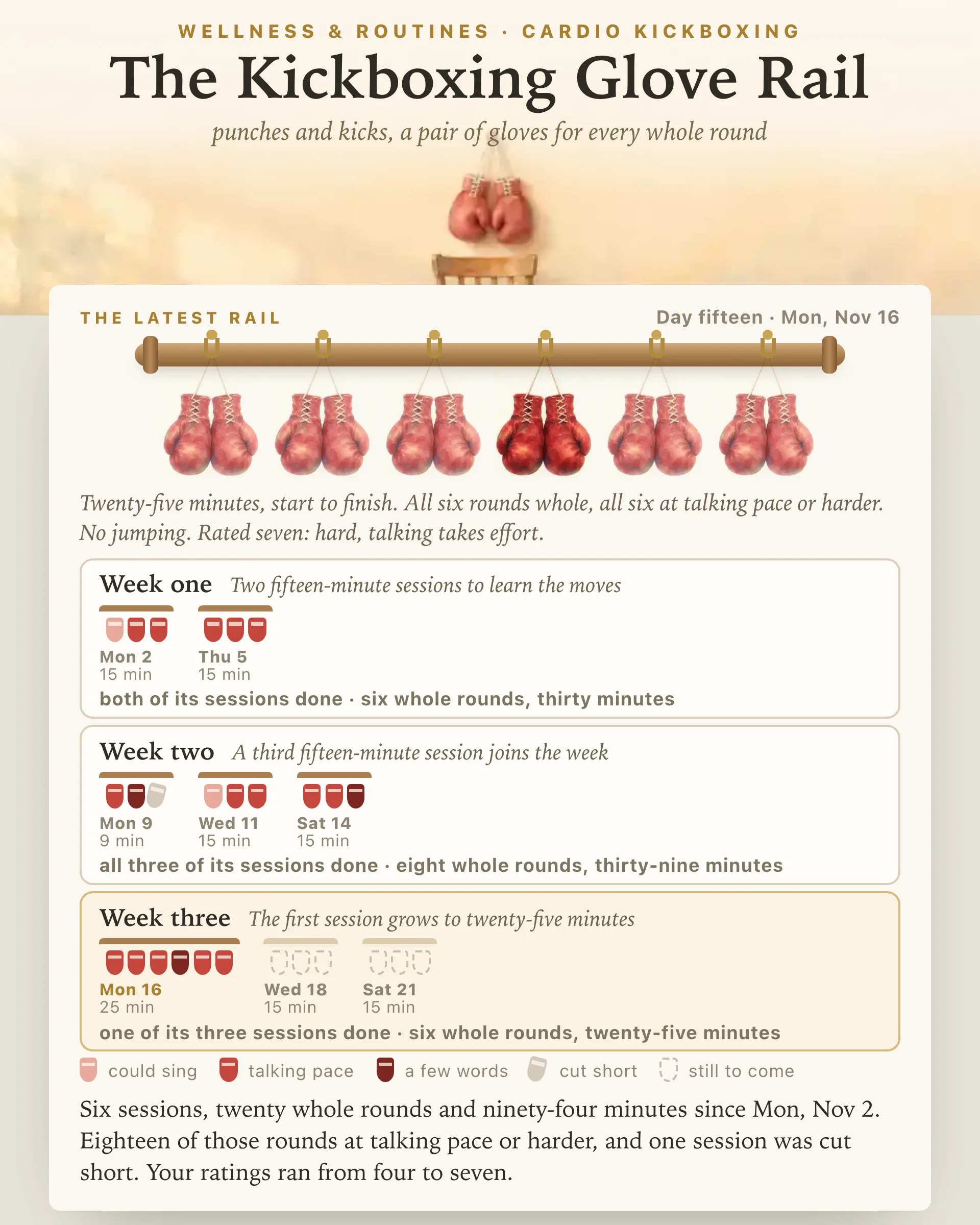
Cardio kickboxing borrows the moves of a fight and leaves out the opponent. You throw jabs, crosses, hooks, uppercuts, knee strikes and low kicks at the air in short combinations, two minutes at a time, with an easy minute between rounds. No bag, no partner. The gloves on this page hang on a wooden rail instead: every round you finish whole hangs one pair.
You choose a length, and the rail sets out one pair of hooks per round:
Each round is two minutes on one combination and one easy minute of walking it off in place. Nine combinations wait on a shelf, from jab and cross to a slip and roll (a small dip of the head and knees, as if a punch slid past) into a cross and a hook. Pick two to six of them and the rounds take them in the order you picked. Or tap together your own from two to four strikes; the shelf keeps three of them, in your handwriting. Halfway through, the cue switches your stance so both sides work.
Three versions cover most bodies and rooms. No jumping is the default: the boxer shuffle becomes quick steps with one foot always down, kind to knees, to a pelvic floor that protests on landing, and to anyone downstairs. The light bounce adds a springy stance. Seated punches move everything to a sturdy armless chair, with seated kicks, knee lifts and toe taps for the footwork.
Keep your elbows and knees soft. Never snap a joint straight: each punch and kick stops just short of full reach. Keep kicks at knee height or lower until your balance is steady, with a chair back within reach, and use it for every side kick. Hold your wrists straight on every punch, the hand in a loose fist.
Near the end of each round, say a full sentence out loud and tap how it came out: you could sing, you could talk but not sing, or only a few words came. That talk test colors the round's gloves, pale for singing, red for talking pace, oxblood for a few words. Then you rate the session from one to ten. The page reads your latest two sessions in order: two in a row at eight or harder suggests an easier version or slower combinations, and two whole sessions in a row at four or under suggests the next version up. A session done in an easier version never counts toward stepping up.
The timer keeps real time even if your phone locks, and only whole minutes and whole rounds count: a round skipped or cut short hangs crooked and gray.
The plan runs six weeks: two fifteen-minute sessions in the first week, three in the second, then one session at a time grows to twenty-five and finally thirty-five minutes. Each week gets its own rail on the wall.
Physical therapists at a university in northern Thailand ran a six-week trial of Thai-boxing intervals done at home with fifty-eight sedentary young adults. Eight one-minute bouts with one-minute active rests improved aerobic fitness, resting blood pressure and resting heart rate more than general health education with moderate exercise did. They were young adults working harder than these rounds ask, for six weeks only.
The same group tested a four-week Thai boxing dance program in older adults at risk of falling. Seventy-eight people living at home improved on balance and functional fitness tests compared with a fall-prevention booklet, and most of the gains held four months later. The study measured balance tests, not falls, and it left out people with conditions that cause falls.
An exercise physiology lab in New Mexico timed two-minute fitness boxing trials at faster and slower punching tempos with eighteen trained young volunteers. Faster punching raised heart rate, breathing and how hard the work felt, while oxygen uptake stayed about the same. Steady, clean combinations beat frantic ones.
A review of the talk test from a Canadian heart institute's prevention and rehabilitation center found that comfortable speech tracks the point where breathing starts to climb, across walking, cycling and other steady exercise. It may be awkward inside short intervals, so this page asks near the end of each round and adds a number.
Check with a doctor first if you have a heart or blood pressure condition, dizzy spells, a recent fall, a joint replacement, or pain in a shoulder, hip or knee. Stop any move that hurts.
To keep your fists down, standing cardio built by length and impact uses marching and step touches in short intervals. A living room dance floor swaps strikes for one simple step per song, and short bursts with long rests suit days you want the work over quickly. This page is the one for rounds: combinations you choose, timed like a bout, logged a pair of gloves at a time.
It is a fitness version of kickboxing: punches, kicks, knee strikes and footwork thrown at the air in short combinations, set into timed rounds with easy minutes between them. Nobody hits anybody, and the aim is steady, breathing-hard effort rather than fighting skill.
Yes. Shadow work at the air keeps your heart rate and breathing up as long as the combinations keep coming, and it spares your wrists the jolt of a bag. A clear patch of floor, sneakers and a sturdy chair for kicks and balance are enough.
Fifteen minutes is a fair start: three of warm-up, three rounds of two minutes on and one easy, then three of cool-down. This plan keeps that length for the first two weeks, then grows one session at a time toward twenty-five and thirty-five minutes.
For most rounds, hard enough that you can talk but would not want to sing, which lands around five to seven on a one-to-ten scale. If you can only get out a few words, slow the next combination and make the easy minute truly easy.
It can be, with the seated or no-jumping version, kicks kept at knee height, soft elbows and knees, and a chair within reach. Check with a doctor first if you have a heart or blood pressure condition, dizzy spells, a recent fall, a joint replacement, or joint pain.
By the team behind Fabulous, the science-based self-care app used by over 30 million people.


