
The Overwhelm Recovery ProtocolWellness & Routines · ~5 min
About this template · Updated November 2026
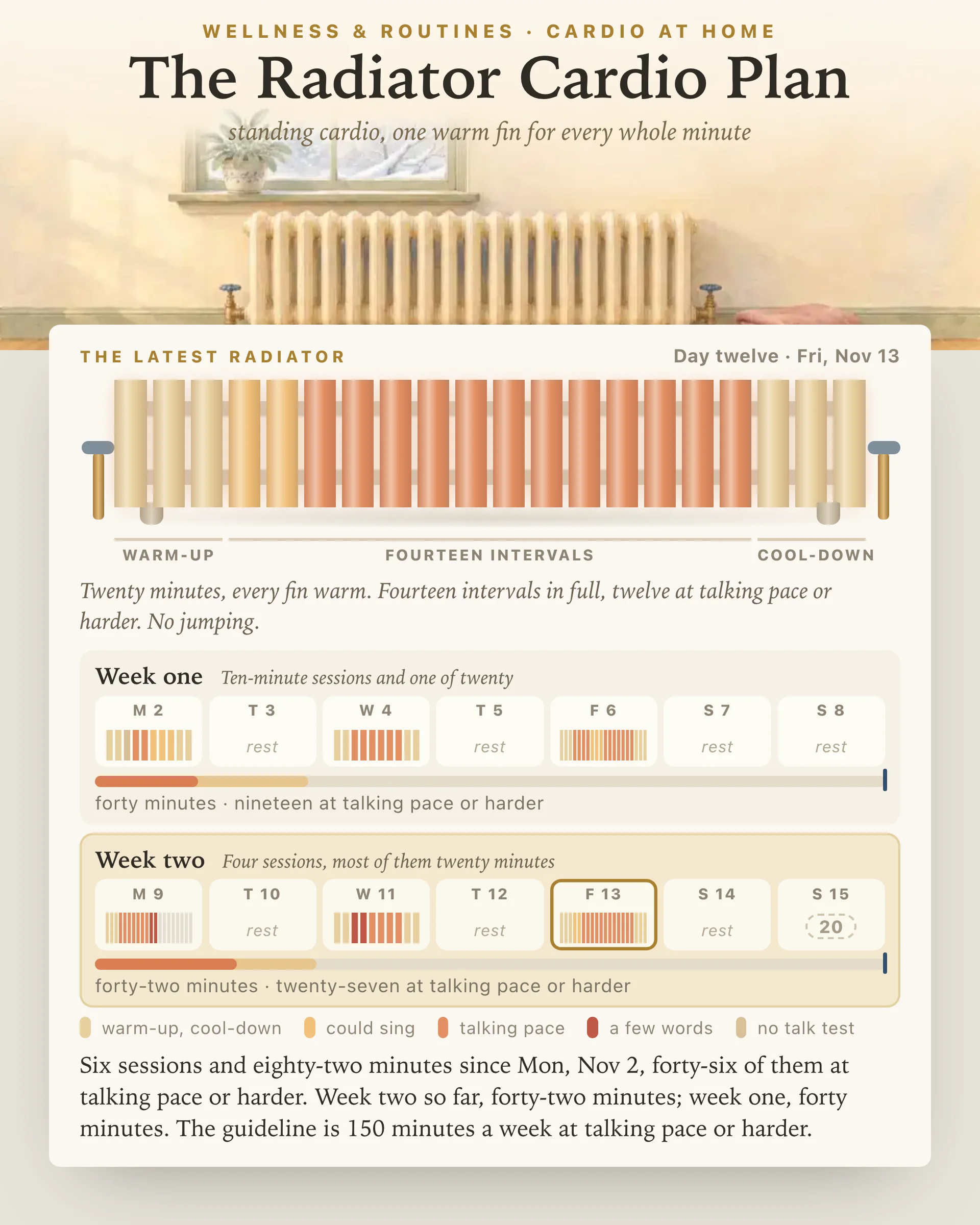
Cardio at home asks for less than most people think: sneakers, a clear patch of floor about the size of a doormat, and a chair or counter within reach. This page builds standing cardio for any adult out of two choices, how long and how much impact, and runs it on a clock. Every whole minute you move warms one fin of a cast-iron radiator, so a finished session looks like a radiator with the heat on.
You pick ten, twenty or thirty minutes, and the radiator grows one fin per minute:
Every interval is forty seconds on a move and twenty seconds of easy marching. Eight moves can fill them: marching, step touches, the boxer shuffle, knee lifts, step jacks (a step out to the side as both arms sweep overhead), stair climbs on the bottom step with a hand on the rail, shadow boxing, and a dance break to a song you like. Keep any three or more, and the intervals take them in turn.
No jumping starts switched on, so every move keeps a foot on the floor. That suits sore knees, a downstairs neighbor and anyone whose pelvic floor complains on landing, a common reason that rarely gets said out loud. A review of exercise and the female pelvic floor found that moderate activity such as walking goes with less urinary leaking, while women athletes are about three times as likely to have urinary leaking as other women, and that the load a pelvic floor tolerates differs from one woman to the next. Turn the switch off and five moves gain hops: jogging in place, a bouncing boxer shuffle, high knees, jumping jacks and a hopping dance. Switch it back any day.
Partway into an interval, say a full sentence out loud and tap how it came out. If you could have sung it, the pace steps up from gentle to steady or from steady to brisk. If you could talk but not sing, it holds. If only a few words came out between breaths, it eases. One answer covers its own minute and the four after it, and your next session starts where this one ended, unless it ended early: a session cut short never carries a step up forward.
A review by Reed and Pipe found comfortable speech likely below the point where breathing starts to climb steeply and unlikely above it, in healthy adults and in people with heart disease, across walking, jogging, cycling and stair steppers. It also warns the test may not suit hard sprint intervals, one reason the intervals here aim for a moderate pace.
The clock reads real time, so a phone that locks mid-session still knows where you are, and a pause holds everything until you go on. A fin warms only when its whole minute has run. Skip a fin and it stays cold; stop early and the log keeps the fins that ran in full. Under a minute logs nothing.
The plan climbs from forty minutes in week one to seventy, then a hundred, then five half hours in week four. The 2020 World Health Organization guidelines ask adults for 150 to 300 minutes of moderate activity a week, or 75 to 150 of vigorous activity, plus muscle-strengthening work on two or more days, and they now count bouts of any length instead of only bouts of ten minutes or more. Each week's row shows the minutes you moved, the share at talking pace or harder, and a mark at 150, with your earlier weeks right above it. It does not grade the week.
In a small trial of stair climbing, inactive young adults climbed three flights, sixty steps, three times a day, three days a week for six weeks. Their peak aerobic fitness rose compared with a group who did nothing, though the authors called the gain modest. Twelve people were in each group, all young, on a stairwell rather than one step at home, so read it as a sign that short bouts of real effort add up, not a forecast. Nothing here promises calories burned or pounds lost.
If you want strength more than breath, a six-move bodyweight circuit of squats, push-ups and planks is the better fit. On days your legs or balance need the seat, seated cardio played like a cassette keeps you in a chair the whole time. Once steady intervals here feel easy, short, hard bursts with longer rests are the next step up.
Check with a doctor first if you have a heart or blood pressure condition, chest pain, dizzy spells, a joint replacement or a recent fall. Stop any move that hurts, and stop at once for chest pain, faintness or breathlessness that does not settle with rest. Keep a sturdy chair or the counter nearby, and a hand on the rail for every stair climb.
Yes. Cardio means keeping big muscles working long enough that your breathing climbs and stays up, and marching, step touches, knee lifts or the bottom stair can do that in a living room. The effort comes from pace, range of motion and busy arms rather than from a machine.
Ten minutes is a real session. The 2020 WHO guidelines count bouts of any length toward the weekly 150 to 300 moderate minutes, so a few short sessions add up just as a long one does. This plan starts with ten-minute sessions and builds to five half hours a week.
Keep one foot on the floor and find the effort somewhere else: quicker steps, bigger arm swings, higher knees, a low step. Step jacks stand in for jumping jacks, and the boxer shuffle stays on the toes with no bounce. Quiet moves also spare a downstairs neighbor and a pelvic floor that leaks on landing.
Use the talk test. Partway into an interval, say a full sentence out loud. If you could have sung it, pick up the pace. If talking works but singing would not, you are at the moderate effort the guidelines count. If only a few words come out between breaths, you are working hard.
Ask a doctor first if you have a heart or blood pressure condition, chest pain, dizzy spells, a joint replacement or a recent fall. Stop any move that hurts, and stop at once for chest pain, faintness or breathlessness that rest does not settle.
By the team behind Fabulous, the science-based self-care app used by over 30 million people.


