
The Overwhelm Recovery ProtocolWellness & Routines · ~5 min
About this template · Updated September 2026
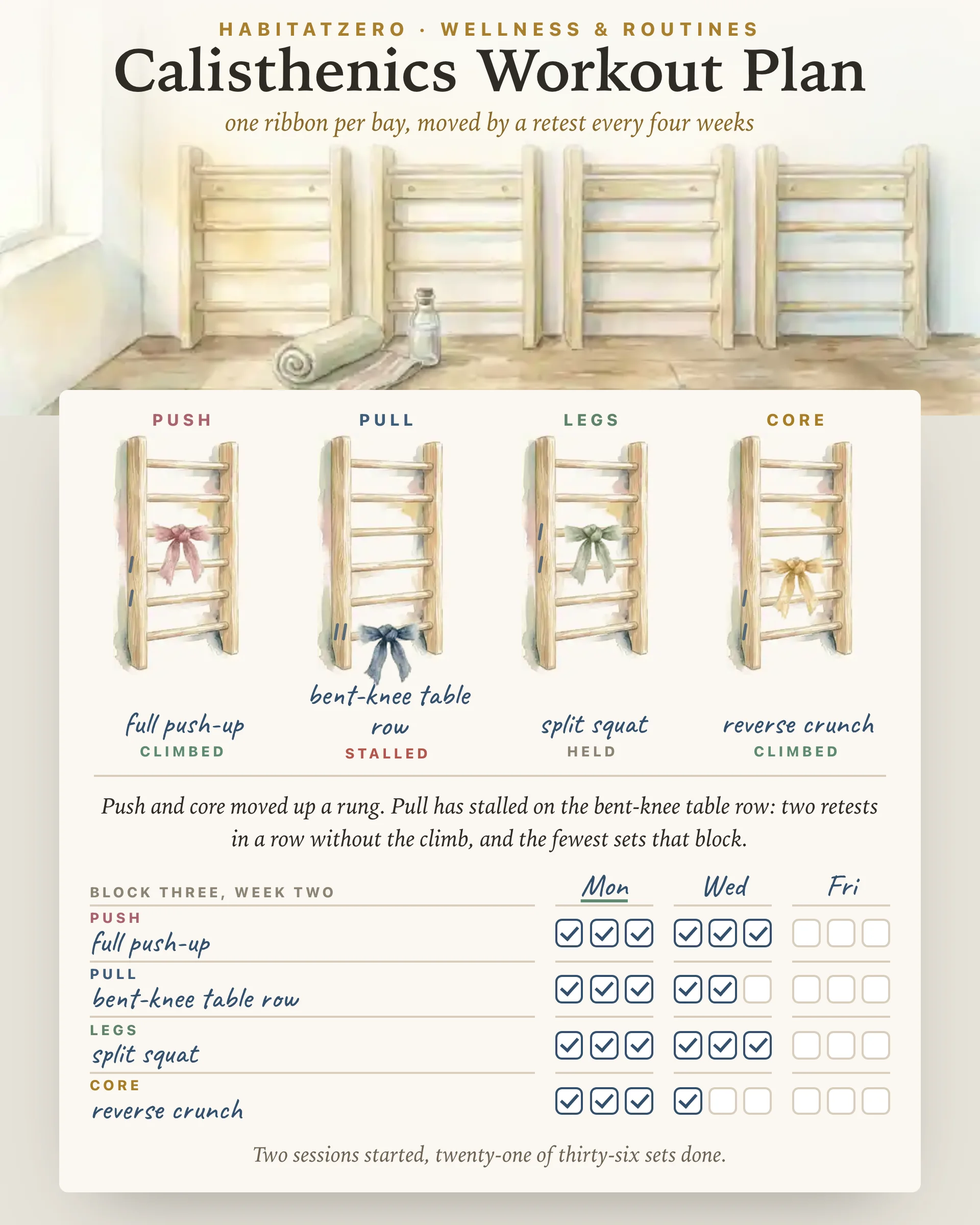
Most bodyweight plans stall at the same moment: the week an exercise stops feeling hard. You either keep doing the version that has gone easy, or you jump to one you cannot do yet and quit after a week of failed reps. A calisthenics workout plan earns its place by answering one question on a schedule: is it time to move up?
This page answers it with a wall: four bays of wall bars for push, pull, legs and core, each with six rungs, from a version almost anyone can manage up to a hard one. You tie a ribbon on the rung you can already do, and every four weeks a short retest decides whether each ribbon climbs, stays put or steps down.
Choose the hardest rung you can do cleanly for the reps it lists. Cleanly means the whole range of each rep, with no sagging hips and no half reps. Starting a rung too low costs you a few easy weeks; starting too high costs you the habit.
Pick three days with a rest day between each, such as Monday, Wednesday and Friday. Each session is the same four moves at your current rungs, three sets each in the rung's rep range (eight to twelve for most), ending every set with a rep or two still in you. Tap a box as each set is done, and close the week on your last training day.
A closed week keeps its marks and takes no new ones, and once a week has a mark, a change of training days starts the week after.
When week four closes, do one all-out set in each bay and count only clean reps. Fifteen or more moves that ribbon up a rung. A number inside the working range holds it for another block. Anything lower steps it down a rung, unless it already sits on the first, which usually means the starting rung was a hopeful guess. The bar rungs use smaller numbers, because a slow pull-up negative is a different kind of hard.
Those thresholds are this page's rule of thumb, not a trial finding: when the top of your rep range comes easily, the work is too light, and on a bodyweight plan you add load with a harder version of the move.
After each retest the page reads out what climbed and what held. A bay that holds at two retests in a row counts as stalled, and the reading sets it beside that block's set counts, because the stalled bay is often the skipped one. If pull logged twenty-one sets while the others logged thirty-three, the fix is showing up for the rows, not a new program.
The American College of Sports Medicine's 2026 position stand on resistance training pooled 137 systematic reviews covering more than 30,000 adults. Training beat doing nothing for strength, muscle size, power, balance and everyday physical function. Strength rose more with two or three sets, a full range of motion and at least two sessions a week, while training to failure and the kind of equipment made no consistent difference.
Bodyweight work counts, as long as it progresses. In a four-week trial of progressive calisthenic push-up training, twenty-three moderately trained men trained three days a week, and both the push-up group and a bench press group raised their one-rep bench press. It was a small, short study in young men, so read it as encouragement rather than proof that push-ups match a barbell for everyone.
The college's earlier position stand on exercise quantity and quality advises resistance exercise for each major muscle group two or three days a week, where a three-day plan sits, and names gradual progression as one way to lower the risks of exercise. That is why the ribbons move one rung at a time.
Stop a set when something hurts rather than burns, and rest that move until it settles. ACSM's screening guidance weighs three things before someone starts exercising: how active they are now, whether they have a known heart, metabolic or kidney disease or signs of one, and how hard they plan to train. If you have a heart condition, a joint problem or a recent injury, check the plan with a clinician before your first session.
January is the obvious start, and the wall is built for the weeks after the first burst of motivation fades. If you want a written target first, set one with The SMART Exercise Target. Spend a rest day on The Daily Stretch Mat, and on a day with no time for the full session, The 7-Minute Workout keeps the habit going.
Begin each movement at the hardest version you can already do cleanly for eight reps, even if that means push-ups against a wall or rows under a sturdy table. Train three days a week and let a retest every four weeks decide when a harder version is due.
The American College of Sports Medicine advises working each major muscle group two or three days a week. This plan runs three full-body sessions with a rest day between them, inside that range and with room to recover.
It is a ladder of versions of one movement, easiest to hardest, such as wall, counter, stair and full push-ups. You step up a rung when the current one turns easy, so the exercise keeps asking a little more without any added weight.
Yes, if the exercises keep getting harder. In one small four-week study, men training progressively harder push-up variations three times a week raised their bench press max. A 2026 ACSM review of reviews found equipment type made no consistent difference and recommends training that progresses.
No. This page shows a filled-in wall so you can see how the ribbons move. To tie your own and keep your weeks, open it in HabitatZero, which is free.
By the team behind Fabulous, the science-based self-care app used by over 30 million people.


