
The Overwhelm Recovery ProtocolWellness & Routines · ~5 min
About this template · Updated November 2026
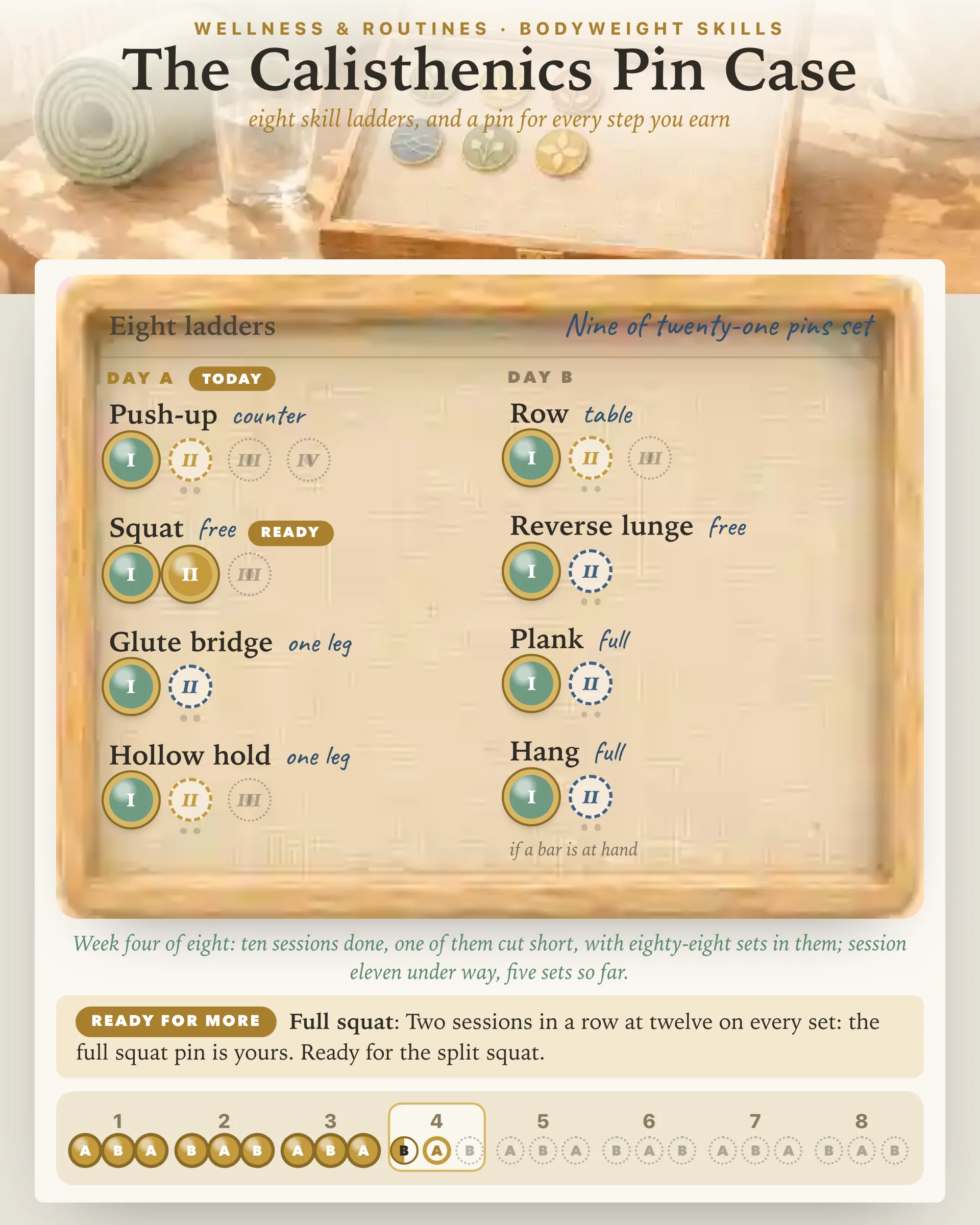
Calisthenics is strength training with your own body as the weight. For most beginners the hard part is not the moves but the distance between them: a full push-up is a long way from where many women start, and a plan that begins on the floor tends to stall by week two. This page closes that distance with ladders. Each of eight skills comes in two to four versions, from one you can likely do today up to the full form, and you climb one rung at a time.
The skills split into two short sessions that take turns, three times a week.
Weeks one and two ask for two sets of each skill, then three. Warm-up and cool-down included, day A runs twenty-three minutes at first and thirty-one later, day B nineteen and then twenty-five, plus a few for the hang.
The page opens on a wooden collector's case with a row for each skill and a pin slot for each version. Tap a skill and choose where you are on its ladder. For rep moves, tap the good reps you did and log the set, marking it stopped early if your form broke partway. For holds, pick an aim of ten to thirty seconds and start the clock: three seconds to settle, then the hold is timed against the real clock, and coming down early keeps only the whole seconds held. After every set a rest clock runs that keeps true time while your phone is locked and never adds anything to the log.
Moving up follows one strict rule. Two sessions of a skill in a row at the top of its range on every set, twelve reps or thirty seconds, with nothing stopped early, set that version's pin and open the next. A session that ended before you reached the skill, or a set stopped early, breaks the run. Two sessions in a row with a set under eight reps or fifteen seconds suggest stepping back for a while.
Bodyweight work builds strength when the sets are hard and the difficulty keeps rising. In a small trial at North Dakota State University, twenty-three young men trained with progressive push-up variations or the bench press three times a week for four weeks, and both groups raised their one-rep bench press, though muscle thickness did not change measurably in that time. Two researchers at Nippon Sport Science University had eighteen young men do three sets of push-ups to failure twice a week for eight weeks, adjusting their position, kneeling for example, so the load matched a light bench press. Strength and muscle thickness grew about as much as with the barbell. The same authors describe an earlier study where three sets of ten push-ups brought no clear gain, and they name too little work as the likely reason. So this page asks for sets close to your limit.
Women respond to strength training at least as well as men. A meta-analysis of studies that gave men and women the same program, by three strength researchers, found similar gains in muscle size and lower-body strength, and larger relative gains in upper-body strength for women. An international panel convened by the World Health Organization advises adults to do muscle-strengthening work for all the major muscle groups on two or more days a week.
What this does not show: the push-up trials were small, brief and in young men, none of them tested this exact plan, and the meta-analysis pooled short studies of young and middle-aged adults. Nothing here promises a change in weight or shape. The aim is strength you can count in reps and seconds.
Breathe out on the effort, as you press, pull or stand, and never hold your breath or bear down. If you notice leaking, heaviness or pressure low in your belly, go back to an easier version and talk with a pelvic health physical therapist, especially in the year after having a baby.
Check with a doctor before you start if you are pregnant or had a baby in the past year, have a heart or blood pressure condition, get dizzy or short of breath with effort, or are healing from an injury or surgery. Stop any move that hurts. Lean on a table's edge before rowing under it.
For four broad ladders with a retest every four weeks, the Calisthenics Workout Plan runs that way. If the wall is your whole starting point, The Wall Push-Up Ladder spends four weeks on that first rung alone. For more ways to hold a plank, The Plank Tree House has ten. This page sits between: eight weeks across eight skills, every set logged, and a pin for each version you earn.
Yes, as a form of strength training. Bodyweight moves build strength when the sets come close to your limit and the versions get harder over time, and studies that put men and women on identical programs found women gain strength at least as well relative to where they began.
Begin against a wall. Every skill on this page is a ladder, so the push-up runs from the wall to a kitchen counter, then your knees, then the floor. You move up a rung after two sessions in a row at twelve good reps on every set.
Three days with a rest day between suits most beginners, and that is the rhythm here, with two short sessions taking turns. Global guidance asks adults for muscle-strengthening work on at least two days each week.
For most women, yes, with a few habits. Breathe out as you push, pull or stand, never hold your breath or bear down, and drop to an easier version if you notice leaking, heaviness or pressure. A pelvic health physical therapist can guide you, especially after pregnancy.
Very little: a wall, a counter, a sturdy chair and some floor space cover most of the plan. The row needs a resistance band anchored in a door or a heavy table that cannot tip, and the optional hang needs a bar built to hold your weight.
By the team behind Fabulous, the science-based self-care app used by over 30 million people.


