
The Overwhelm Recovery ProtocolWellness & Routines · ~5 min
About this template · Updated September 2026
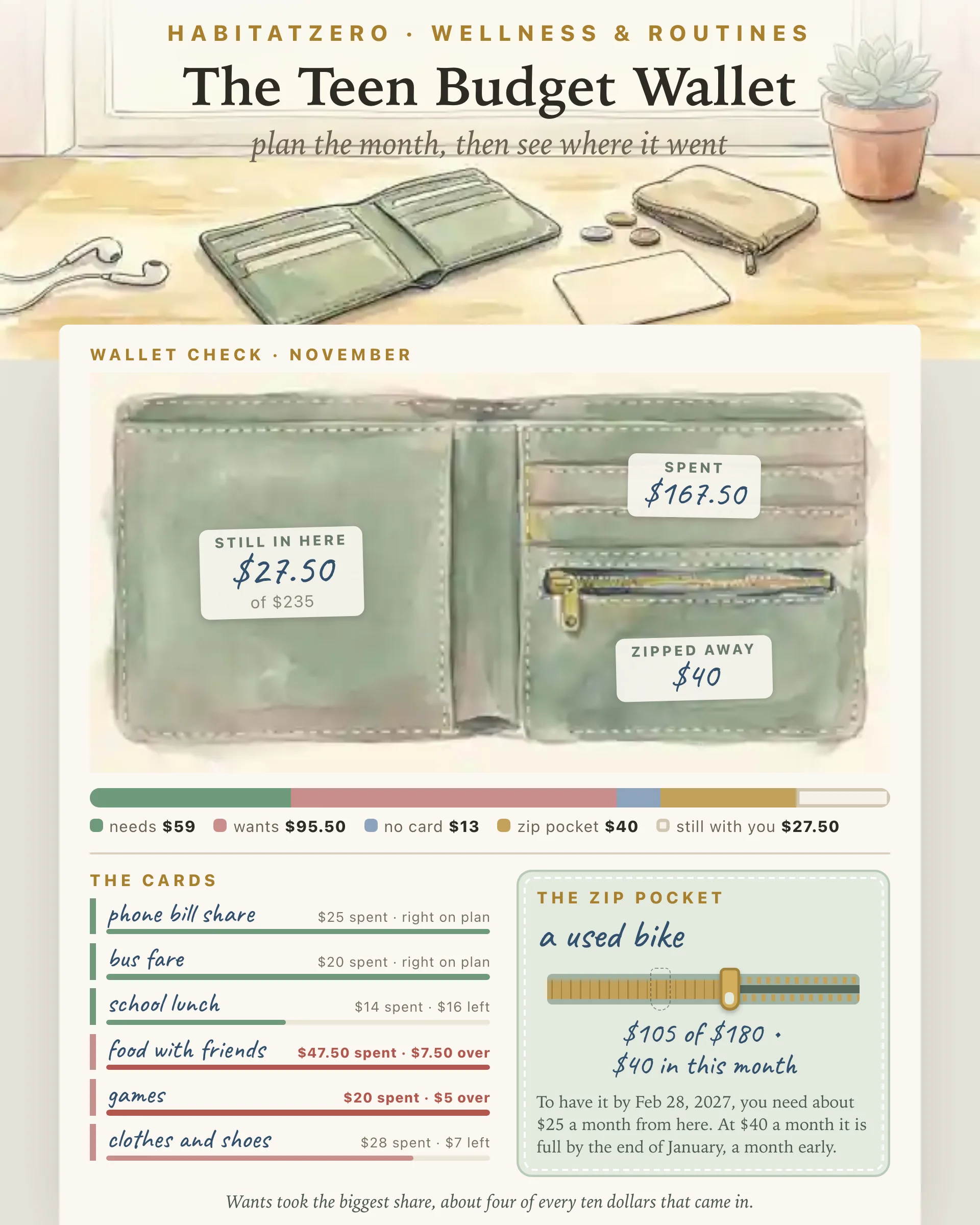
The first money that is really yours, from an allowance, a weekend job or a birthday card from Grandma, has a way of vanishing without any moment you could point to. A few lunches out, a game on sale, a ride home, and the month is gone. This budgeting worksheet for teens is built around one question, where did it go, and it answers with your own numbers instead of a lecture.
The page is laid out like the inside of a wallet, one job per part.
The wallet check at the bottom reads the month back to you: what is still in the billfold, what was spent, what went into the zip pocket, which cards went over, and how far your goal moved. It also works out the pace your date needs, and when the pocket fills if you keep going.
When a new month begins, the wallet keeps your plan, carries your savings forward and starts a clean list; the old month stays closed so its record stays honest. Nothing here connects to a bank or a debit card. It only knows what you type in.
Most teen budget sheets stop at the plan, and the plan is the easy half. For families with teenagers, the Consumer Financial Protection Bureau's Money as You Grow program suggests something more specific: help your teen track what they actually spend in a month. The gap between the plan and the real month is where the useful surprises live: a food card that runs dry by the twentieth teaches what no one could have told you.
The same CFPB page offers a rule of thumb for saving: set aside ten percent of what you earn. The zip pocket shows what a tenth of your month comes to, as a place to start rather than a rule. A steady amount you keep putting in beats a big one you give up on in the second week.
Money habits can be taught. A 2022 meta-analysis of 76 randomized experiments covering more than 160,000 people found that financial education improves both what people know about money and what they go on to do with it, with effects about as large as teaching programs achieve in other subjects. Closer to your age, a Federal Reserve Bank of New York study of states that required math and financial literacy classes in high school found modest drops in late payments and debts sent to collections among young adults who finished school under those rules. Most of those gains faded with age, and results depended on what the classes taught.
None of that research tested this page. A month in a wallet is practice, not a course, and none of it is financial advice; what it offers is a real month of your own money to look at.
Set the wallet up the day your allowance or first paycheck of the month arrives. Jot spending the same day, because a purchase nobody wrote down drops out of the story. At the end of the month, read the wallet check and change one card, not five.
If most of your money comes from jobs around the house, The House Time Card is where you and your parent can agree on what each chore pays. If your savings goal still feels fuzzy, give it a price and a date on the SMART Goals Worksheet first. And budgeting is only one stop on a longer line; The Life Skills Route Map shows the others between now and eighteen.
The wallet works best when your teen owns it. Settle what money comes in and which costs are theirs to cover before the month starts, then step back. The CFPB describes the teen years as the stage when young people start earning and making their own choices, with a parent's guidance and feedback helping them get there. Feedback lands best after the month, not in the middle of it. Sit down with the wallet check, ask what surprised them, and let them pick what to change next time.
Four things: every way money comes in (allowance, a job, gifts), the costs that are yours to cover sorted into needs and wants, one savings goal with a price and a date, and a running list of what you actually spent. The last part matters most, because the plan only teaches you something once you can hold it up against the real month.
There is no single right share. The Consumer Financial Protection Bureau offers a rule of thumb of saving ten percent of what you earn, and the zip pocket shows what a tenth of your month comes to. A teen with few bills can often put in more, and a steady amount you keep up beats a big one you abandon in week two.
A need is a cost you have to cover for the month to work, such as your share of the phone bill, bus fare or school lunch. A want is a choice, like food with friends, games or new shoes while the old pair still fits. Which costs count as yours depends on the deal you have at home, so settle that first.
Agree up front on what money comes in and which costs belong to the teen, then stay out of the day-to-day. When a card runs out before the month does, let it. Mistakes with thirty dollars are cheap lessons, and the wallet check at the end of the month is the natural time to talk about them.
The page shows a filled-in November wallet you can look through. To run your own month and carry the plan and your savings into the next one, personalize it in HabitatZero for free. It never connects to a bank or a card; it only knows the amounts you type in.
By the team behind Fabulous, the science-based self-care app used by over 30 million people.


