The Overwhelm Recovery ProtocolWellness & Routines · ~5 min
About this template · Updated September 2026
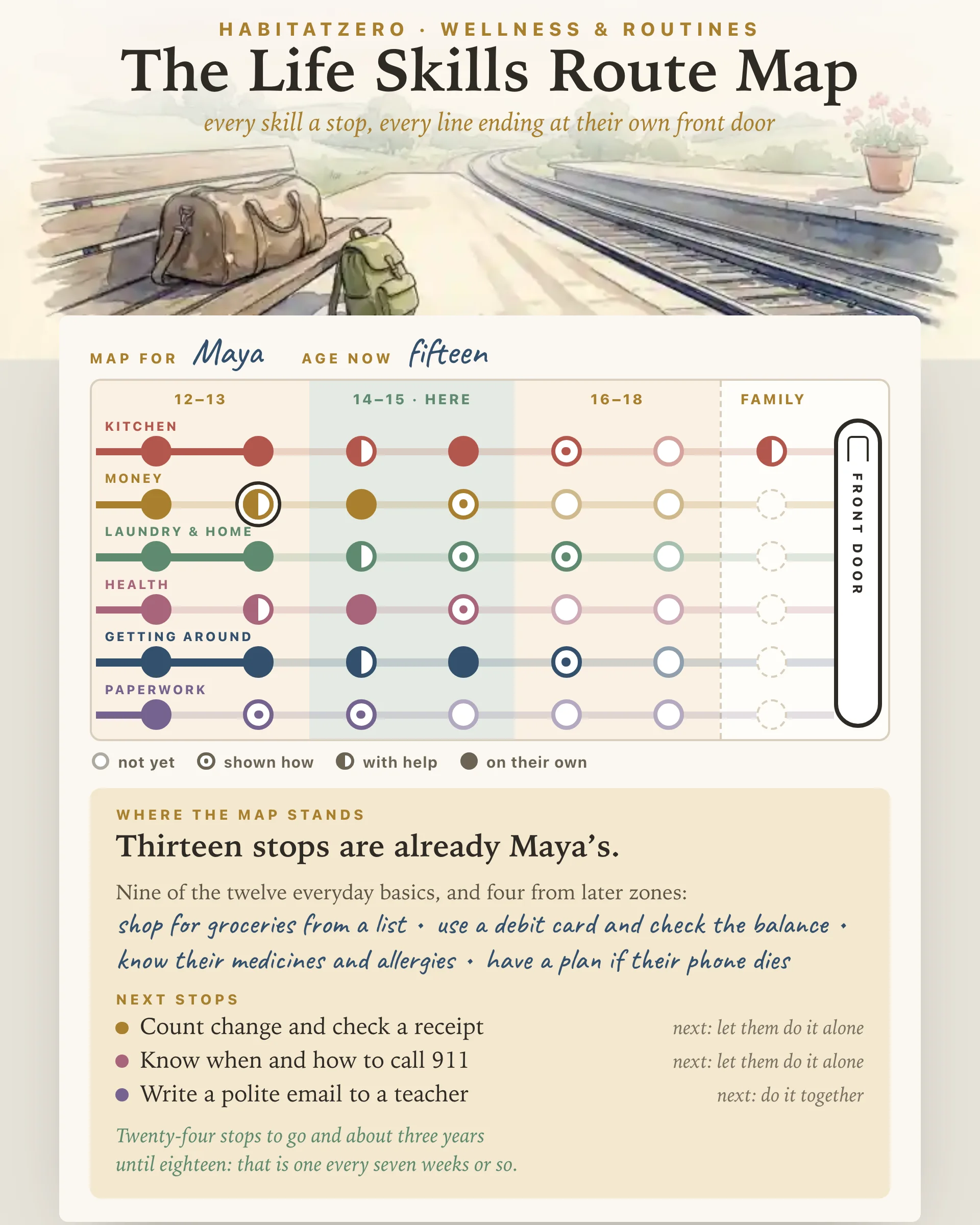
Most parents hit the same moment. Your teen is a year or two from leaving, and you notice you are still the one doing their laundry, booking their dentist visits and calling the pharmacy, mostly because it was faster. None of that was wrong. But every job you kept is a job they will meet for the first time on their own, usually on a bad day.
The Jed Foundation's guide for parents describes launching a teen as a process of helping them take ownership of their lives while gradually reducing your own involvement, rather than one big talk the summer before they go. This page makes that slow handover visible.
Each skill on the map passes through the same three stages. First you show them how while they watch. Then they do it with you beside them, taking the lead while you catch what slips. Then you step back and they do it on their own, start to finish, without a reminder.
Teachers call this scaffolding. A review of ten years of classroom research by Janneke van de Pol and colleagues names three features that make it work: help matched to what the learner can already do, support that fades over time, and responsibility that moves steadily across to the learner. The word is borrowed from construction, where a scaffold is a temporary structure put up to help while a building is made, then taken away. The handful of studies that measured results suggest it works, though the authors call for more research. Those studies also watched teachers and students, not parents and a stubborn stain, so treat the fit as a good bet rather than a tested result.
The map has six colored lines: kitchen, money, laundry and home, health, getting around, and paperwork. Each line holds six stops spread across three age zones, from packing their own lunch around twelve or thirteen to filing a simple tax return around sixteen to eighteen. Treat the ages as a rough order, not a deadline. A fifteen-year-old who already cooks the family dinner is not ahead of anyone, and a seventeen-year-old who has never used a debit card is not behind.
Tap a stop and its ticket opens with a plain line on what doing it alone actually looks like, so you both agree on the bar. Set it to shown how, with help or on their own, and the station fills in. When two neighboring stops on a line are both theirs, the track between them turns solid. A line that is theirs from end to end runs all the way to the front door.
Every family has skills a general list misses, like the chili everyone asks for or the drive to a grandparent's house. Each line has room for one family stop of your own, just before the front door.
Under the map, the reading does the planning. It names what is already theirs, then picks three next stops. The basics come first, and within them the skills closest to done, so the next practice is usually a small step rather than a new project. Each pick carries its next move: show them, do it together, or let them do it alone. Add their age and the map works out a pace, such as one new stop every seven weeks, that gets every line to the front door by eighteen.
The clearest long-term finding is about cooking. A study that followed more than a thousand young people found that those who rated their cooking skills as very adequate at eighteen to twenty-three were preparing meals with vegetables more often and eating fast food less often a decade later. It is observational and built on self-ratings, so it cannot prove that cooking caused the difference.
The Jed Foundation makes a second point worth keeping: dealing with the fallout of a small mistake, such as a penalty for something mailed too late, can be the most effective way for a teen to learn not to repeat it. So let the with-help stage include a few errors while the stakes are low and you are close by.
No study sets a correct age for each skill. The zones here are a practical ordering, and your teen's pace will be their own.
Sit down with the map on an unhurried weekend, ideally with your teen holding the phone. Walk it one stop at a time, and hold off marking a skill as theirs while it still needs a nudge. Come back every month or two to move the stops that changed, and print the map for the fridge so the next three stay in sight.
If the household itself needs a fairer split of work first, the Household Chore List is where to settle who does what. When a lease is close, the First Apartment Checklist picks up where this map ends, room by room. And if the talk turns to what they might do for work, a short career quiz for teens is an easy way in.
Every stop you hand over now is one they will not have to learn alone later.
Most lists land on the same six areas: feeding themselves, handling money, keeping clothes and a home in order, looking after their own health, getting around safely, and paperwork such as forms, job applications and a first tax return. This route map lays out thirty-six of them so you can see at a glance which ones your teen already handles alone.
Use ages as a rough order rather than a deadline. The map opens around twelve and thirteen with basics like packing lunch, a load of laundry and knowing when to call 911, moves to recipes, a debit card and a bus route around fourteen and fifteen, and finishes with pay stubs, prescription refills and a simple tax return around sixteen to eighteen.
Use three moves for each skill. Show it once while they watch, do it together while they take the lead, then step back and let them do it alone even when it is slower or messier than your way. Teachers call this scaffolding, and the stepping back is the move busy parents most often skip.
Begin with saving toward something they want and checking their change and receipts. Next comes a debit card whose balance they actually look at and a month of tracked spending. By the last zone they should be able to read a pay stub and pay a bill before its due date, which keeps late fees and overdrafts out of their first year alone.
Yes, there is no charge. The filled-in route map on this page is an example you can explore and print as it is. To keep a map for your own teen and move its stops over the months, personalize it in HabitatZero for free.
By the team behind Fabulous, the science-based self-care app used by over 30 million people.