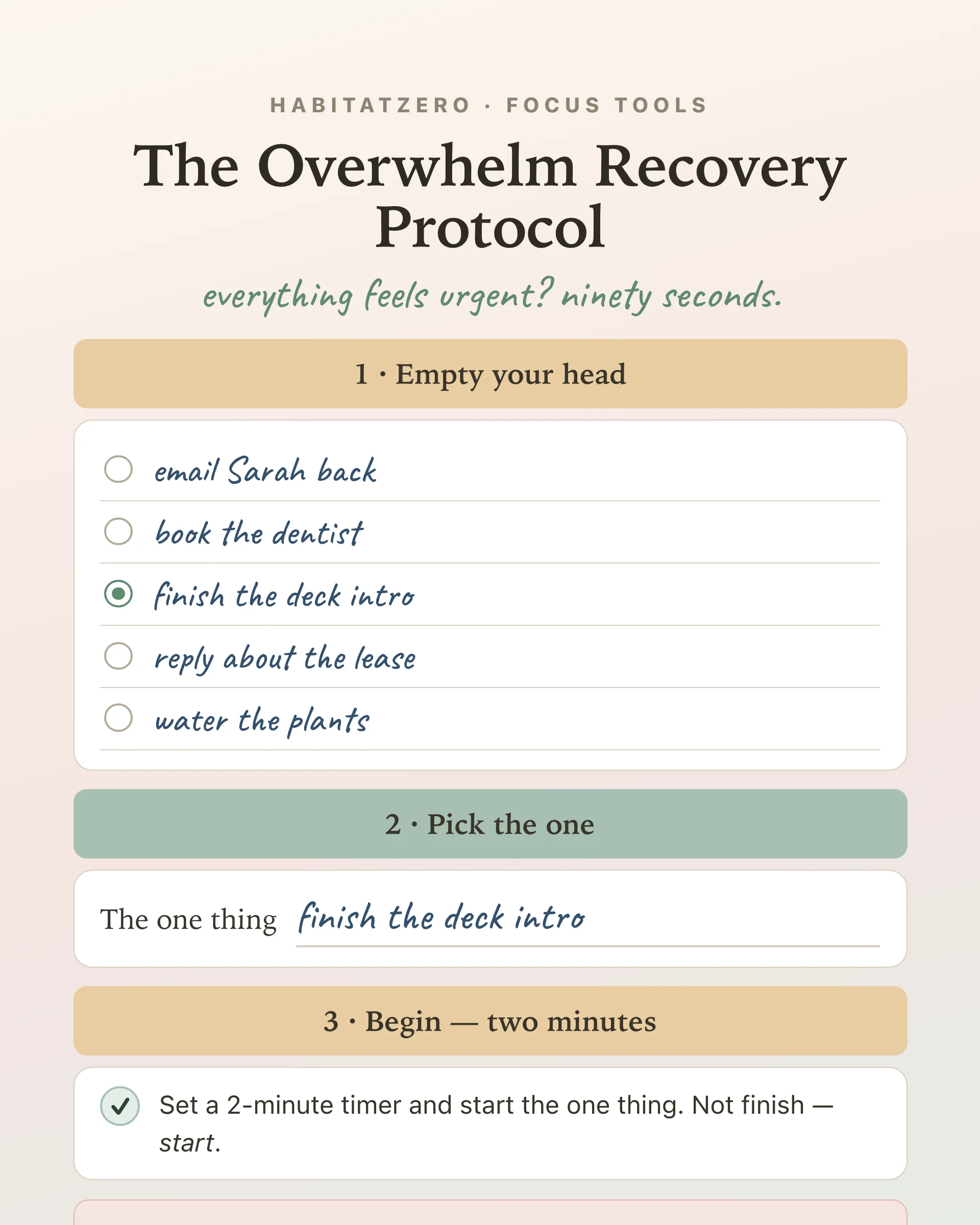
The Overwhelm Recovery ProtocolWellness & Routines · ~5 min
About this template · Updated September 2026
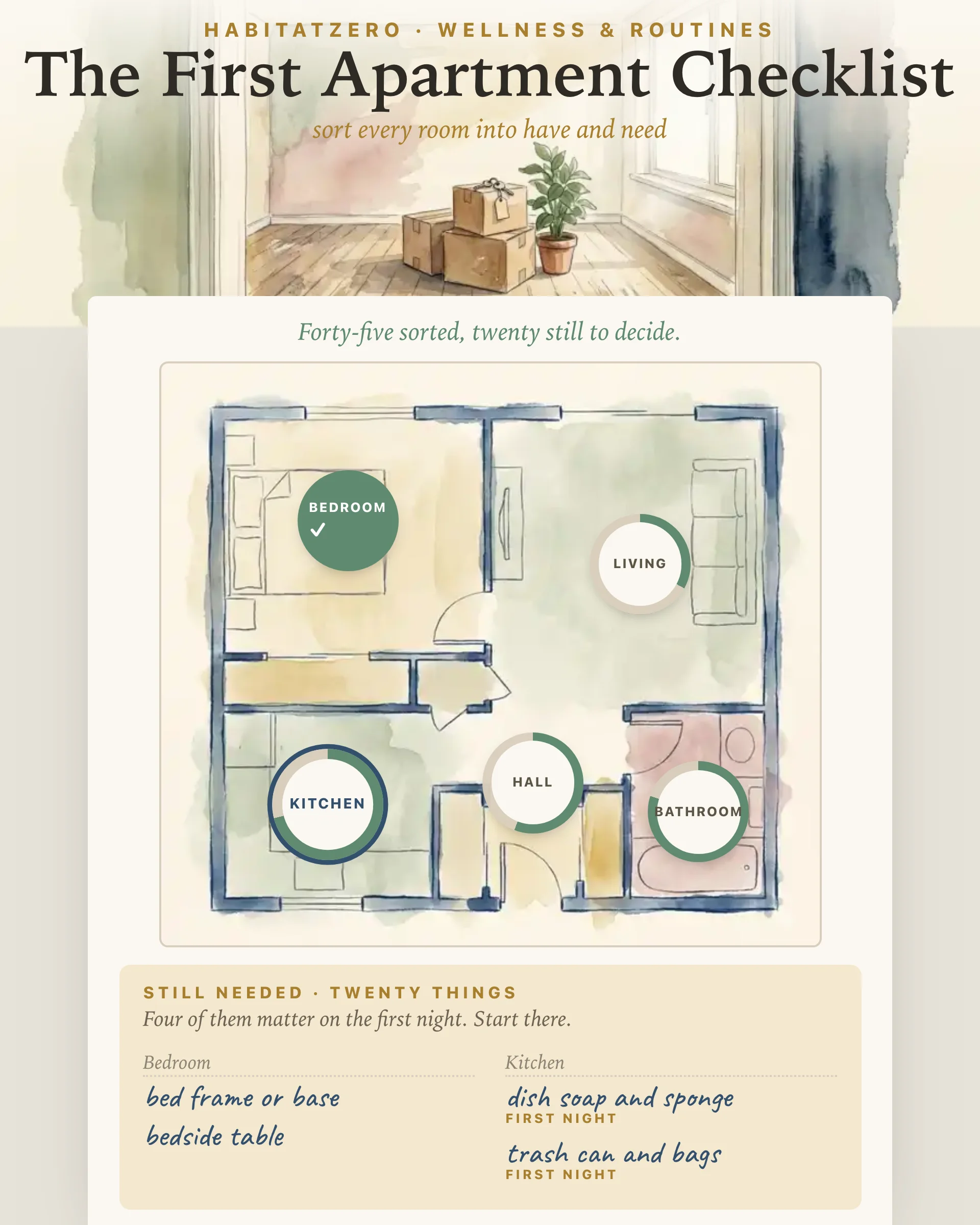
You have the keys, a few boxes and rooms that echo. Every list online for this moment runs past a hundred items and gives a colander the same weight as a mattress. This page takes a different route: it draws the apartment as a floor plan, lets you sort each room into what you already own and what you still need, and hands back only the second list, with the first-night things on top.
Walking from room to room is how people actually notice what is missing. You stand in the bathroom and see there is nowhere to hang a towel; you open a kitchen drawer and find no can opener. The plan keeps that habit alive on the page. Five rooms sit on it: bedroom, bathroom, kitchen, living room, and a hall and closet for everything that belongs to no room, from the box cutter to the renters insurance. Tap one and its list opens beneath.
Each room carries a small ring. It fills as you sort and turns solid green once every item in that room has a decision. That is the only score the sheet keeps, and it earns its place: a half-filled ring over the kitchen tells you where the next ten minutes should go.
Beside every item sit two words, have and need. Have means it is yours already or coming with you. Need means it is not. Anything you have not tapped stays undecided, and the line at the top counts those too, because undecided is where forgotten things live. A second tap clears a mark, and each room accepts up to six lines of your own on the handwriting line at the bottom.
Around sixty items are built in, fewer than most lists on purpose. A pot with a lid, a frying pan, one good knife and a board will feed you for a month. Curtains matter more than a coffee table. Keeping the choosing light is the right instinct, and the research agrees: a meta-analysis of choice overload found that large assortments make deciding harder mainly when you do not yet know what you want, which describes almost everyone furnishing a first home.
Nineteen items carry a first-night tag: a mattress, sheets and pillowcases, pillows and a duvet; a shower curtain, towels, toilet paper and soap; plates, cups, cutlery, dish soap and a trash can; a phone charger, a box cutter, a basic toolkit, a cleaner and paper towels; the smoke alarm checked and the utilities switched on. With those sorted, the first night is fine and everything else can wait for a second weekend.
Two of them are not shopping at all. The U.S. Fire Administration's advice is to have alarms inside and outside each sleeping area and on every level, tested monthly and replaced after ten years, so press the test button before the first night rather than assuming the last tenant did. And renters insurance sits in the hall list because your landlord's policy will not replace your belongings or pay for somewhere to stay while the building is repaired; it protects the building, not what you carry into it.
Everything you mark need gathers at the bottom of the sheet under Still needed, grouped by room, first-night things first, in your own handwriting. It is the list you take to the shop, and it moves as you do: tap got it beside a line and the item slides back to have, the ring over its room creeps forward, and the count at the top drops by one.
That is the quiet case for a written list over memory. When eight hospitals introduced a short surgical safety checklist, complications and deaths both fell, not because the surgeons did not know the steps but because a list catches the step a tired person skips. Moving day is a long way from an operating room, yet the failure has the same shape: you know you need toilet paper, and you still arrive without it.
It does not price anything, because a first apartment budget depends entirely on what comes with you, and a list that guesses is worse than no list. It does not walk you through the lease, the deposit or the inspection, though the hall holds renters insurance, the utilities and the wifi so the admin cannot slip. And it does not decide for you: a rug is a need for one person and a never for another, which is exactly why the buttons are yours to press.
Open it the week the lease is signed, before the first shopping trip, and sort the bedroom and bathroom first. Come back the evening after moving day, when the empty rooms start listing what they lack, and add your own lines while they are fresh. Once the rings are full, the Cleaning Checklist takes over the keeping of the place, the Meal Planner puts the one pot and one pan to work, and the Home Routines Journal is where a first apartment turns into a home.
Begin with what the first night depends on: a mattress, sheets, pillows, a shower curtain, towels, toilet paper, a phone charger and a box cutter. After that, one pot, one pan, plates, cups and cutlery let you cook, while a toolkit, a cleaning kit and trash bags cover the rest of the first week. This page holds around sixty such items across five rooms and lets you add your own.
A bed that is made up, a bathroom that works with a curtain and a towel, a way to charge your phone, something to open the boxes with, something to clean with, and the electricity switched on. Those items carry a first-night tag here so they rise to the top of your still-needed list.
A printed list treats a colander like a mattress. Here each room sits on a floor plan whose rings fill as you sort, and only the items you mark need make it onto the shopping list, so you never carry a page of things you already own. The finished sheet still prints cleanly if you want it on paper.
That depends almost entirely on what comes with you, which is why this page separates have from need before it counts anything. Furnish the bedroom and bathroom first, cook from one pot and one pan for a month, and let the living room wait until you know how you actually use the space.
The preview on this page is a filled example you can read but not change. Personalizing it in HabitatZero, which is free, gives you your own copy that remembers every room and keeps the still-needed list current as you shop.
By the team behind Fabulous, the science-based self-care app used by over 30 million people.