The Overwhelm Recovery ProtocolWellness & Routines · ~5 min
About this template · Updated September 2026
A chore chart built for a seven-year-old tends to fail with a teenager, and laziness has little to do with it. Stickers feel like being managed, and a list taped up without their say reads as orders, so every missed job becomes an argument about who is in charge.
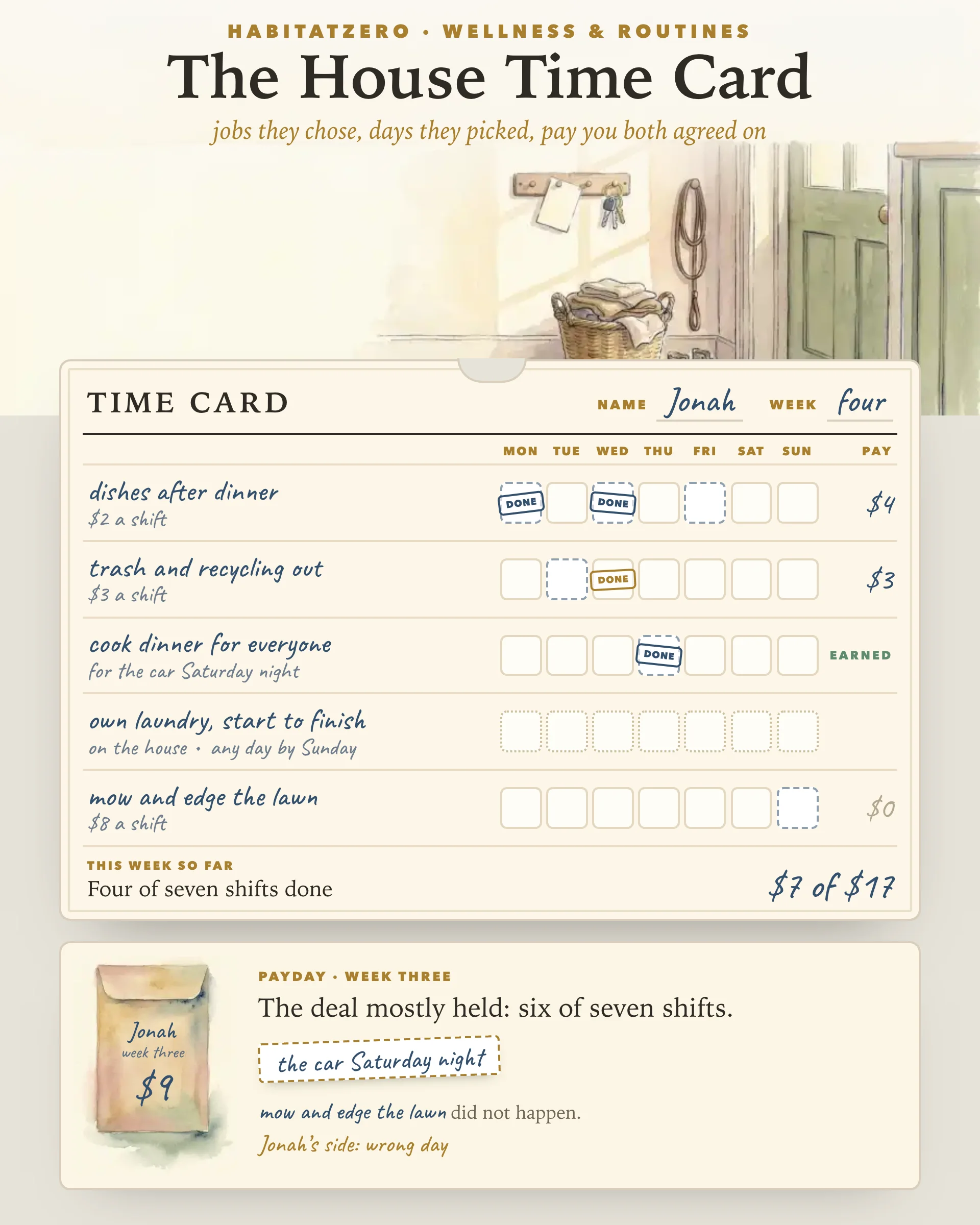
This card borrows its shape from a first job. Your teen claims the jobs, picks the days, and agrees with you on what each one pays. A finished shift gets an ink stamp, and on Sunday night the two of you hold payday to see where the deal held.
What you want is a teen who does their share because they accept the reasons for it, not only while someone is watching. Researchers in self-determination theory call this internalization, and a review of their parenting studies names chores and homework as tasks where it needs active support. It lists four ingredients: explaining the reason behind a request, recognizing how the child sees it, offering real choices, and keeping controlling tactics to a minimum. None of this means dropping structure. Clear expectations stay; what changes is how they get set.
The card builds all four in. The job board offers the choices, the days belong to your teen, and payday asks for their side before it suggests anything. There is no penalty column, because a missed shift is a reason to rewrite the deal, not to push harder.
The board has two lists. For thirteen to fifteen: dishes after dinner, trash and recycling, clearing the table, vacuuming, walking the dog, feeding pets and helping with one dinner a week. For sixteen to eighteen, the jobs ask for more judgment: cooking for everyone, a grocery run with a list, the whole bathroom, mowing, washing the car and driving a sibling to practice. Both lists add a few jobs for your teen's own things, like laundry, lunches or booking appointments.
Keep at least one job from the first group on the card. In two studies of nine- to fourteen-year-olds, only routine chores done for the whole family went along with more concern for others at home, and only among the older kids. Self-care jobs and pitching in on request showed no such link. It is a correlation from 1996, so read it as a nudge rather than a rule.
Tap a job on the board and it lands on the card in handwriting. Your teen taps its days, or leaves it open until Sunday. Then you settle what it earns: dollars per shift, haggled a dollar at a time; a privilege such as the car on Saturday night; or nothing, marked on the house. Six jobs fill the card, which is plenty alongside school.
Tap a box when the job is done and it takes a stamp. A job done on a day nobody agreed to still counts, but its stamp comes out gold, so drifting days show at a glance.
Payday closes the week. The envelope shows what was earned, privileges that came through go on slips, and one plain sentence says how the deal held. When a job keeps landing on another day, one tap moves it there. When a job slipped, your teen picks their side (wrong day, too much that week, forgot, not worth it, not sure how) and the card offers a change that fits the reason. The last four paydays stay on file, so a job that slips week after week stands out.
Families disagree, and the worry has a real source. A large review of experiments found that tangible rewards tend to undermine interest in activities people already enjoy. In the studies that tested both kinds of task, though, the effect did not carry over to dull ones, and most chores are dull. Paying for the lawn is unlikely to spoil a love of mowing that was never there.
Money alone will not make a job feel like theirs, either, which is why on the house is one of the choices: some jobs simply come with living in a home.
Helping at home is not a burden most teens silently resent. In a daily diary study of more than seven hundred fourteen- and fifteen-year-olds from Latin American, Asian and European backgrounds, helping the family was generally not stressful and went along with more happiness, largely because it gave them a sense of doing their part. Studies like these show associations; they do not prove that a chore chart builds character. Nothing here measures your teen, and the card's sentences are openings for a conversation, not verdicts.
Set it up side by side at the start of the school year or the summer break, and hold the first payday a week later. Print a fresh card whenever the deal changes.
If the adults in the house also need to settle who does what, The Household Chore List totals everyone's minutes. A younger sibling who still loves checking boxes is better served by the Chore Chart. And once the time card starts to feel like a real job, The Signpost, a career quiz for teens, makes a good next conversation.
Most teens between thirteen and fifteen can load the dishwasher, take the trash and recycling out, vacuum, walk the dog, put groceries away and help cook a meal. From about sixteen, add jobs that take more judgment: cooking dinner for everyone, a grocery run with a list, the whole bathroom, washing the car, and driving a sibling once they have a license. Keep at least one job on the list that serves the whole household, not just their own room and laundry.
There is no standard rate, so settle one together and write it down. This card prices each job per shift, anywhere from one dollar to twenty, and totals the week at payday. Small amounts suit quick daily jobs, and bigger ones suit long jobs like mowing or cooking for the family. If a job keeps getting skipped, raising its rate at payday is a fair thing to try before anything else.
Families disagree, and both camps have a point. Experiments on rewards found that paying people for something they already enjoy can dull their interest, yet the effect did not appear for dull tasks, which describes most chores. One middle path is a few jobs done simply because everyone lives there, plus extra jobs that earn money or a privilege. Each row on this card can carry any of the three.
Yes. Printing this page drops every button and the painting and keeps a clean weekly chart: your teen's name, each job with its pay, a box for every day with the agreed days outlined, and blank rows to fill in by hand. A new card prints on a single letter page. Stamp or initial each box on the day the job gets done.
The card on this page belongs to a sample family four weeks in. Your own teen's card, with its stamps and paydays kept from one week to the next, lives in HabitatZero, and signing up is free.
By the team behind Fabulous, the science-based self-care app used by over 30 million people.