
The Overwhelm Recovery ProtocolWellness & Routines · ~5 min
About this template · Updated September 2026
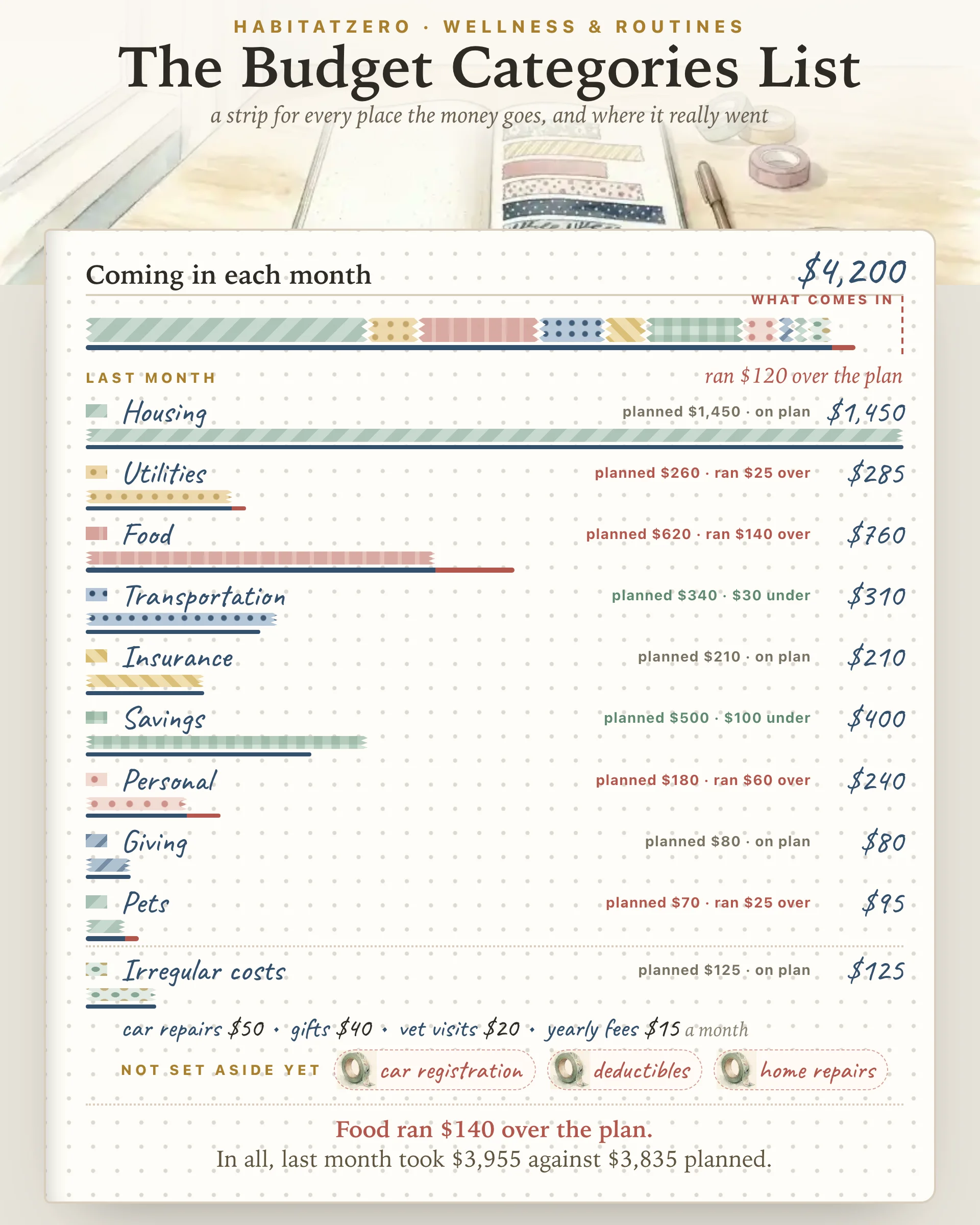
A budget is only as good as its list of categories. Leave one out and the money still leaves, just without a name, and the month ends with two hundred dollars you cannot account for. This page starts you with ten common budget categories, lets you shape the list to your own life, and then shows where your money actually went against the plan.
Most household budgets can be built from the same short set:
Pets, childcare, kids and health are common additions once they are big enough to watch on their own.
For a sense of scale, the Bureau of Labor Statistics found that in 2024 the average American household put about a third of its spending into housing, about a sixth into transportation and about an eighth into food. Those are averages across very different lives, not targets. Your list should describe your month, not the nation's.
Start with what comes in each month after taxes, then go down the list. Peel off any category you never pay for, rename any that deserves a truer name, and tear a new strip for anything missing. The page holds fourteen categories, because a list you can read at a glance is a list you will actually check.
As you give each category a monthly amount, it becomes a strip of washi tape. Across the top of the page, every strip is laid end to end against a line that marks your take-home pay, so you can see at once how much of the month is spoken for and how much is still loose. In the list, each strip is sized against the biggest, so the two or three categories carrying most of the weight stand out.
The hardest categories to budget are the ones that skip most months. Researchers who studied how people predict their own spending found that we budget ordinary purchases fairly well but underestimate exceptional ones, partly because each car repair or wedding gift feels like a one-time event instead of part of a pattern that returns every year. A related line of work found that people underpredict their future expenses because a typical month is what comes to mind, and that asking why the coming month might be different brings the unusual costs back into view.
This page asks that question for you. Your categories point to the irregular costs that usually travel with them: a car brings repairs and registration, insurance brings deductibles, a pet brings vet visits. Any that are missing wait at the bottom as rolls of tape. Tap one, write what it costs in a year, and the page sets aside a twelfth of it each month inside a single strip for irregular costs. If a roll does not apply to you, mark it not mine and it steps aside. When those yearly costs deserve a savings plan of their own, the Sinking Funds Shelf gives each one a jar and a date.
A plan stays a guess until you hold it up against what happened. The Consumer Financial Protection Bureau suggests tracking a full month of spending instead of a week or two, since a whole month reveals the small purchases that add up and sometimes pull against your priorities.
Switch the page to last month and copy in what each category really took from your bank and card statements. A pen line appears under each strip. Where a category ran over, the line runs past the tape in red; where it came in under, a dashed line marks the room that was left. The reading below ranks where most of the money went, names the categories that ran over or came in under, and totals the month against the plan.
The page sorts and adds up your own numbers. It does not know your debts, your goals or your tax situation, and nothing on it is financial advice. If you want a rule of thumb for dividing your pay, the 50/30/20 Budget is a common place to begin, and if you would rather give every dollar a job before the month starts, the Zero-Based Budget is built for exactly that.
January is the natural moment for it, and it works just as well after a raise, a move or a new bill. Set up your list once, then come back each month with your statements and write in what really happened. Three months of pen lines will tell you more about your own spending than any national average can.
Most household budgets come down to housing, utilities, food, transportation, insurance, debt payments, savings, personal spending and giving, plus one line for costs that arrive only once or twice a year. Pets, childcare and health often earn a line of their own once they get large.
Enough that every category means something to you, and few enough that you can check them all in a minute. Ten to fourteen suits most households, which is why this page stops at fourteen strips.
It depends on where you live and what you earn. In the Bureau of Labor Statistics survey of 2024 spending, the average household put about a third into housing, about a sixth into transportation and about an eighth into food. Averages are for scale; your own figures are the ones to plan with.
They are the costs that skip most months: car repairs and registration, insurance deductibles, gifts, yearly memberships and vet bills. Dividing each yearly cost by twelve and setting that much aside every month keeps any one of them from landing on a single paycheck.
The filled example on this page is free to look through. Personalizing it in HabitatZero, also free, keeps your strips, amounts and last month's figures ready for the next visit.
By the team behind Fabulous, the science-based self-care app used by over 30 million people.


