Leaves on a StreamEmotional Fitness · ~3 min
About this template · Updated September 2026
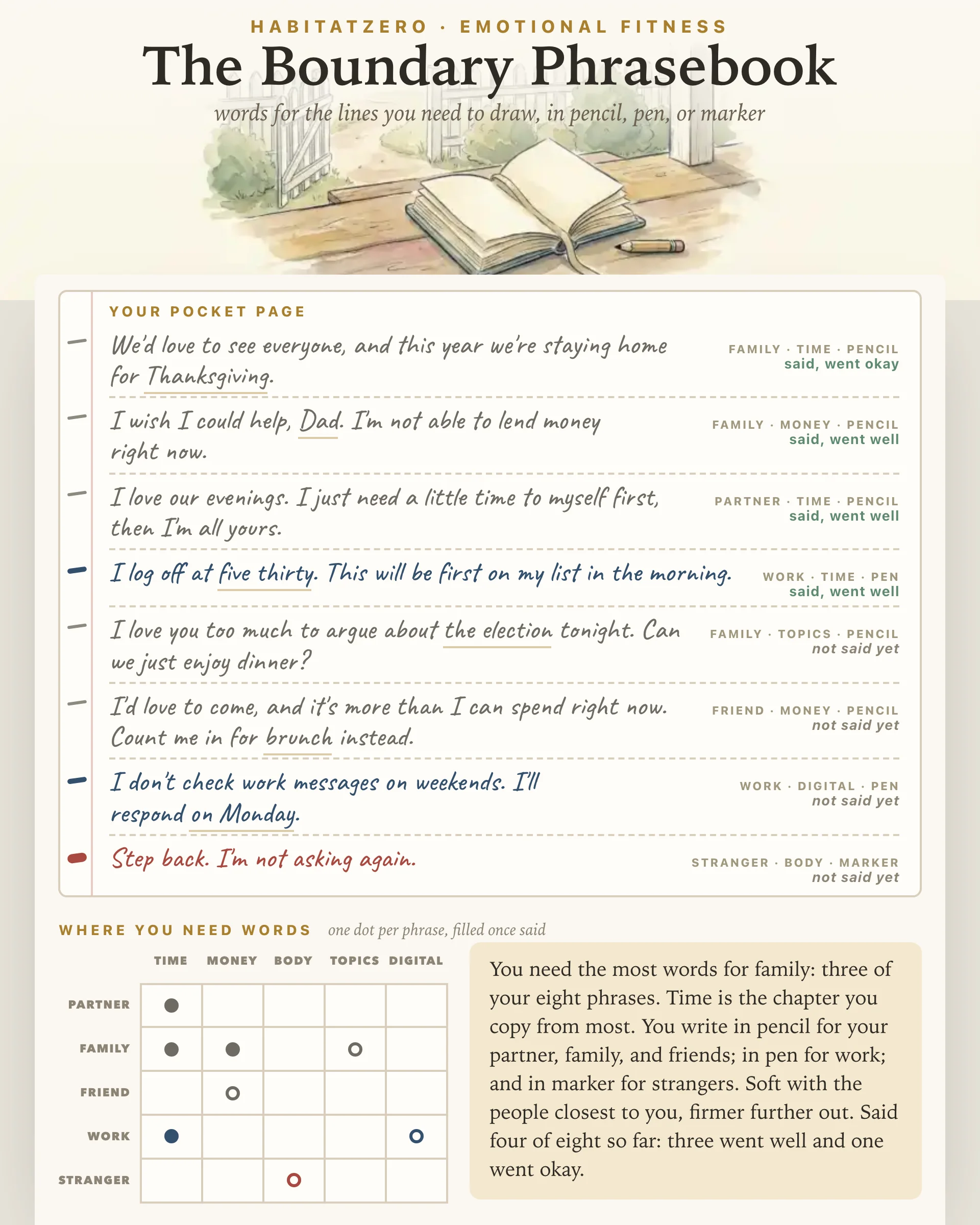
You usually know what you want to say no to. The work call at nine at night, the cousin asking for another loan, the question at dinner about when you're having kids. What goes missing is the sentence. The moment arrives, your mind empties, and a yes comes out because it was the only word already on your tongue.
This page is a phrasebook for that moment. It won't decide your limits, but it hands you words for them ahead of time, so the no is ready before you need it.
Part of what makes a no hard is the story you tell yourself about how it will land. In a set of studies on turning down invitations, Julian Givi and Colleen Kirk found that the people saying no overestimated the fallout: they expected the person who invited them to be angrier, to feel less cared about, and to be less likely to ask again than that person really was. Those studies looked at social invitations, like lunch or a ballgame, not at every kind of limit. Still, they suggest the dread before a no is often bigger than the reaction after it.
Practicing direct, respectful statements is also the heart of assertiveness training, a behavior therapy technique that was once a hugely popular subject of research. A 2018 review in Clinical Psychology: Science and Practice called it a forgotten evidence-based treatment: the early research was encouraging, and then studies of it largely dried up. The idea has a respectable history, much of its evidence is old, and a phrase list covers only the vocabulary part. Saying the words out loud, to real people, is the rest.
The tabs across the top are the people: partner, family, friend, work and stranger. Each tab opens onto five chapters: time, money, body, topics and digital. Every page holds two situations, such as a loan request or a relative who drops by unannounced, each written at three strengths.
Copy down the ones you'd actually say. They land on your pocket page in the ink of their tool, with blanks for your own names, days and amounts. The page holds twelve and turns away a thirteenth until you cross one out.
Once you've used a phrase, mark how it went: well, okay or badly, and it keeps its words the way you said them. As the marks pile up, the index at the bottom reads back who you need the most words for, which chapter you copy from most, and which tool you pick up with each person. You might find you write in pencil with family and in pen at work, or that the firm ones went better than you expected.
Soft isn't weak, and final isn't rude. Soft suits someone who means well and has never been told. Clear suits a limit you'll have to repeat, where extra warmth would sound like wiggle room. Final is for a line that has already been crossed, or for the second time you've had to say the same thing.
Whatever the strength, say it once and let it stand. You don't owe a list of reasons. One sentence of care and one sentence of no usually does the job, and each extra reason hands the other person something to argue with.
Some people meet a boundary with pressure, threats or worse. If you're afraid of what someone will do when you say no, the problem isn't your wording, and no phrasebook can fix it. The National Domestic Violence Hotline is free, confidential and staffed around the clock: call 1-800-799-7233 or text START to 88788. This page is practice for everyday limits, not a stand-in for that kind of help or for a therapist.
If you don't yet know which limit to set first, the Boundaries Worksheet helps you find the situation that drains you most and write one boundary around it. For a request that needs a whole conversation rather than a sentence, build it one step at a time with The DEAR MAN Script. To hear how your wording sounds when it drifts passive or aggressive, try The Three-Station Radio.
They are short, ready-made sentences for stating a limit out loud: saying no, asking for space, or closing a subject. Having one prepared matters because the moment you need it is usually the moment your mind goes blank. Examples: I don't lend money to friends. I'm offline after six, and I'll pick this up in the morning.
With family: Please call before you come over. With a partner: I'm stepping away for twenty minutes, then we'll finish this. With a friend: That's over my budget, so I'll sit this one out. At work: I don't have room for this right now. With a stranger: That's private, I'd rather not say. The phrasebook holds a hundred and fifty of them, sorted by relationship and subject.
Pair one warm sentence with one clear no, and leave out the list of reasons. A reason is allowed, but every extra one gives the other person something to argue with. A soft phrase such as I'd love to come, and it's more than I can spend right now, is polite and still a complete answer.
Soft is warm and leaves a door open, which suits someone who means well and has never been told. Clear is plain and kind with no apology, for a limit you expect to repeat. Final is said once and not open to debate, for a line that has already been crossed. Most people need all three, just with different people.
Not to read it: this page shows a filled-in sample pocket page and a handful of phrases you can use today. To open all hundred and fifty, copy them onto your own page, fill in the blanks and keep track of how each one went, use the phrasebook in HabitatZero, which is free.
By the team behind Fabulous, the science-based self-care app used by over 30 million people.