
Leaves on a StreamEmotional Fitness · ~3 min
About this template · Updated September 2026
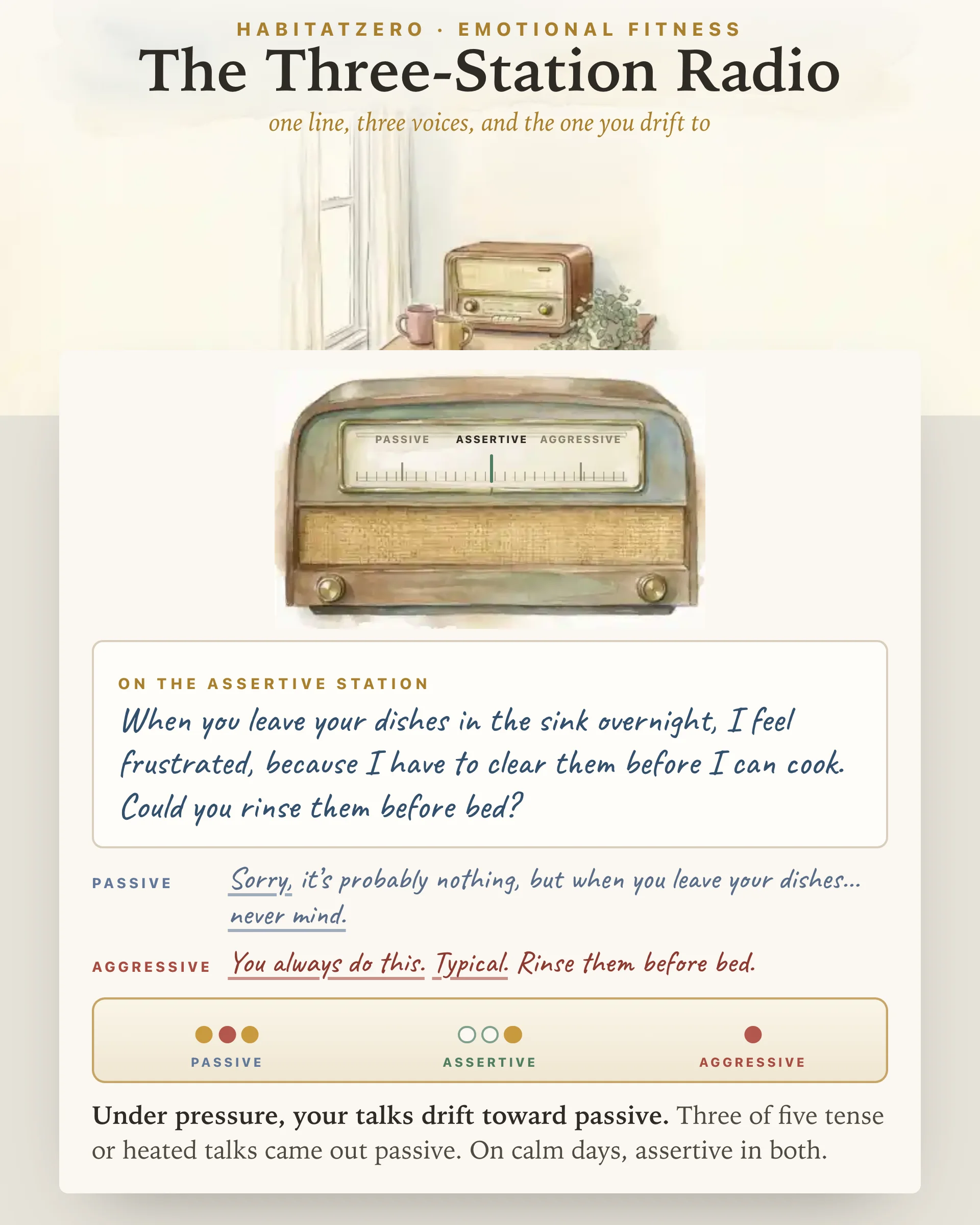
You know what you want to say. The trouble starts on the way out. Some days it leaves as an apology, the request folded so small inside it that the other person steps right over it. Other days it leaves as a verdict: always, never, typical. Assertive communication is the third way through. You say what happened, how it lands on you and what you are asking for, and you leave the other person room to answer.
The I-statement at the heart of that third way has a known author. Psychologist Thomas Gordon coined the name I-message in the 1960s and wrote about it in his 1970 book Parent Effectiveness Training, and Gordon Training International still teaches his model. This radio is our own practice tool, built without the involvement of Gordon's organization and not endorsed by it.
Every station plays the same content; only the voice changes.
Passive-aggressive is a blend worth naming too: the request stays unsaid while the resentment leaks out sideways, as sarcasm, lateness or a pointed silence.
Tap a station on the dial and the needle swings over; the card underneath plays an example line in that voice and marks each giveaway, with how that voice tends to sound and look. Then write your own in four short blanks: When you, I feel, because and Could you. Or tap one of six common situations, from dishes left in the sink to work sent at six on a Friday, and edit it.
As you type, a static check reads your words. Hedges like sorry, a bit and just pull the needle toward passive; absolutes, labels and threats pull it toward aggressive. Change the words and the needle settles back on center. It is a word list, not a judge: it cannot hear your tone, and a flagged word is sometimes the right one. Treat each flag as a question.
After a real conversation, log it: how charged it was, which station actually came out and whether you felt heard. Each talk drops a dot on a band under the three stations. Old tube radios drifted off their station as they warmed up, and people do much the same. Once a few tense talks are in, the page names the station you drift to under pressure, and when your calm days tell a different story, it says so. The log keeps twelve talks at a time.
A 2018 review in Clinical Psychology: Science and Practice called it a forgotten evidence-based treatment: low assertiveness turns up across many clinical problems, and early studies found the training useful for a range of them. The authors also point out that research on it as a stand-alone treatment has shrunk drastically, so much of that support is old.
The wording itself seems to matter, at least on paper. In a 2018 study in PeerJ, people read opening lines for imagined conflicts and judged how defensive the listener would get. Lines in I-language, and lines that acknowledged the other person's view, were rated less hostile, and the best openers did both. Those were ratings of hypothetical scenes, not recordings of real arguments.
Keep your expectations in proportion. In a factorial trial with 1,093 university students who had mild depressive symptoms, an assertiveness module inside a smartphone therapy program improved assertiveness skills, but including it made no measurable difference to how much the students' depression eased; they improved with or without it. Practice builds the skill. It is not a cure for low mood, and a clear request can still be met with a no.
Use it the night before a conversation you keep circling, then again afterward to log how it went. If you want a wider view of how you reply across everyday moments, The Reply Rack files your answers by style. For a request with more structure, The DEAR MAN Script walks through DBT's version one letter at a time, and if the trouble is a line someone keeps crossing, start with the Boundaries Worksheet.
It is the wrong tool when the other person hurts, threatens or controls you. Better phrasing does not make an unsafe relationship safe, and you do not owe anyone a perfectly worded request. In the US, the National Domestic Violence Hotline takes calls at 1-800-799-7233 and texts sent to 88788 with the word START, free and confidential, at any hour.
It means saying what happened, how it affects you and what you would like, in plain words, while leaving the other person free to answer. Passive communication keeps the request quiet or unsaid, and aggressive communication turns it into blame or an order.
Describing one specific thing the other person did rather than judging them, owning your feeling with an I-statement, making a single clear request, saying no without piling on apologies, and keeping your voice level. One example: When you cancel our plans at the last minute, I feel let down. Could you give me a day's notice next time?
Passive puts the other person's comfort first, so the ask shrinks or goes unsaid. Aggressive puts winning first, with absolutes, labels and orders. Assertive treats both people as counting: a clear description, an owned feeling and a request that can be answered yes or no.
Then clearer wording is not the fix, and your safety comes first. In the US, the National Domestic Violence Hotline is free, confidential and open at all hours: call 1-800-799-7233 or text START to 88788.
This page shows a filled-in example of the radio. Writing your own line, running the static check on it and keeping a log of real talks all happen once you personalize the worksheet in HabitatZero, which is free.
By the team behind Fabulous, the science-based self-care app used by over 30 million people.


