
Leaves on a StreamEmotional Fitness · ~3 min
About this template · Updated September 2026
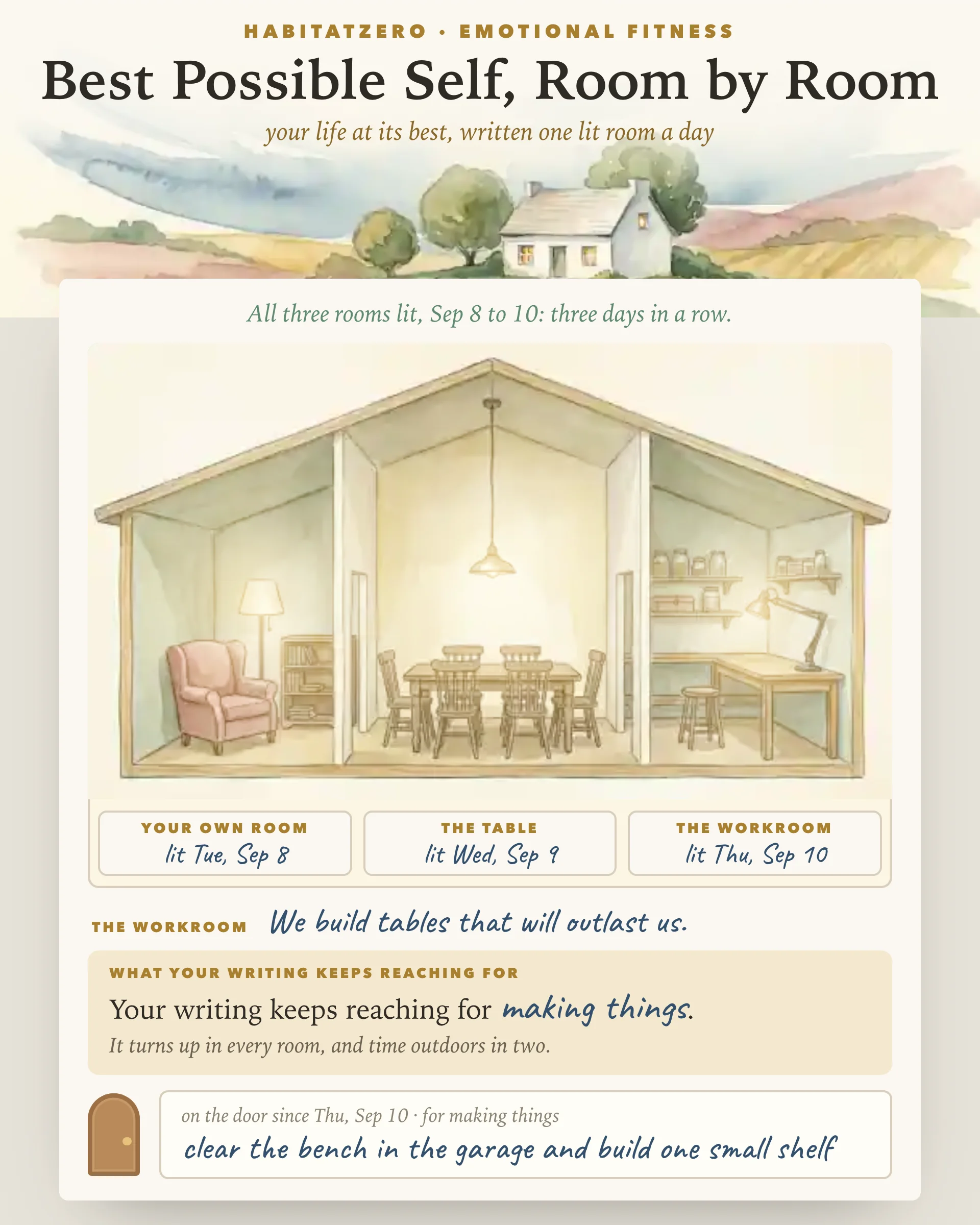
The best possible self exercise comes from Laura King, a psychologist at the University of Missouri, who first tested it in a 2001 study of writing about life goals. The worksheet on this page is an independent interactive version made by HabitatZero. King and her university had no part in building it and have not endorsed it.
The instruction fits on an index card. Picture your life some years from now, after everything has gone as well as it possibly could because you worked for it, then write about that life as though it has already arrived. Not a wish list or a pep talk: a description, with mornings, rooms, people and small details in it.
King asked 81 college students to write for twenty minutes on four days in a row. Some wrote about a trauma, some about their best possible future self, some about both, and a control group wrote about a neutral topic. Writing about the best possible self was significantly less upsetting than writing about trauma, and it was followed by a rise in well-being measured three weeks later. Five months on, all three emotional writing groups showed less illness in health center records than the controls. It was one small study, yet it started a long line of research.
A best possible self can sprawl across everything at once. Meevissen, Peters and Alberts gave everyone the same three parts to build the picture from, personal, relational and professional, and then asked for five minutes of imagining it every day for two weeks. Optimism rose more in that group than in a group that pictured their ordinary daily activities, and the gain held up after accounting for changes in mood.
This page turns those three parts into rooms. Your own room holds the personal picture: your body, your habits, your free hours. The table holds your people. The workroom holds what you make, fix, teach or look after.
Choose a room, set ten, fifteen or twenty minutes, and light the lamp. The lamp brightens as the minutes pass, and the timer measures from the moment you began, so switching tabs or setting your phone down does not pause it. When the page stares back, tap a starter line such as "On an ordinary morning I" and keep going.
When the lamp is full, mark up to five parts of life the writing reached for, from friends and family to rest, money or faith. Parts whose words already appear in your writing carry a small dot. Then keep the room and leave the next one for tomorrow, the way the studies spread the writing across several days.
Once two rooms are lit, the house reads back. Every part you marked gets a row with a small window for each room, lit where it turned up, and the part that appears most is named as what your writing keeps reaching for. Beside it, the door offers a small step toward that part, or a line for your own. One step hangs there at a time, and you mark it taken when it is done.
After the third room, a five-minute walk-through lays all three rooms out to reread and picture. The page counts one walk per day and notices when they fall on consecutive days. The rooms you write stay in your own sheet, and nothing here grades them.
The clearest summary is a 2019 meta-analysis in PLOS ONE that pooled 29 studies and 2,909 people. Compared with control groups, the best possible self produced small to moderate gains in optimism and well-being and a larger one in positive mood, with only small effects on negative mood and depressive symptoms. Just three of those studies checked back after more than three months, so how long the change lasts is still an open question.
The evidence that does exist points toward practice. In a four-week study by Sheldon and Lyubomirsky, the exercise gave an immediate boost to positive mood, and the boost held for the people who kept doing it. That is why this page ends with a daily walk-through rather than a finish line.
None of this makes it a treatment for depression or anxiety; it is a practice that does its best work as a small, repeated habit. If picturing any good future feels impossible right now, rather than merely hard, or if you find yourself thinking about hurting yourself or ending your life, tell someone today: in the US you can call or text 988, and anywhere else your local emergency number will connect you with help.
Reach for it when the future feels foggy, after a setback that shrank your sense of what is possible, or in the quiet week before a new year begins. If you cannot tell which future deserves the title of best, sketch three rival lives first with The Odyssey Plan. If you would rather speak to that future person than describe them, A Letter to My Future Self seals a letter until a date you choose. And once the house shows you what it keeps reaching for, The Life Map can turn that picture into milestones at one, three and five years.
It is a writing practice from psychologist Laura King: you imagine a future in which everything has gone as well as it could, thanks to your own effort, and describe that life in detail for about twenty minutes. It has become one of the most widely used positive psychology exercises.
In the first study people wrote for twenty minutes on four days in a row. Later versions split the picture into personal, relationship and work parts and added five minutes of imagining it each day for two weeks. This page asks for one room a day at ten to twenty minutes, then an optional five-minute walk-through.
A 2019 review of 29 studies found small to moderate gains in optimism and well-being compared with control groups, and a larger boost to positive mood. The gains seem to last only while people keep practicing, and the exercise is not a treatment for depression or anxiety.
Take one part of life at a time: yourself, the people close to you, then your work. Write in the present tense as if it already happened, and favor specific mornings, places and people over a list of goals. Spelling and grammar do not matter here.
This page shows a sample house with all three rooms lit. Writing your own rooms against the lamp, and finding them waiting the next evening, happens when you open it in HabitatZero, which costs nothing.
By the team behind Fabulous, the science-based self-care app used by over 30 million people.


