
The Overwhelm Recovery ProtocolWellness & Routines · ~5 min
About this template · Updated November 2026
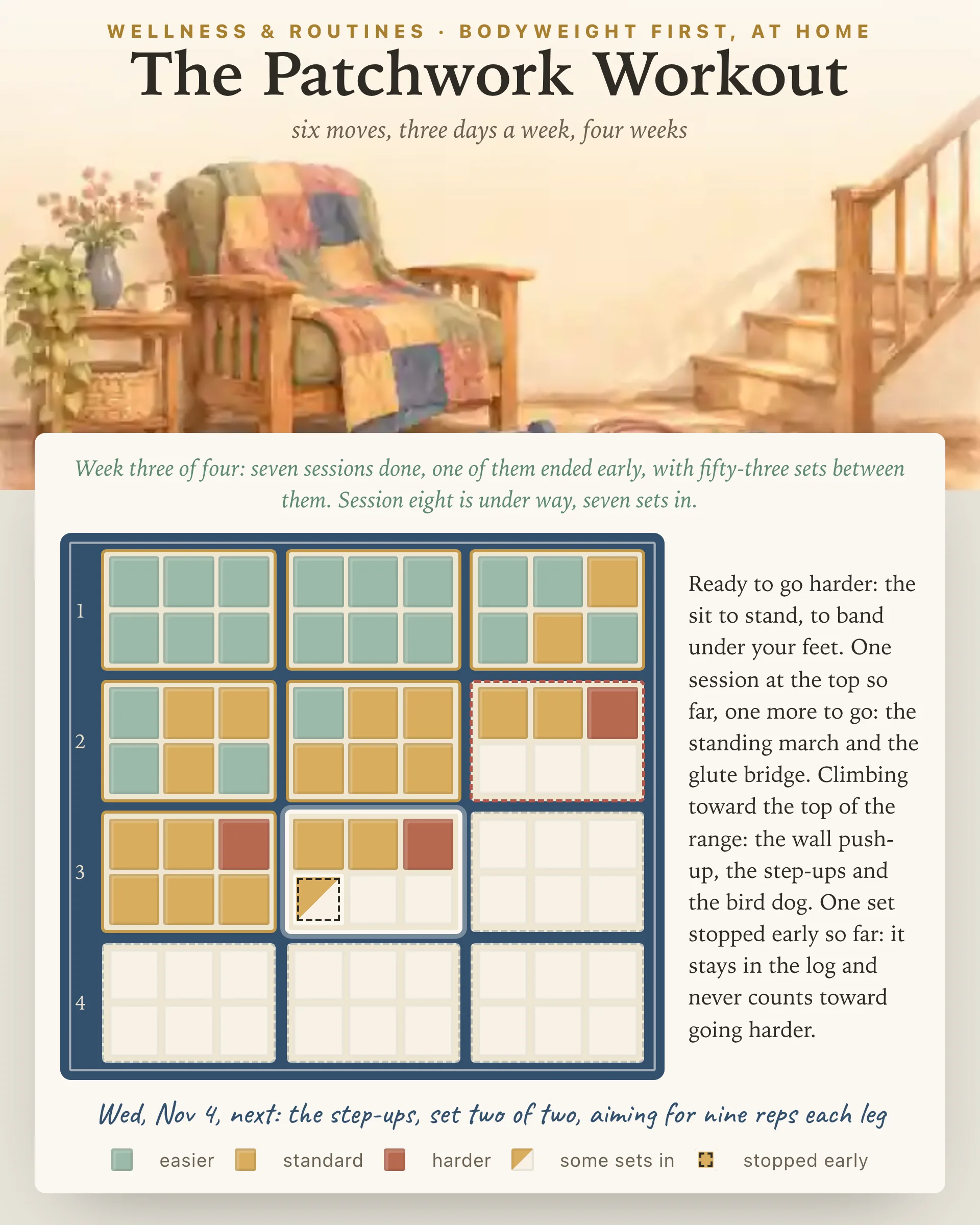
You do not need a gym or weights to start getting stronger. This beginner workout for women at home gives you six bodyweight moves, three days a week for four weeks, each with an easier version. Every set you finish sews a patch on a quilt, and the log keeps every rep.
Standing moves come first and floor moves last, so you get down only once.
Light dumbbells or a band only change a move's harder step: a dumbbell at your chest for the sit to stand, a band above your knees for the bridge.
Week one is one set of each move, about fifteen minutes with a two-minute warm-up walk. Week two adds second sets of the chair, wall and bridge moves. Weeks three and four are two sets of everything, about twenty-five minutes.
Each move has a range. The page aims you at the bottom of it and adds a rep, or ten seconds of marching, after each whole session. When every set reaches the top of the range in two sessions in a row, the card offers the next version. Once could be luck; twice means the move has settled in.
A session ended early never counts toward that, and neither does a set stopped partway: its whole reps go in the log, marked stopped early. Stepping back is easier. A set under the range brings a suggestion to return to the version before, unless something else stopped you.
Count me through gives you five seconds to get set, then paces each rep a word at a time: stand up, sit down slowly. A rep counts once it is finished, or you can log a set done at your own pace. A minute of rest follows each set, and both clocks read the real time, so a phone that locks between sets still knows how long you rested. The log gives each session a row, with each set's count under its move, colored by version.
The Coil Pot Workout Plan runs twelve weeks, at home or at a gym, with loads that grow. The Dumbbell Bookshelf assumes you own a pair and climbs from eight reps to twelve before the weight goes up. This page starts a step earlier: nothing to buy, an easier version of every move, four weeks, and a rule that picks each move's next version from your own last two sessions.
A 2020 meta-analysis led by Hagstrom pooled 24 studies of resistance training in healthy adult women, lasting four weeks to a year, and found large gains in strength. Supervised training did more for lower-body strength, and the studies were of moderate quality, so those averages say little about a home plan done alone.
In a four-week trial led by Kotarsky, one group did push-ups that got harder version by version, three days a week, and another did the bench press. Both groups raised their one-rep bench press, and muscle thickness did not change measurably in either. The 23 people were young, moderately trained men, so the trial shows that stepping up through versions can build strength, not what it will do for a woman starting out.
Breathe out on the effort, and never hold your breath or bear down. A narrative review by Bø and Nygaard, two pelvic floor researchers, found that moderate activity such as walking goes with less leaking, that female athletes are about three times as likely to leak as other women, and that the load a pelvic floor handles well almost certainly differs from woman to woman.
If you leak, or feel heaviness or a bulge low in your pelvis, tell a doctor or a pelvic floor physical therapist. A Cochrane review of 31 trials with 1,817 women found that about three in four women with stress leaking who did pelvic floor muscle training reported it cured or better, against about one in ten without it. Most trials were small to moderate in size and followed women for under a year. The Pelvic Floor Hammock takes you through that training day by day.
Check with a doctor or physical therapist first if you are pregnant or gave birth in the past year, have a heart or blood pressure condition, have had a fall, dizzy spells, a joint replacement or recent surgery, or live with osteoporosis or pain that keeps coming back. Stop any move that hurts, and keep a sturdy chair, counter or stair rail within reach for every standing move.
One that uses moves you already do every day and a plan that tells you when to make them harder. Here that means marching in place, standing up from a chair, a push-up against the wall, stepping up onto a stair, lifting your hips while lying on your back and reaching an arm and the opposite leg on hands and knees. Each move has an easier version, so nobody starts out of reach.
Three days with a rest day between them suits most people starting out, for example Monday, Wednesday and Friday. Public health guidelines ask adults for muscle-strengthening work on at least two days a week, so three short sessions clear that with room to miss one.
When you have reached the top of its range, every set and whole, in two sessions in a row. One good day can be luck, two in a row usually is not. If a set comes in under the bottom of the range, the card suggests easing back to the version before.
It is common, but it is not something to put up with quietly. Breathe out on the effort and never bear down or hold your breath. If you leak, or feel heaviness or a bulge low in your pelvis, see a doctor or a pelvic floor physical therapist. In trials, pelvic floor muscle training cured or eased stress leaking for about three in four women who did it.
Anyone who is pregnant or gave birth within the past year, has a heart or blood pressure condition, has had a fall, dizzy spells, a joint replacement or recent surgery, or lives with osteoporosis or pain that keeps coming back. Ask which moves and versions suit you, and stop any move that hurts.
By the team behind Fabulous, the science-based self-care app used by over 30 million people.


