
The Overwhelm Recovery ProtocolWellness & Routines · ~5 min
About this template · Updated November 2026
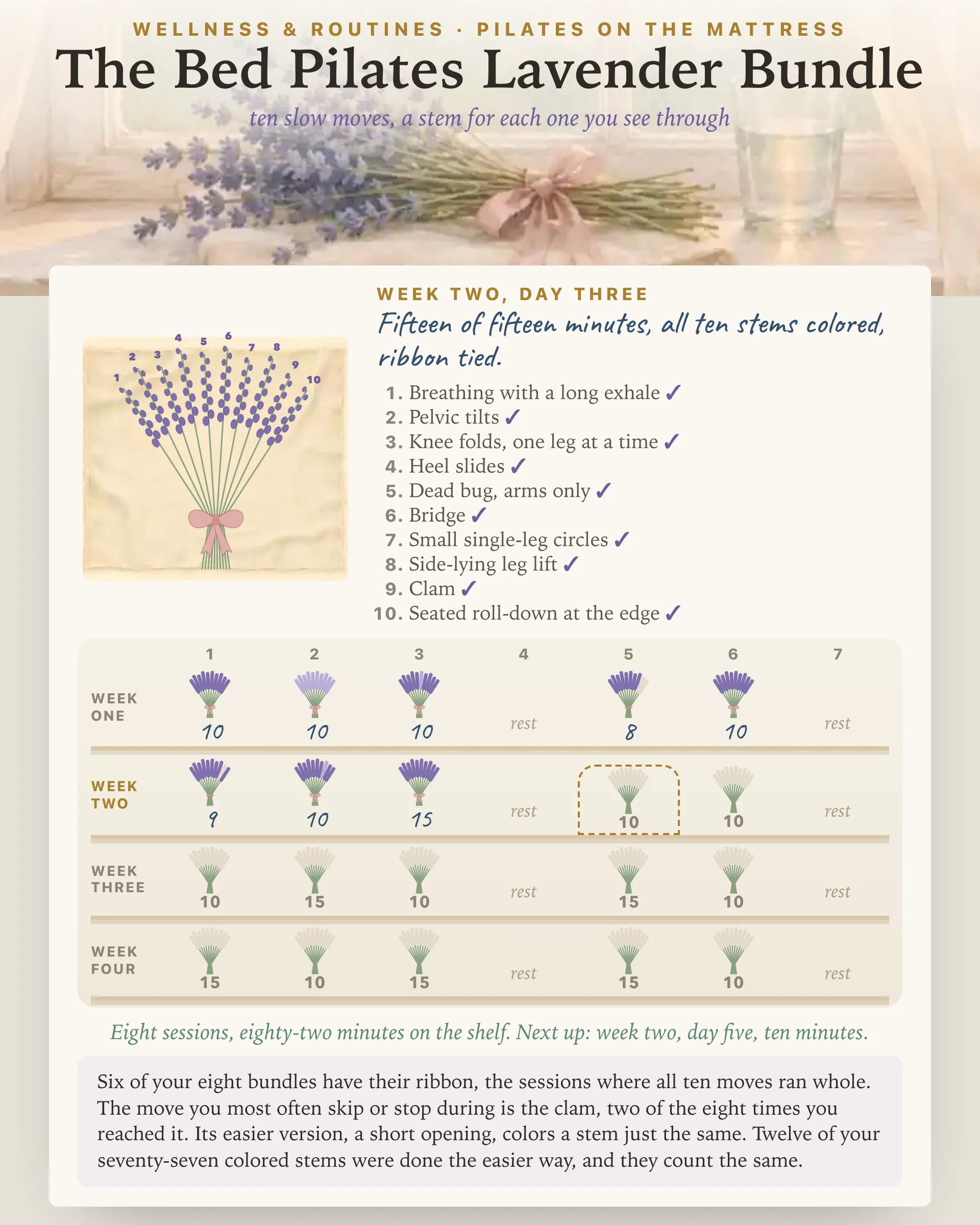
Some days the floor is simply too far away. Knees that complain on the way down, a back that takes a while to unlock in the morning, or plain low energy at night can turn a mat session into one you skip. Bed Pilates moves the practice to where you already are: a firm mattress, slow breathing, and small movements for the deep muscles around your trunk and hips, finishing on the edge of the bed with your feet on the floor.
Stores and studios sometimes call the reformer, the sliding Pilates machine with springs and straps, a Pilates bed. This page has nothing to do with that machine. It needs an ordinary bed, a pillow, and ten or fifteen minutes.
Every move has an easier version, such as raising only a heel instead of the whole leg. A mattress gives way, so there is no kneeling, standing or balance work.
Choose ten or fifteen minutes, the usual or the easier version, and whether to keep the roll-down. The clock gives each move a tenth of the session and tells you when to switch legs or sides halfway.
Each move is a lavender stem in a bundle lying on linen. A stem takes its color only when its move runs its whole time; a move done the easier way gets a paler stem that counts the same. A skipped move leaves its stem bare, and its seconds never count. End early and only whole minutes are kept. When all ten stems color in one session, a ribbon ties the bundle. The clock keeps real time, even if your phone locks.
Finished bundles go on a four-week linen shelf, five sessions a week: ten minutes throughout week one, then one, two and finally three fifteen-minute sessions. A reading under the shelf names the move you most often cut short.
To get into position, sit on the edge, lean down onto your forearm as your legs come up, and roll onto your back with your knees bent. Getting out reverses it: bend your knees, roll onto your side, and push up with your arms as your feet swing down to the floor. The tenth move starts exactly this way. Stay seated for a few slow breaths before you stand, longer if the room feels unsteady, and rise with a hand on something sturdy.
No trial has tested Pilates done in bed. A search of PubMed for Pilates studies that mention a bed or a mattress turns up reformer research and hospital exercise work, nothing resembling this routine. The evidence below comes from classes on a floor mat and carries over only loosely to a softer surface.
For older adults, a 2018 meta-analysis of nine randomized trials by researchers in São Paulo found that mat Pilates improved dynamic balance, leg strength, hip and low-back flexibility, and aerobic fitness compared with control groups, in people aged sixty and over. Only five of the nine trials were rated high quality, and the authors called for better studies.
For chronic low back pain, the Cochrane review of Pilates, covering ten trials and 510 people, found low to moderate quality evidence that it eases pain and disability more than minimal care, and no clear sign that it beats other kinds of exercise.
A 2020 review of ten studies on body composition found Pilates on a mat did no better than other training, or none, for body fat, lean mass or waist size. So nothing here promises toning or a flatter stomach.
Talk with a doctor or physical therapist before you begin if you have osteoporosis or a past spine fracture, back pain that travels down a leg, a new hip or knee, a recent operation on your back or belly, a heart or blood pressure condition, or dizziness when you get up, or if you are pregnant or recently gave birth. With osteoporosis, leave the roll-down out. It curls the spine forward, and an international expert consensus on exercise with osteoporosis favors spine-sparing ways to move, such as bending at the hips, plus a physical therapist's advice after a spine fracture. The tenth stem then becomes seated breathing with no forward curl. Stop any move that hurts.
The Bed Yoga Fan holds yoga poses on the mattress, such as a reclined twist and happy baby. Turn Back the Covers is a wake-up routine for older adults that ends with a careful stand. The Mat Pilates Class Deck deals the classical order on the floor. This bundle keeps to Pilates basics, small and slow, on the surface you woke up on.
It is a short set of Pilates-style moves done lying and sitting on your own mattress: slow breathing, small pelvic and leg movements, gentle trunk work and side-lying hip work. It suits mornings, evenings and days when getting down to the floor feels like too much.
No. Some studios and stores call the reformer, a sliding carriage with springs and straps, a Pilates bed. This routine needs no equipment at all, just an ordinary bed with a firm mattress and a pillow.
Nobody has tested it. Trials of Pilates use floor mats or machines, and a mattress gives way under you, which makes each move gentler and less stable. Treat it as a kind way to start or end the day, and add mat or standing work when you are ready.
Bend your knees, roll onto your side, and push up with your arms while your feet swing down to the floor. Sit on the edge for a few slow breaths before you stand, and wait longer if you feel light-headed.
Ask first if you have osteoporosis or a past spine fracture, back pain that travels down a leg, a new hip or knee, a recent operation, a heart or blood pressure condition, or dizziness on standing, or if you are pregnant or recently gave birth.
By the team behind Fabulous, the science-based self-care app used by over 30 million people.


