Leaves on a StreamEmotional Fitness · ~3 min
About this template · Updated September 2026
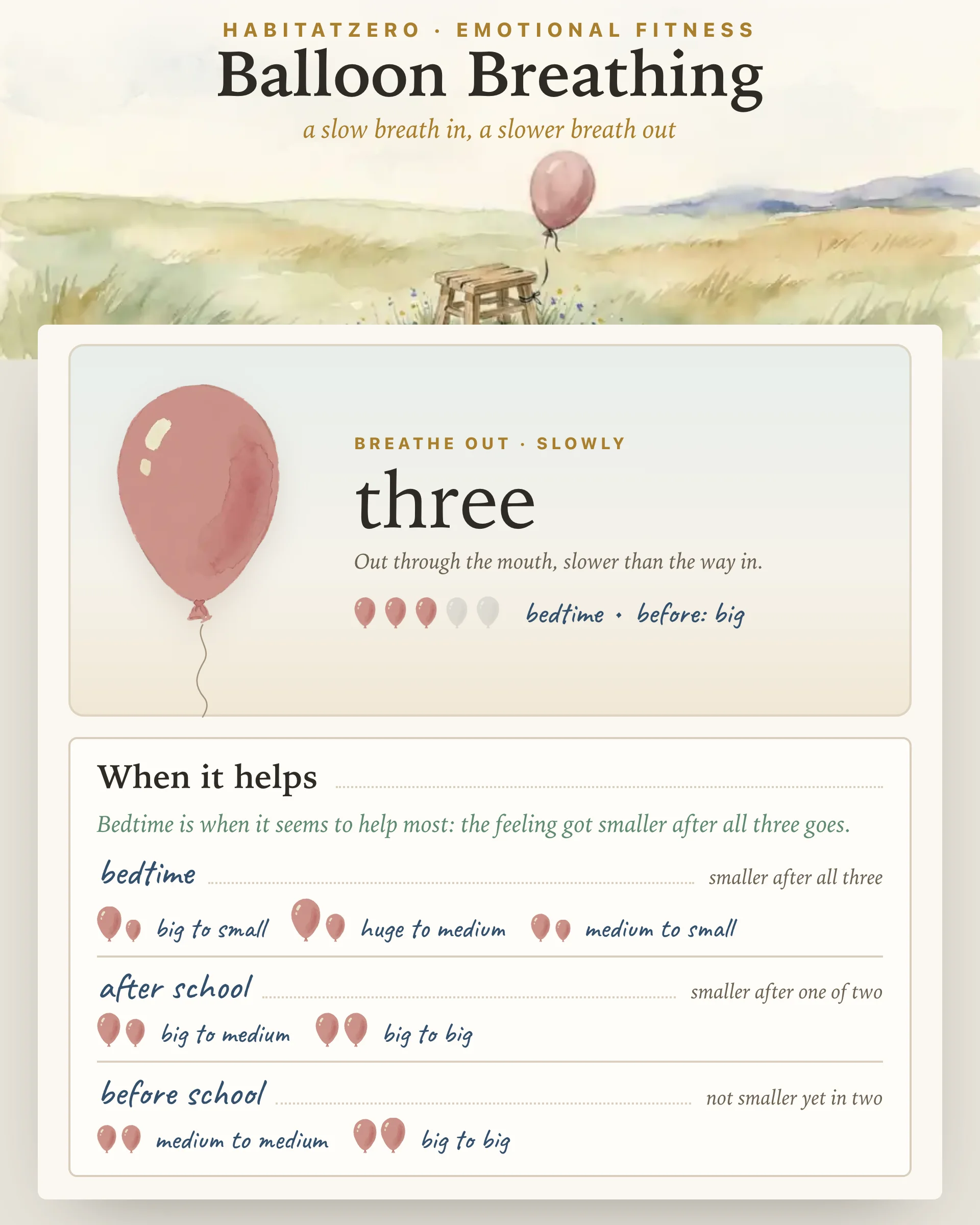
Balloon breathing gives a child something to picture while they slow down. They imagine a balloon sitting in their belly, fill it with a slow breath in, and let the air out with an even slower breath out. The picture does the teaching: to fill a balloon down in the belly, the breath has to travel low, so the belly rises while the shoulders stay put, and to let it down gently, the breath out has to stay unhurried. It is a child-sized way into belly breathing, the slow diaphragmatic kind.
This page is written for you, the parent or teacher. You set the pace and keep the notes; the balloon is for your child.
Three to five balloons is plenty for most children. ZERO TO THREE's version for families adds movement: the arms rise over the head into a big round balloon on the breath in and come back down on the breath out, which suits younger kids who find sitting still harder than breathing slowly.
Teach it on an ordinary, calm afternoon. A skill your child has run through a dozen times when nothing is wrong is far easier to reach for when something is.
Pick a pace: in two and out three for little ones, in three and out four for most school-age kids, or in four and out five for older kids and any adult breathing along. Press start, and the painted balloon fills during the breath in and shrinks during the breath out while the count appears beside it in words. Each count lasts one second, and a go ends after five balloons.
Before you start, tap how big the feeling is, from a small balloon up to a huge one. Afterward, tap it again and choose when this happened, such as bedtime, after school or before a test, or type a moment of your own. Add the go, and it lands in the log under that moment.
The log is where the page earns its keep. Once the log holds three goes and some moment has come up twice, it names the moment where the feeling most often got smaller, and the moment where it has helped least so far. A reading that says bedtime works every time while the rush before school does not is worth having: it hints at doing a round a little earlier on school mornings, before the feeling has built up.
The evidence for slow breathing in children is encouraging but modest. In a study of 122 Primary 5 students in Singapore, roughly American fifth graders, the children who took deep breaths before a timed math test reported less anxiety and scored better than a comparison group that skipped the breathing.
A more everyday test came from a micro-randomized trial in children's daily life. Over fifteen days, 171 children aged nine to thirteen were randomly assigned each day to a guided slow breathing exercise, a different video, or no activity at all. On average, the breathing did not change how relaxed or upset they felt. On days when a child was more worried than usual, though, they felt more relaxed after breathing than after doing nothing, while it did no better than the other video. The authors concluded that the situation shapes whether a breathing exercise helps.
That finding is why this page tracks when, not just whether. Your log cannot prove the balloon caused anything, since feelings also shrink with time and a grown-up's attention. What it can show is where the practice and a calmer child keep turning up together, so you know where to spend it.
Balloon breathing is a calming skill, not a treatment. If worries or big feelings keep getting in the way of school, sleep or friendships, talk with your child's pediatrician or a counselor.
The same name turns up in physical therapy, where it means something else: the 90/90 bridge with ball and balloon, in which you breathe out into a real balloon to train posture and trunk stability. That is a rehab exercise to learn from a physical therapist, and it is not what this page teaches.
Start on calm days, then bring the balloon to the moments your log flags as hard, a little before the feeling peaks. It pairs well with Bubble Breathing for a child who would rather blow than picture, and with The Feelings Thermometer when you want a finer scale for how big a feeling is. A quiet spot set up like a Calm Corner gives the balloon a regular place to happen.
If your child gets dizzy or tingly, stop and let them breathe normally. The next go can use a quicker pace.
It is slow belly breathing with a picture attached. Your child imagines a balloon in the belly, fills it on a slow breath in, and lets the air out on a longer breath out. The balloon image is a child-sized way to teach diaphragmatic breathing.
Start when your child is calm rather than mid-meltdown. Sit together with a hand on the belly and breathe along with the balloon for three to five slow breaths. Once it feels familiar, bring it out a little before the moments that usually get hard.
It can take the edge off for some children at some moments, and a study that followed children through their days found the benefit depends on the situation. It is a calming skill to practice, not a treatment, so if worry keeps getting in the way of school or sleep, talk with your pediatrician.
No. The version for kids only imagines the balloon. Physical therapists use a separate exercise in which you breathe out into an actual balloon to train posture and trunk control, and that one is best learned from a therapist.
This page shows a filled-in example of the balloon and its log. To run the balloon with your child and keep a record of their goes, open it in HabitatZero, which costs nothing.
By the team behind Fabulous, the science-based self-care app used by over 30 million people.