
The Overwhelm Recovery ProtocolWellness & Routines · ~5 min
About this template · Updated November 2026
A balance board tips the moment you stand on it. A round wobble board rests on a dome and tips every way; a rocker board rests on a curved base and tips one way only. Keeping either steady takes small, constant corrections from your ankles, feet and hips: that is the practice. Here are ten balance board exercises in order, a clock for every hold and six weeks of short sessions, all beside a kitchen counter.
Put the board in a corner or doorway with the counter right beside you. Use a non-slip floor or mat, never a loose rug, and stand in bare feet or shoes with grip, not socks. Prop the screen up on the counter so you never reach for it mid-hold. The first hold opens once you mark those four checks.
On a rocker, the fifth move becomes soft taps of each end with a pause at level. Tell the page which board you have and the cues follow it.
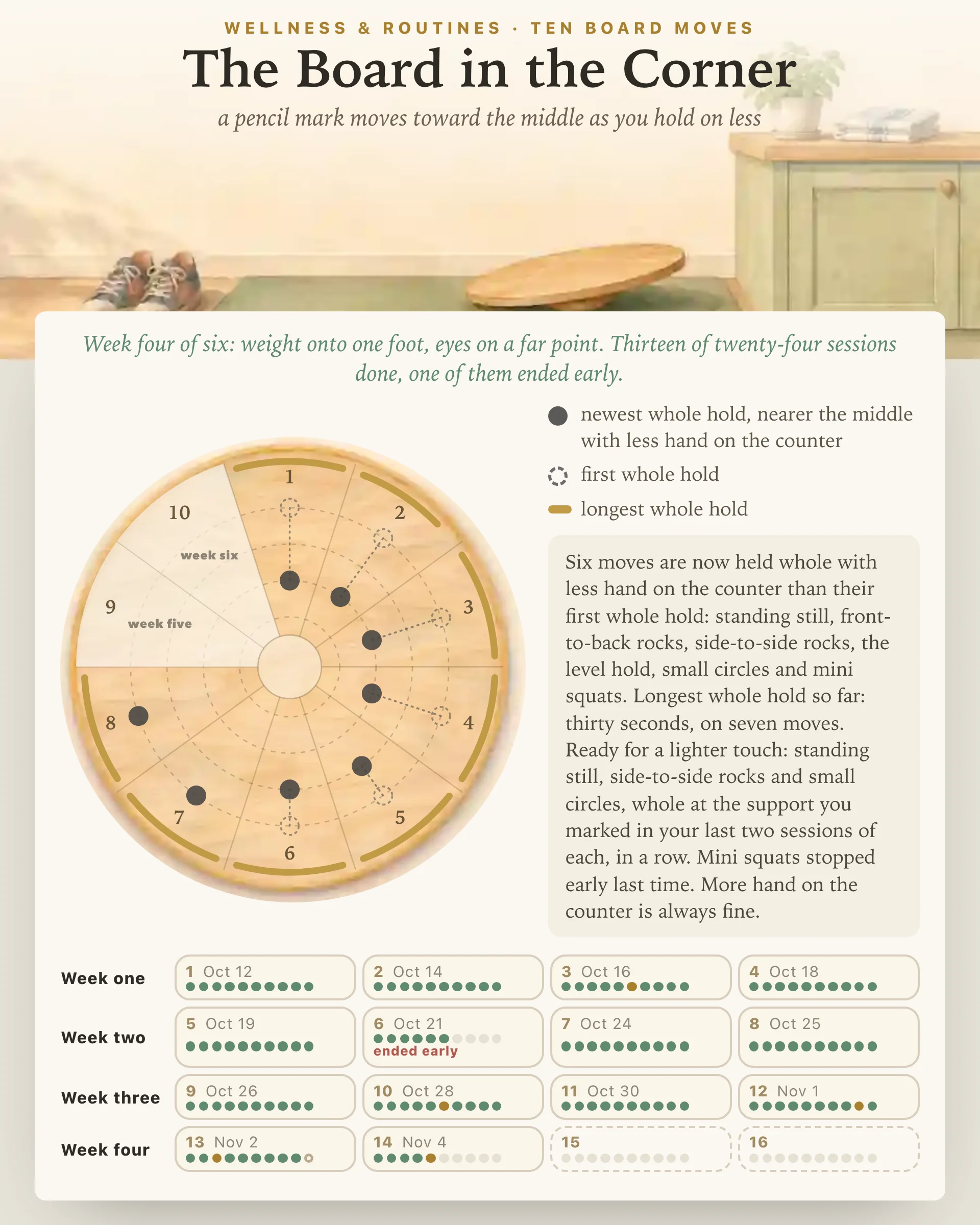
Before each hold you mark your support: two hands on the counter, one hand, fingertips, or hands hovering an inch above it. Each round is one minute: ten seconds to settle your hands, a hold, then rest. Holds run twenty seconds in week one, twenty-five in weeks two and three, and thirty from week four. Ten rounds make a session, four sessions a week, with new moves joining as the weeks go.
The clock keeps real time even if your phone locks, and a hold counts only when its whole time runs. To stop early, step down, then tap stop: your whole seconds go in, marked stopped early, and never count toward going lighter. A round that feels wrong today can be skipped.
On the painted board, each move's newest whole hold leaves a pencil mark, near the rim for two hands and nearer the middle as your touch gets lighter, with a faint ring for your first whole hold and gold on the rim for your longest. When a move has run whole at the same support in its last two sessions in a row, the page says a lighter touch is there for you. A stop says more hand is fine. Nothing is set beside anyone else's numbers.
Most balance board research is on ankle sprains in athletes. Sports medicine researchers in Amsterdam followed 116 volleyball teams through a season, about 1,100 players, and gave over half the teams a balance board program. Those teams had fewer sprains, but only among players who had sprained an ankle before. Players with an earlier knee injury had more knee overuse trouble on the program, so ask first if your knees have a history.
The same group then followed 522 athletes aged 12 to 70 who had sprained an ankle in the previous two months. Half got an eight-week home program with a balance board, three times a week. Over the next year, 22 percent of them sprained it again, against 33 percent of the rest. The sprains were self-reported, and only about a quarter did the whole program.
For older adults, the evidence is for balance training in general, not boards. A Cochrane review of 94 trials with 9,917 people aged 60 and over, mostly women living at home, found weak evidence that balance, strength and mixed exercise moderately improve balance tests at the end of a program. Most trials stopped measuring there. Board studies in older people are few and small: rehabilitation researchers in Tokyo studied 23 nursing home residents averaging 84, and the 11 who trained on wobble boards for nine weeks then stood longer on a board and on a soft mat than the 11 who did not, which shows they got better at the task they practiced. None of these shows that a board prevents falls, and this page gives no fall-risk score.
The Balance Ladder climbs ten holds on the floor at a counter, the place to start if a board feels like too much. The Shorebird Shelf times how long you stand on each foot, a check to run between sessions here. The Door Frame works balance through standing yoga poses. Only this page puts you on an unstable surface.
Check with a doctor or physical therapist first if you have had a fall, get dizzy or lightheaded, have numb or tingling feet, have had a joint replacement, have an ankle or knee injury that is still healing, or live with a heart or blood pressure condition. Stop any move that hurts or makes you dizzy, and keep a hand within an inch of the counter for every move, even when you mark hands hovering.
They can be, with a counter to hold and a clear corner, but a board tips by design, so losing your footing is a real risk. Ask a doctor or physical therapist first if you have fallen, get dizzy, have numb feet or have had a joint replacement, and keep a hand near the counter for every move.
A round wobble board sits on a dome and tips in every direction. A rocker board sits on a curved base and tips only one way, front to back or side to side depending on how you turn it. A rocker is often the gentler place to start, and this page gives cues for both.
No study has settled a daily dose. This page uses ten-minute sessions four days a week, with holds of twenty seconds in week one rising to thirty by week four, because short, regular practice is easier to keep up and easier to stop when your legs tire.
Two Dutch trials found that board programs lowered the chance of another sprain in athletes who had sprained an ankle before. In the volleyball trial, players with no earlier sprain saw no clear benefit. If a sprain is recent or still swollen, let a doctor or physical therapist say when to start.
No study has shown that. For older adults the firmer evidence is for balance and strength training in general, which improves balance tests at least right after a program. A board is one way to practice, not a falls treatment, and this page gives no fall-risk score.
By the team behind Fabulous, the science-based self-care app used by over 30 million people.


