Leaves on a StreamEmotional Fitness · ~3 min
About this template · Updated September 2026
The thinking underneath this page belongs to John Bowlby and Mary Ainsworth, who showed that small children organize their behavior around whoever keeps them safe, and to Cindy Hazan and Phillip Shaver, who asked in 1987 whether adult romantic love runs on the same machinery. The Harbor Chart is an independent worksheet built on that body of work; none of the researchers named here reviewed it, endorsed it or had any hand in it.
Most attachment style quizzes hand you one of four names and stop. The research they borrow from has moved on. Since the late nineties, adult attachment has been measured on two continuous dials rather than sorted into bins: how much you worry about the bond (will they leave, do I matter, why the silence) and how much room you keep (do I lean on them, do I let them lean on me). The four familiar names are simply the corners of that square. Low on both dials is what researchers call secure. High worry with little room is anxious, sometimes preoccupied. Low worry with plenty of room is avoidant, sometimes dismissing. High on both is fearful-avoidant. Kim Bartholomew and Leonard Horowitz drew that square in 1991, and it has held up.
The corners make good shorthand. The trouble starts when a quiz treats them as four kinds of person. In 2015 Chris Fraley and colleagues ran taxometric analyses, built to detect whether a trait comes in natural categories, and found no evidence of types at all. Attachment varies by degree, the way height does, not by kind.
You begin by naming one person: a partner, a parent, a close friend, or a first name. Then come twelve lines, each marked rarely, sometimes, often or nearly always. Six listen for worry (a late reply that swallows the afternoon, needing to hear that you matter) and six for room (keeping feelings back when asked, wanting space when someone comes very close).
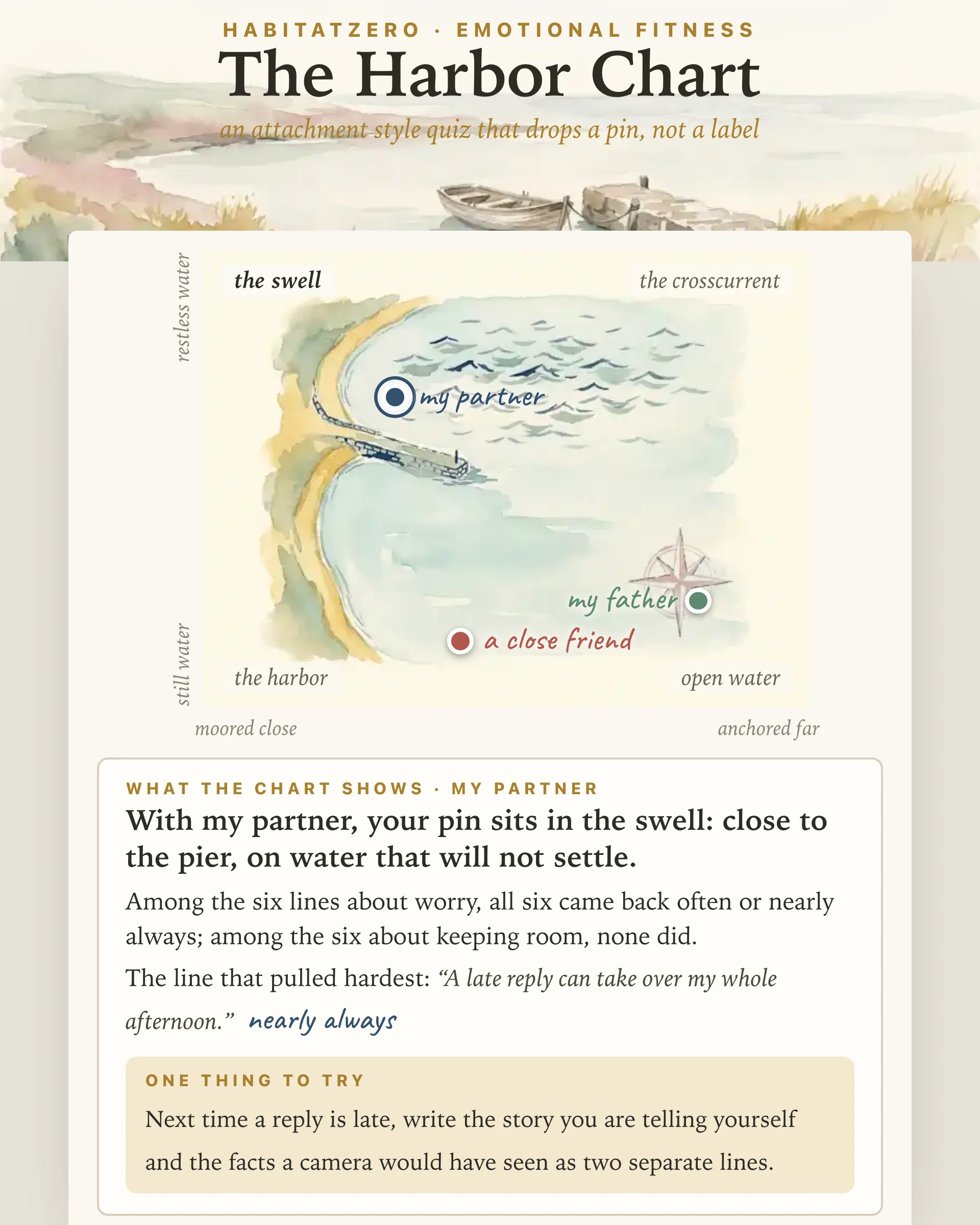
Drop the pin and the chart plots your room answers against your worry answers. Worry moves the pin up into rougher water; room moves it out from the pier. It lands in one of four waters, which are the four corners with the clinical names taken off: the harbor, the swell, open water and the crosscurrent. The reading underneath never says what you are. It says where this pin sits with this person, counts the worry lines and room lines that came back often or more, quotes the line that pulled hardest, and names what researchers would call that corner, with a reminder that a corner describes twelve answers and nothing more. When a pin lands near the middle on both dials, the reading says so and asks you to hold the lean lightly.
The chart holds three pins, one per person. Answer again with someone else in mind and the next pin drops beside the first; answer for someone who already has one and it moves instead of doubling. Lifting a pin takes two taps.
It supports the two dials. It supports the idea that the pattern belongs partly to the relationship: when Fraley's group built a questionnaire that asks about mother, father, partner and best friend separately, the same people answered differently from one bond to the next, which is why this chart wants a second and third pin. And it supports change. A study that followed the same people across fifty-nine years of their lives found that, on average, both the worry dial and the room dial turned down as people moved from their teens into their seventies, rather than settling early and staying put.
It does not support a diagnosis. Attachment styles are not conditions, no diagnostic manual lists them, and a twelve-line self-report is a snapshot, not an assessment. It does not support reading your childhood off a quiz: the lines ask how you relate now, and nothing here can see how you were held at eighteen months. It does not support the idea that a name settles who you should date, or that two particular corners are doomed together. And the crosscurrent is not the same thing as the disorganised attachment described in infant research, however often the two get swapped online.
If what the chart shows is causing you lasting pain, a therapist who works with attachment has far better tools than four stops and a painted bay; this page is for noticing, not for treatment.
Take it after a wobble, once the hour has passed and you can answer for how things usually are, not how they felt at nine last night. Take it before a conversation about where you stand, so you know which of your own lines are loudest. Retake it a season later and compare pins.
If the pin sits in the swell, the Anxious Attachment Journal is the natural next page: it splits the story you started telling from what a camera saw, one wobble at a time. If two pins belong to the same household, the Couples Check-In gives both people a pen. And if the pin sits out in open water, the Boundaries Worksheet helps you tell the room you need from the room you keep by reflex.
Adult attachment research describes two dimensions rather than four boxes: how anxious you feel about the bond and how much distance you keep. Low on both is usually called secure, high worry with low distance anxious or preoccupied, low worry with high distance avoidant or dismissing, and high on both fearful-avoidant. On this chart those four regions are the harbor, the swell, open water and the crosscurrent, and a pin can land anywhere between them.
No. Attachment styles are descriptions of how people tend to relate, not conditions, and a twelve-line self-report is a snapshot of one relationship on one day. The result here is worded as a reflection on your answers. If closeness or distance causes you lasting distress, a therapist who works with attachment can look properly.
Yes. Long-term studies that follow the same people across decades find that worry and distance both shift with age and with experience, and measures that ask about specific relationships show that the same person can lean one way with a partner and another with a parent. That is why this chart keeps one pin per person and invites you to retake it later.
Anxious attachment leans toward wanting more closeness than feels available and reading silence as a threat to the bond. Avoidant attachment leans toward guarding independence and feeling uneasy when someone depends on you or comes very close. On the chart, worry moves the pin up and distance moves it out from the pier, so the two leans land in different waters.
The public page shows a worked example with pins already dropped. To answer the twelve lines about your own relationships and keep the pins, open it inside HabitatZero, which costs nothing.
By the team behind Fabulous, the science-based self-care app used by over 30 million people.