Leaves on a StreamEmotional Fitness · ~3 min
About this template · Updated July 2026
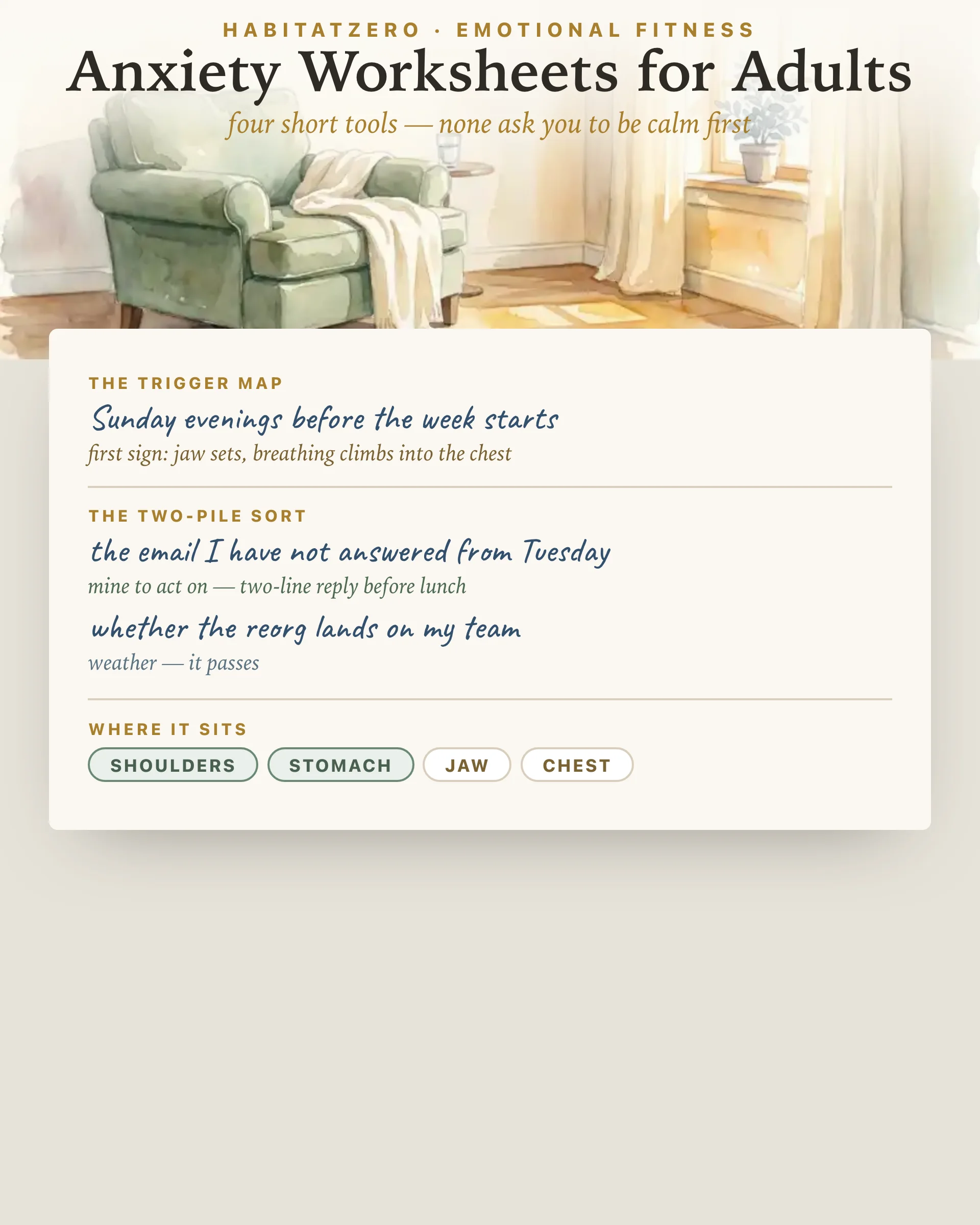
Adult anxiety is a competent performer. It answers email on time, keeps its calendar, and looks from the outside like conscientiousness — while inside, Sunday evening has a dread all its own and the jaw has been set since Tuesday. These four worksheets are for that adult. They are tools, not treatment: a map of what sets you off, a way to steady mid-spike, a sort for the worries themselves, and a check-in with the body that carries all of it. None of them ask you to be calm first.
The first tool is cartography. You list what reliably lights the fuse — Sunday evenings, unread messages past a dozen, a certain tone in a meeting — and, where you have caught it, the earliest sign in your body that a spike has started. Two things happen with a map like this. First, naming does real work: putting an emotional state into words measurably quiets the brain's alarm circuitry, which is why a trigger written in daylight ambushes less at dusk. Second, the map is usually shorter than the anxiety implied. Most people find a handful of entries explain nearly all their spikes, and a finite list is a very different opponent than a formless everything.
The first-sign column is the quietly powerful one. A spike caught at "jaw sets" needs a far smaller tool than a spike caught at full spiral — the earlier the sign, the earlier the choice.
Mid-spike is no time for insight; the thinking brain is busy being hijacked. So the second tool is deliberately physical, three touchpoints done for real and tapped off as you go: press both feet into the floor for ten slow seconds; name five things you can see, out loud; then say the date, the place, and one true thing. Anxiety talks entirely in someday — the touchpoints answer in today, which is the only place your feet actually are. Grounding of this kind is a staple of clinical practice not because any single version has a famous trial behind it, but because orienting to the present is the reliable first move before any other tool works. If you want more structure, 5-4-3-2-1 grounding runs the full senses ladder, and box breathing gives the exhale something to count.
Nothing in this section is saved, on purpose. Touchpoints belong to the moment they steady.
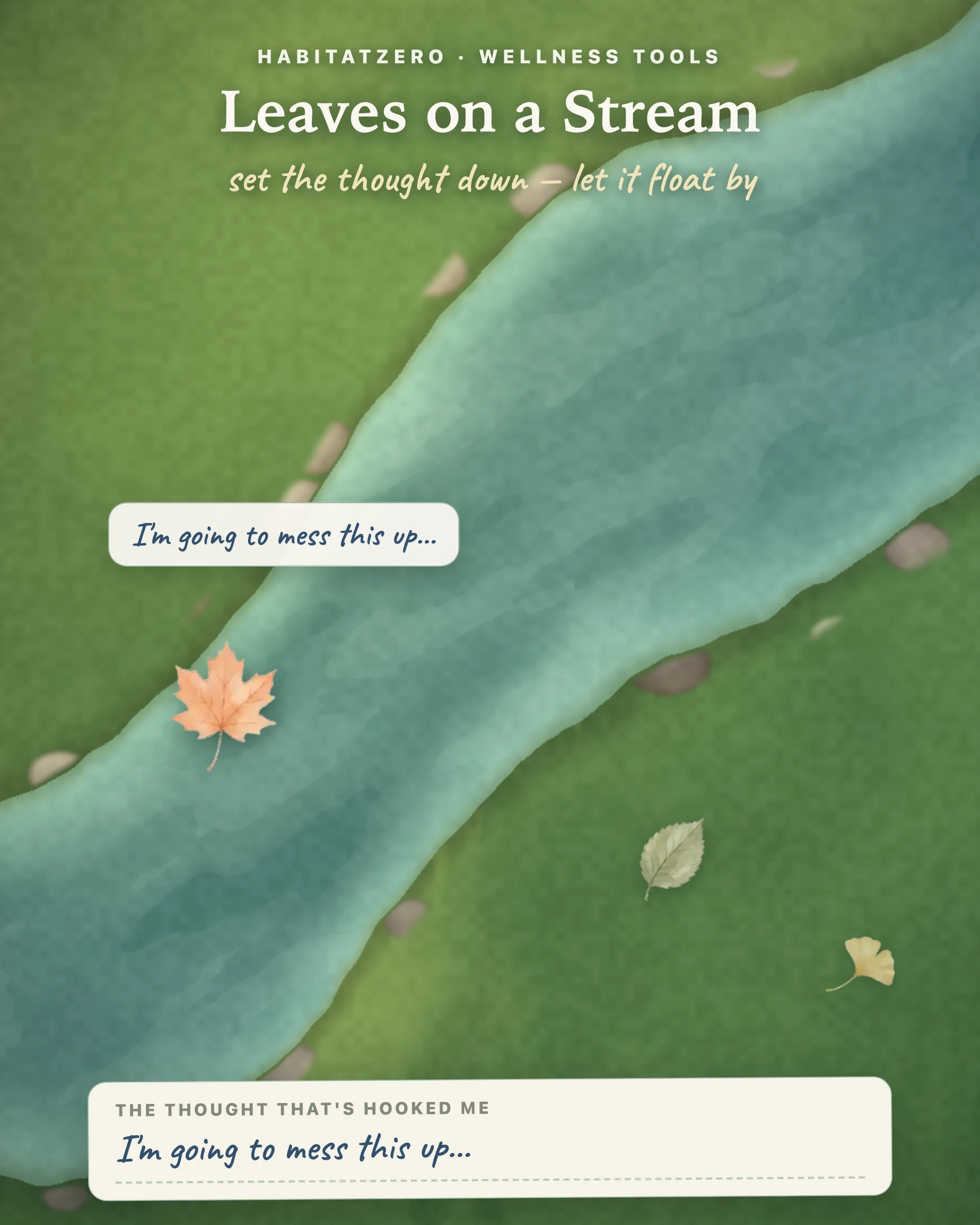
Worry blurs an important line: between what is yours to move and what is merely near you. The third tool redraws it, one worry at a time. Each worry gets exactly one pile. Mine to act on — and then it owes you a single next move, small and concrete, two minutes or two lines, no grander. Or weather — real, unpleasant, and not improved by your supervision, so it gets permission to pass without your help. The discipline is in the sorting, not the solving: an unanswered email is yours; whether the reorg lands on your team is weather until the day it isn't. Most worry loads lighten not because anything got solved, but because half the pile turned out to be weather you had been carrying by hand.
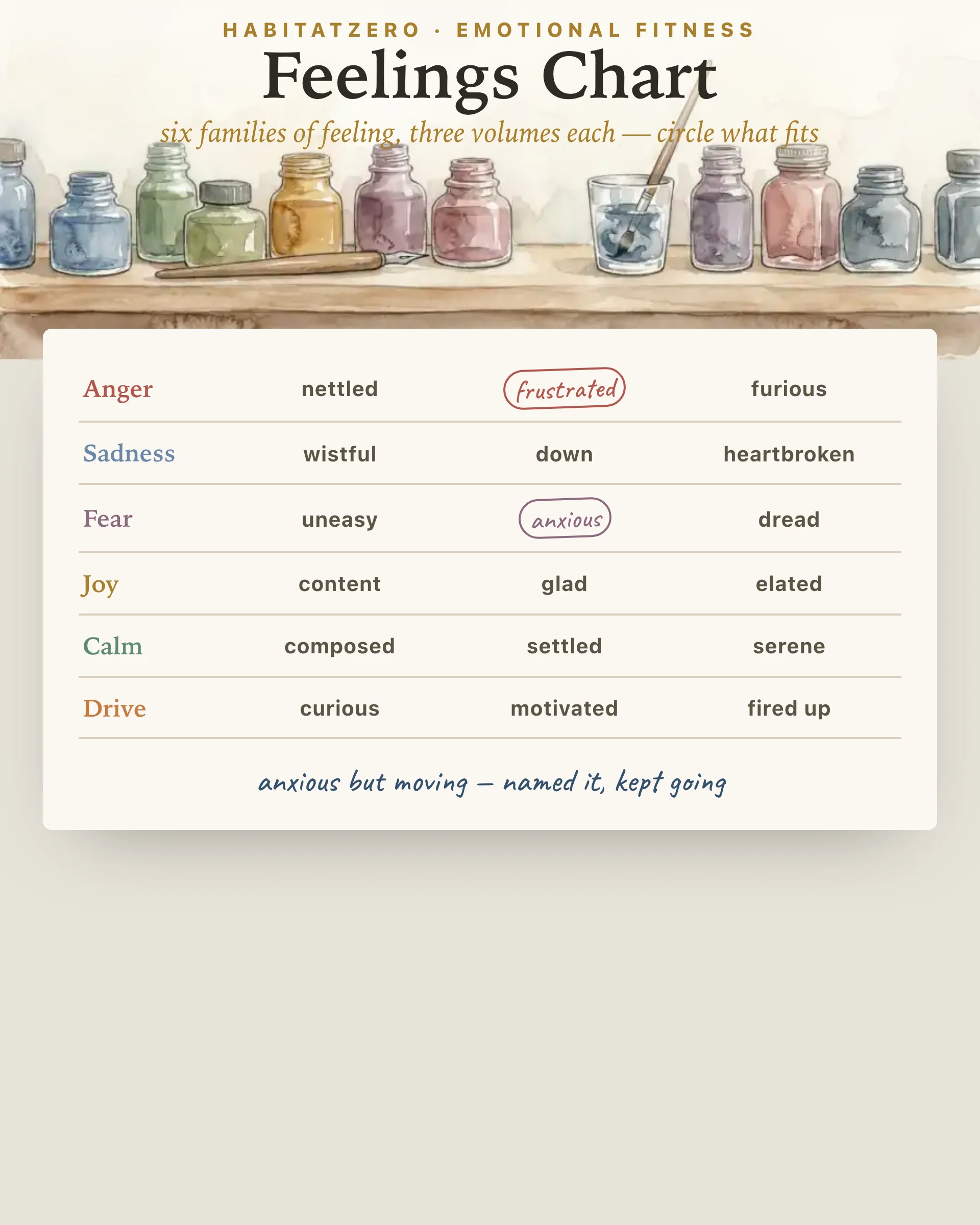
Anxiety is a body event before it is a thought — the fist behind the sternum arrives ahead of the story about the meeting. The fourth tool is a check-in: tap where it lives today (jaw, shoulders, chest, stomach, hands, everywhere) and describe the sensation in your own words. This is the body-scan family of practice, and that family has evidence behind it: a comprehensive meta-analysis of mindfulness-based approaches found moderate, reliable benefits for anxiety. On this sheet the check-in also feeds the map — the sensations you learn to spot here become the first-sign entries that catch the next spike early.
This page's counterpart, anxiety worksheets for teens, covers the same ground in a teen's register — including a write-and-release exercise that deliberately stores nothing, and a section written for parents, counselors, and teachers.
These worksheets are self-help tools, not therapy, and they cannot measure, diagnose, or treat anxiety. If anxiety has been steering most days for months — shrinking what you say yes to, wrecking sleep, making the map above feel endless — the strongest move on this page is the honest one: take the map to a mental-health professional and let it be your head start. If you are in crisis or thinking about hurting yourself, call or text 988 (US) right now, or reach your local emergency number.
Four tools on one sheet. A trigger map, where you record what reliably sets anxiety off and the first body sign of a spike. Three grounding touchpoints for the middle of a spike — feet into the floor, five things named out loud, then date, place, and one true thing. A two-pile worry sort that files each worry as either mine to act on or weather. And a body check-in that maps where the anxiety physically sits today.
You build the map on calm days, one entry at a time: the situation that lights the fuse, and — if you have noticed it — the earliest sign in your body that it has started. Most people find their triggers are fewer and more repetitive than the anxiety made them feel; seeing eight entries explain ninety percent of spikes is itself a relief. The first-sign column matters most: the earlier you catch a spike, the smaller the tool needed to steady it.
Almost every worry resists the sort at first — that resistance is the exercise. If any part of it is genuinely yours to move, it goes in mine to act on, and only the movable part earns the next move you write under it. Everything left over — other people's choices, outcomes not yet decided, the past — is weather: real, often unpleasant, and not improved by your rumination. Sorting does not shrink a worry; it stops you from carrying the half that was never yours.
When anxiety is steering the ship — narrowing what you say yes to, wrecking sleep for weeks, or filling most days regardless of what you sort or map — a page has done what a page can do, and a professional is the right next step. These tools are self-help, not treatment or assessment. They pair well with therapy rather than replacing it, and the trigger map makes a genuinely useful thing to bring to a first appointment.
Free, in the browser, no signup — this public page shows a filled-in preview of all four tools working. Inside Fabulous, your trigger map, sorted piles, and body notes save privately to your account, because the map is a document you build over months, not minutes. The touchpoints deliberately save nothing; they are for the moment they happen in.
By the team behind Fabulous, the science-based self-care app used by over 30 million people.