
The Overwhelm Recovery ProtocolWellness & Routines · ~5 min
About this template · Updated November 2026
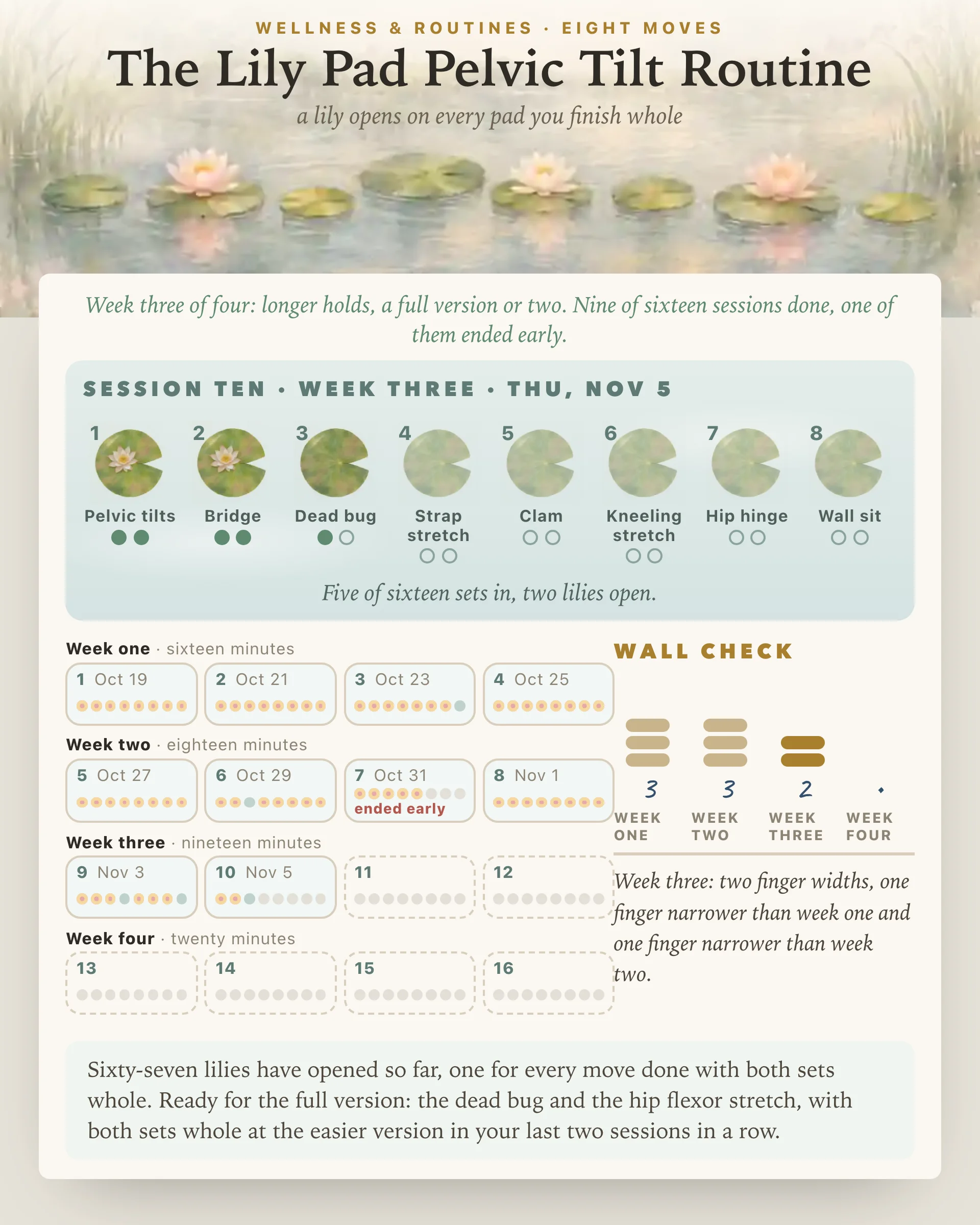
An anterior pelvic tilt means your pelvis sits tipped forward when you stand: the front of the hips a little lower than the back, the low back curving a touch more. If you searched for anterior pelvic tilt exercises after spotting that curve in a photo, start with the good news. It is how most bodies stand, and the angle on its own says little about pain. This page gives you eight moves for the hips and core, a clock that counts every set for you, and four weeks to make them a habit.
A physical therapy researcher at a university in Greater Manchester measured pelvic tilt in 120 healthy adults in their twenties. Some forward tilt showed up in 85 percent of the men and 75 percent of the women. Forward is the usual direction, not a defect.
Physical therapy researchers in Australia pooled 43 studies that compared people with and without low back pain. On average they found no difference in standing pelvic tilt or in the curve of the low back. People with pain moved more slowly, but whether that came before the pain is unknown.
Rehabilitation researchers in Tehran studied 600 adults with and without back pain, weighing seventeen physical traits at once. Tilt and the size of the low back curve were not linked with pain. The endurance of the back muscles and the strength of the hip and belly muscles were. A snapshot like this cannot show that strengthening prevents pain, but it hints where effort is better spent.
Can exercise move the pelvis at all? In a small study at the same English university, a single session of hip flexor stretching tipped the pelvis back by about one degree on average in 23 healthy men, with no change in the low back curve. One degree is far too little to see, and nobody measured whether it lasted. An anatomy study of thirty pelvises adds a further catch: the bony points people press to judge tilt sit at different heights from one pelvis to the next, so even an expert eye can misread it.
So this routine makes no promise about how you will look or stand. What you can build is strength in the glutes and deep belly muscles, easier hamstrings and hip fronts, and a feel for tucking your pelvis when a move calls for it.
The session starts on the floor and ends standing, so you only get down once: pelvic tilts lying down, a glute bridge, a dead bug, a hamstring stretch with a strap, a side-lying clam, a half-kneeling hip flexor stretch with your pelvis tucked, a hip hinge with a broom along your back, and a wall sit with your low back resting toward the wall. Each has an easier version, such as heel taps for the dead bug or the hip stretch done standing at a counter, and every move starts there.
Each session is two sets of every move, four days a week. Press start and the clock gives you fifteen seconds to set up, then paces each rep or counts each second of a hold, with twenty seconds of rest between sets. Reps and holds grow every week, with holds of fifteen or twenty seconds in week one and thirty by week four, so sessions run from sixteen minutes to twenty. The clock keeps real time even if your phone locks.
Stop a set partway and only its whole reps or seconds go in, marked stopped early. A lily opens on a move's pad once both its sets run whole. When a move has run whole at its easier version twice in a row, the page tells you its full version is ready. If a full version stops early, it points you back to the easier one.
Once a week, stand with your heels two inches from a wall and your buttocks and shoulder blades resting on it, with a chair close by. Breathe out and slide stacked fingers into the gap at your low back. The page sets each count only beside your own earlier ones. There is no right size of gap, and shoes or the time of day can move it a finger either way.
The Hip Flexor Clothesline is six stretches for the front of the hip, built for long days in a chair. This routine shares two moves with it, the half-kneeling stretch and a bridge, and spends most of its time on strength. The Plumb Line Posture Plan works the neck, shoulders and upper back. When the bridges here start to feel easy, The Balloon Glute Workout takes the hips further.
Back pain that comes with numbness, tingling or weakness in a leg, trouble with bladder or bowel control, or pain after a fall needs a doctor before any exercise. Check with a doctor or physical therapist first if you have back pain now, are pregnant, have had back, hip or knee surgery or a joint replacement, have had a fall or dizzy spells, or live with a heart or blood pressure condition. Stop any move that hurts, and keep a sturdy chair or counter within reach whenever you kneel or stand.
It means the pelvis sits tipped forward when you stand, with the front of the hips a little lower than the back and the low back curving a touch more. Most people stand this way: in one study of 120 healthy young adults, about four in five had some forward tilt.
Usually not by itself. A review of studies comparing people with and without low back pain found no difference, on average, in standing pelvic tilt or in the curve of the low back. In a study of six hundred adults, back muscle endurance and hip and belly strength were linked with back pain, while the tilt angle was not.
Maybe a little, and nobody knows for how long. One session of hip flexor stretching tipped the pelvis back by about one degree on average in a small study of healthy men, far less than the eye can see. These moves are worth doing for stronger hips and core, whatever your angle does.
No home test measures the angle well, partly because the bony points people feel for sit differently from one pelvis to the next. This page uses a plainer weekly check: count the stacked fingers that fit between your low back and a wall, and compare the count only with your own earlier weeks.
See a doctor first for back pain with numbness, tingling or weakness in a leg, trouble with bladder or bowel control, pain after a fall, or pain that keeps getting worse. Ask a doctor or physical therapist before starting if you are pregnant or have had back, hip or knee surgery.
By the team behind Fabulous, the science-based self-care app used by over 30 million people.


