Leaves on a StreamEmotional Fitness · ~3 min
About this template · Updated September 2026
The best-known anger wheel belongs to Jane Nelsen. Her Anger Wheel of Choice, part of Positive Discipline, gives a child a circle of respectful things to do once anger shows up. This page is an independent tool with a different job, finding the word for the anger itself, and Positive Discipline has not reviewed, endorsed or partnered with it.
Angry is a blunt word. It covers the driver who cut you off and the colleague who took the credit, the toddler who will not put on shoes and the bank that called during dinner. Said that bluntly, it tells you almost nothing about what to do next. Frustration at a stuck project calls for a different move than resentment about an old remark, and crankiness at nine at night usually calls for a sandwich before a conversation.
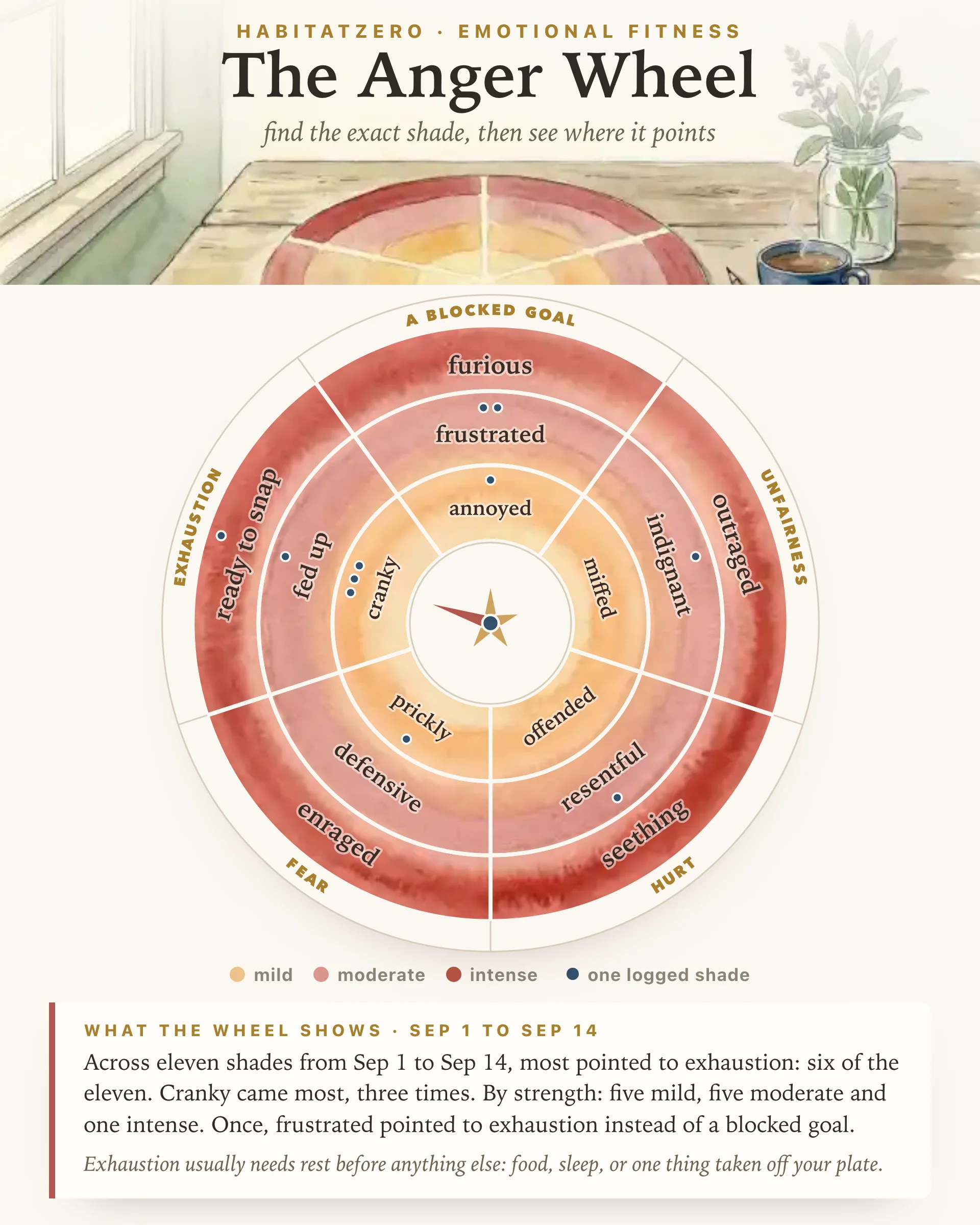
Fifteen shades sit on three rings. The inner ring holds the mild ones (annoyed, miffed, offended, prickly and cranky), the middle ring the moderate ones, and the rim the intense ones, up to furious, outraged, seething, enraged and ready to snap. Distance from the center is the strength of the feeling.
The circle is also cut into five parts by what each shade usually points to:
So one tap answers two questions at once: how strong is this, and what is it about?
Tap the shade that fits closest. A card opens with what the word means, which way it usually points and what it tends to need at that strength, from a small fix for a mild shade to a pause before acting for an intense one. Anger does not always point where it usually does, so the card asks which way it pointed this time. Frustration on four hours of sleep can be more about exhaustion than about the project, and the need changes with your answer.
Log it with a few words, for today or yesterday. Each logged shade leaves a pen mark on its cell, and a small rose at the center grows toward the direction your shades point most. From the third shade on, the page reads the log back in plain sentences: which direction leads, which shade comes most, how strong they ran and which ones went somewhere unusual. Change a row's direction or remove it, and the marks and the reading follow. The log holds thirty shades, enough for a few weeks of honest noticing.
For a child, switch to kid words. The same cells turn into simpler shades such as bugged, huffy, sulky and grouchy, the five parts are named the way a child would say them, and the print button makes a poster for the fridge or a classroom wall.
The case for a precise word has good support. In a fourteen-day diary study, Lisa Feldman Barrett and colleagues found that people who drew finer distinctions among their negative feelings reported regulating those feelings more often, especially when they ran intense. That is a correlation, not proof that a wheel will calm anyone down, but it is the reason this page asks for the exact shade instead of a score.
The five directions come from research on how people appraise an angering moment. When Peter Kuppens and colleagues asked people about recent unpleasant situations, a blocked goal, unfairness and someone to hold accountable tended to travel with anger, yet no single one of them was necessary or sufficient for it. That is why the wheel says a shade usually points somewhere, and lets you point it elsewhere.
Exhaustion earns its own part. In an experiment by Zlatan Krizan and Garrett Hisler, restricting sleep over two days intensified anger during a task set against unpleasant noise, and sleepiness accounted for most of the effect. Some anger is a fuel gauge.
None of this makes the wheel a test. It cannot tell you whether your anger is a problem, and it is no stand-in for help. If anger comes often, frightens you or the people around you, or ends in harm to someone or something, a counselor or doctor is the right next step.
Open it once the first heat has passed, the same day if you can, while you still remember what set it off. Give it two weeks and see whether a direction shows. If your wheel keeps leaning toward hurt, The Anger Iceberg helps you look at the feelings underneath. For a feeling that is not anger at all, The Feelings Wheel covers the whole range. When you want something to do in the moment, The Cool-Down Fan keeps techniques within reach.
With a child, choose a calm afternoon rather than the middle of a meltdown. Point at your own shades first, say which way they pointed, and let the wheel do some of the talking.
It is a circular chart of anger words. This one places fifteen shades in rings, from mild near the center to intense at the rim, and cuts the circle into five parts by what the anger usually points to. Finding the right word therefore also hints at the cause and at what might help.
Popular lists sort anger into styles such as passive or volatile, and those are informal labels rather than diagnoses. This wheel sorts it two plainer ways. By strength, it runs from annoyed, miffed, offended, prickly and cranky, through frustrated, indignant, resentful, defensive and fed up, to furious, outraged, seething, enraged and ready to snap. By direction, each shade usually points to a blocked goal, unfairness, hurt, fear or exhaustion.
Switch the wheel to kid words. The shades become simpler ones such as bugged, huffy, sulky, growly and grouchy, and the five parts are named the way a child would say them, like not fair or too tired. Print it on a calm day, let your child point to the word and the ring, then talk about what might help next time.
No. Jane Nelsen's Anger Wheel of Choice is a wheel of respectful things a child can do once anger shows up. This page is a separate tool for naming the feeling itself, built independently, and Positive Discipline has not reviewed, endorsed or partnered with it.
You can read the whole wheel on this page, every shade and what it needs. To log your own shades, watch the marks gather and print your poster, personalize the template in HabitatZero, which costs nothing.
By the team behind Fabulous, the science-based self-care app used by over 30 million people.