Leaves on a StreamEmotional Fitness · ~3 min
About this template · Updated September 2026
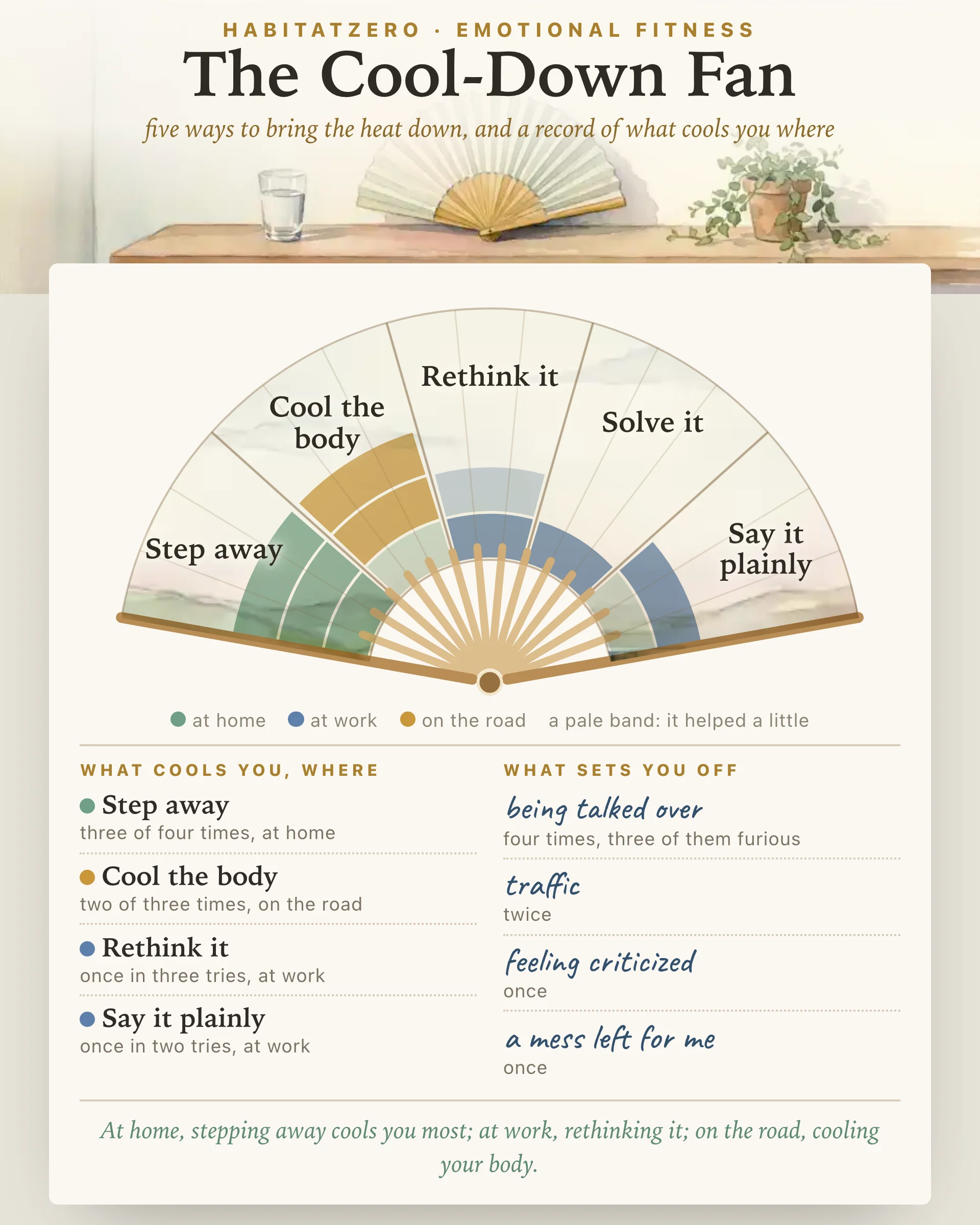
Anger moves faster than thought. Your jaw is set and a reply is half typed before any calmer part of you has had a say. Anger management techniques do not try to stop that first surge, which is a normal response to being blocked or treated unfairly. They work on the next ten minutes: what you do with your body, your thoughts and your voice while the heat is still high.
The American Psychological Association's guide to controlling anger before it controls you lays out the core set. This page arranges five of them on the folds of a paper fan, roughly in the order they tend to help, and keeps a record of which ones cool you down, and where.
You may have heard that anger builds like steam and has to be let out, so you punch a pillow or yell in the car. The urge makes sense, but the evidence does not back it. In a classic experiment, Brad Bushman had angered volunteers hit a punching bag while thinking about the person who provoked them, and they came out angrier and more aggressive than people who did nothing at all. The APA's guide calls the let-it-all-out idea a dangerous myth. Wanting relief was never the mistake; stepping away and cooling the body just get you there without feeding the grudge.
Say how hot it is and the fan marks where to start. Furious points left, because rethinking and problem solving go better once the heat drops. Tap any fold to open its steps, and press the trying button on the ones you use.
Once you have cooled down, log the moment: what set it off, where you were, how hot it got, and whether each fold cooled you, helped a little or missed this time. Every fold that cooled you paints a band on the fan in the color of the place, so over a few weeks the fan becomes a picture of your own anger. Underneath sits your list: what cools you, where, and the sparks that set you off most often.
A meta-analysis of twenty-three controlled studies with adults found medium to large effects across the treatments tested, with the analysis favoring cognitive approaches for anger behind the wheel and for a general short fuse, and relaxation for anger in the moment. That split is why this page asks where you were and how hot it got: the fold that settles you in traffic may not be the one that works at the kitchen table.
Two cautions. Those studies tested structured treatment programs, not a fan on a screen, and nobody has run a trial of this page. Your record shows a pattern, not a diagnosis, so treat it as practice notes.
If your anger feels out of control, or it keeps costing you relationships or work, a psychologist or licensed counselor can help. The APA notes that with counseling, a very angry person can move closer to the middle range in about eight to ten weeks.
If your anger has led to hurting someone, or someone at home is afraid of you, the National Domestic Violence Hotline takes calls from people on either side of that behavior: call 800-799-7233 or text START to 88788. If anyone is in danger right now, call 911. And if the anger has turned inward and you are thinking about ending your life, call or text 988 in the US, or your local emergency number anywhere else.
Open a fold at the first sign of heat, when your jaw tightens or a sharp reply starts forming, and log the moment later that day. Once a flare has passed, The Anger Iceberg helps you name the hurt or worry underneath it, and Reframing Glasses takes the rethinking fold further.
The best-studied ones come from cognitive behavioral therapy: settling the body with slow breathing and relaxation, rethinking the heated thought, solving the real problem, and asking for what you need without aggression. A planned timeout makes room for all four. Reviews of controlled studies with adults report medium to large drops in anger, and which technique helps most varies from one person to the next.
Put distance between the spark and your reply. Say you need a few minutes and leave the room, breathe out for longer than you breathe in, and unclench your jaw and hands. Once your body has settled, look at the thought feeding the heat and decide what, if anything, still needs saying.
It feels as if it should, but the research points the other way. In a well-known experiment, people who hit a punching bag while dwelling on the person who angered them came out angrier and more aggressive than people who sat quietly. A slow walk can help you settle; hitting things while replaying the grudge is what backfires.
Keep a short record for a few weeks: what set it off, where you were, how hot it got and what you tried. Patterns tend to show up fast, such as two situations accounting for most of your worst moments, and once you know them you can plan a cool-down before you walk into one.
Without an account you can read all five techniques and look over a filled-in fan right here. Opening folds in the moment, logging your own moments and watching the bands build up happens in HabitatZero, which is free.
By the team behind Fabulous, the science-based self-care app used by over 30 million people.