Leaves on a StreamEmotional Fitness · ~3 min
About this template · Updated September 2026
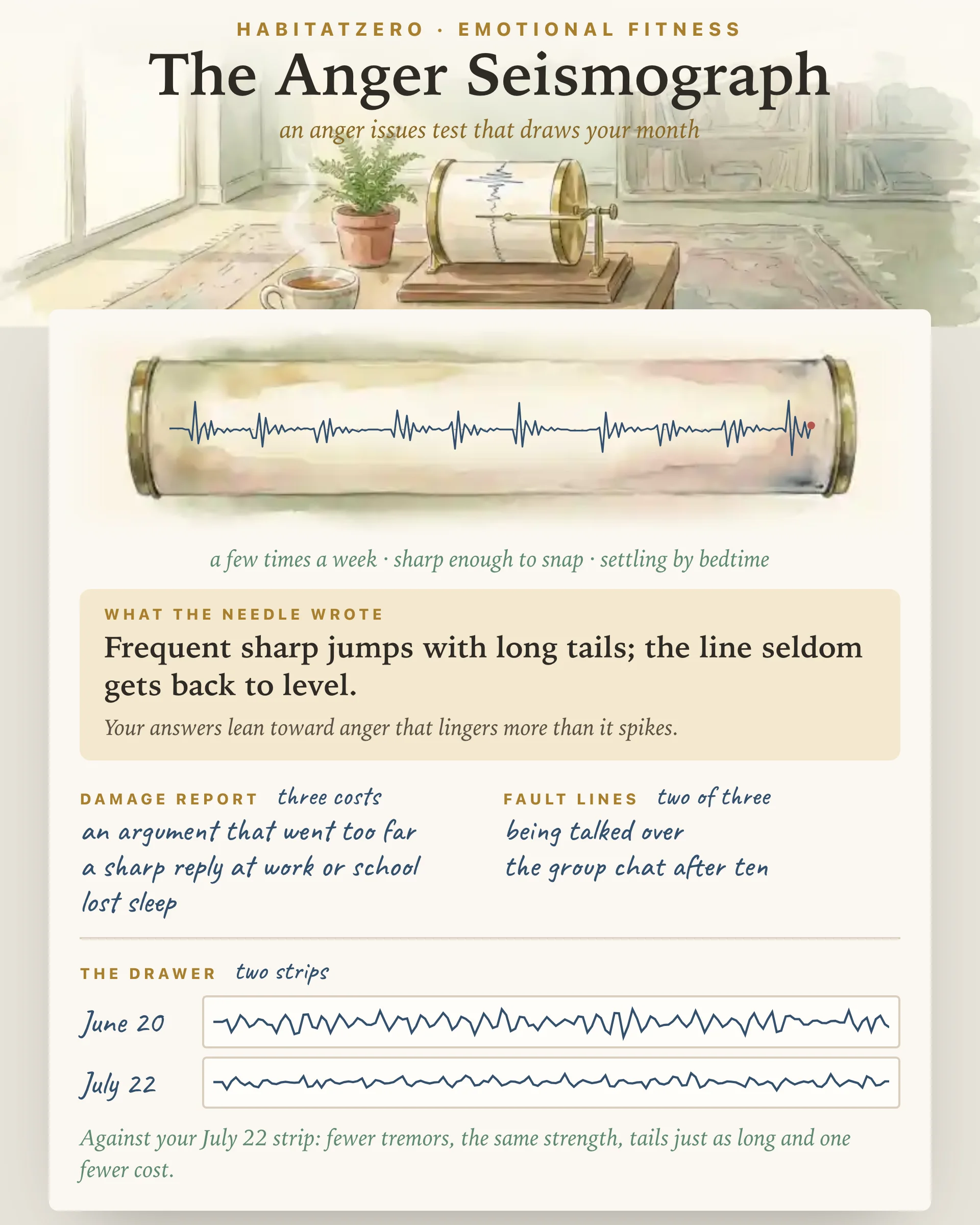
If you are looking up an anger issues test, you probably have a reason: a blowup you regret, something a partner said, a month that ran hotter than it should have. This page will not hand you a verdict. It works the way a seismograph does. You describe the past month, the needle draws what your anger has been doing, and the page reads that line back to you in plain words.
It is a self-check, not an assessment. Nothing here can diagnose you or rule anything out, and no answer turns into a label.
Anger itself is not the problem. The American Psychological Association describes it as a normal and usually healthy emotion that becomes a problem when it gets out of control and starts costing you at work, in your relationships and in the overall quality of your life. The same guidance adds that if you do have a problem with anger, chances are you already know it.
So the dials skip the question of whether you get angry and ask how. How often did it show up this past month, from once or twice to several times a day? How strong did it usually get, from a flicker of annoyance to something beyond your control? How long did it take before you felt settled again? Each answer shapes the trace: more jumps for more often, taller ones for stronger, and longer tails for anger that takes its time to fade.
Three more sections fill in the picture. Where it goes covers the loud forms and the quiet ones, because the APA notes that easily angered people do not always curse and throw things; some withdraw or sulk, and anger held in can turn inward. The damage report lists what anger cost this month. Fault lines are the situations where pressure builds, up to three of them, the ones that shake you most.
Once the three dials are set, the page writes a short reading from your own answers. It describes the shape of the line, says which way your answers lean, quotes back your costs and fault lines, and suggests one next step that fits the pattern.
File the strip with one line about what the month held. Next month, set the dials again and the reading compares the two: fewer tremors or more, taller peaks or gentler ones, longer tails or shorter. The drawer holds six strips, about half a year of honest records.
Anger that feels out of proportion is common. In a national survey of more than 34,000 US adults, 7.8 percent reported anger that was inappropriate, intense or poorly controlled. It was more common among men and younger adults, and it went along with poorer day-to-day functioning.
The dials on this page are not a validated instrument, and the trace is a picture of your answers rather than a measurement. No line on the drum means you have a disorder, and no page like this can tell anger issues apart from depression, trauma, sleep loss or anything else that shortens a fuse. What it can do is turn a vague worry into something concrete enough to act on.
Help works, and it does not take years. The APA suggests considering counseling when anger feels out of control and is affecting your relationships and important parts of your life, and says that with counseling a highly angry person can move toward a middle range of anger in about eight to ten weeks.
Two harder questions ask whether anger has led to someone being hurt, pushed or threatened, and whether anyone at home seems nervous or afraid when you are angry. A yes or a not sure changes the reading: it opens with where to turn instead of tips.
That order is deliberate. When someone at home is afraid, the issue is safety, not only a quick temper. The National Domestic Violence Hotline takes calls from people on either side of those behaviors, including people questioning their own, at 1-800-799-7233 or by texting START to 88788. It also says plainly that it does not recommend anger management on its own for abusive patterns; it points to certified intervention programs instead, with anger work and counseling as possible supplements. If anyone is in danger, call 911 now.
And if anger swings inward and brings thoughts of hurting yourself, reach out the same day: call or text 988 in the US, or your local emergency number.
Take it near the end of a month on a calm evening, answering for the whole month rather than for today, and file the strip. Then let the reading point you somewhere useful. If long tails keep showing up, The Anger Iceberg helps you find what sits underneath them. If the spikes are the trouble, Steady the Flame gives the first minute somewhere to go. If one fault line keeps shaking, The Road From a Trigger follows it from the first warning sign to a plan.
A month later, set the dials again. Two strips side by side show you something one strip cannot: which way the needle is moving.
It looks at the past month along five lines: how often anger showed up, how strong it got, how long it took to settle, where it went and what it cost. Your answers draw a trace and come back as a short reading in words, never as a score or a label.
Common signals are anger that flares over small things, shows up most days, takes hours or days to fade, or leaves damage behind, such as arguments that go too far, trouble at work or people who seem wary around you. Quieter forms count too, like long silences, sulking and replaying a slight for days.
No quiz can diagnose anyone, and this one does not try. It is a self-check that reflects your answers back to you. A licensed therapist or your doctor can do a real evaluation, and it is worth asking for one if anger keeps costing you at home or at work.
Reach out when anger feels out of your control, when it keeps costing you relationships or work, or when anyone around you seems afraid of you. If someone is in danger, call 911. The National Domestic Violence Hotline at 1-800-799-7233 also takes calls from people worried about their own behavior.
The page shows one sample month already drawn on the drum. Setting your own dials, keeping the reading and filing a strip each month to compare happens in HabitatZero, which is free.
By the team behind Fabulous, the science-based self-care app used by over 30 million people.