Leaves on a StreamEmotional Fitness · ~3 min
About this template · Updated September 2026
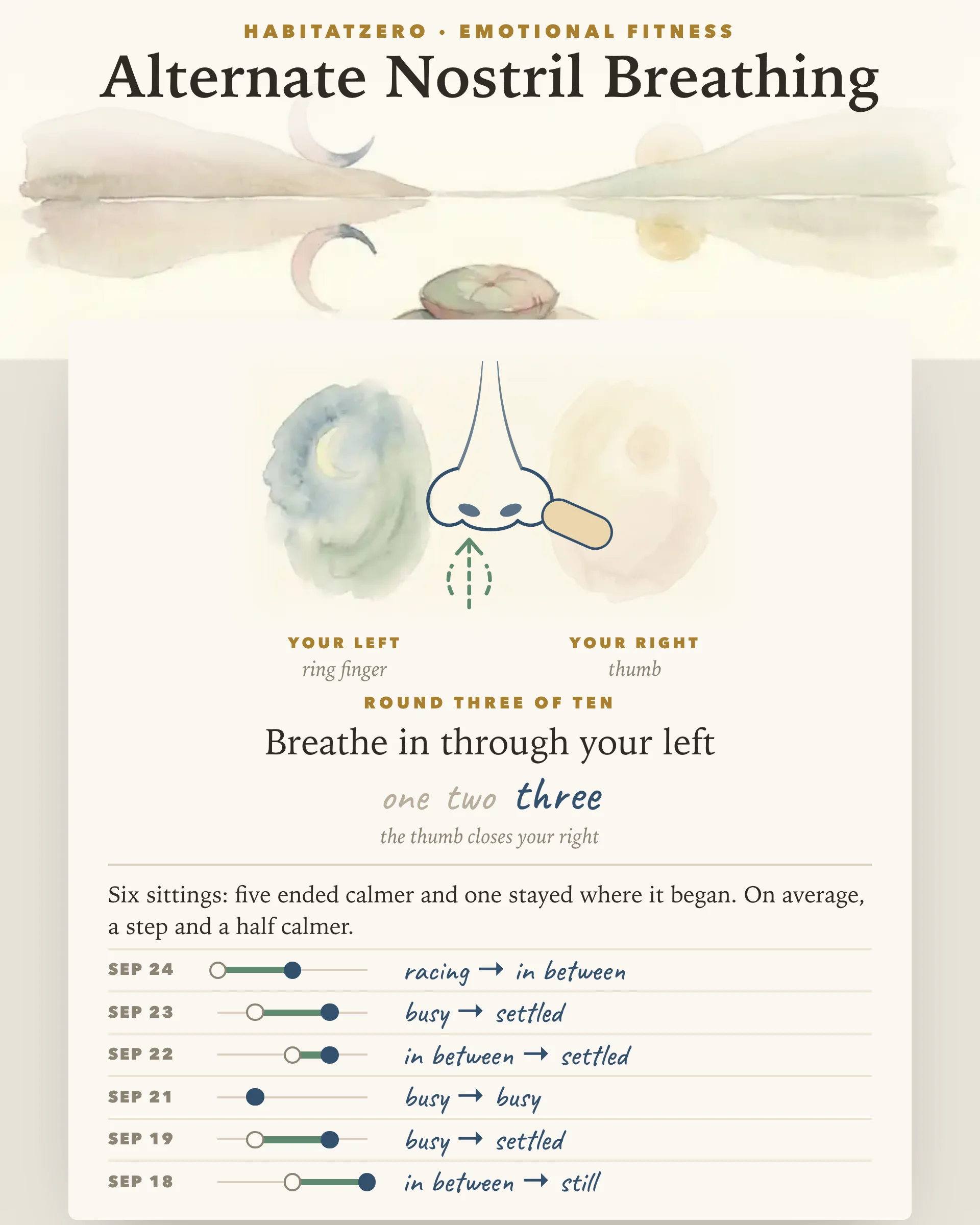
Alternate nostril breathing comes from pranayama, the breath practices of yoga. Classic hatha yoga manuals, among them the fifteenth-century Hatha Yoga Pradipika and the Gheranda Samhita, teach breath work meant to clear the body's channels, and the practice still carries that old purpose in its Sanskrit name: nadi shodhana, usually translated as channel cleaning. In some circles it goes by anulom vilom. This page teaches the plain version beginners usually learn first, without the traditional breath holds.
Sit tall, raise your right hand and fold your index and middle fingers into your palm, a hand shape yoga teachers call vishnu mudra, leaving the thumb and ring finger free. Then:
Those four breaths are one round. You start and finish on the left, and the switch comes at the top of a breath, just before you let it out. With your left hand, the two fingers trade sides.
The plate at the top is the practice drawn out. A pale moon sits on your left and a sun on your right, a nod to the old channel map, which links the left channel, ida, with the moon and the right one, pingala, with the sun. Between them is a nostril diagram drawn as if you were looking into a mirror, so your left stays on the left of the screen.
Before you begin, tap how your mind feels, from racing to still, and add a few words about what is going on if you like. Pick a count of three, four or five and five, ten or fifteen rounds, and the page works out roughly how long that takes. Then the plate leads: the side you breathe through stays bright, the closed side fades, a small pad shows which finger closes it, and the count climbs one word a second.
When the rounds end, you tap how your mind feels now. Each sitting becomes a row in the log, a short line from where you started to where you finished, and the log keeps a running tally of how many sittings ended calmer and the average shift in steps. It holds fourteen sittings, two weeks of daily practice.
Studies of this particular technique are small. In a study of twenty-six young men, systolic blood pressure fell and heart rate variability measures rose while they practiced, which the authors read as a shift toward the calming branch of the nervous system. A 2024 review and meta-analysis pooled six randomized trials with 525 people and found blood pressure lower after practice than in the control groups, but the trials differed so much from one another, and so few were blinded, that the authors ask for better trials before anyone leans on the number.
On anxiety itself, a pilot trial with thirty medical students had half of them practice for fifteen minutes before a simulated public speaking test while the rest sat quietly. The practice group's anxiety scores trended lower, but the gap never reached statistical significance, and the authors call for a larger study.
The wider picture is steadier. A meta-analysis of breathwork trials found a small-to-medium drop in self-reported stress and anxiety across randomized controlled trials, while noting that most studies carried a moderate risk of bias and urging caution so that the hype does not outrun the evidence. You will also read that alternate nostril breathing balances the two halves of your brain. That idea comes from a modern reading of the old channel map, not from any of the trials above.
So the honest summary is a calm, structured way to slow your breathing, with early and modest evidence behind it. Your own log, sitting after sitting, is the fairest test you have.
Try it in a daytime pause when your thoughts are running ahead of you: before a call, on a break, first thing in the morning. Some people come out of it more alert than sleepy, so see how it leaves you before you rely on it at bedtime.
Skip it while either side of your nose is blocked, because pushing air through a congested nostril turns the practice into a strain. Keep the breath holds of the traditional form for later, ideally with a teacher, stop and breathe normally if you feel light-headed, and talk with your doctor first if you live with a heart or lung condition. If anxiety is shaping your days, a breathing practice can sit beside professional support but should not stand in for it.
When a blocked nose rules this one out, Box Breathing never asks you to close a side. For a longer sit at an even pace, try Resonance Breathing, and for a reset in under a minute, The Physiological Sigh.
It is a yoga breathing practice where you close one nostril with a finger, breathe in through the other, then trade sides for the breath out. Its Sanskrit name, nadi shodhana, is usually translated as channel cleaning, and in some circles it goes by anulom vilom.
Sit tall and fold your index and middle fingers into your palm, the hand shape called vishnu mudra. Close the right nostril with your thumb and breathe in through the left, close the left with your ring finger and breathe out through the right, breathe in through the right, then switch again and breathe out through the left. Those four breaths make one round.
The research is promising but thin. Small studies have seen blood pressure drop and heart rate variability rise during a session, and a pilot trial with thirty students found a trend toward less anxiety before a speech that fell short of significance. Treat it as a calming practice to test on yourself, not a treatment.
For most people it is gentle. Skip it while either nostril is blocked, leave the breath holds of the traditional version until a teacher has shown you them, stop if you feel light-headed, and ask your doctor first if you have a heart or lung condition.
The nostril diagram and a filled sample log are right here on the page. Pacing your own rounds and keeping a before-and-after record of each sitting happens in HabitatZero, which costs nothing.
By the team behind Fabulous, the science-based self-care app used by over 30 million people.