
The Overwhelm Recovery ProtocolWellness & Routines · ~5 min
About this template · Updated November 2026
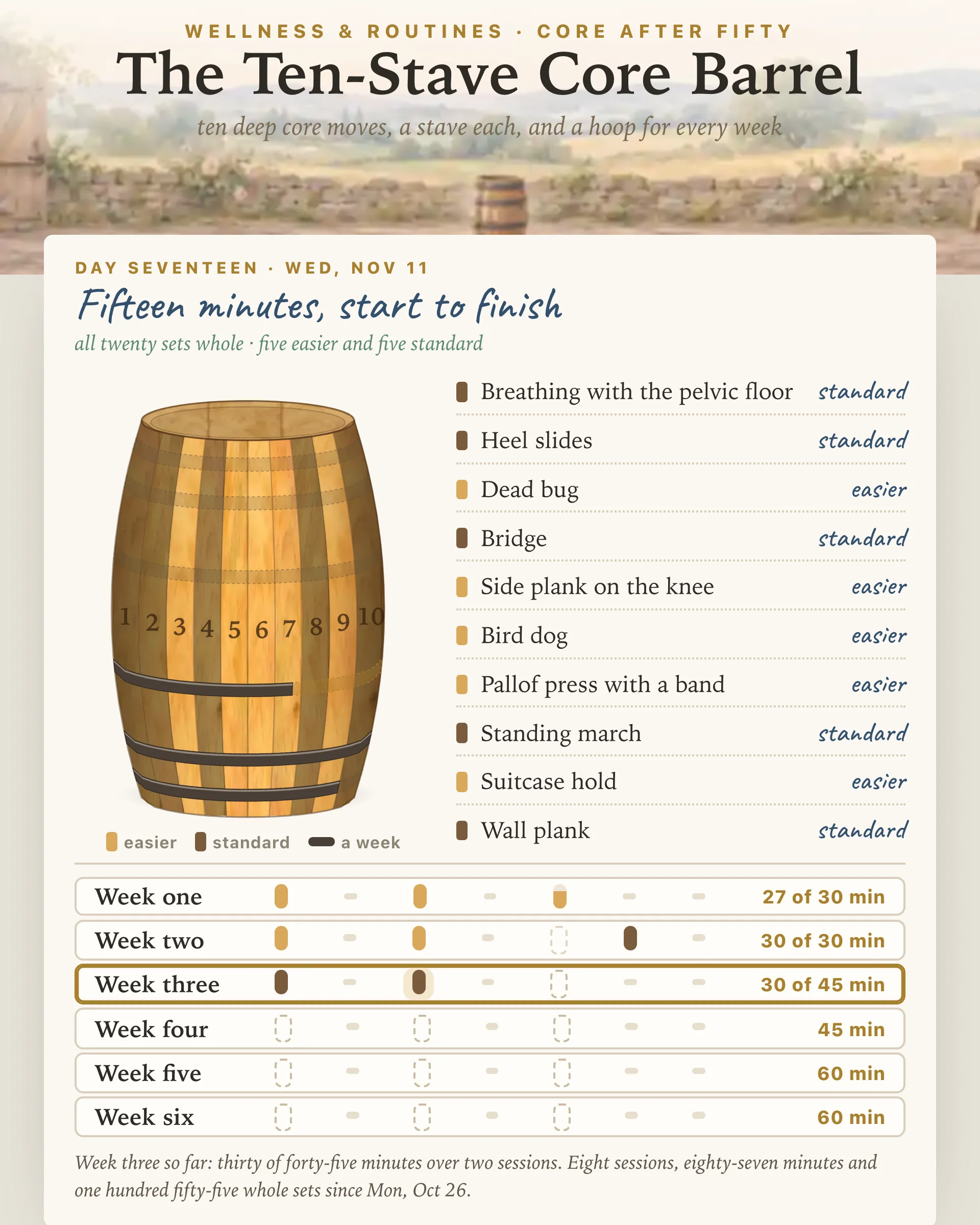
Ab exercises for women over 50 do a different job from the six-pack routines we grew up with: carrying groceries without a sore back, getting up off the floor, sneezing without a worry. This page treats your core like a barrel. The lid is your breathing muscle, the base is your pelvic floor, and the staves all around are the deep belly muscles at the front and sides and the long muscles that run along your spine.
Each has an easier and a standard version, and you go down to the mat once and up to the counter once.
Every move gets a few seconds to get into place, then two timed sets with a rest between: sets of twenty seconds in week one, forty by week five. The timer counts reps at a steady pace and says when to breathe out, and it counts holds down. A set counts only when it runs all the way through, filling half its stave: honey at the easier version, walnut at standard. An early end logs only whole minutes, skipped time never returns, and the clock reads real time, so a locked phone still knows where you are. Each week's minutes drive one hoop on, from the base up, and after two whole sessions in a row at the easier version, a move suggests trying standard.
Breathe out on every effort; never bear down or hold your breath to force a last rep. If you leak, or feel heaviness or a bulge down below, stop that move and see a doctor or a pelvic floor physical therapist. Targeted training helps there: a Cochrane review of pelvic floor muscle training gathered 31 trials with 1,817 women who leaked urine, and those who leaked when coughing or straining were about eight times as likely to report a cure as women given no treatment. Its trials were mostly small to moderate in size, and their programs varied widely. The breathing move here is a starting habit, not that treatment.
For bones, a 2022 UK expert consensus on exercise with osteoporosis, from a multidisciplinary panel of researchers and clinicians, advises against forward bending that is sustained, repeated, weighted or taken to the end of its range, and notes reports of spinal fractures linked to sit-ups. Much of it rests on expert agreement, because trials are scarce. So nothing here curls you up, the bridge keeps a straight back, and the suitcase weight comes off the floor with bent knees.
In a small trial of core stability training in Guangzhou, China, 31 women averaging about sixty-four, all with long-standing low back pain, added four weeks of core exercises, four times a week, to their physical therapy. Compared with women who had physical therapy alone, they improved more on pain, disability and two walking and balance tests, and their deepest belly muscle measured thicker on ultrasound. It was short, had no follow-up and took only women with back pain, so it cannot say what a woman without pain would gain, or whether anyone falls less.
Ab work does not melt the belly either. In a six-week trial of abdominal exercises, 24 sedentary adults aged eighteen to forty did seven ab exercises five days a week. Their belly fat, waist size and body fat ended up no different from a group that did nothing, though their curl-up endurance grew. They were younger than you and few, so take it as a caution, not proof: this page promises nothing about your belly or waist, which change with eating, sleep, all your movement and time.
See your doctor or a physical therapist before you begin if you have had a fall, dizziness, a fracture, a joint replacement, surgery on your belly, back or pelvis, a hernia, a heart or blood pressure condition, or pain that lingers. Stop any move that hurts, and keep the counter or a sturdy chair within reach for every standing move.
The Core Rings never goes down to the floor. The Standing Cairn is a standing circuit with a weight in hand at its harder levels. The Twelve-Blossom Pilates Branch is a full Pilates mat practice with a stand-in for each move. This barrel works the deep core and the muscles around your spine, set by set, with your pelvic floor and bones in mind.
The most useful ones train the deep belly muscles, the pelvic floor and the muscles along your spine without curling you up. This plan uses ten of them: breathing with the pelvic floor, heel slides, dead bug, bridge, side plank on the knee, bird dog, a Pallof press with a band, a standing march, a suitcase hold and a wall plank. The best routine is still the one you keep doing, so every move has an easier version.
For anyone with osteoporosis or low bone density, a 2022 UK expert consensus advises against forward bending that is repeated, sustained, weighted or taken to its end range, and it notes reports of spinal fractures linked to sit-ups. Plenty of women over fifty have never had a bone scan, so this plan leaves crunches out and trains the core with the spine kept long.
This plan asks for three sessions a week with a rest day between, ten minutes a session for the first two weeks, fifteen for the next two and twenty for the last two. A missed day can move to the next one, and a session ended early still keeps its whole minutes.
No exercise burns fat from one spot. In a six-week trial, younger adults who did ab exercises five days a week built endurance but saw no change in belly fat or waist size compared with people who did nothing. Your waist changes with eating, sleep, all your movement and time. A stronger core helps with carrying, getting up off the floor and steadier posture rather than with the shape of your belly.
Usually, yes. Every move has an easier version, the standing moves keep a hand on the counter, and the timer never rushes you, since a pause stops the clock. See your doctor or a physical therapist first if you have had a fall, a fracture, dizziness, a joint replacement, recent surgery, a hernia, a heart or blood pressure condition, leaking or pain that lingers.
By the team behind Fabulous, the science-based self-care app used by over 30 million people.


