
The Overwhelm Recovery ProtocolWellness & Routines · ~5 min
About this template · Updated September 2026
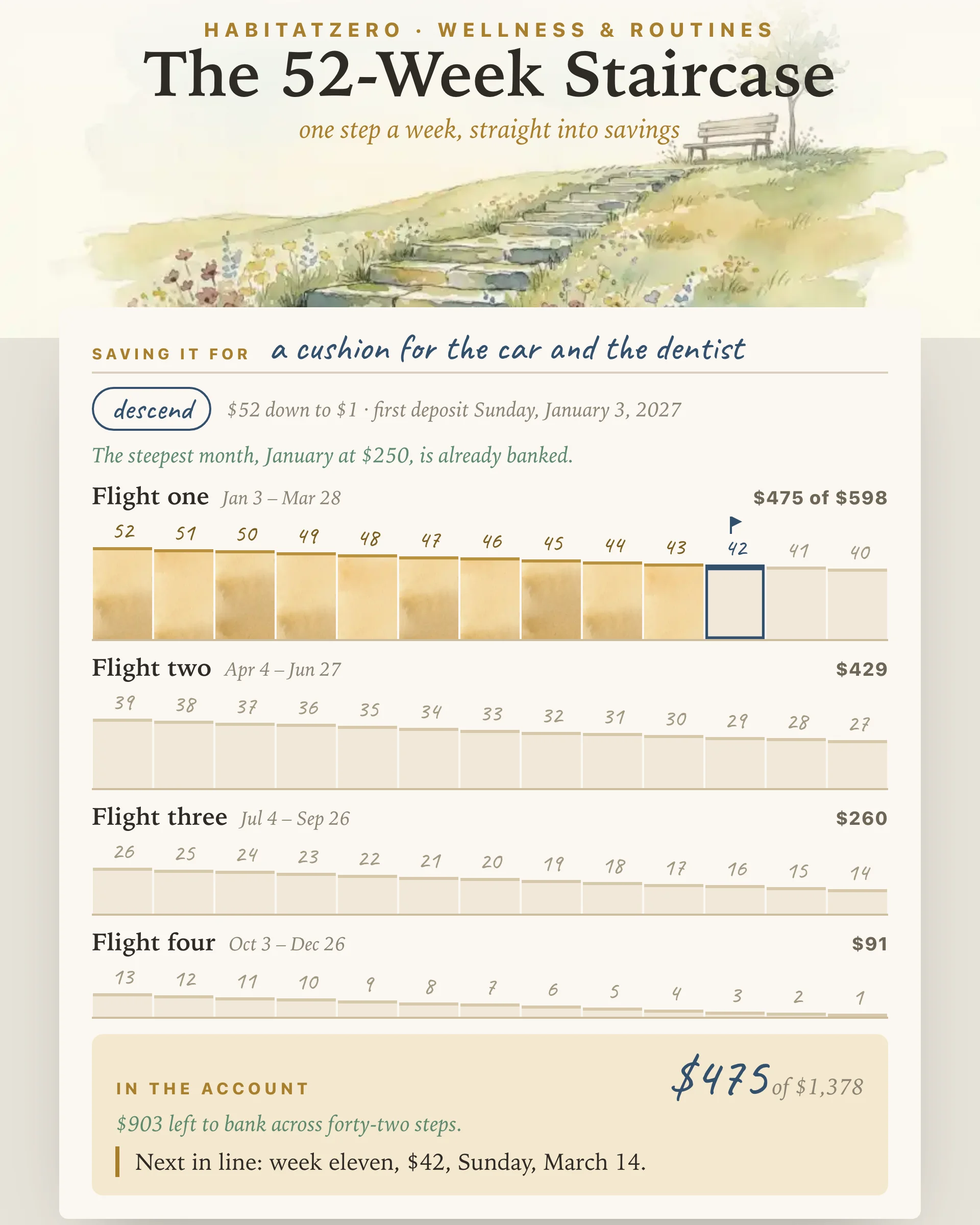
The 52 week savings challenge is simple arithmetic with a long tail. You set aside $1 in the first week, $2 in the second and one dollar more every week after that, so the fifty-second deposit is $52 and the year adds up to $1,378. Draw those deposits to scale and they form a staircase. This page draws exactly that: four flights of thirteen steps, one per quarter, and each step fills in once its money reaches the bank.
Climb is the familiar version: the first weeks cost almost nothing, but the load gathers at the end. With a first deposit on Sunday, January 3, 2027, the last quarter asks for $598, far more than the $351 that January through June ask for together. October turns out to be the steepest single month, $210 across its five Sundays, and December's four deposits still come to $202, landing on top of gift shopping.
Descend turns the stairs around. You bank $52 in week one, while the resolve is fresh, and each week after asks a dollar less. January becomes the heavy month, $250 across five deposits, and by December the steps are $4, $3, $2 and $1.
Level spreads the same total evenly: $26.50 every week. Nothing gets steep, and one recurring transfer can carry the year. Only the calendar adds unevenness: a month with five deposit days asks $132.50, and a month with four asks $106.
Each shape scales. Steps of $2 make the year $2,756, and steps of $5 make it $6,890. Every total on the page is the exact sum of its steps.
Choose a shape and a step size and the staircase redraws. Add the date of your first deposit and each step gets its own due date, each flight gets its months, and the plan box names the steepest month of your year. Flip between the shapes before you begin; seeing where each one puts the heavy month makes the choice easy.
Each week, make the transfer first, then tap that week's step. It fills in, and the account panel shows what is banked, what is left to bank and which week is next in line. A banked step asks for a second tap before it comes back out, so a stray finger never erases a deposit.
You can bank steps out of order: in a tight week, take a smaller open step and come back for the skipped one, which the next-in-line note keeps pointing to. Once a step is banked, the shape and size stay fixed, so money you already moved never changes value. Start over if you want a different plan, or print the staircase for the fridge.
The staircase counts; a savings account holds. Put the steps somewhere you do not spend from, at a bank insured by the FDIC or a credit union insured by the NCUA. Federal deposit insurance covers at least $250,000 at each insured bank, so a year of steps sits well inside it. A separate account also puts a small wall between the savings and your debit card.
On the level plan, a weekly automatic transfer does the work. On climb or descend, schedule it for the same weekday and update the amount as you go.
No trial has tested the 52 week challenge itself, so treat it as a well-shaped habit rather than a proven program. Three findings explain the shape.
Recording progress helps. A meta-analysis of 138 randomized studies found that interventions prompting people to monitor their progress toward a goal improved goal attainment, and the effect was larger when progress was physically recorded or made public. Tapping a step every week is that kind of record.
Starting small and escalating has a precedent. In the Save More Tomorrow program, employees committed ahead of time to steer part of each future raise into retirement savings; in its first implementation, participants' average saving rate rose from 3.5 percent to 13.6 percent over 40 months. The climbing staircase borrows that rising shape, though a weekly dollar is a far smaller promise than a payroll deduction.
Deciding in advance can help too. When a Philippine bank offered clients a savings account that restricted withdrawals until a goal of their own choosing, average savings balances in the group offered it grew by 81 percentage points more than in the comparison group over twelve months. Picking your shape and start date before the first deposit is a light version of that commitment.
This page is a counting tool, not financial advice. Whether $1,378 is the right target depends on your income, any high-interest debt and what else those dollars have to cover.
January is the traditional start, but any week works: set a date and the whole year lines up behind it. If a heavy fall worries you, give the known end-of-year costs their own jar on the Sinking Funds Shelf. To free up the weekly dollars, try a stretch of the No-Spend Challenge. If you would rather save toward one named goal in amounts you pick, the Savings Tracker is made for that.
With $1 steps the year adds up to $1,378: a dollar in week one, two in week two, and so on up to $52 in week fifty-two. Doubling each step makes it $2,756, and $5 steps make it $6,890.
It is the same set of deposits in the opposite order. You start with $52, put away a dollar less each week and finish with $1, so the heaviest weeks fall in January instead of at the end of the year. The total stays $1,378.
Yes. Setting aside $26.50 every week for 52 weeks also reaches $1,378, and a fixed amount is the easiest version to hand over to a recurring transfer.
In a savings account you do not spend from, at an FDIC-insured bank or an NCUA-insured credit union. A year of steps sits far below the federal insurance limit, and keeping it apart from checking makes the deposits harder to dip into.
You can explore the sample staircase on this page without signing in. To bank your own steps week by week and find the count waiting for you next Sunday, open it in HabitatZero, which is free.
By the team behind Fabulous, the science-based self-care app used by over 30 million people.


