The Overwhelm Recovery ProtocolWellness & Routines · ~5 min
About this template · Updated September 2026
Credit first. The 369 method that circulates on TikTok and Instagram was popularised in 2020 by Karin Yee, the law-of-attraction teacher behind Choosing Gratitude, who borrowed Nikola Tesla's well-known attachment to the numbers three, six and nine and turned it into a writing schedule. This sheet is an independent piece of work; nobody connected to her has reviewed or approved it, and it describes the practice in its own terms rather than hers.
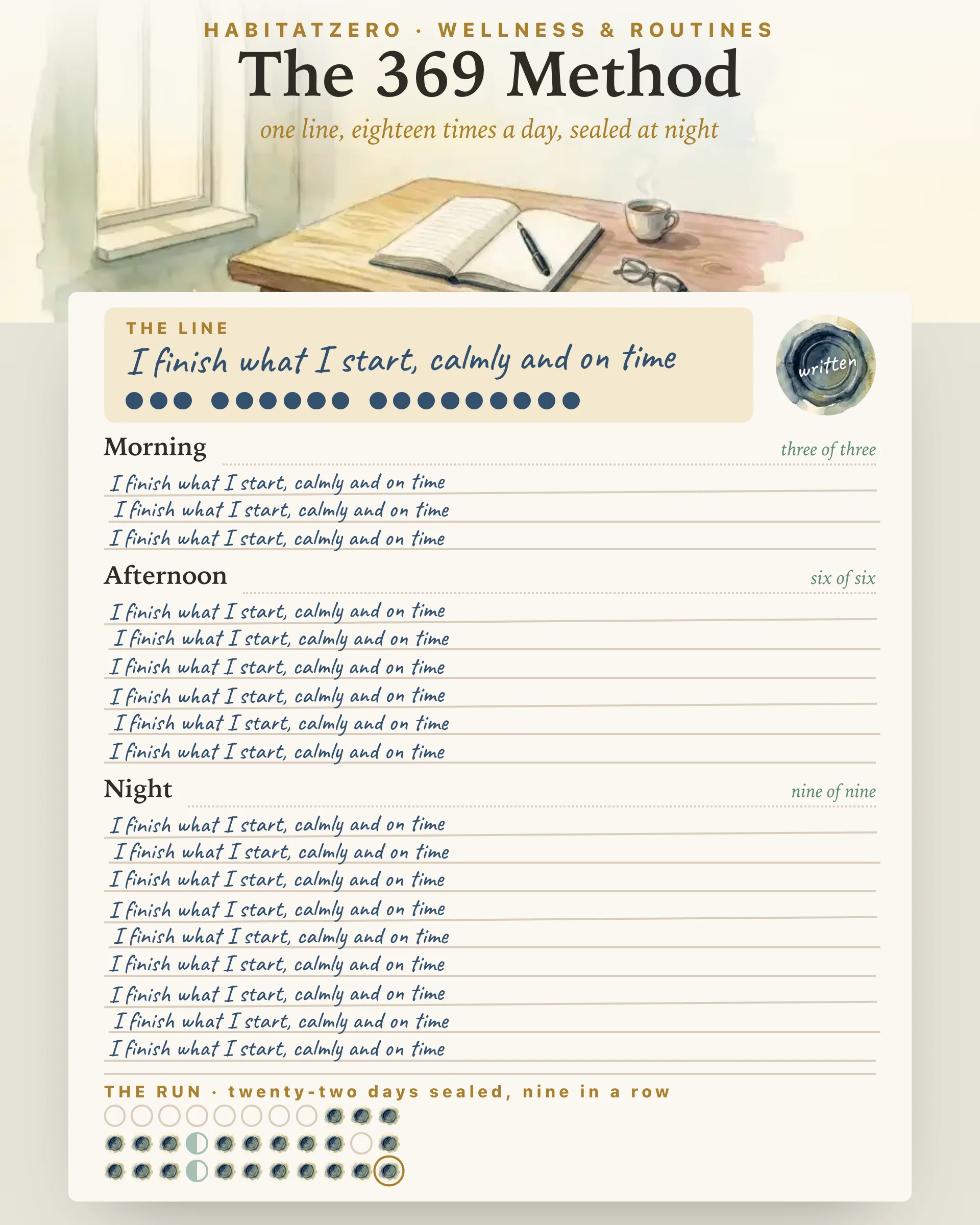
The schedule is the whole method. Choose one sentence about who you are becoming. Write it out three times when you get up, six times in the afternoon and nine times before bed. That is eighteen copies a day, and most people who try it commit to a run of thirty-three days.
The page is a copybook. You set the line once, by tapping a suggestion or writing your own, and the three blocks below open one ruled line at a time: three in the morning block, six in the afternoon, nine at night. Each open rule takes a copy only when the words match the line above, ignoring capitals and full stops, and then settles into ink and passes the pen to the next rule. Type something close but different and the rule stays open and tells you so.
A string of eighteen beads above the blocks fills as you go, and when the last one fills a wax seal presses onto the day. Under the blocks, thirty-three circles hold the last thirty-three days: a seal for every day that reached eighteen, a half-filled circle for a day you started and did not finish. Miss a day and the row breaks, which the sheet shows without comment.
If you prefer a paper notebook, and many people do, write there and tap written on paper on each block. The beads and the seal count those copies too, marked a shade lighter so you can tell the two apart later.
It does not bring money, a person or a result any closer. The numbers carry no mechanism, and neither does the ink, and this page will not suggest otherwise. What the routine can do is narrower: it puts one intention in front of you at three fixed points of the day, every day, for a month. That is a focus practice, and it is worth doing as one.
The best-studied cousin of this routine is the implementation intention, a plan in the shape of when this happens, I will do that. A meta-analysis of ninety-four tests found that forming such plans had a medium-to-large effect on whether people reached their goals (Gollwitzer and Sheeran, 2006). The 369 schedule already borrows the fixed cue, three moments in the day, so it makes sense to borrow the rest: write a line about a behavior, and know where in your day it happens.
The second finding is a warning about the line itself. When people with low self-esteem repeated a flattering statement about themselves, they ended up feeling worse, not better, while people who already believed it gained only a little (Wood, Perunovic and Lee, 2009). A line you cannot yet stand behind is not neutral; it argues with you eighteen times a day. Pick one that is true on your good days.
Third, picturing a wished-for future as if it had already arrived has been shown to lower measured energy, and in one study the people who did it got less done in the week that followed (Kappes and Oettingen, 2011). That is the case against lines about arriving, I have the promotion, and for lines about doing, I finish the report before I open the inbox.
Finally, a note on the pen. Expressive writing, fifteen to twenty minutes on something that matters to you across a few sessions, has a solid record of modest health benefits (Baikie and Wilhelm, 2005). Copying one sentence is not that. It is closer to a bead counted on a string, and it earns its place as a small daily act of attention, not as a substitute for the longer kind of writing.
Present tense, about something you do rather than something you receive, true on your better days, and short enough to write nine times at night without resentment. I show up for the morning run passes. I am a millionaire by June fails on three counts. If the line you want is a feeling, name the act that produces it.
Use the sheet for one run with one line. If what you want is to write claims you can back with evidence, the Affirmation Journal asks for a because-line every time. If you need a single intention for one meeting or one hard conversation rather than a month, the Intention Setter is built for that hour. And if the wish behind your line needs a first concrete step more than it needs repetition, the Manifestation Journal will not let you plant it without one.
A daily writing schedule: one chosen sentence written three times in the morning, six in the afternoon and nine at night. It spread from TikTok in 2020 and is usually run for thirty-three days with the same line throughout.
Not in the sense the trend promises. Nothing about the numbers or the ink changes what happens outside your notebook. What the schedule does reliably is put a single intention in front of you at three fixed moments every day, and that kind of repeated cue is close to what goal research calls an implementation intention, which does have a track record.
One short sentence in the present tense about something you do, worded so it is true on your better days. Research on positive self-statements found that repeating a claim you do not believe can leave you feeling worse, so a line about behavior beats a line about arriving: I show up for the morning run, not I am wealthy by June.
Either. The sheet accepts typed copies and inks them only when they match the line, or you can write in a paper notebook and tap written on paper to keep the count and the seal here.
The public page opens a filled example you can read but not write on. Signing in to HabitatZero, which costs nothing, turns the sheet live so your line, your eighteen and your run are kept from one day to the next.
By the team behind Fabulous, the science-based self-care app used by over 30 million people.