The Overwhelm Recovery ProtocolWellness & Routines · ~5 min
About this template · Updated July 2026
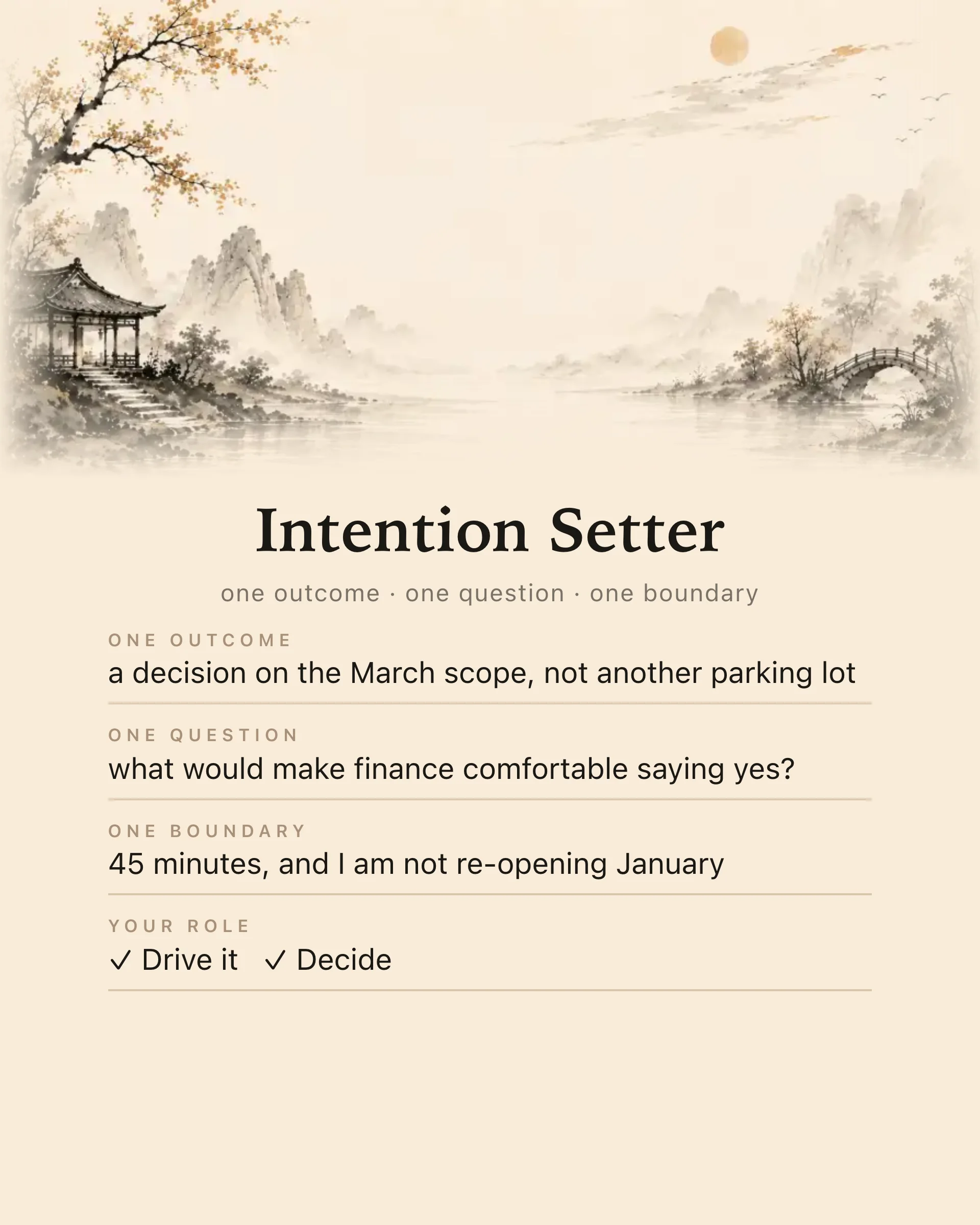
Most moments don't announce themselves. The meeting starts, the conversation turns, the work block opens with one glance at the inbox — and an hour later you find out what the moment decided to do with you. Intention setting is the two-minute practice of getting there first. This worksheet keeps it deliberately small: pick the moment, name it in a line, then set one outcome, one question, one boundary, and the role you mean to play. Nothing to journal, nothing to review weekly. Just a short act of aiming, done right before the thing it aims at.
"Be more present" is a lovely wish and a useless plan, because it never says when. The version of intention setting that actually changes behavior is specific about the moment: this meeting, this conversation, this stretch of the afternoon. Psychologists call the strong form of this an implementation intention — a pre-decided plan tied to a concrete situation — and Peter Gollwitzer's research found that these simple, situation-bound plans reliably outperform vague resolve. The insight travels well beyond habit formation: a plan attached to a moment fires when the moment arrives. One attached to "life generally" never gets its cue.
That's why this worksheet starts by asking what the intention is for. A meeting, a conversation, a work block, or the day — four different kinds of moment, and the sheet adjusts its questions to fit. The day version is the classic daily intention: today, in a phrase, before the inbox gets a vote.
The spine of the practice is three lines, and the discipline is the word one.
One outcome — what would make it worth it? Not the agenda, not everything that could usefully happen: the single result that would let you walk out satisfied. By the end, we'll have a decision on scope. By tonight, I'll have sent the draft. Naming it changes how you spend the middle of the moment, because you can feel when it's drifting away from the thing that matters.
One question — the one thing to get answered. Meetings and conversations generate noise; a pre-written question is a filter. When it gets answered, you'll notice. When the moment ends and it hasn't been asked, you'll notice that too — usually in time to ask it.
One boundary — a line to hold: time, scope, or energy. Forty-five minutes and not a minute more. We're deciding March, not re-opening January. I'll say the hard part once, kindly, and not chase it. Boundaries written down in advance survive; boundaries improvised under social pressure mostly don't.
Three lines is the whole apparatus, and that's the point. A five-part framework for how to behave in a meeting evaporates the moment the meeting gets interesting. Three short lines fit in working memory, where an intention has to live to be any use.
The last section asks how you'll show up, and it changes with the moment. Walking into a meeting: drive it, contribute, decide, listen, or support. Opening a hard conversation: open it gently, hear them out, say the hard thing, hold your ground, repair. Sitting down to work: start it, go deep, stay on one thing, finish something. Tick any that fit — some moments genuinely need you to both listen and decide.
The reason this section earns its place: every room assigns roles to people who arrive without one. The loudest agenda recruits you; the mood of the conversation sets yours. Choosing a role in advance isn't rigidity — you can still adapt — it's just the difference between playing a part you picked and playing whatever part was left over.
If you like the aiming-before-acting shape of this, it has good neighbors: the smart goals worksheet does the longer-horizon version of the outcome line, and the sunday reset points the same deliberateness at a whole week. But this sheet's own ambition stays small on purpose. Intention setting fails as a ceremony and works as a reflex — two minutes, four lines, done before the moments of the day where you'd otherwise run on default. The best measure of the practice isn't how the sheet looks when you finish it. It's the moment, an hour later, when the meeting tries to wander past its forty-five minutes and you hear yourself — pleasantly, and to your own mild surprise — holding the line you wrote down.
Deciding, before a moment starts, what you want from it and how you mean to show up — instead of finding out afterward what it did with you. This worksheet keeps the practice deliberately small: name the moment, then set one outcome, one question, one boundary, and the role you'll play. It works for a meeting, a conversation, a work block, or the whole day.
A goal points at a result, usually weeks or months out. An intention points at a single upcoming moment and says how you'll be in it. 'Ship the project' is a goal; 'in this afternoon's review, get one clear decision and don't let it run past forty-five minutes' is an intention. They cooperate well: goals set the destination, intentions decide how you'll walk today's stretch of the road.
Because you'll actually remember them. A five-point agenda for how to behave in a meeting evaporates the moment the meeting gets interesting. One outcome, one question, one boundary is small enough to hold in your head under pressure — and research on implementation intentions suggests that specific, pre-decided plans are exactly the form that survives contact with a busy day.
The same exercise pointed at the whole day: today, in a phrase — what is it really about, what would make it worth it, what line will you hold. Morning works best, before the inbox gets a vote. Switch the worksheet to 'the day' mode and it takes about two minutes; many people pair it with an evening look-back at whether the boundary held.
Yes. The worksheet is free, runs in your browser, and asks for no signup. If you want a paper copy on your desk before the meeting starts, print the page: the sheet is print-styled, and your browser can save the print output as a PDF. Inside Fabulous your intentions also save to your account, so you can look back at what you set against how it actually went.
By the team behind Fabulous, the science-based self-care app used by over 30 million people.