Leaves on a StreamEmotional Fitness · ~3 min
About this template · Updated July 2026
Every manifestation journal makes the same opening move: write the life you want as though it's already arriving. Where the genre goes wrong is the second move — most versions stop there, leaving the want on the page like a lottery ticket. This one adds the two moves that give written intentions actual traction: a rehearsed process and a committed first step. Feet on the ground, pen still dreaming.
Ink doesn't negotiate with reality, but it reliably reorganizes the person holding the pen — and the mechanics are studied.
Naming aims attention. A want written specifically — I am reading my short story to the writing group, not I want to be more creative — becomes something your week can notice opportunities for. Vague intentions can't be recognized on arrival; named ones can.
Rehearsing the process beats savoring the outcome. In the classic experiment, students who spent a few minutes a day visualizing how they would study — where, when, with what in hand — earned better results than students who visualized the triumphant grade itself; the process group planned more and worried less (DOI: 10.1177/0146167299025002010). That's why this journal's second field asks for the scene of you doing the work: the kitchen table, the printed draft, the unglamorous middle. Outcome daydreams are dessert; process scenes are groceries.
A when-then step closes the gap. Decades of research on implementation intentions — plans in the form when X, I will Y — show they make follow-through markedly more likely than intention alone (DOI: 10.1037/0003-066X.54.7.493). The journal calls this the bridge, and it won't plant an intention without one: one concrete act, within two days, with its trigger written down.
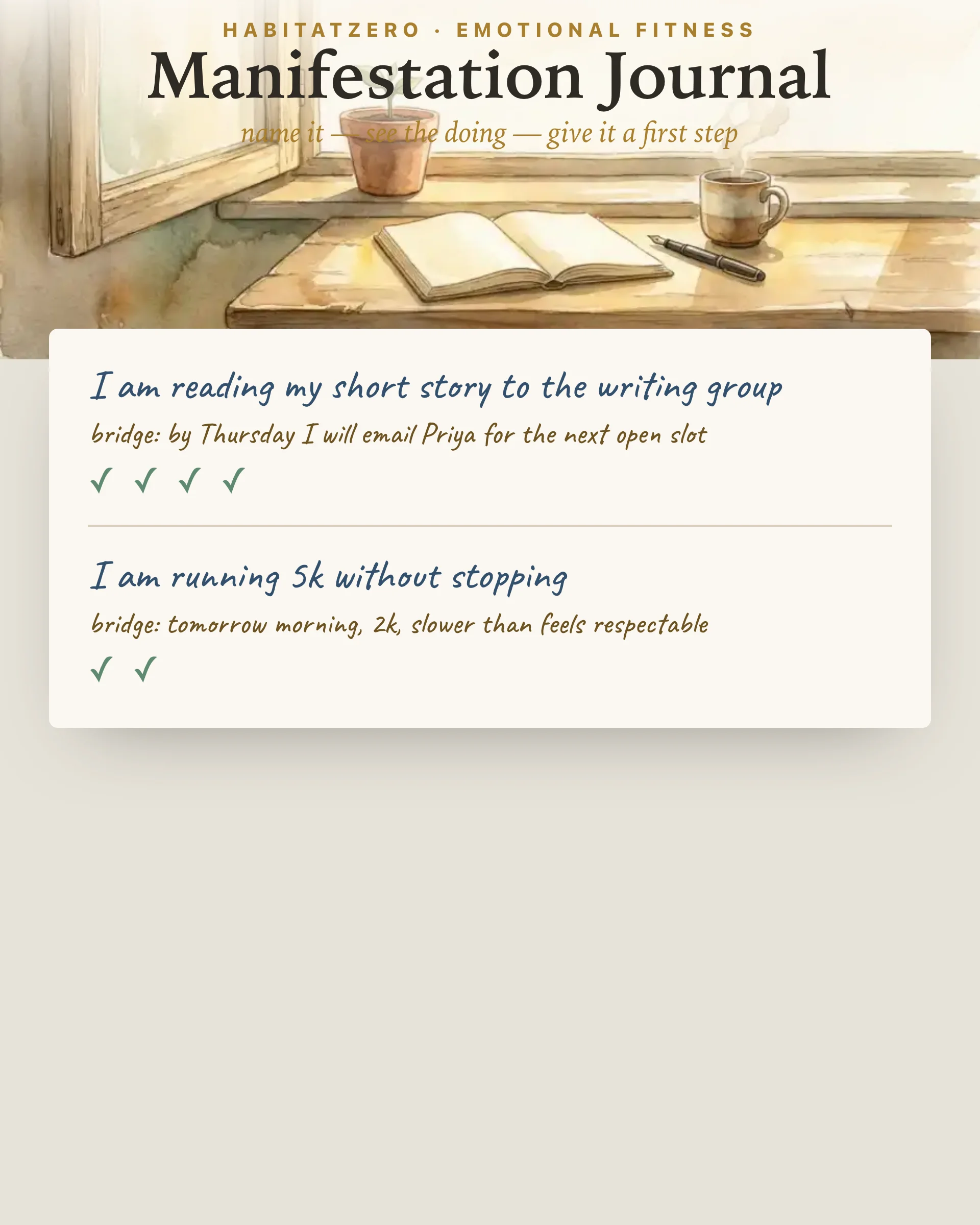
Each planted intention carries its three parts — the name, the scene, the bridge — plus a date and a tally row. The tally is the journal's quiet thesis: every time you act on an intention, you tap it, and a handwritten checkmark joins the row. Not affirmation counts, not visualization minutes — acts. A month later, the plot reads honestly: the intention with eleven checkmarks is being manifested; the one with zero is being postponed, and now you know which is which.
The plot holds twenty intentions at most, and fewer is stronger. Two or three tended intentions gather checkmarks fast enough to feel alive; a scroll of thirty wishes gathers dust. When the plot fills, harvest what arrived and release what stopped mattering — both count as the practice working.
Name it: I am running 5k without stopping. See the doing: Laces on before coffee, the same loop past the bakery, slowing down instead of stopping when it burns. The bridge: Tomorrow morning — 2k, slower than feels respectable.
Notice what the example doesn't contain: no finish-line photo, no medal, no version of the sentence that skips the part where running is hard. The doing is the manifestation; the checkmarks are the receipts.
Plant exactly one. Name it in the present tense, write four honest sentences of the doing, and give it a bridge you could clear by the day after tomorrow. Then go clear the bridge and come back for your first checkmark — the journal works in that order, not the other one.
A notebook practice for turning wants into intentions: you write what you are moving toward as though it is underway, picture the path in detail, and revisit it until acting on it feels obvious. This version keeps the format and grounds it — every intention carries a written process scene and a first step with a two-day deadline.
Writing does not bend the universe, but it demonstrably changes the writer. Naming a specific intention focuses attention, mentally rehearsing the process improves planning and follow-through in controlled studies, and committing a when-then step makes action markedly more likely. That chain — attention, rehearsal, commitment — is the working part, and it is exactly what this journal exercises.
Name it: I am reading my short story to the writing group. See the doing: Tuesday nights at the kitchen table, printing the draft and marking it up with the red pen. The bridge: by Thursday I will email Priya for the group's next open slot. Then a tally checkmark each time you actually act — that row of marks is the entry finishing itself.
Because outcome daydreams are dessert and process scenes are groceries. In the classic experiment, students who visualized how they would study outperformed those who visualized the grade itself — rehearsing the doing produced plans and reduced anxiety, while savoring the result mostly produced a pleasant evening. This journal points your pen at the doing on purpose.
The plot caps at twenty, and fewer is stronger. Two or three tended intentions accumulate checkmarks quickly, which feeds the practice; a long wishlist mostly accumulates guilt. When the plot fills, harvest what arrived and release what stopped mattering — both are progress.
No belief required. Treat it as structured intention-setting: a named direction, a rehearsed path, a committed first step, and a running count of your own follow-through. Skeptics tend to like the checkmark tally best — it is the least mystical instrument on the page.
By the team behind Fabulous, the science-based self-care app used by over 30 million people.