The Overwhelm Recovery ProtocolWellness & Routines · ~5 min
About this template · Updated September 2026
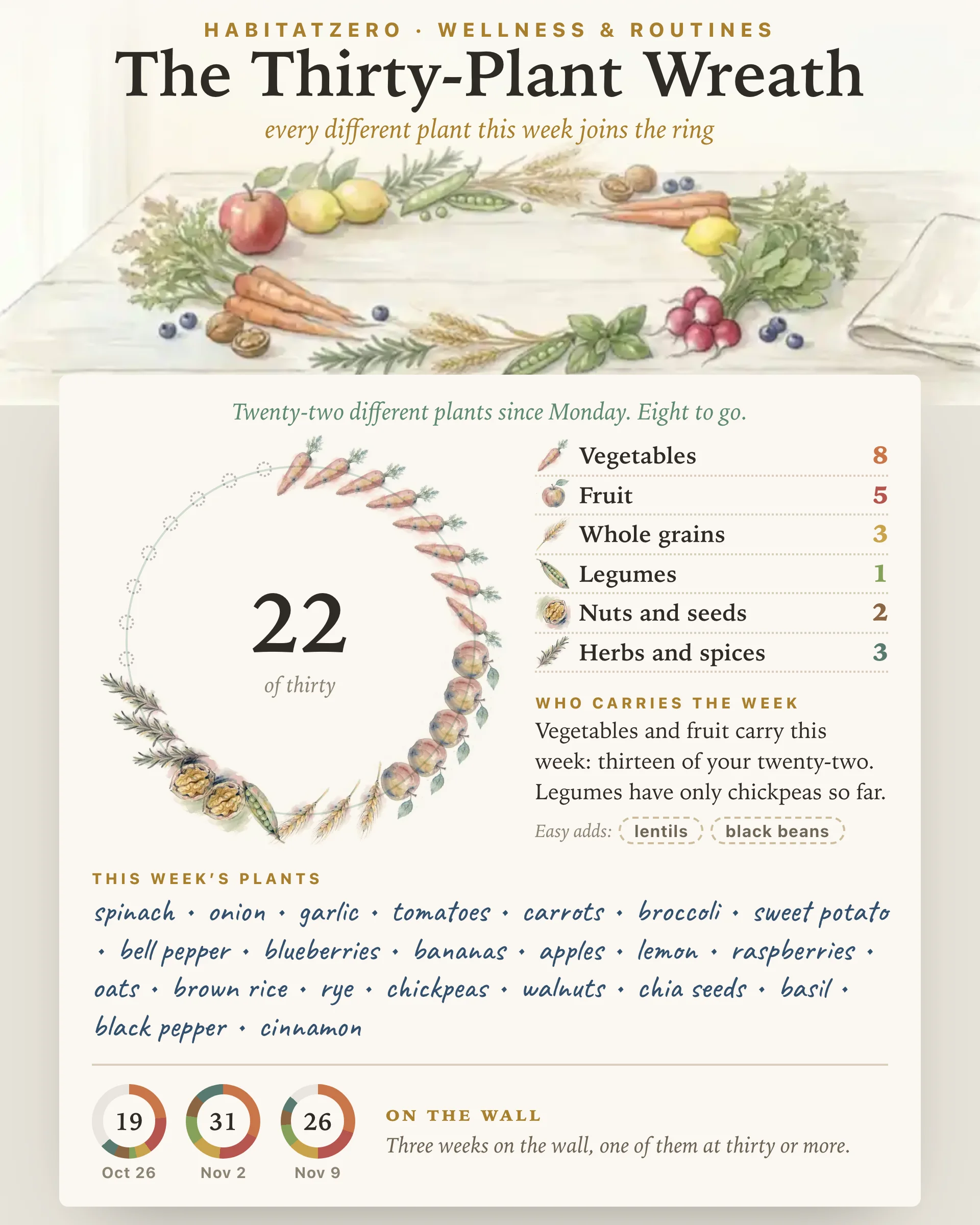
Thirty plants a week sounds like a lot until you start counting. The oats in this morning's bowl count. So do the blueberries on top, the garlic in last night's pasta sauce, the chickpeas in a lunch salad and the cumin in the soup. The target is variety, not volume: thirty different plant foods across seven days, however small the serving. This page turns that target into a wreath you can watch fill.
The figure traces back to the American Gut Project, a citizen science study in which more than eleven thousand volunteers mailed in stool samples and answered questions about how they live and eat. Its main results were published in 2018 by McDonald and colleagues in mSystems. One question asked how many different plants a person eats in an average week, and it told people to count every plant inside a mixed food: a can of soup with carrots, potatoes and onion is three plants, and each grain in a multigrain bread counts on its own.
When the researchers compared volunteers who answered more than 30 with those who answered 10 or fewer, the high-variety group had a more diverse community of gut bacteria, more of certain bacteria that ferment undigested plant material, and fewer copies of some antibiotic resistance genes. How many different plants people ate lined up with those differences better than labels like vegan or omnivore did.
Be clear about what kind of finding that is. It is an association, drawn from people who chose to take part and who reported their own eating. Nobody was assigned to eat thirty plants and then followed, so the study cannot show that reaching thirty causes better health. Thirty was simply the edge of the top answer box on the questionnaire. The team behind the project, whose work continues as the Microsetta Initiative, describes thirty as a guideline rather than a rigid threshold and puts the weight on overall variety. That is how the wreath treats it too: something to aim at, never a verdict on your week.
Six groups do the work here: vegetables, fruit, whole grains, legumes such as beans, lentils and peanuts, nuts and seeds, and herbs and spices. Each different plant counts once per week, whether you eat it once or every day. Canned, frozen and dried plants count the same as fresh ones.
Herbs and spices are plants, so they count. They also arrive by the pinch, which is why they keep a group of their own on the wreath: you can see at a glance how much of your total they are carrying. A few cases are judgment calls. Black beans, kidney beans and pinto beans are all varieties of one species, the common bean, so a strict count would score them once. The page counts what you write, and the rule is yours to set.
Pick a group, then tap what you ate; anything the chips miss goes on the line underneath. Type a plant the page already lists under the wrong group and it is filed with its own, so chickpeas typed under grains land with the legumes. Try to add something twice and the page turns it away with a note, because a second helping is not a second plant.
Each plant becomes a small painted token on the ring, and the tokens sit in group order, so a full wreath reads like a chart. From the fifth plant on, the page reads the week back to you: which one or two groups are carrying it, which ones are quiet, and a few one-tap adds from the quiet ones. At thirty the ring closes. Past thirty, a second ring starts inside the first and holds thirty more, and that is where the wreath stops taking plants.
On the same day each week, hang the wreath up. It moves to a small wall of past weeks, each one drawn as a ring colored by group, and a fresh, empty wreath begins.
Mixes are the quickest route. A bag of mixed nuts, a can of three-bean chili, trail mix with seeds and dried fruit, or a spice blend can add several plants in one go. Rotate rather than add: brown rice one week, farro or barley the next. Pick up one plant on each grocery run that would not usually land in your cart, and scatter seeds or chopped herbs over dishes you already make. None of this asks you to eat more food, only to eat a little more widely.
If you plan the week's dinners ahead, the Meal Planner has room to write one new plant into each night, and The Fridge Door Meal Plan builds a grocery list from meals you already like. If the wreath is one of several habits you are keeping this week, the Weekly Habit Tracker can hold the others.
Tap in the day's plants after dinner, or right after a meal while it is fresh. Glance at the reading before you shop, when a quiet group is easiest to fix. This is a count of variety, not a diet or a weight plan. If a health condition, a medication or a digestive problem shapes what you can eat, your clinician's advice comes first, and if tracking food ever starts to feel like pressure rather than curiosity, set the wreath aside.
Any plant food: vegetables, fruit, whole grains, legumes such as beans, lentils and peanuts, nuts and seeds, and herbs and spices. Each different plant counts once in a week, however often you eat it, and a mixed dish counts every plant in it, so a soup of carrots, potatoes and onion adds three.
From the American Gut Project, a citizen science study of gut microbes published in 2018. Volunteers who said they ate more than 30 different plants in a typical week had a more varied community of gut bacteria than those who said ten or fewer. That is a survey association, not proof that eating thirty plants causes better health.
Count beyond vegetables and lean on mixes. A bag of mixed nuts, a can of three-bean chili, multigrain bread or a spice blend each bring several plants at once. Rotating your usual grain or bean from week to week and buying one unfamiliar plant on every grocery run adds up quickly.
Yes. They count here like any other plant, but because they come by the pinch the wreath keeps them in a group of their own, so you can see how much of your week they are carrying and decide how much weight to give them.
Anyone can look through the filled example on this page. Tapping in your own plants and keeping past weeks on the wall happens in HabitatZero, which is free to use.
By the team behind Fabulous, the science-based self-care app used by over 30 million people.