
The Overwhelm Recovery ProtocolWellness & Routines · ~5 min
About this template · Updated November 2026
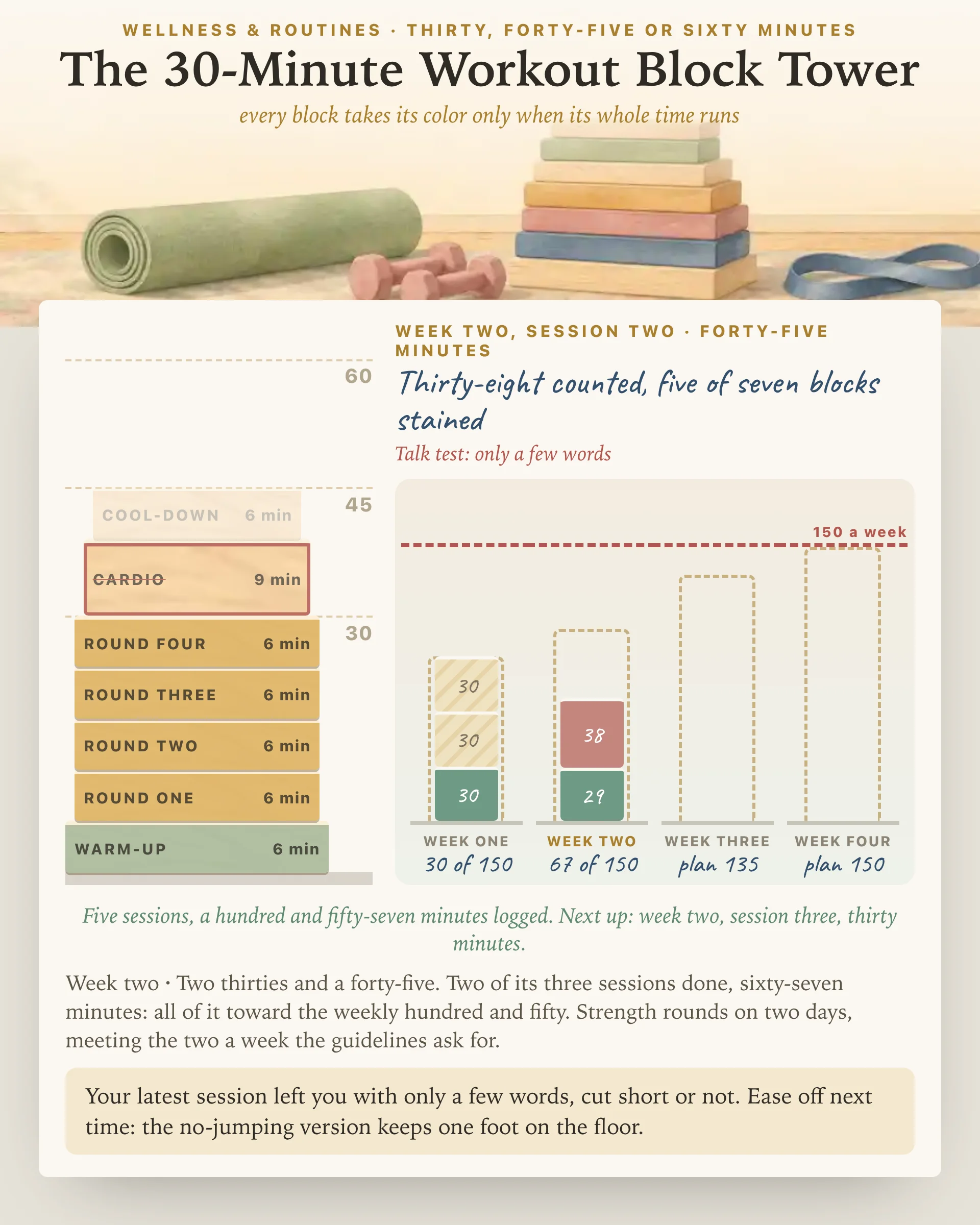
Half an hour is long enough for a whole session: warm up, work every big muscle group, raise your heart rate, and cool down. This page builds that session as a small tower of wooden blocks. You pick thirty, forty-five or sixty minutes and what you have at home (nothing, a pair of dumbbells or a band), and the blocks stack so the parts come to exactly the length you chose.
Every session has four kinds of block, stacked from the bottom up. The warm-up gives a minute to each easy move, from marching to hip circles. The strength rounds are six moves of one minute each, forty seconds of work and twenty to breathe: a squat, a push, a hinge, a pull, a lunge and a core move or overhead press, chosen for your equipment. The cardio block follows, a minute per move, and the cool-down ends on slow breathing.
The length decides how many blocks there are and how tall they stand. Thirty minutes is five of warm-up, two six-minute rounds, eight of cardio and five of cool-down. Forty-five is six, four rounds, nine and six. Sixty is eight, five rounds, twelve and ten.
One choice sets the version of every move. Easier leans on a chair or a wall and shrinks the range. No jumping keeps one foot on the floor, so the cardio stays low-impact; most people should start there. With hops turns a few cardio moves into their jumping form. If one move is too much mid-session, the player swaps just that minute to its easier form.
The timer works from the real clock, so it keeps true time even if your phone locks mid-session. A block takes its color only when its whole time has run: skip a move, or stop in the middle of the cardio, and that block stays bare wood. Only whole minutes count. Stop at 22:40 and twenty-two minutes are logged; skip forty seconds and they never come back, even if you finish. Under a full minute logs nothing.
The Physical Activity Guidelines for Americans, summarized in 2018 by the federal health agencies that wrote them, ask adults for at least 150 minutes a week of moderate aerobic activity, or 75 of vigorous activity, plus muscle-strengthening work on two or more days (Piercy and colleagues, 2018). The four-week plan climbs toward that: three thirties, then a forty-five added, then three forty-fives, and a final week of forty-five, sixty and forty-five that reaches 150.
Only moderate minutes count toward that line, and the talk test judges them without a heart rate monitor. After each session, you say whether, in the rounds and the cardio, you could sing, could talk but not sing, or could manage only a few words. A review by two cardiac rehabilitation researchers in Ottawa found that comfortable speech generally means you are below the point where breathing turns labored, and that the test held steady across walking, cycling and other machines, though it suits very hard intervals less well (Reed and Pipe, 2014). The sing, talk, few-words split is common advice built on that idea.
Sessions you could talk through, or found hard, stack toward the 150 line; sessions you could sing through stay in the log in a paler stripe. The guidelines let a vigorous minute count double, but this page counts each minute once and lets one rating stand for the whole session, so read the line as a target rather than a measurement. The note under the chart reads your two latest sessions in order: two whole ones you could sing through, on the same version, point to the next version up, and one that left you with a few words points down, even if you cut it short.
A 2022 meta-analysis of sixteen cohort studies, led by researchers at Tohoku University in Japan, found that adults who did muscle-strengthening activities had a ten to seventeen percent lower risk of early death, heart disease, cancer and diabetes (Momma and colleagues, 2022). These were observational studies of adults without serious illness, so they show a link rather than proof that the strength work causes it, and the lowest risk sat around thirty to sixty minutes a week. This plan's rounds come to about thirty-six minutes in week one and an hour and a quarter in week four; the data cannot say whether that last quarter hour helps. Nothing here promises weight loss or a particular shape.
On a busy day, the ten-minute kitchen timer fits five moves into a short gap. For one fixed circuit to repeat, the seven-minute card deck runs twelve moves at forty seconds each. For set bodyweight circuits three to five days a week, there is the lace-up shoes plan.
Check with your doctor first if you have a heart or lung condition, chest pain, dizziness or fainting, blood pressure that is not under control, a joint replacement or recent surgery, or if you are pregnant. Keep a sturdy chair within reach for the standing moves, stop anything that hurts, and leave a rest day between sessions.
Three thirty-minute sessions a week give you strength work on three days, more than the two the US guidelines ask for, and about ninety of the hundred and fifty weekly minutes of moderate activity. A quick walk on two other days, or stretching some sessions to forty-five minutes, closes the gap.
Two more strength rounds and a little more of everything else: six minutes of warm-up, four six-minute rounds, nine minutes of cardio and six of cool-down. Three of them in a week come to a hundred and thirty-five minutes.
Here it is eight minutes of warm-up, five six-minute strength rounds, twelve minutes of cardio and ten of cool-down. The plan saves the full hour for the fourth week, once thirty and forty-five minutes feel steady.
Use the talk test during the strength rounds and the cardio. Being able to talk in sentences but not sing is the moderate effort the guidelines count. If you could sing, the next version up is ready; if you could manage only a few words, ease off a version.
Ask first if you have a heart or lung condition, chest pain, dizziness or fainting spells, blood pressure that is not under control, a recent joint replacement or surgery, or a pregnancy. Whatever your health, stop any move that hurts.
By the team behind Fabulous, the science-based self-care app used by over 30 million people.


