
The Overwhelm Recovery ProtocolWellness & Routines · ~5 min
About this template · Updated September 2026
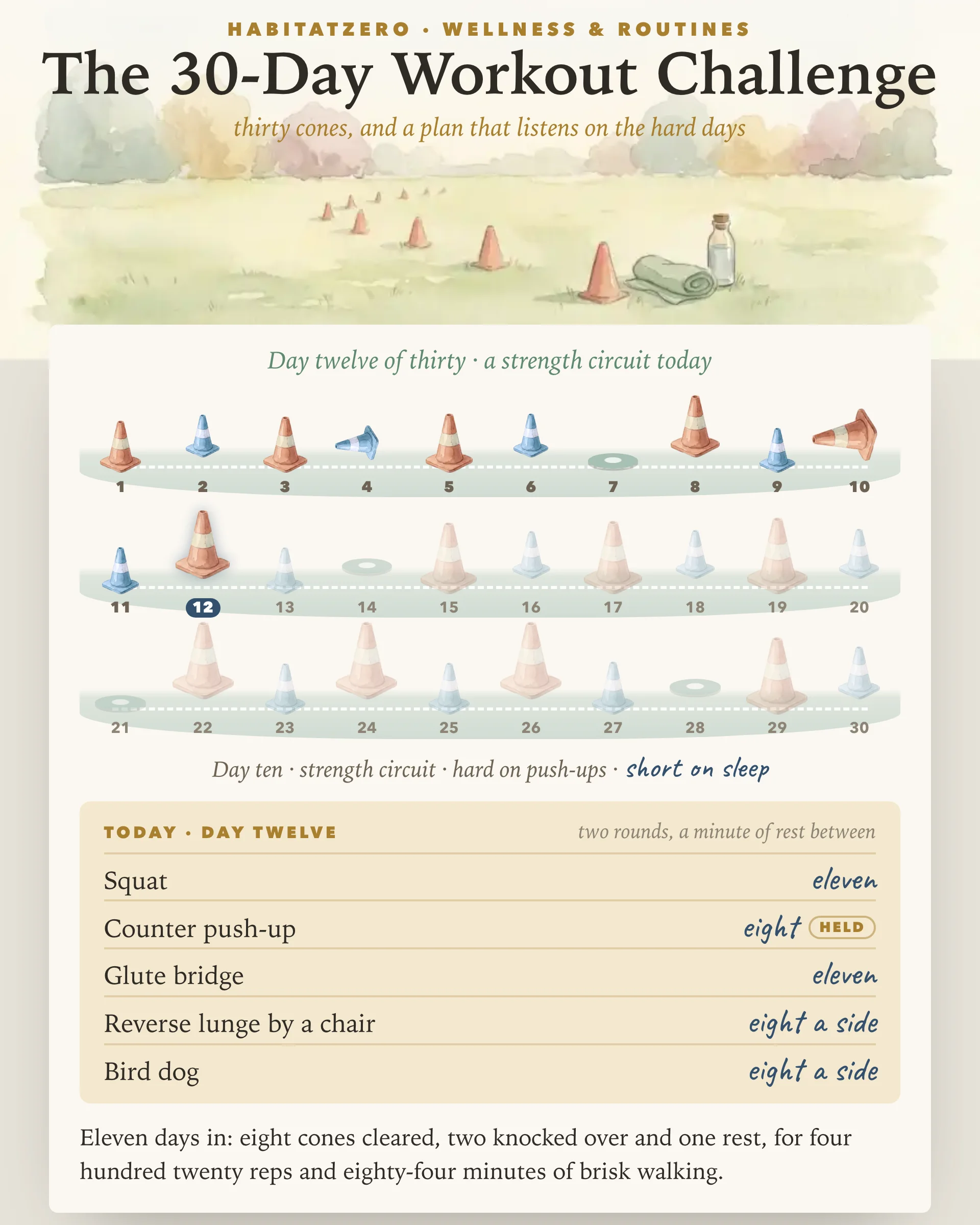
Many thirty-day challenges hand you a fixed chart whose numbers only go up. Day one feels easy, day nine hurts, and by day fifteen the chart and your body disagree. This one lays the month out as thirty cones on a lawn and changes its numbers when you tell it how a day went. It asks for a wall, a sturdy chair, a patch of floor and about twenty minutes.
Each week runs the same way: circuit, walk, circuit, walk, circuit, walk, rest. Over the month that makes thirteen circuits, thirteen walks and four rest days, so no two strength circuits ever land on back-to-back days.
The circuit is five moves done for two or three rounds, with a minute of rest between rounds:
Each move carries one form cue, since one thing to watch is plenty while you count. Walks are brisk enough that you could talk but not sing, and on a wet day stairs or marching in place count.
After each cone you tap one of four words. Easy raises the next counts by two, steady by one, and hard holds them where they are. Tell it which move made the day hard and only that move waits while the other four keep climbing, because tired arms are no reason to hold back your legs. Two hard circuits in a row step every move back one.
It hurt is different. The cone becomes a red flag, the next day turns into a rest, and the counts step back. If pain comes back on a second day, the course pauses and asks you to have it checked. You can take back a day you logged by mistake with two taps.
Every move has a cap: fifteen squats and bridges, twelve push-ups, ten lunges and bird dogs a side, and thirty minutes of walking. The numbers lean on the American College of Sports Medicine's progression guidance for resistance training. For newcomers it recommends a load you can move about eight to twelve times, raised only once you can do one or two reps beyond the target, and it treats sets of more than fifteen reps as endurance work. Bodyweight moves get harder through a tougher version or a slower tempo, not more reps, and the last reps of a long set are where form slips. So once a move reaches its cap, the page asks you to slow it down instead: three counts on the way down, one on the way up.
The CDC's advice for adults is at least 150 minutes of moderate activity a week plus muscle-strengthening work on two or more days, covering the legs, hips, back, abdomen, chest, shoulders and arms. The five moves cover that list. ACSM's broader position stand puts strength work for each major muscle group at two or three days a week and notes that raising intensity and volume gradually may lower the risks of exercise. Hence the walks between circuits, and counts that climb one rung at a time.
This page makes no promises about your weight or the shape of your body, and a month is too short to judge either. What usually changes is the counts: day twenty-nine asks for more than day one did, and the moves feel steadier.
A month is also shorter than most habits need. In a study that followed people building a daily routine, the time for a new behavior to feel automatic ranged from 18 to 254 days, and missing a single day made little difference to the process. Treat day thirty as the end of the first stretch, not the finish line, and let a knocked-over cone be what it is: one day.
Stop for sharp pain or pain that lingers, and log the day as it hurt so the plan can respond. If you have a heart, joint or back condition, are pregnant or had a baby recently, or are coming back from an injury or surgery, ask your clinician which moves suit you before day one. Mild soreness a day or two after a new move is common; joint pain during one is not something to push through.
Start on a quiet day, often at the turn of a month or the new year. Once the thirty cones are behind you, keep two or three strength days a week going on the Workout Calendar, log what you did in a Workout Journal, or turn the walking days into a Walking Challenge of their own.
They work best as a way to start moving on a schedule you can keep. Over a month the counts climb and the moves usually feel steadier, but the real prize is a routine that carries on after day thirty.
This page makes no promises about weight or shape, and a month is short for either. What you can expect is to finish doing more squats, push-ups and walking minutes than you managed on day one.
Yes, if you choose new to this. You begin with wall push-ups, chair squats and ten-minute walks, and nothing climbs after a day you mark as hard. A wall, a sturdy chair and some floor are all the equipment it asks for.
Moving most days is fine, but muscles need time between strength sessions. Here the circuits fall every other day with brisk walks in between and a full rest every seventh day, which keeps strength work near the two or three days a week that guidelines suggest.
The public page shows a sample month you can look through. To set out your own cones and have the plan respond to your days, open it in HabitatZero, where it saves as you go at no cost.
By the team behind Fabulous, the science-based self-care app used by over 30 million people.


