The Overwhelm Recovery ProtocolWellness & Routines · ~5 min
About this template · Updated September 2026
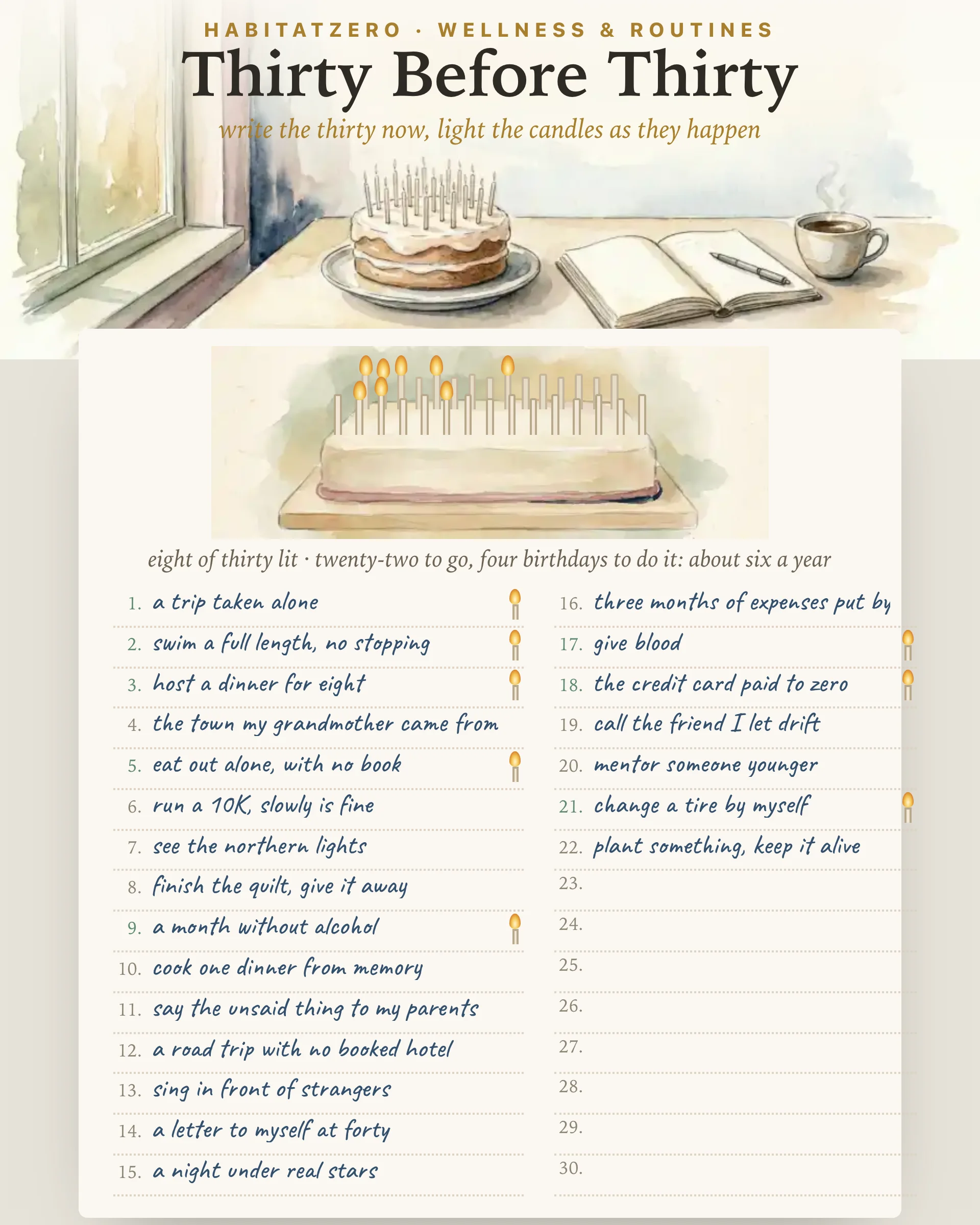
A 30 before 30 list is a promise with a birthday attached: thirty things you mean to have done before the decade turns. People write them in the notes app and on the backs of receipts, and a lot of them end the same way, nine entries about travel, one burst of enthusiasm, then silence. This page is built around the two places those lists go wrong: the writing and the keeping.
The thirty is not decoration. It is the cap that makes every line compete for its place. A list that can grow forever asks nothing of you, while a list that stops at thirty asks, each time, whether this entry deserves a slot more than the one it would push out. Write the ones you would be quietly sorry to leave undone, not the ones that sound good at dinner.
The birthday does its own work. Adam Alter and Hal Hershfield studied people whose age ended in a nine and found them overrepresented among first-time marathon runners, as if the approaching decade sharpened the question of what the last one had added up to. You do not have to wait until twenty-nine to borrow that sharpness. Putting the deadline on paper brings it forward to whatever age you are now, and gives it thirty specific places to land.
Under the cake sit ten age chips. Tap yours and the sheet turns your birthday into a pace: how many lines are still unlit, how many birthdays remain, and roughly how many a year that comes to. At twenty-six with nothing lit yet, that is about eight a year. The number is a nudge rather than a schedule; mostly it tells you whether the list needs a few cheap, nearby entries to be honest.
Below that is the ideas tray. Eight areas of life, places, skills, body, money, people, courage, making and giving, each with a handful of suggestions to tap and a line for writing your own. The tabs count what you have written in each area, and a line under the list names the imbalance in plain words: leaning on places, nothing yet for money or people. A good thirty usually touches most of the eight. A list that is all flights is a vacation itinerary with a deadline.
Each line you write lands in handwriting on the numbered sheet with its area beside it. When one of them actually happens, tap the small candle at the end of the line and a candle lights on the cake above. Thirty is the cap, and the sheet says so when you try to write a thirty-first: let one go before writing another. Removing a line takes two taps, so a stray touch never costs you anything.
Two findings sit underneath this. Hengchen Dai, Katherine Milkman and Jason Riis showed that temporal landmarks, the first of the month, the start of a week, a birthday, are followed by measurable rises in aspirational behavior, from gym visits to commitments people sign up for. A thirtieth birthday is about as large a landmark as ordinary life offers, and a list gives the pull somewhere to go. Separately, a meta-analysis of 138 experiments by Benjamin Harkin and colleagues found that prompting people to monitor their progress toward a goal reliably raised the odds of reaching it, and more so when the progress was physically recorded. Candles on a cake are a record you can see from across the room.
What none of this shows is that a list makes you happier, or that thirty is the right number. Thirty is a convention. Someone at twenty-eight with two birthdays left should probably write a shorter list and light more of it. This page is a tool for deciding and remembering, not a verdict on a decade.
Put the cheap, near ones in first: a restaurant alone, the call you keep postponing, a night under real stars. They light early and pull the harder ones along. Write the specific version of each, so not "travel more" but the town your grandparents came from. Include at least one line that costs nothing but nerve. And reread the list on each birthday, swapping out anything you no longer want; a list you would be embarrassed to show a friend is a list you will stop opening.
Write the thirty in one sitting, ideally somewhere in your early or mid twenties, though twenty-eight is not too late. Come back whenever a line happens. If you want the shorter seasonal version, twenty dreams with one starred as next up, the Bucket List is built for that. When one of your thirty is big enough to need a plan of its own, take it to the Goal Map and split it into monthly milestones. And if the question under the list is who you want to be at thirty rather than what you want to have done, the Future Self Journal asks it directly.
Thirty things you want to have done by your thirtieth birthday, written down in one place. It differs from an open-ended bucket list in two ways, a fixed number and a fixed deadline, and those two constraints are what turn a wish into a plan.
Mix cheap, near things with a few big ones, and spread them across the parts of your life: places, skills, body, money, people, courage, making and giving. This sheet offers a handful of ideas in each area and points out the areas you have left empty.
No, though the pace changes. With one birthday left the sheet will tell you that thirty things means more than two a month, which is your cue to write smaller, nearer entries and to light the easy ones early.
The bucket list on this site holds twenty dreams with one starred as next up and no deadline at all. This page holds exactly thirty, sorts them by area of life, reads a pace from your age, and lights a candle on a cake for every one you do.
The filled example on this page is open to explore. Writing your own thirty and lighting candles over the years happens inside HabitatZero, which costs nothing to use.
By the team behind Fabulous, the science-based self-care app used by over 30 million people.