
Leaves on a StreamEmotional Fitness · ~3 min
About this template · Updated September 2026
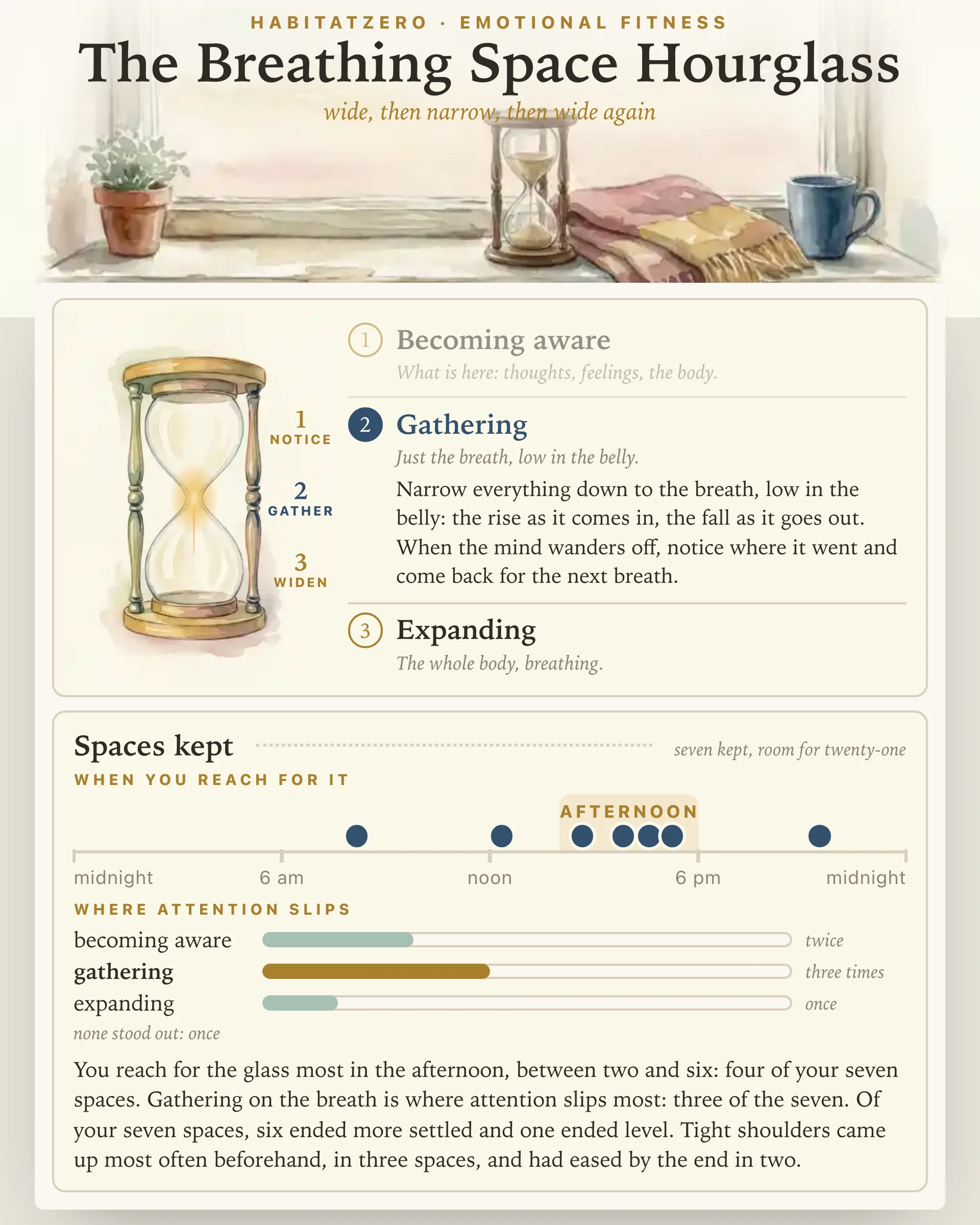
The three-minute breathing space comes from mindfulness-based cognitive therapy, the eight-week course that Zindel Segal, Mark Williams and John Teasdale set out in Mindfulness-Based Cognitive Therapy for Depression. This hourglass is an independent practice page. Its authors, their publisher and the people who train MBCT teachers had no hand in it and have not endorsed it.
The breathing space exists because a long meditation is hard to reach for in the middle of a bad afternoon. Segal has explained that he, Teasdale and Williams designed it for real-world moments, whenever automatic pilot takes over, and that each of its three steps lasts roughly a minute. It is short enough to fit between two meetings and shaped enough that you know what to do once you are in it.
Williams and his coauthor Danny Penman suggest you picture the practice as an hourglass, and the shape carries the whole instruction.
Nothing in the practice asks you to breathe in a special way. Your breath keeps its own pace; the glass only paces where your attention rests.
Before you turn the glass, you mark how settled you feel on a row of five sand marks, from stirred up to settled, and you can tap up to four things that are here, or write your own. Then a light moves through the painted glass. It drains from the top bulb during the first minute, gathers into a bead in the neck during the second and fills the base during the third. The words for each step sit beside it, with a quiet note of how long is left. If you would rather close your eyes, glance back when you like. If you switch tabs or your screen goes dark, the glass keeps time by the clock and picks up wherever it has got to.
Afterward you check in again: how settled you are now, which of the things you named are still here, and which step was hardest to stay with. Keep the space and it lands on a day line at the hour you started it. After a week or so the record begins to answer two practical questions: when in the day you actually reach for a breathing space, and where your attention slips most. When one step keeps slipping, the reading offers a way back into it.
MBCT has a solid research base. An individual patient data meta-analysis pooled nine randomized trials covering 1,258 people with recurrent depression and found that those who took the course were less likely to relapse over roughly sixty weeks than those who did not. Comparisons with other active treatments, antidepressants among them, also leaned in its favor.
That finding belongs to the whole program, with its weekly classes and practice at home in between. The breathing space by itself has hardly been studied, so nobody can say how much of MBCT's benefit it carries. Treat this page as a practice rather than a treatment. The aim is not to relax on command, either: the steps ask you to notice and allow what is there, so a space that leaves you as stirred up as before still counts.
If low moods keep coming back, a therapist trained in MBCT can take you through the full course, which is where the evidence actually sits. And if dark thoughts turn toward ending your life, set the hourglass aside and call or text 988 in the US, or your local emergency number, so you can talk to someone right away.
Williams and Penman describe two uses for it: a regular pause that punctuates the day, and an emergency practice for the moments when you feel under pressure. Try both. Put the first few spaces somewhere easy, such as after lunch or before you open your inbox, so the steps feel familiar. Then reach for the glass in harder moments: before a difficult call, in the parked car, when a worry starts to loop.
If one thought keeps grabbing you in the middle of a space, Thoughts Are Not Facts works on exactly that. For a longer practice, The Body Scan Cord walks attention through the body part by part, and on days when three minutes feels like too much, The Minute Bench asks for only one.
It is a short mindfulness practice from mindfulness-based cognitive therapy, done in three steps of roughly a minute each: take stock of whatever is here, narrow attention down to the breath, then widen it to the body as a whole. Mark Williams, one of its designers, pictures it as an hourglass, wide at the top, narrow in the middle and wide again at the base, and the words for each step on this page work as a short script.
No. It was designed by Zindel Segal, Mark Williams and John Teasdale while they were building mindfulness-based cognitive therapy. MBCT grew out of the mindfulness-based stress reduction program that Kabat-Zinn founded, and he wrote the foreword to their book, which is probably why his name often gets attached to it.
The honest answer comes in two parts. MBCT as a whole, eight weekly group classes with practice at home in between, has good trial evidence for lowering the risk of relapse in people with recurrent depression. The breathing space on its own has barely been studied, so its value is best judged by trying it for a week and reading your own record.
No. This hourglass is an independent practice page built around the published steps. It has no connection to the MBCT authors, their publisher or any MBCT teaching center, and none of them has reviewed or approved it.
You can look around the filled-in sample on this page first. To turn the glass yourself, check in and keep a record of your spaces, open it in HabitatZero, where it is free.
By the team behind Fabulous, the science-based self-care app used by over 30 million people.


