
The Overwhelm Recovery ProtocolWellness & Routines · ~5 min
About this template · Updated September 2026
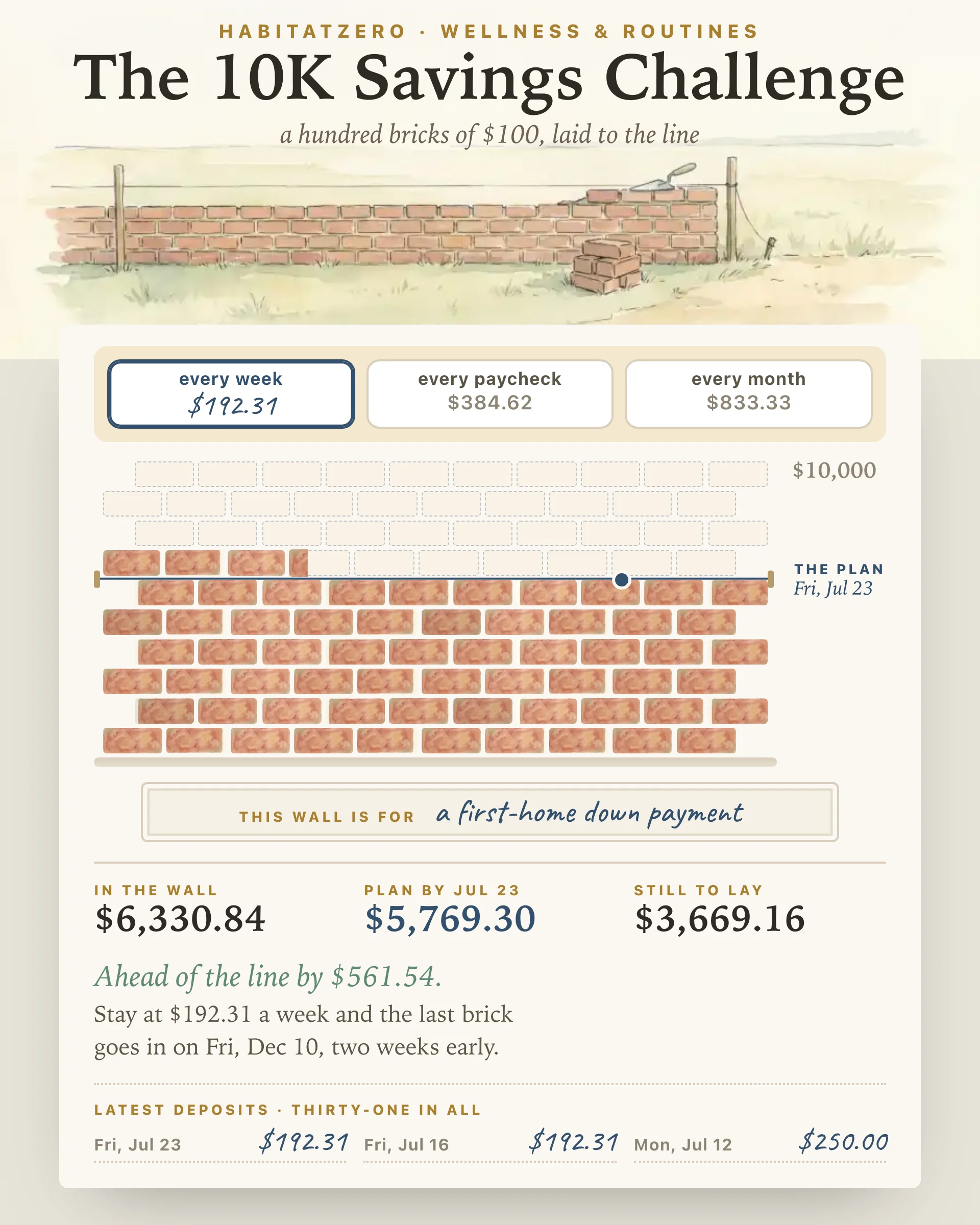
The 10k savings challenge asks you to put away $10,000 in one year. Spread over fifty-two weeks, that is $192.31 a week. Over twenty-six paychecks it is $384.62 each, and over twelve months it is $833.33. The number is big enough to soften a bad month and plain enough to check against a calendar, which is the job this page does.
Ten thousand dollars does not divide evenly by fifty-two. The true weekly share is about $192.3077, so a deposit rounded to $192.31 overshoots: fifty-two of them come to $10,000.12. This page rounds the even share to the nearest cent and lets the final deposit absorb the difference, so fifty-one deposits of $192.31 are followed by one of $192.19. Paid every two weeks, twenty-five deposits of $384.62 end with $384.50. Monthly, the share rounds down to $833.33, which makes the twelfth deposit four cents heavier at $833.37. Whichever rhythm you pick, the plan lands on exactly $10,000.00.
The 5000 savings challenge is the same plan at half the size, and the page folds it in as a half wall: $96.15 a week, $192.31 a paycheck or $416.67 a month, each with a final deposit a few cents lighter or heavier so the half wall lands on exactly $5,000.00.
Your $10,000 becomes a hundred bricks of $100, laid in ten courses of $1,000. When money reaches your savings account, you lay it here: the planned amount with one tap, half of it on a thin week, or any figure you type. Bricks fill from the ground course up, and a deposit that is not a round hundred paints part of the next brick, so no dollar goes uncounted.
Bricklayers stretch a string between the corners of a wall to keep each course level. The string on this wall marks the height your plan says the wall should reach today, and a pin shows the exact brick. Bricks standing above the string mean you are ahead; bare chalk below it means you are behind.
Under the wall, the page reads the gap. Ahead of the string, it dates your last brick if you keep to the plan, or says how small your final deposit becomes. Behind it, you get two honest options: the raise on each remaining deposit that still finishes on the original date, or the later date your usual amount reaches. One tap lays exactly the gap if you can close it at once.
That depends on your income, and nobody should pretend otherwise. $833.33 a month is the whole savings and debt share of The 50/30/20 Budget on about $4,167 of monthly take-home pay. If the numbers do not fit, the half wall is a real challenge too, and so is starting in March. Paid every two weeks? The Biweekly Budget shows where a $384.62 transfer could come from before you commit to one.
January is a natural starting line for a reason. Dai, Milkman and Riis found that Google searches for diet, gym visits and commitments to pursue goals all rise after temporal landmarks like a new year, a new month or a birthday. Their explanation is that a landmark opens a fresh mental accounting period and files past imperfections under the previous one. It helps in July too: if the string has run away from you, the first of a month is a fair moment to start laying again.
Payday is the other lever. After one company switched its 401(k) plan to automatic enrollment, Madrian and Shea found participation significantly higher, and a large share of new employees stuck with both the default contribution rate and the default fund. Defaults shape saving. An automatic transfer on payday makes the planned amount your default, and this page becomes the record you check, not a decision you remake each week.
Neither study tested a savings challenge, let alone a wall of bricks. They explain why the start date and the default matter; they cannot promise that a tracker will make you save.
Keep the dollars somewhere safer than a drawer. At an FDIC-insured bank, deposit insurance covers $250,000 per depositor, per insured bank, for each account ownership category, and savings accounts, money market deposit accounts and CDs all count as covered deposits. Stocks, bonds, mutual funds and crypto assets do not, so a year of bricks does not belong in any of them. A separate account with no debit card makes each brick harder to borrow back.
This page keeps the count, never the money. It has no bank connection; the figures are the ones you type, stored in your own sheet. It is a tracker for your plan, not financial advice.
Set it up in the first week of January, or on the next payday that feels like a clean start, and open it whenever a transfer clears. If your $10,000 is really several goals sharing one account, The Sinking Funds Shelf splits a total into named pots, and this wall can carry the largest of them.
$192.31 a week for fifty-two weeks. Fifty-two full deposits at that amount would overshoot by twelve cents, so this page makes the last one $192.19 and the year closes on exactly $10,000.00. Paid every two weeks, it is $384.62 per paycheck with a final $384.50; saving monthly, it is $833.33 with a final $833.37.
For some households it is and for many it is not. $833.33 a month is the whole savings and debt share of a 50/30/20 budget on about $4,167 of monthly take-home pay. If that is out of reach, the half wall saves $5,000 the same way, and a later start or a slower rhythm still counts as the challenge.
The same year at half the size. It works out to $96.15 a week ending on $96.35, $192.31 a paycheck ending on $192.25, or $416.67 a month ending on $416.63. Here it is the half wall: fifty bricks of $100 instead of a hundred.
The page says by how much and offers two ways back. Raise each remaining deposit to the amount it works out, which still finishes on the original date, or keep your usual deposit and accept the later finish date it names. One tap can also lay exactly the gap if you can close it at once.
In a savings account at an FDIC-insured bank, where deposit insurance covers up to $250,000 per depositor, per bank, for each ownership category. Stocks, mutual funds and crypto assets are not insured deposits. This page only keeps the count and never connects to a bank.
By the team behind Fabulous, the science-based self-care app used by over 30 million people.


