
The Overwhelm Recovery ProtocolWellness & Routines · ~5 min
About this template · Updated September 2026
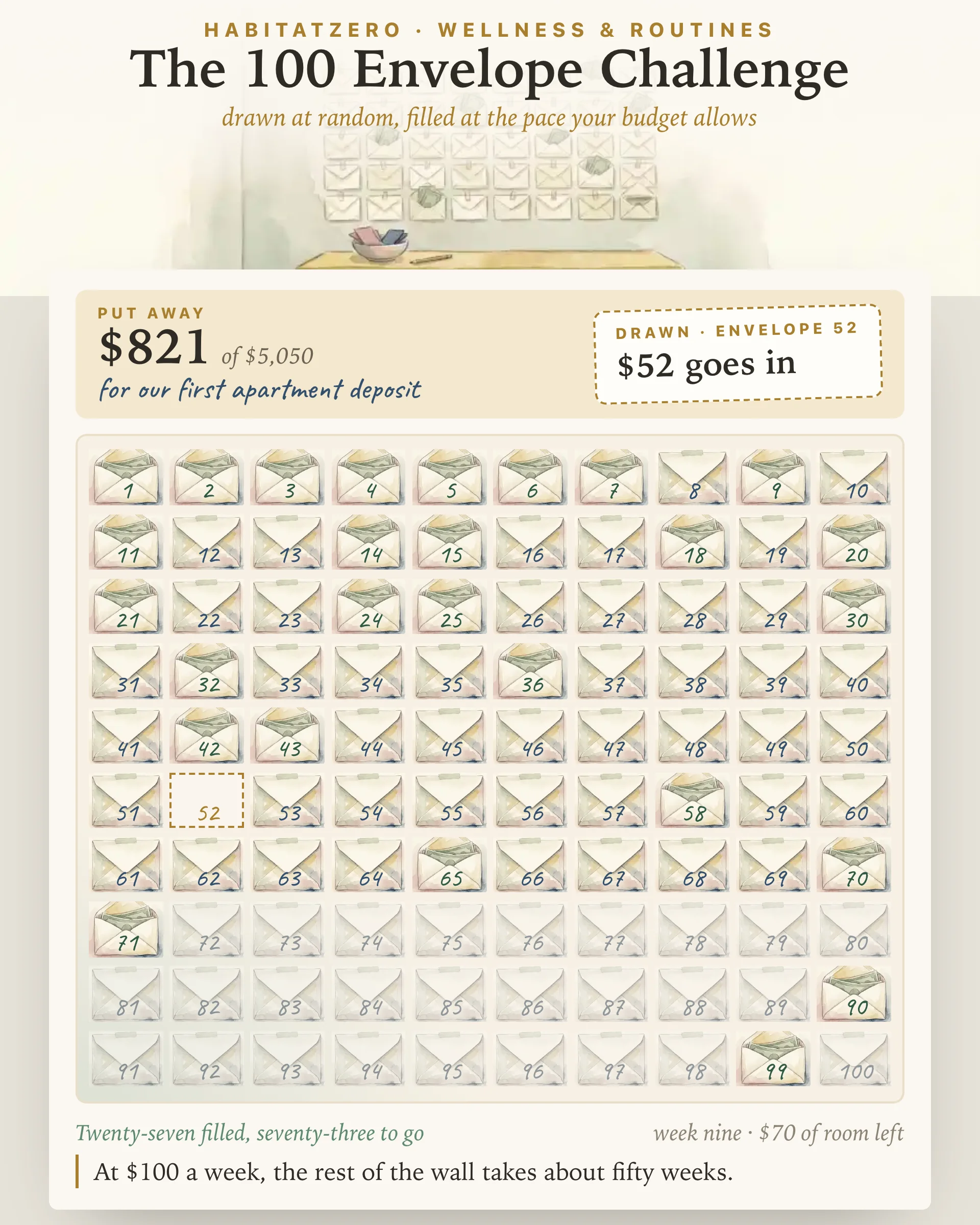
The rules fit on a sticky note. Number a hundred envelopes from 1 to 100, mix them up, and draw one. The number you pull is how many dollars go inside. Draw again the next day, and the next, until every envelope is full. When the last one is stuffed, you have saved $5,050.
That total is no accident. Pair the envelopes from the outside in, 1 with 100, 2 with 99, 3 with 98, and each pair holds $101. A hundred envelopes make fifty pairs, and fifty times $101 is $5,050. The same trick explains the half version: when each envelope holds half its number, from 50¢ up to $50, every pair is worth $50.50 and the wall comes to $2,525.
The wall at the top of this page is the challenge, painted. Press draw and it picks an empty envelope at random, takes it off the wall, and tells you what goes in. Move that money into savings, then mark it filled: the envelope fills with bills and the running total climbs. If today is the wrong day for that amount, put it back and nothing is lost. If you keep a real box of envelopes and drew from it, tap the same number on the wall instead.
Three settings make the wall fit your budget rather than the other way around. Envelope size switches between the full wall and the half one; change it midway and every filled envelope keeps what went into it, while the empty ones take the new size. Pace sets the rhythm: one a day, one a week, or what fits each week. With that last pace you slide in how much you can set aside each week, and the wall will only draw envelopes that fit the room still left. The rest fade until a week has room for them. Beneath the settings, one line estimates how long the rest of the wall will take at that pace, drawing at random the way the wall does.
For a lot of budgets it is not, and that deserves saying plainly. One envelope a day averages $50.50, which is about $354 a week, or more than $1,500 a month on top of rent, food and everything else. Some days you draw $3 and others $97. Looking at that and choosing a slower wall is not failing the challenge.
A slower pace is just as good. One envelope a week takes a hundred weeks, just under two years, at a little over $50 a week. Half size at one a week averages about $25. The what-fits pace lets a thin week put in $15 without anything breaking: the big envelopes simply wait for a week with more room. Every filled envelope is money set aside that was not there before, whichever pace filled it.
The version of the challenge you see in videos ends with a box stuffed with cash. That makes a satisfying reveal and a poor place to keep $5,000. Cash at home can be lost or stolen, it is easy to borrow from on a tight week, and it earns nothing. Treat the envelopes as the count and a savings account as the place: each time you fill one here, move the same amount into the account. The Consumer Financial Protection Bureau calls a bank or credit union account generally one of the safest places to put your money, and at an FDIC-insured bank, deposits are covered to at least $250,000.
Nobody has run a controlled trial of the 100 envelope challenge, so be wary of anyone calling it proven. What has been studied is the mechanism underneath it: dividing money into small, separate portions. In a set of experiments, Cheema and Soman found that partitioning a resource into smaller units slows how fast people use it up, because each partition adds a small pause and a fresh decision. A numbered envelope is a partition you can see.
The reason to build a cushion at all is well documented. In the Federal Reserve's survey of households for 2025, 63 percent of adults said they would cover a surprise $400 expense with cash or its equivalent, leaving more than a third who would have to reach for something else. On average, eight draws at full size come to about $400, or sixteen at half size, so a first cushion arrives long before the wall is done.
This page is a tracker for your own plan, not financial advice. If you carry high-interest debt or are unsure what to save for first, a qualified financial counselor can help you weigh it.
Most walls start in January, and the first weekend of the year is a fine time to hang one. Any fresh start works as well: a new job, a tax refund, a date you are saving toward. If you want a chart built around one goal amount of your choosing, the Savings Tracker is the better fit. If the real question is where the weekly room comes from, split your take-home pay with The 50/30/20 Budget first. And a month of The No-Spend Challenge beside the wall can free up the cash for the big envelopes.
A full wall of envelopes numbered 1 to 100 holds $5,050. Pair the envelopes from both ends, 1 with 100 and 2 with 99, and every pair makes $101, fifty pairs in all. At half size, where each envelope holds half its number, the wall comes to $2,525.
For many households it is a stretch, and there is no shame in saying so: one envelope a day averages $50.50, or about $354 a week. A slower pace is just as good. One a week takes a hundred weeks at just over $50 a week, and half size cuts every figure in two.
Yes, and plenty of people do. Pick one a week for a wall that fills in just under two years, or set a weekly amount and let the wall draw only envelopes that fit what is left of it. Envelopes too big for your week simply wait, and nothing counts as missed.
It is safer in a savings account. Let the numbered envelopes, paper or painted, keep the count, and move each amount into an account at an insured bank or credit union, where it is protected and cannot slip out of a drawer on a tight week.
This page works as one. The preview shows a wall nine weeks in; personalize it in HabitatZero, free, to draw from your own wall and keep the total between visits.
By the team behind Fabulous, the science-based self-care app used by over 30 million people.


