
The Overwhelm Recovery ProtocolWellness & Routines · ~5 min
About this template · Updated November 2026
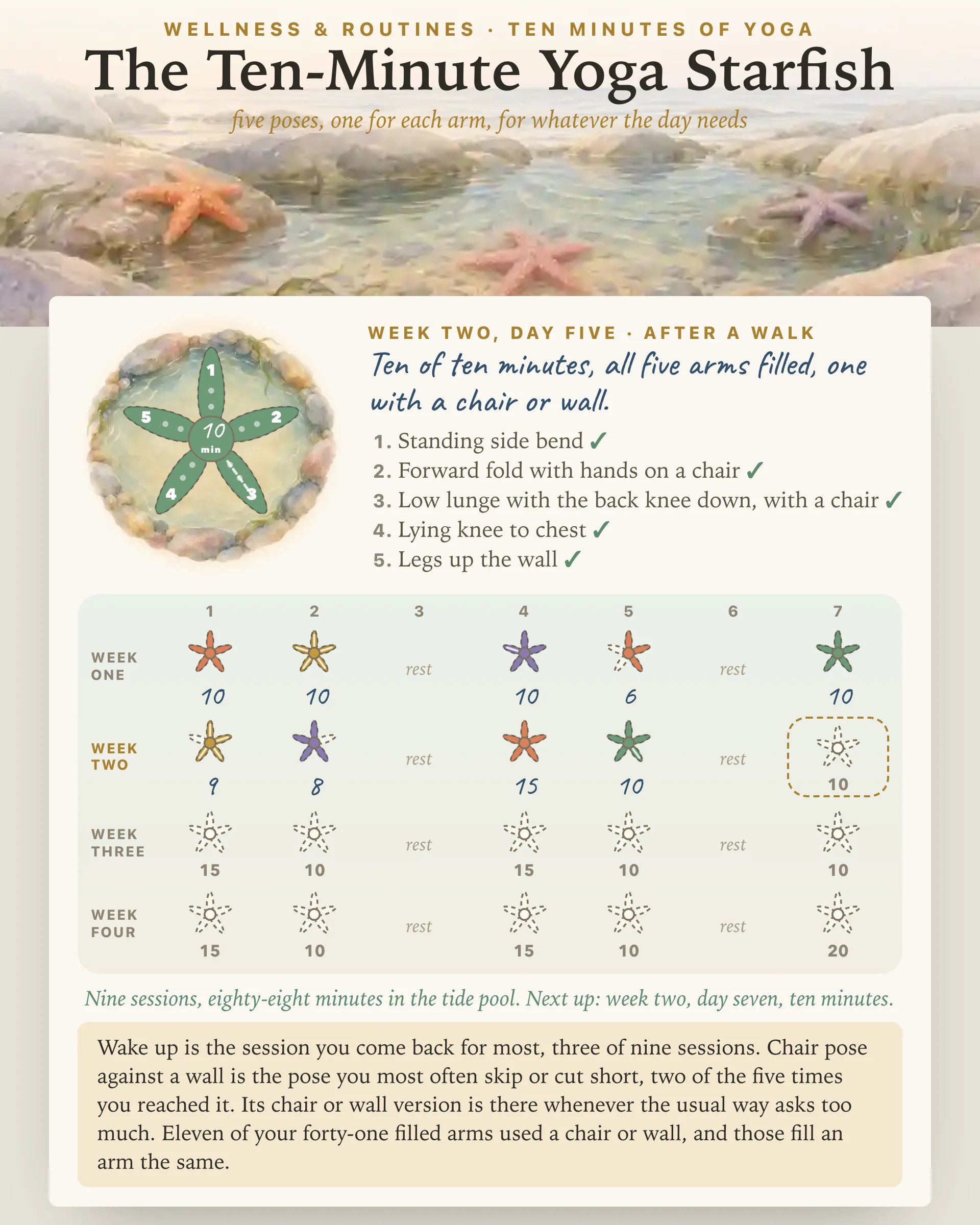
Most days hold ten minutes, not an hour for a class: before the kettle boils, between two calls, after you kick off your sneakers. Ten minutes of yoga fits any of those gaps, but a stiff back at seven in the morning wants something different from legs that just walked two miles.
Tell this page what this part of the day needs, and it hands you five poses while a clock walks you through them and the five arms of a starfish fill one by one.
Every pose has a version with a chair or wall. Cat and cow happens at the front of a seat, the lunge holds a chair back, and legs up the wall becomes sitting with your feet on a stool. Choose it for the whole session, or swap one pose while the clock runs.
At ten minutes each pose gets two, and poses done on both sides take a minute a side. Choose fifteen and each pose gets three minutes; choose twenty and it gets four.
The clock keeps real time, so a phone that locks halfway through the lunge is still in the right place when you look back. An arm fills only when its pose runs its whole time. Skip a pose and its arm stays empty, and the skipped time is never counted. End early and only whole minutes go in the log; under a minute, nothing does.
Below, a four-week tide pool keeps each finished session as a small starfish in the color of its need, minutes beside it. After a few, the page tells you which part of the day you return to most and which pose you most often skip or cut short.
Five short sessions a week, with two rest days. Week one is ten minutes each time, fifty in all. Week two slips in one fifteen, week three has two, and week four ends on a twenty. Each day suggests a length; you can always pick another.
Short sessions count. When the US physical activity guidelines were updated in 2018, the team at the Department of Health and Human Services that summarized them dropped the old rule that activity had to come in blocks of ten minutes or more: moderate activity of any length now adds to the weekly total. Most held poses are light effort, though, so let these sessions join walking and strength work in a week of moving more and sitting less, not replace them.
The trials of brief yoga are small. Researchers at the University of Western Sydney had twenty office workers do fifteen minutes of seated poses at their desks, and they rated their stress lower than after ordinary work. Each did it once, and the changes in heart rate and breathing faded afterward. Sport scientists in New Zealand gave twenty women in strength sports ten minutes of yoga a day for one menstrual cycle; they reported cramps, bloating and stress less often than in cycles without it. Twenty people, their own ratings, one month: a hint worth having, not proof. Nothing here shows that ten minutes a day makes you flexible by a set date, changes your weight or clears anything out of your body.
With back, hip or knee pain, a recent injury or surgery, high blood pressure, or a pregnancy, ask a doctor or physical therapist which poses suit you, and stop any pose that hurts. If you have glaucoma, ask about the head-down poses: eye researchers in New York measured eye pressure during four of them in twenty people, ten with glaucoma, and on average it rose within a minute in all four, legs up the wall and the standing forward bend included, then settled within two minutes of sitting up. The chair versions keep your head higher.
The 10-Minute Kitchen Timer Workout is short exercise that gets you breathing harder, not held poses. The Morning Yoga Sundial is one flow for the start of the day. The Yoga Mannequin teaches twelve poses over six weeks, two at a time. This page is ten minutes shaped to whatever the day is doing now.
Open it when a gap appears and you know what it is for: a stiff start, a long sit, tired legs, a busy head at night. Pick the need, keep the plan's minutes or choose fifteen or twenty, and let the starfish fill.
Ten minutes is long enough for five slow poses held two minutes each, and since 2018 the US activity guidelines count moderate activity done in stretches of any length. Most held poses are light effort, so let these sessions sit beside walking and strength work in your week rather than stand in for them.
Here it depends on the moment. Waking up runs from cat and cow to a forward fold with your hands on a chair. A desk break adds a seated twist. After a walk brings in knee to chest and legs up the wall. Winding down stays close to the floor.
The five poses stay the same and each hold gets longer: three minutes a pose at fifteen, four at twenty, with poses done on both sides split evenly. The four-week plan works in one fifteen during week two and finishes week four with a twenty.
Yes. Every pose has a version with a chair or wall: cat and cow sitting at the edge of a seat, the lunge holding a chair back, and legs up the wall swapped for sitting with your feet on a stool. Pick it for the whole session or for one pose at a time.
Anyone with back, hip or knee pain, a recent injury or surgery, high blood pressure, or a pregnancy should ask a doctor or physical therapist which poses suit them. With glaucoma, ask about the head-down poses, such as a forward fold or legs up the wall, since eye pressure rises in poses like these. Stop any pose that hurts.
By the team behind Fabulous, the science-based self-care app used by over 30 million people.


