
The Overwhelm Recovery ProtocolWellness & Routines · ~5 min
About this template · Updated November 2026
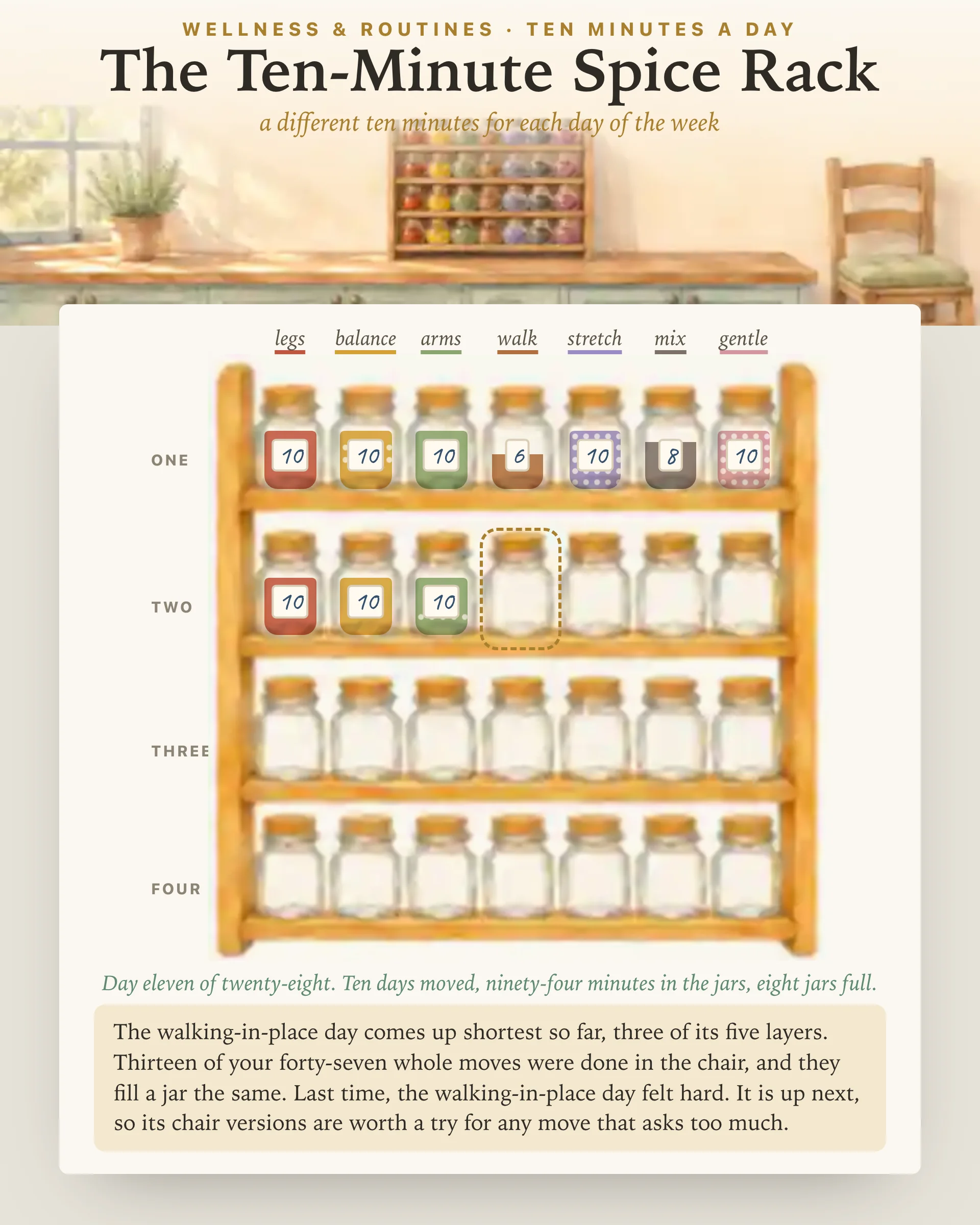
Most days can spare ten minutes: the stretch before lunch, the gap after the morning news. The hard part of a 10 minute exercise for seniors is rarely the time. It is repeating the same five moves until they bore you, or never reaching balance work. This page gives each day of your week its own ten minutes and keeps them on a spice rack, one jar per day.
Day one is legs: marching in place, sit to stand, heel raises, side leg lifts and a calf stretch. Day two is balance, with a hand on the kitchen counter for every standing move. Day three works your arms and upper back. Day four is walking in place, from an easy march to a brisk one and back down. Day five is stretching. Day six mixes moves from the legs, arms, balance and stretch days, and day seven is gentle: slow breathing, ankle circles and an easy stroll around your rooms.
Each day is five moves of two minutes. Work at your own pace and rest inside the two minutes whenever you like. Every move has a chair version in plain words. Choose standing with the chair at hand, or all in the chair, and while the timer runs you can turn any single move to its other version.
Press start and the page leads you through the five moves, showing what to do and how much time is left, and tells you when to switch sides. It reads the clock itself, so a phone that dims keeps true time, and a pause holds it until you go on.
A move pours its layer into the jar only once its whole two minutes have run. Skip a move and its time is left out. End early and only the whole minutes you moved go in. Later the same day you can go on with the moves that are left, and a jar never holds more than ten minutes.
The rack has four shelves, one per week, with seven jars on each. Every whole move adds a layer, dotted when it was done in the chair, and a label on the glass holds the day's minutes. Days count from your own sessions rather than the calendar, so a missed day leaves no gap. Once a day is done, tap whether it felt easy, about right or hard. A reading under the rack says which day of your week comes up shortest, how many moves you did seated, and which day felt hard the last time it came round.
US guidelines ask older adults for activity that mixes balance training with aerobic and strengthening work, and note that the least active people gain the most from even modest increases (Piercy and colleagues, 2018). Ten minutes a day comes to seventy minutes a week, about half the 150 minutes of moderate activity they suggest, and not all of it is moderate. Let walks and active chores add the rest.
A review by members of the committee behind those guidelines found that activity in bouts of any length was linked with better health, including lower death rates (Jakicic and colleagues, 2019). That evidence came from surveys and observational studies of adults in general, not older adults in particular, and the randomized trials it found had only tested bouts of ten minutes or longer.
Trials in older people are few and small. Exercise researchers at an Australian university gave thirty-eight adults around seventy, most of them women, four weeks of nine-minute home strength sessions, once, twice or three times a day (Fyfe and colleagues, 2022). Everyone finished, most sessions got done, and only two problems were reported in more than thirteen hundred sessions. But chair-stand scores improved about as much in a comparison group that carried on as usual, so the trial shows short sessions are workable, not that they build strength. In a smaller pilot, a university team in England split twenty healthy people around seventy at random, and half did brief strength moves at home twice a day for four weeks (Perkin and colleagues, 2019). In those ten, how often they could stand up from a chair in one minute rose by about a third, while the other ten saw no change. Twenty people over one month cannot say whether such gains last or matter in daily life.
None of these studies tested this rotation of days, and nothing here is shown to prevent falls.
The Patchwork Week lays out longer sessions, fifteen to thirty minutes, pairing kinds of exercise across your chosen days. The Chair Circuit builds a seated circuit around the body areas you pick. The Folding Screen gives ten joint-by-joint moves a minute each. This page fixes the length at ten minutes and changes the moves instead, a new set for each day of the week, with a chair version always one tap away.
Talk with your doctor or a physical therapist first if you have had a fall, dizzy spells, a joint replacement, a heart or blood pressure condition, or pain that has not settled. Stop any move that hurts. Hold the counter for every standing balance move, and use a sturdy chair without wheels, pushed against a wall. Chest pain, unusual breathlessness or dizziness means sit down, stop and get checked.
It is a real start, though not the whole amount. US guidelines ask older adults for about 150 minutes a week of moderate activity plus strength and balance work, and ten minutes a day comes to seventy. They also say short stretches of activity count, so walks and active chores can fill in the rest.
Over a week, a little of everything: leg strength such as sit to stand, balance holds at a counter, arm and back work such as push-ups against a wall, marching to raise your breathing, and gentle stretching. This page gives each of those its own day, plus one mixed day and one gentle day.
Yes. Each of the twenty-eight moves has a chair version written out in plain words, and a seated move fills the jar the same as a standing one. Choose all in the chair before you start, or swap one move at a time while the timer runs.
Only what you did is kept. The whole minutes you moved go in the jar, and any move that ran its full two minutes adds its layer. Later the same day you can go on with the moves that are left.
For most people, yes, and some activity beats none. Talk with your doctor or a physical therapist first if you have fallen, felt dizzy, had a joint replaced, or have a heart or blood pressure condition or pain. Stop any move that hurts, and hold the counter for every standing balance move.
By the team behind Fabulous, the science-based self-care app used by over 30 million people.


