Is Estrogen the Best Longevity Drug?
399. You Are the Experiment: Hormones, Peptides & Longevity with Dr. Amy Killen
The brief
Dr. Amy Killen argues that estrogen is the most effective, cheapest longevity drug available, yet women avoid it out of outdated fear. She and Dr. Kelly Casperson explain why only 5% of women use hormone therapy today, versus 30% in the 1990s, and why starting hormones even at 73 can still protect bone and pelvic floor health.
A commuter jet lands in Bellingham, Washington, carrying seventy-six passengers. The crew calls for five wheelchairs. Dr. Kelly Casperson, a urologist and the podcast's host, does the math in her head: 6.6 percent of the plane needed help walking off of it (38:37). The number stays with her, because it is not really a number about wheelchairs. It is a number about how many people are living longer than they are living well.
That gap, between how long a body survives and how long it functions, is the subject Casperson and her guest, physician Dr. Amy Killen, spend an hour circling. Killen spent almost ten years working emergency medicine shifts in Austin before she noticed the obvious: stress, bad sleep, and poor food were going to turn her into a patient too (02:20). She moved into hormone therapy and longevity medicine at a moment when almost no one took either seriously. The conversation that follows is less a tour of supplements than an argument about what medicine has decided counts as a disease, and what it has decided does not.
The Natural Fallacy
Killen and Casperson start with a word that derails almost every public talk either of them gives: natural. Someone always asks whether a hormone is natural, as if that settles anything. Casperson's answer is that anthrax is natural, and so is being eaten by a lion (05:36). Killen's version is sharper.
"Natural is not better. Better is better. That's it. Whatever works the best is better." — Dr. Amy Killen [06:56]
The point connects to something larger happening at the regulatory level. Casperson mentions a recent conference where FDA officials signaled they might approve treatments for cellular health itself, not just for named diseases (02:57). That would be a real shift. Right now, a drug only gets approved if it fixes a condition with a billing code. Nothing in the system rewards keeping someone healthy in the first place. Whether aging itself counts as a disease is an old argument, but Killen's framing cuts through it: the label matters less than the fact that something is changing a person's physiology for the worse, and medicine should be allowed to intervene before it becomes one of the diseases it already treats (04:31).
Menopause gets caught in the same logic. A woman is not diagnosed until a full year has passed without a period, which means doctors are naming a condition based on what did not happen last year, not on what is happening in a patient's body today (09:41). Casperson points to a recent analysis built from roughly 300 million lab results, which found that metabolic and cardiovascular markers, bone density, lipids, insulin resistance, begin shifting about ten years before a woman's final period, not at some arbitrary birthday (10:35). Men decline gradually. Women fall off a cliff, and the cliff starts long before anyone calls it menopause (10:57).
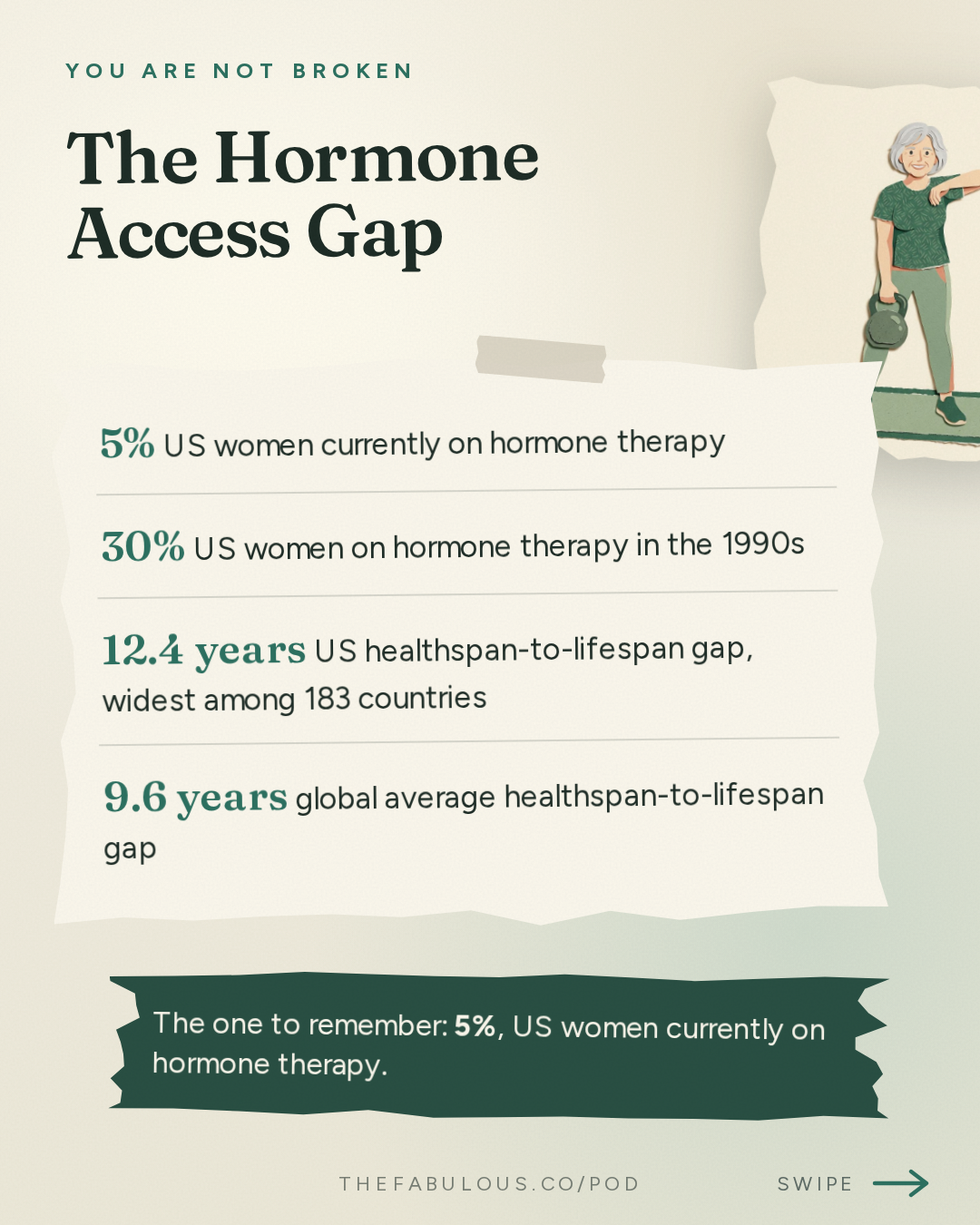
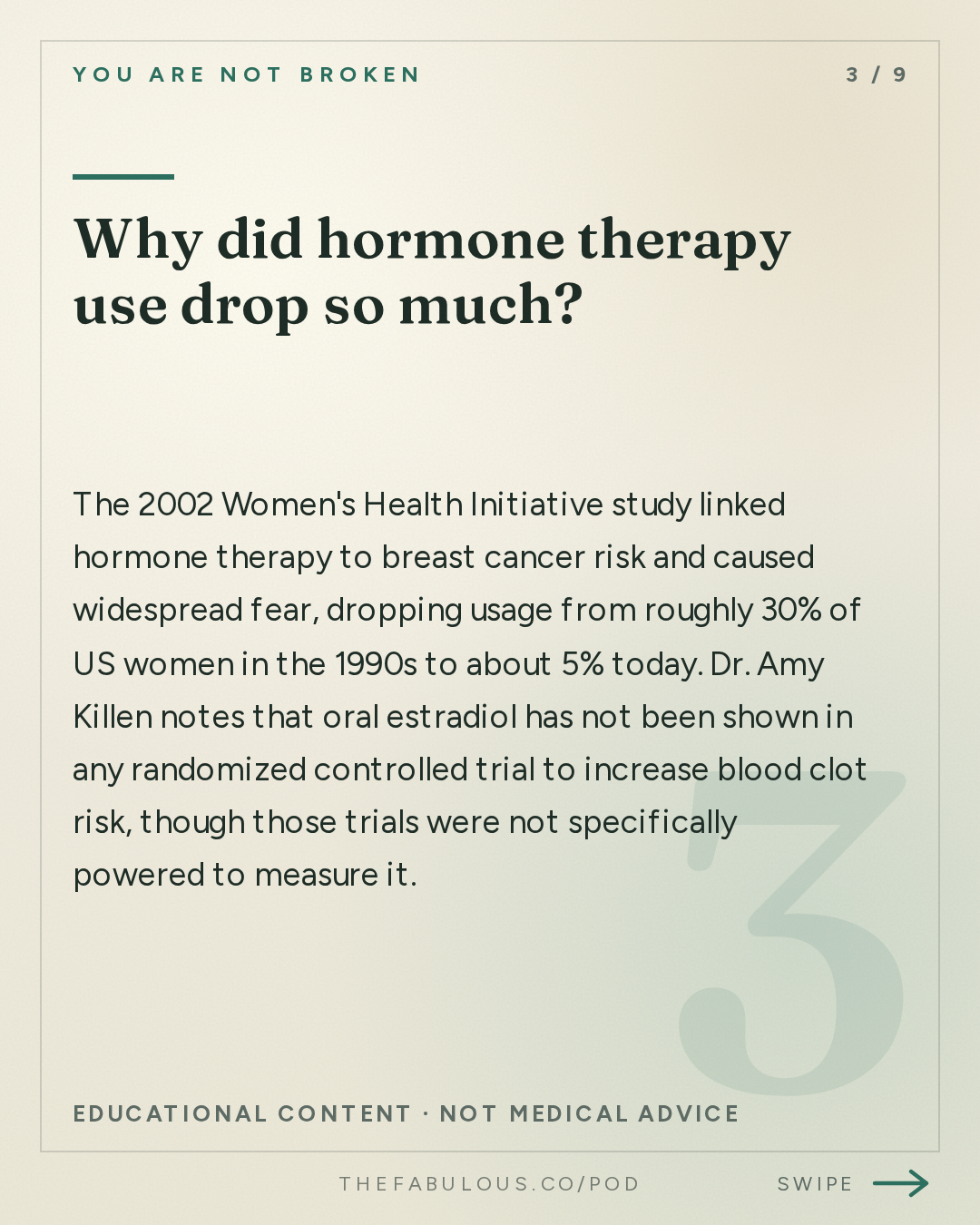
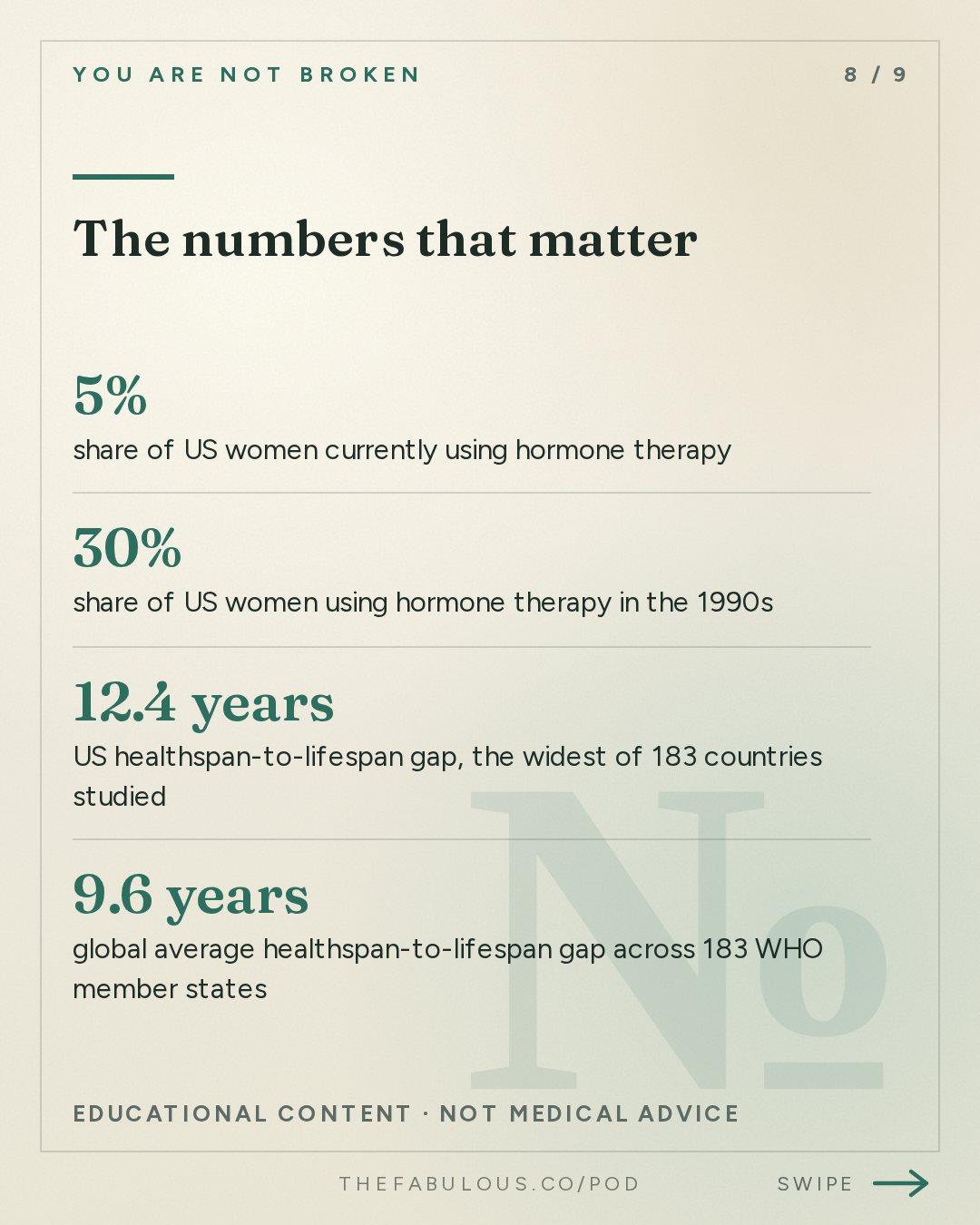
The practical fallout is an access collapse that both doctors find hard to explain to outsiders. Hormone therapy use among American women has dropped from roughly 30 percent in the 1990s to about 5 percent today (16:22, 16:47), a legacy of the 2002 Women's Health Initiative study, which linked hormone therapy to breast cancer risk in ways later research has complicated considerably. Casperson notes that even a celebrity example, like Martha Stewart's public admission that she has used hormones for forty years at age 82, matters because it gives ordinary women permission to say the same thing without shame (14:02).
A Cheap Drug Nobody Will Prescribe
The episode's sharpest argument is also its simplest. A newly published JAMA Network study measured the healthspan-lifespan gap, the number of years a person lives in poor health, across 183 World Health Organization member countries. Globally, that gap averages 9.6 years (31:22). The United States has the widest gap of any country studied: 12.4 years (32:12). Women fare worse than men everywhere, spending about 25 percent more time in poor health near the end of life, largely from chronic disease (32:12).
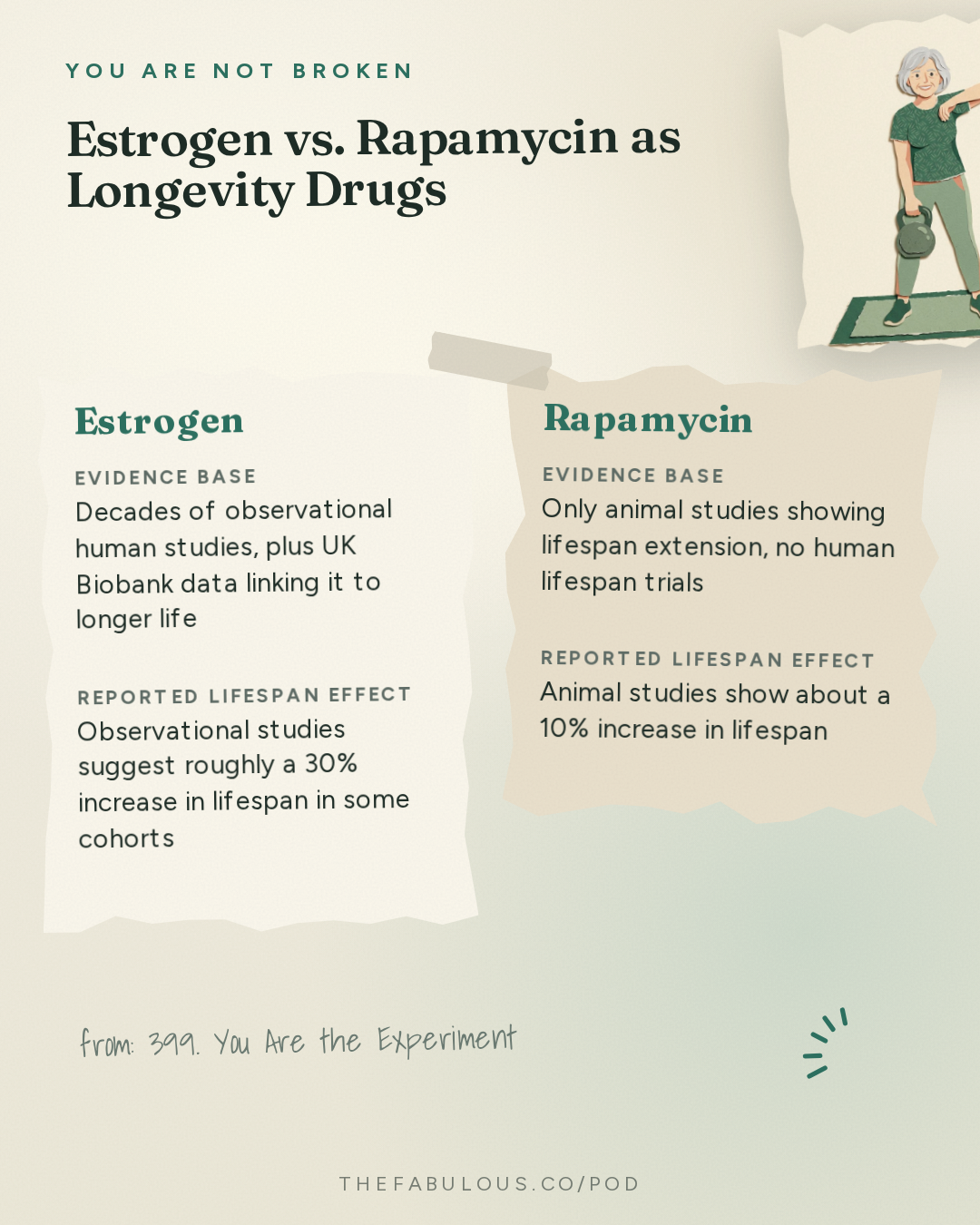
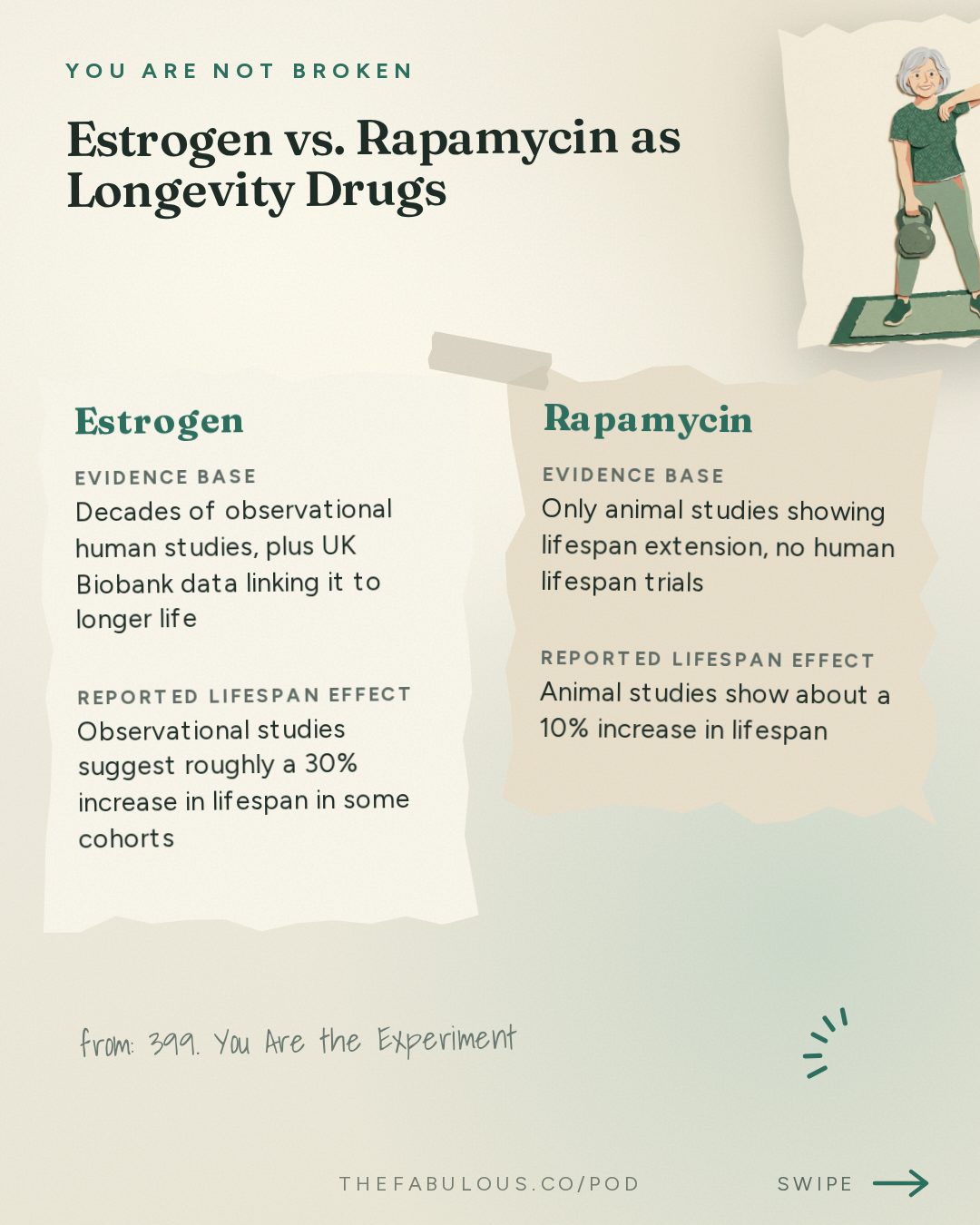
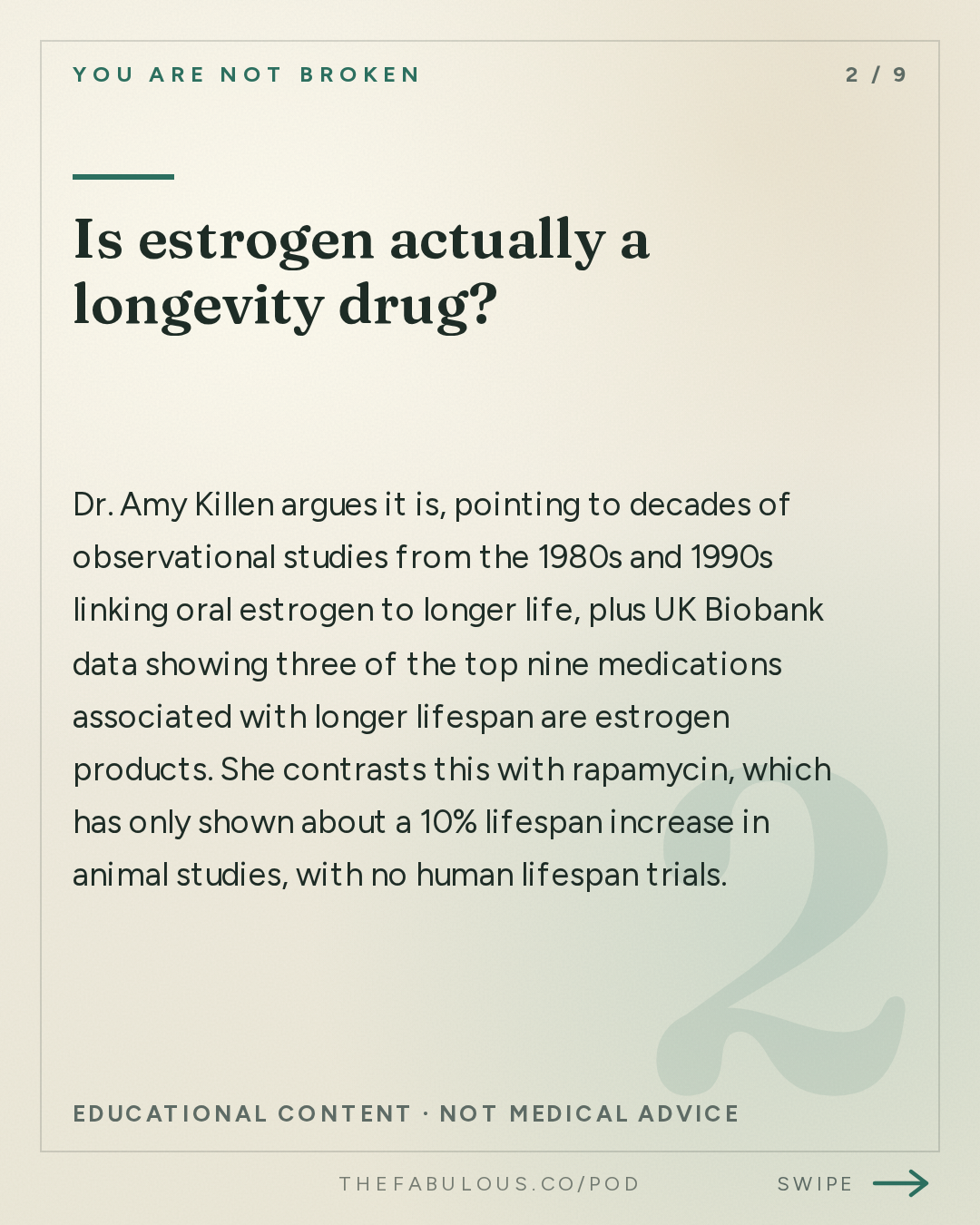
Killen's frustration is that longevity conferences, still dominated by male researchers, obsess over drugs like rapamycin and dasatinib while ignoring a treatment already sitting on pharmacy shelves. Rapamycin and similar compounds have only ever shown benefit in animal studies, and even there, the gains are modest, around a 10 percent increase in lifespan (34:06). Oral estradiol costs about three to thirty dollars a month, depending on supplier (34:06, 36:56), and decades of observational research from the 1980s and 1990s associate it with meaningfully longer life. Data from the UK Biobank, a long-running health database, found that three of the top nine medications associated with longer lifespan were estrogen products (52:19).
"It is the most successful longevity drug in existence, and we act, we act as if it's gonna kill you." — Dr. Amy Killen [34:06]
Killen also pushes back on the clot-risk narrative that still shapes prescribing habits. No randomized controlled trial of oral estradiol has shown an increased blood clot risk, though the major trials were not statistically powered to measure that outcome specifically (37:24). She is careful not to overclaim certainty, but the imbalance bothers her: women are told to fear a drug with a thin, inconclusive risk signal, while a very real and well-documented risk goes almost unmentioned.
That risk is falling. As many Americans die from falls each year as die from breast cancer or car accidents, somewhere between 35,000 and 40,000 deaths annually (39:02). One in two women over 50 will break a bone due to osteoporosis or osteopenia (39:36), and hormone therapy reduces osteoporosis risk by roughly half (39:02). Killen describes her own mother's case: osteopenic, not yet osteoporotic, stable on bioidentical estrogen and progesterone for years, until she broke her hip. The surgical team crossed out her hormone prescription on discharge paperwork and sent her home without it, recovering from a fracture that the hormones may have helped prevent in the first place (40:19). A 2025 JAMA trial comparing testosterone to placebo after hip fracture found that individualized testosterone therapy cut the need for a cane or walker at six months by half (42:16), a result Casperson says has not visibly changed clinical protocols despite being randomized and placebo-controlled.
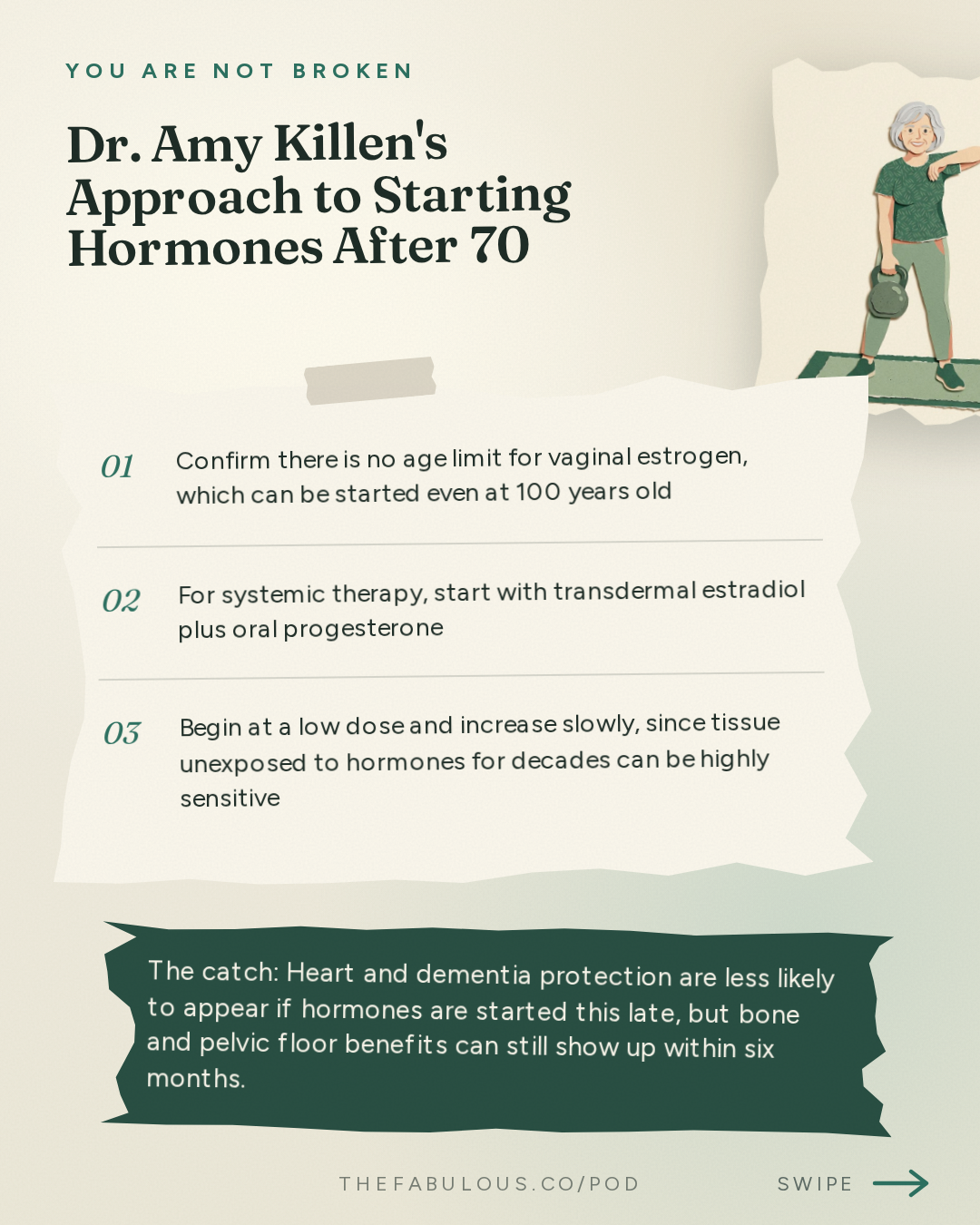
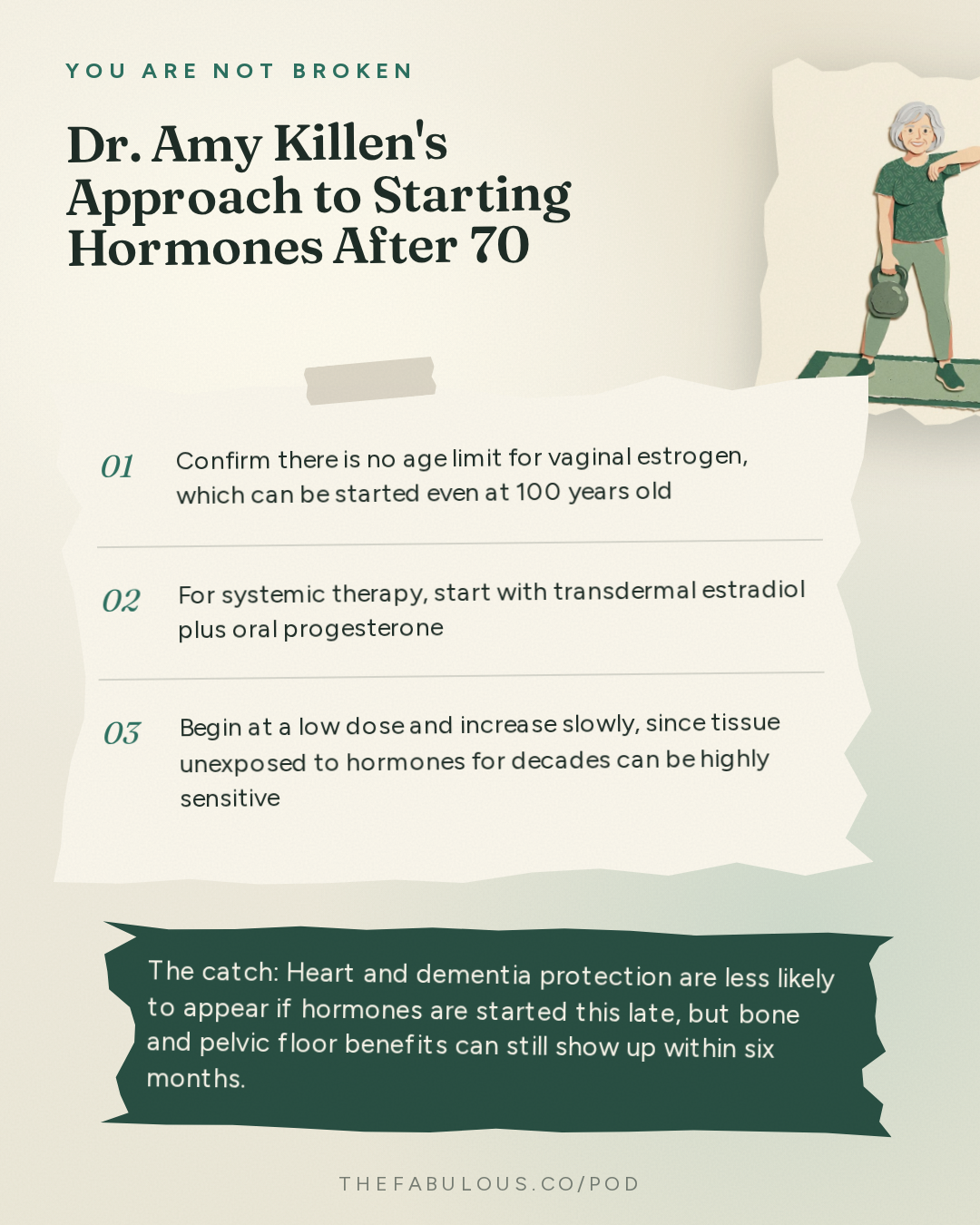
None of this means hormones are for everyone, or that starting is simple past a certain age. Casperson tells the story of a hypothetical 73-year-old who has been turned away by five doctors already. Her answer: no one is too old for vaginal estrogen, which works even at 100 (45:26). For systemic therapy that late, the calculation shifts from weighing cancer or heart disease risk to weighing side effects, mild things like breast tenderness or unexpected spotting, against real, if narrower, benefits (45:47). Heart and dementia protection are less likely to materialize starting that late, but bone density and pelvic floor tissue still respond, often within six months (46:27). The advice is to start low and go slow, because tissue that has not seen hormones in twenty years can be unexpectedly sensitive (48:09).
The conversation closes on something neither doctor treats as a hormone question at all: strength. Killen calls lifting heavy things, a body, a kettlebell, a band, at least two or three times a week, the highest-return habit available to anyone trying to stay mobile (49:48). Casperson adds that body composition, not the number on a bathroom scale, is the metric that predicts how someone ages, and recommends a DEXA scan after 40, noting that Medicare's own cutoff of 65 for covering the scan is a budget decision, not a medical one (51:08). It brings the episode back to the plane in Bellingham. The wheelchairs were not an accident of time. They were, in a lot of cases, the compounded result of hormones withdrawn too early, muscle never built, and a medical system that waited for consensus instead of treating the decade of decline that was already visible in the labs.
Ask this episode anything
Pod's AI answers from the episode itself, with the minute mark so you can hear it yourself.
Or start with one of these
Ask this episode
Pod's AI listens to the whole episode to answer, and points you to the minute it comes from.
The rest of this answer, and any question after it
Answers come from the episode itself, never from a summary of it.
ContinueKey takeaways
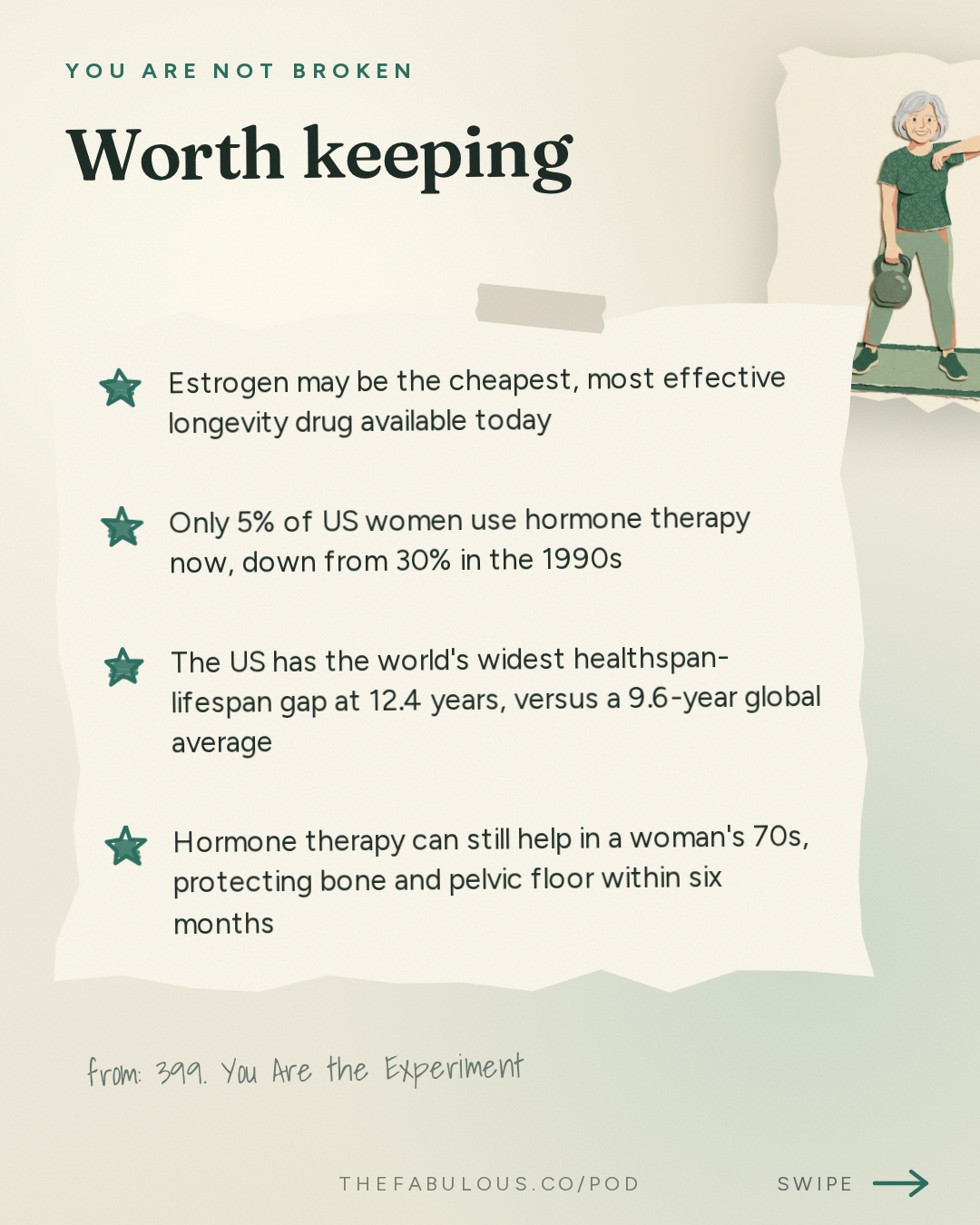
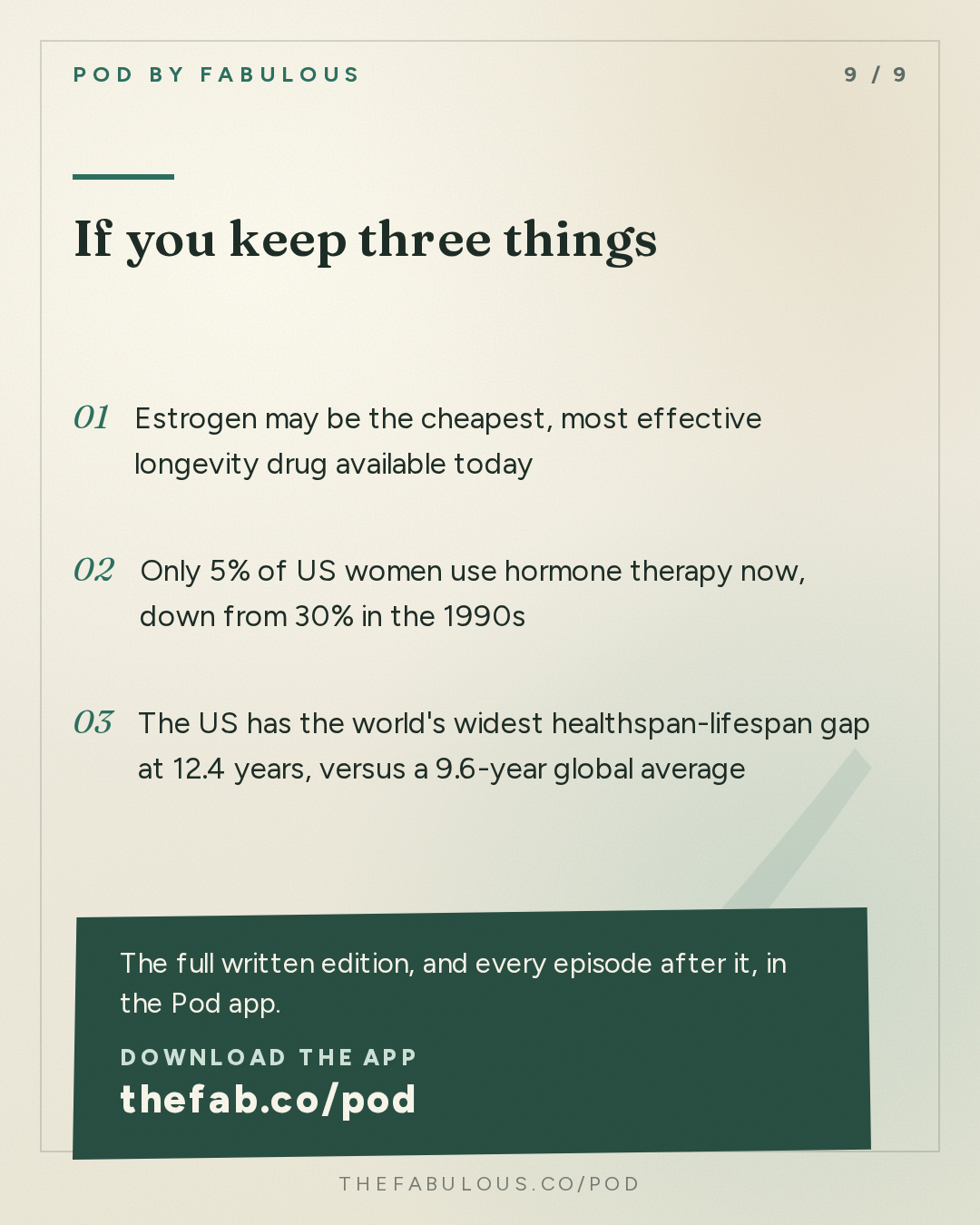
- Estrogen may be the cheapest, most effective longevity drug available today
- Only 5% of US women use hormone therapy now, down from 30% in the 1990s (16:22, 16:47)
- The US has the world's widest healthspan-lifespan gap at 12.4 years, versus a 9.6-year global average (31:22, 32:12)
- Hormone therapy can still help in a woman's 70s, protecting bone and pelvic floor within six months (46:27)
- Falls kill as many Americans yearly as breast cancer, roughly 40,000 deaths, making strength training a longevity priority (39:02, 49:40)
The episode in cards

By the numbers
- 5% percent share of US women currently using hormone therapy
- 30% percent share of US women using hormone therapy in the 1990s
- 12.4 years US healthspan-to-lifespan gap, the widest of 183 countries studied
- 9.6 years global average healthspan-to-lifespan gap across 183 WHO member states
- 40,000 deaths/year annual US deaths from falls, comparable to breast cancer deaths
- $9 dollars cost of a 90-day supply of oral estradiol
In their words
“Natural is not better. Better is better. That's it. Whatever works the best is better.”
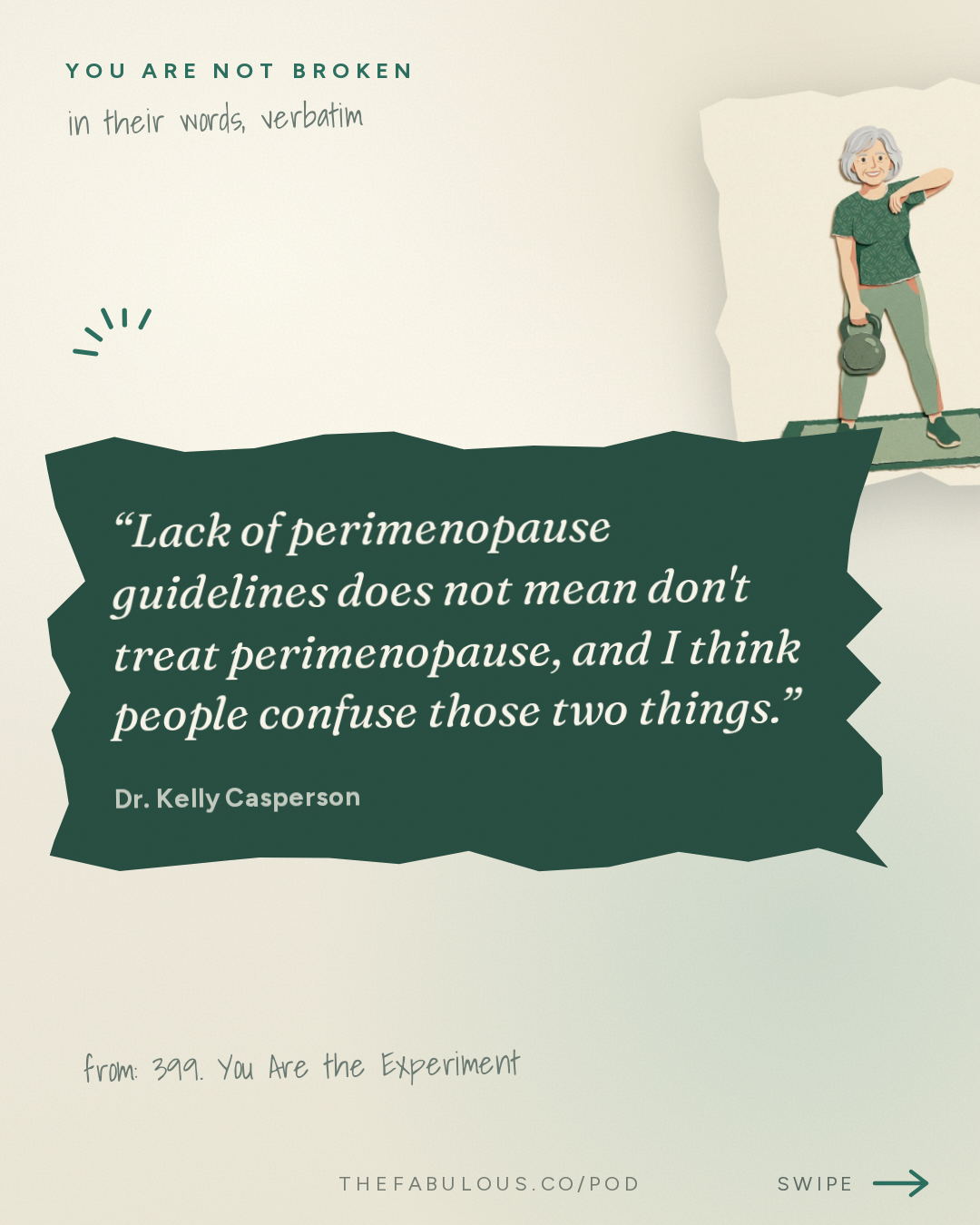
“Lack of perimenopause guidelines does not mean don't treat perimenopause, and I think people confuse those two things.”
“It is the most successful longevity drug in existence, and we act, we act as if it's gonna kill you.”
“Did you know as many people die in America every year of falls as breast cancer?”
Protocols
-
Starting hormone therapy after 70
Dr. Amy Killen says there is no age limit for vaginal estrogen, which can be started even at 100 years old, and for systemic therapy she typically uses transdermal estradiol with oral progesterone, starting at a low dose and increasing slowly because tissue unexposed to hormones for decades can react strongly, with side effects like sore breasts or spotting treated as normal unless they persist.
Low starting dose, increased gradually over months
-
Evaluating testosterone therapy by feel, not just labs
Dr. Kelly Casperson prioritizes how a patient feels and any side effects over the serum testosterone number itself, because testosterone levels do not consistently correlate with symptoms or well-being, and she checks lab values last rather than first.
Ongoing, reassessed at follow-up visits
-
Using investigational peptides more safely
Dr. Amy Killen tells patients considering non-FDA-approved peptides to source them only from a 503A certified compounding pharmacy, never from internet or unregulated sellers, and to understand that most of these peptides, including BPC-157, lack human safety data and remain investigational.
As needed, with monitoring of liver function, cholesterol, and blood pressure
-
Strength training as the top longevity habit
Dr. Amy Killen recommends lifting heavy things, whether body weight, a kettlebell, or a resistance band, at least two to three days a week as the highest-return lifestyle habit for long-term health.
2 to 3 days per week
Questions this episode answers
Is estrogen actually a longevity drug?
Dr. Amy Killen argues it is, pointing to decades of observational studies from the 1980s and 1990s linking oral estrogen to longer life, plus UK Biobank data showing three of the top nine medications associated with longer lifespan are estrogen products (52:19). She contrasts this with rapamycin, which has only shown about a 10% lifespan increase in animal studies, with no human lifespan trials (34:06).
Why did hormone therapy use drop so much?
The 2002 Women's Health Initiative study linked hormone therapy to breast cancer risk and caused widespread fear, dropping usage from roughly 30% of US women in the 1990s to about 5% today (16:22, 16:47). Dr. Amy Killen notes that oral estradiol has not been shown in any randomized controlled trial to increase blood clot risk, though those trials were not specifically powered to measure it (37:24).
Is it too late to start hormone therapy at 70 or older?
Dr. Amy Killen says no one is too old for vaginal estrogen, which works even at age 100, and systemic hormones can still be started in the 70s (45:26). Heart and dementia protection are less likely to appear if started this late, but bone density and pelvic floor tissue still respond, often within six months (46:27).
What is the US healthspan-lifespan gap?
A JAMA Network study across 183 World Health Organization member states found the United States has the widest gap between lifespan and healthspan of any country studied, at 12.4 years, compared with a global average of 9.6 years (31:22, 32:12). Women everywhere have a larger gap than men, spending about 25% more time in poor health near the end of life (32:12).
Are peptides like BPC-157 safe to use?
Dr. Amy Killen says most popular peptides, including BPC-157, have only been studied in animals, not humans, and she advises sourcing them only from a 503A certified compounding pharmacy rather than unregulated internet sellers (23:26, 24:18). Her main concerns are the lack of long-term human safety data and inconsistent supply quality.
How much does falling contribute to death and disability in older adults?
As many Americans die annually from falls as from breast cancer or car accidents, roughly 35,000 to 40,000 deaths a year, and one in two women over 50 will break a bone from osteoporosis (39:02, 39:36). Dr. Amy Killen and Dr. Kelly Casperson point to hormone therapy, which reduces osteoporosis risk by about 50%, and strength training at least two to three times a week as the top interventions (39:02, 49:40).
The full read, in cards
Go deeper
- Nature paper on metabolic and cardiovascular markers around menopause — analyzed roughly 300 million lab results and found markers shift about ten years before a woman's final period
- JAMA Network global healthspan-lifespan gap study — measured the gap between lifespan and healthspan across 183 WHO member states, finding the US had the widest gap at 12.4 years
- JAMA randomized trial of testosterone versus placebo after hip fracture (2025) — found a 50% decreased risk of needing a cane or walker at six months with individualized testosterone therapy
- UK Biobank analysis of medications linked to longer lifespan — found three of the top nine medications associated with longer life were estrogen products
Mentioned
Dr. Amy Killen · Dr. Kelly Casperson · Substack · FDA · Martha Stewart · BPC-157 · Mark Cuban · JAMA Network · World Health Organization · Women's Health Initiative (WHI) · UK Biobank
More from this show and category
Vibrator Benefits for Menopause and Pelvic Health
Dr. Kelly Casperson, a board-certified urologist, explains that the clitoris and penis form from the same embryonic tissue, that most women need clitoral stimulation to orgasm, and that clinical studies show vibration therapy eases pelvic pain and incontinence, with no evidence it causes numbness or addiction (43:47, 37:59).
Marty Klein on Sexual Intelligence and ED
Sex therapist Dr. Marty Klein says erectile dysfunction is usually about expectation, not biology, and genital function barely predicts sexual satisfaction. He also warns that AI relationships remove the friction, messiness, and empathy that make human connection and personal growth possible.
Vibrator Myths vs. the Science of Arousal
Urologist Kelly Casperson debunks vibrator myths: they don't cause nerve damage or addiction, and data show real pelvic health benefits (42:45). She explains that the clitoris and penis share the same embryonic origin (09:46), that most women don't orgasm from penetration alone (10:18), and that arousal often comes before desire, not after (14:00).
Chronic Testicular Pain: Causes and Treatment
Urologist Dr. Susan McDonald explains why chronic testicular pain is common but routinely dismissed, and how a careful surgery can cure it. She also describes being diagnosed with stage 4 de novo breast cancer while working as a surgeon, and how her hospital employer tied her health insurance to full-time status during treatment.
