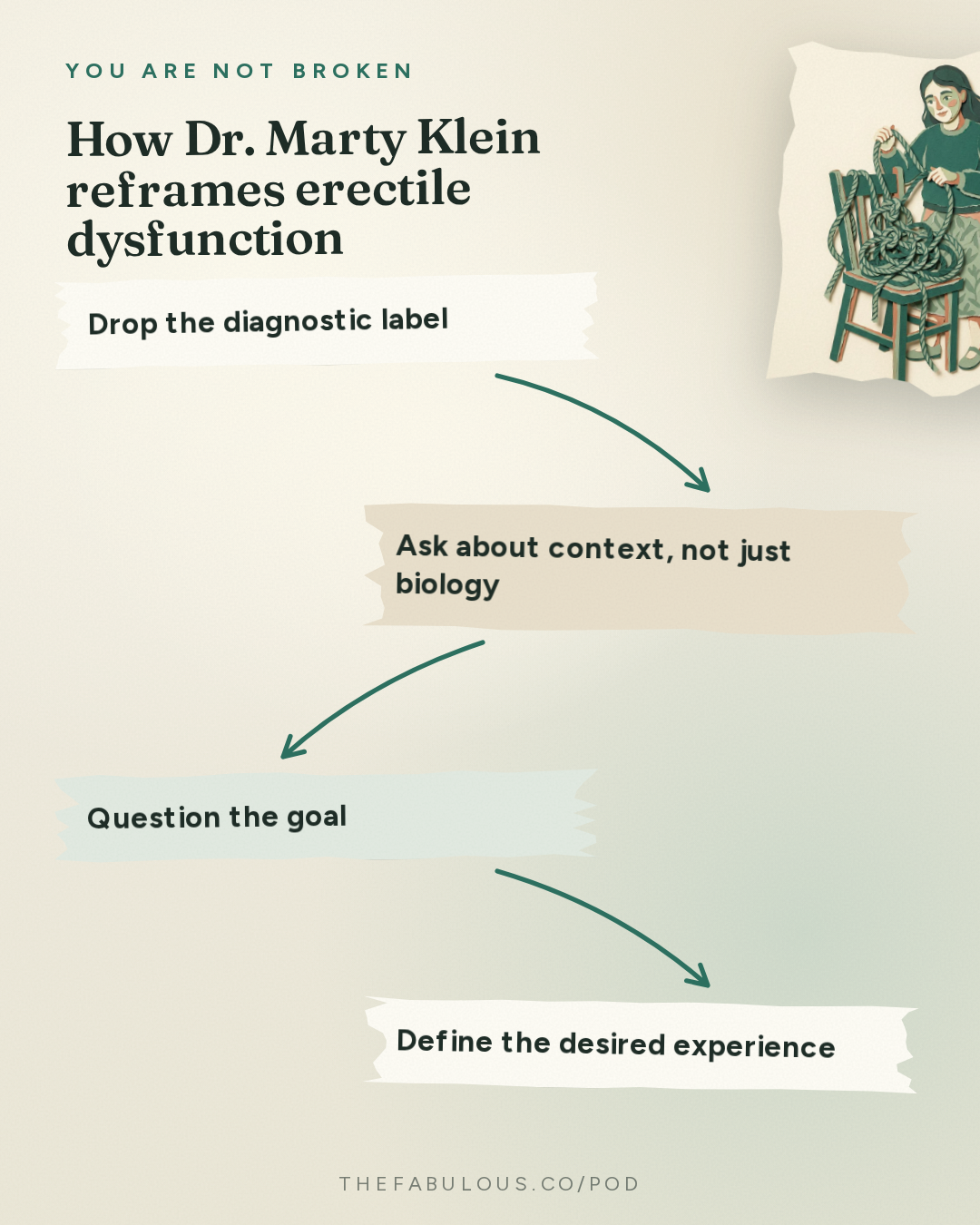
Marty Klein on Sexual Intelligence and ED
396. Hope Is Not a Strategy — Dr. Marty Klein on Communication, Masculinity, and What Makes Sex Satisfying
The brief
Sex therapist Dr. Marty Klein says erectile dysfunction is usually about expectation, not biology, and genital function barely predicts sexual satisfaction. He also warns that AI relationships remove the friction, messiness, and empathy that make human connection and personal growth possible.
Half the patients who walk into Dr. Marty Klein's office in Palo Alto are software engineers. He says it almost as a punch line, but the diagnosis behind it is serious: these are people, men and women both, who think about sex the way they think about code (01:05). They want it to work. They are not sure what working even means. They are, in his words, all up here, lacking much connection with their bodies (01:12). It is tempting to file this under Silicon Valley eccentricity, but Klein, who has been practicing for decades, thinks the pattern is universal. Once an adult decides how sex works, he says, that person will keep the theory for life, whether it serves them or not, unless something forces the question (01:35).
What forces the question, in his telling, is rarely insight. It is friction. A couple is in bed, bodies entwined, and the man loses his erection. Most couples, Klein says, turn away from each other at that exact moment, or start an argument, and that is the end of it (03:59). Nobody notices that a decision just got made. He spends a lot of session time slowing that moment down, pointing out that people are making choices so quickly they mistake the choice for a fact about the world (03:36). The fix sounds almost too simple: notice the decision, and you can make a different one (04:22). Klein's own gloss on this is blunt. It's simple, he says, but it's not easy.
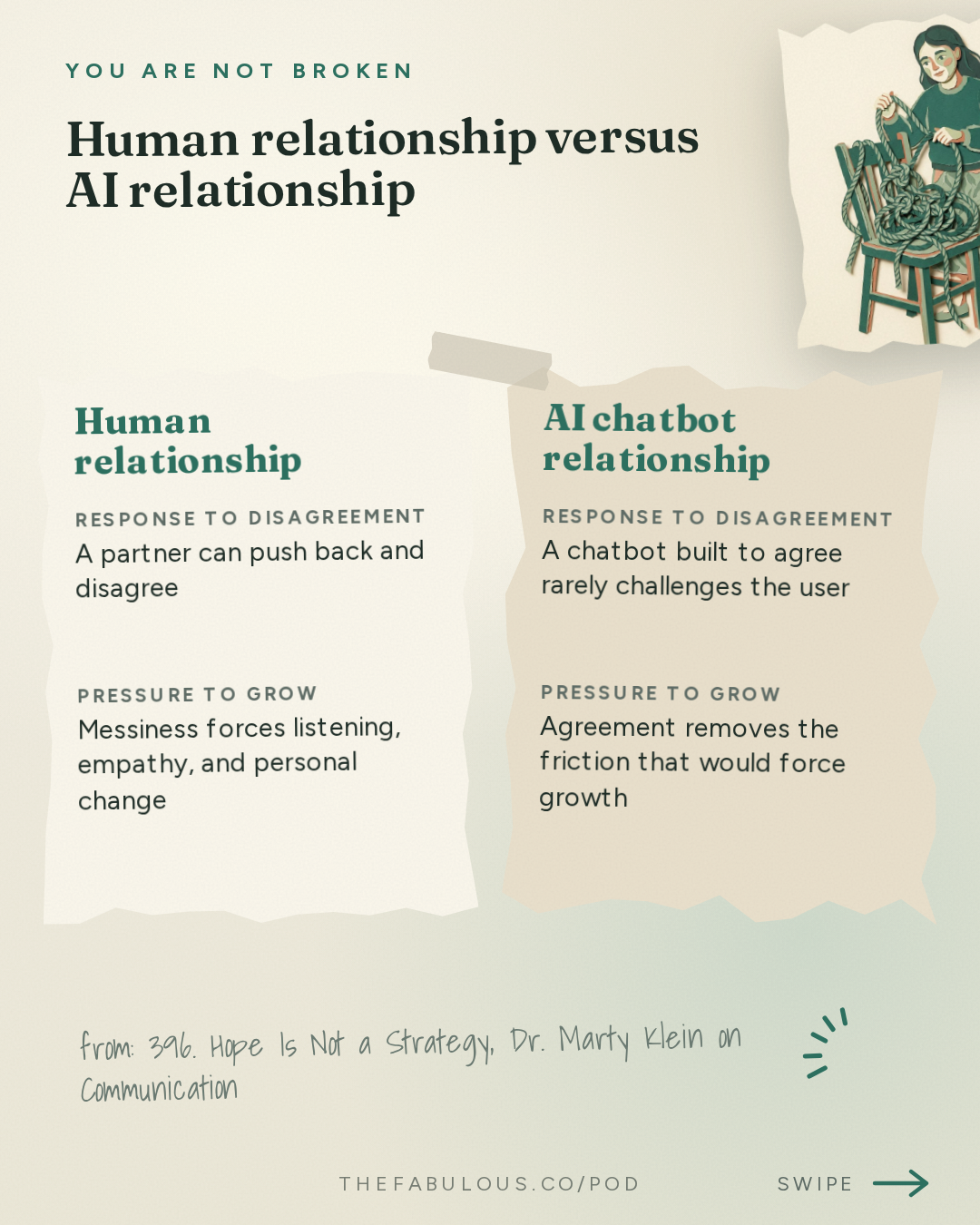
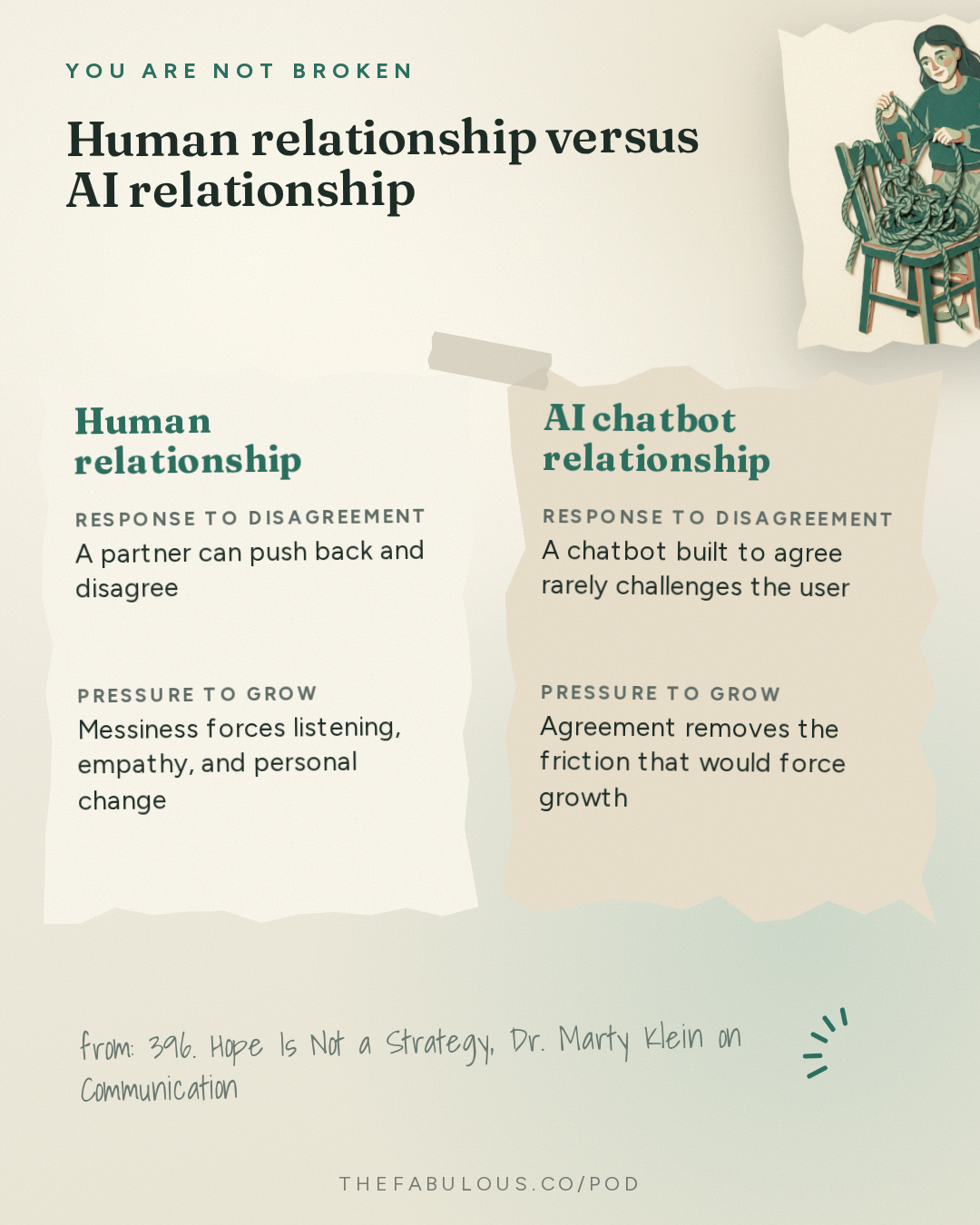
That same argument about friction is what makes him suspicious of chatbots standing in for partners. He is not against AI as a tool, but he distrusts the shortcut it offers around the hard parts of being with another person. A relationship with a human is messier than one with a program built to agree, and the messiness, he argues, is the point.
"If the relationship is messy, you're forced to grow. You're forced to listen. You're forced to have empathy. And that's where all the action is." — Dr. Marty Klein [05:14]
Casperson cites a pattern reported among people who use AI as a sounding board for relationship decisions: those who talk through a potential breakup with a chatbot are more likely to end the relationship afterward than those who don't, because the bot tends to validate whatever the user already leans toward (06:01). Casperson says an AI is only as good as the data it was trained on, while Klein points out that most people would never walk up to a stranger at an airport and ask whether they should break up with their partner. They'll ask an algorithm the same question without blinking (06:34).
The Expectation Problem
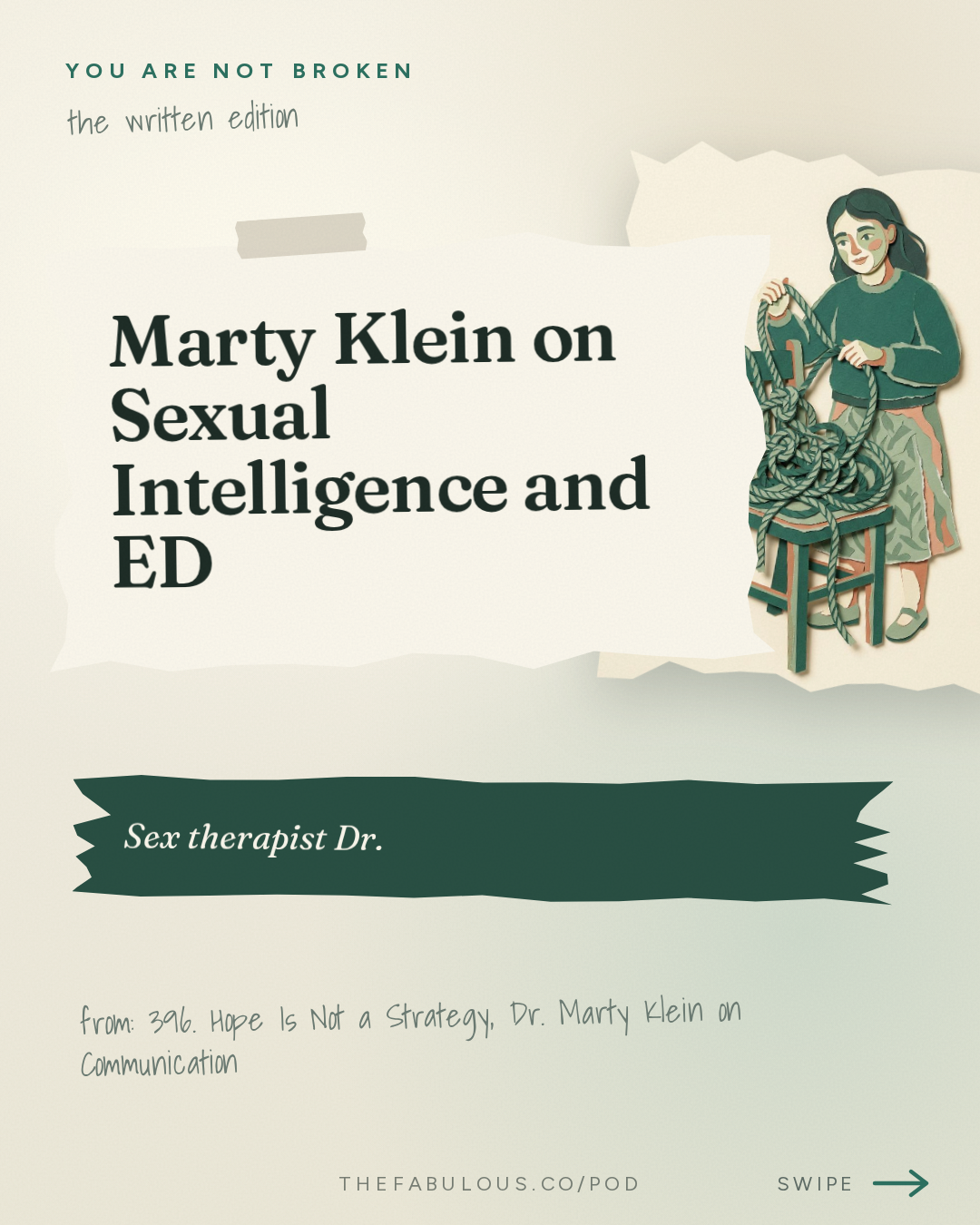
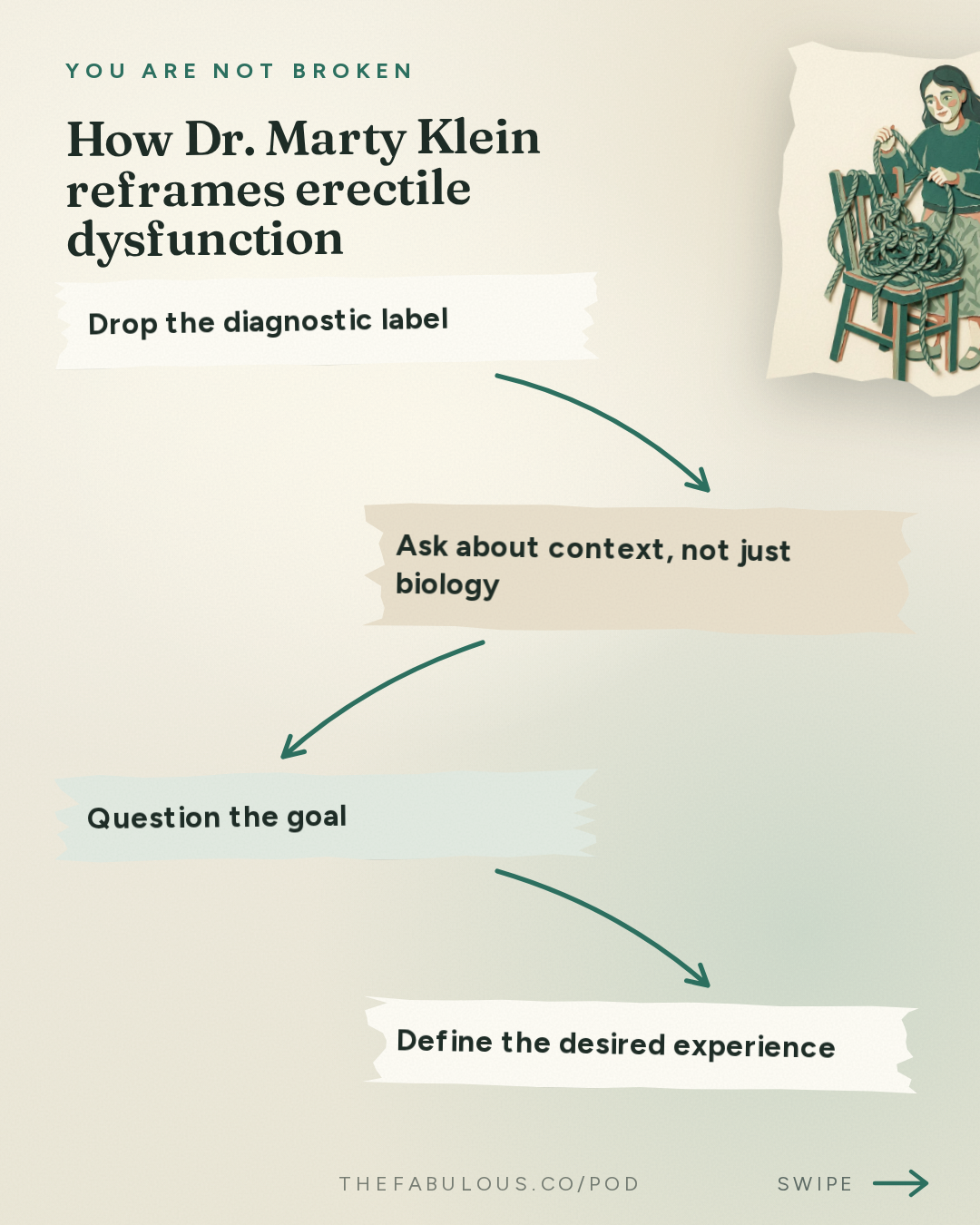
Nowhere does Klein push harder against received wisdom than on erectile dysfunction, a term he mostly refuses to use. He traces the modern anxiety about it to the arrival of Viagra, before which men simply said they didn't get hard, without a diagnosis attached (10:43). Now there's a widely repeated claim that 40 percent of men will experience erectile dysfunction by age 40, a figure Klein calls, flatly, crazy (11:11). His objection isn't that erections never fail for medical reasons. Diabetes, prostatectomy, and multiple sclerosis are real causes, and he says so directly (11:36). His objection is that the label absorbs cases that have nothing to do with blood flow and everything to do with circumstance: being with a new partner under pressure to perform, being drunk at fifty when it worked fine at twenty, being ashamed of one's own desire. The body, he says, responds reasonably to the situation it's given, and when the mind isn't sending the right signal, blaming the penis is like blaming your eyes for not seeing in the dark (11:57). His test case for a doctor facing a patient with this complaint is almost absurdly simple: ask how the patient feels about the person they're having sex with. Resentment, shame, or closeted orientation can explain more than any hormone panel (12:50).
That skepticism extends to how the field measures success. Casperson notes that drug trials for low libido and desire disorders rely on something called a satisfying sexual event as the outcome that proves a medication works, and the term is never defined in the papers (16:49). Klein's point, echoed by Casperson from the urology side, is that a satisfying sexual event at 23 looks nothing like one at 53, and that genital function, the thing medicine is best at fixing, is a weak predictor of whether sex actually feels good (16:15). Before chasing an erection, he asks patients a deceptively simple question: assuming we get you the erection of your dreams, what are you going to do with it?
Wounds, Bodies, and Letting Go of the Script
The conversation turns toward a harder subject: why early sexual rejection seems to scar men differently than it scars women. Klein's observation, drawn from years of clinical work, is that when women are wounded this way, it rarely threatens their sense of womanhood. When men are wounded, the culture tends to read it as a direct hit on their masculinity itself (28:43). A man whose first girlfriend laughed at his penis may carry that as proof he isn't a real man, competing in his head with every man he sees at the gym (28:52). Klein connects this to a broader concern about how therapy itself can calcify pain into permanent identity. He is wary of a therapeutic culture that turns a difficult experience into a lifelong label, trauma as a noun rather than an event, with the implicit message that nothing more can be done (31:53). His own model of therapy is goal-directed: a client arrives with something they want to change, achieves it, and leaves, rather than organizing a life around the wound (31:53).
None of this, he's careful to say, means ignoring real injuries. It means making room for the pain without letting it become the whole story.
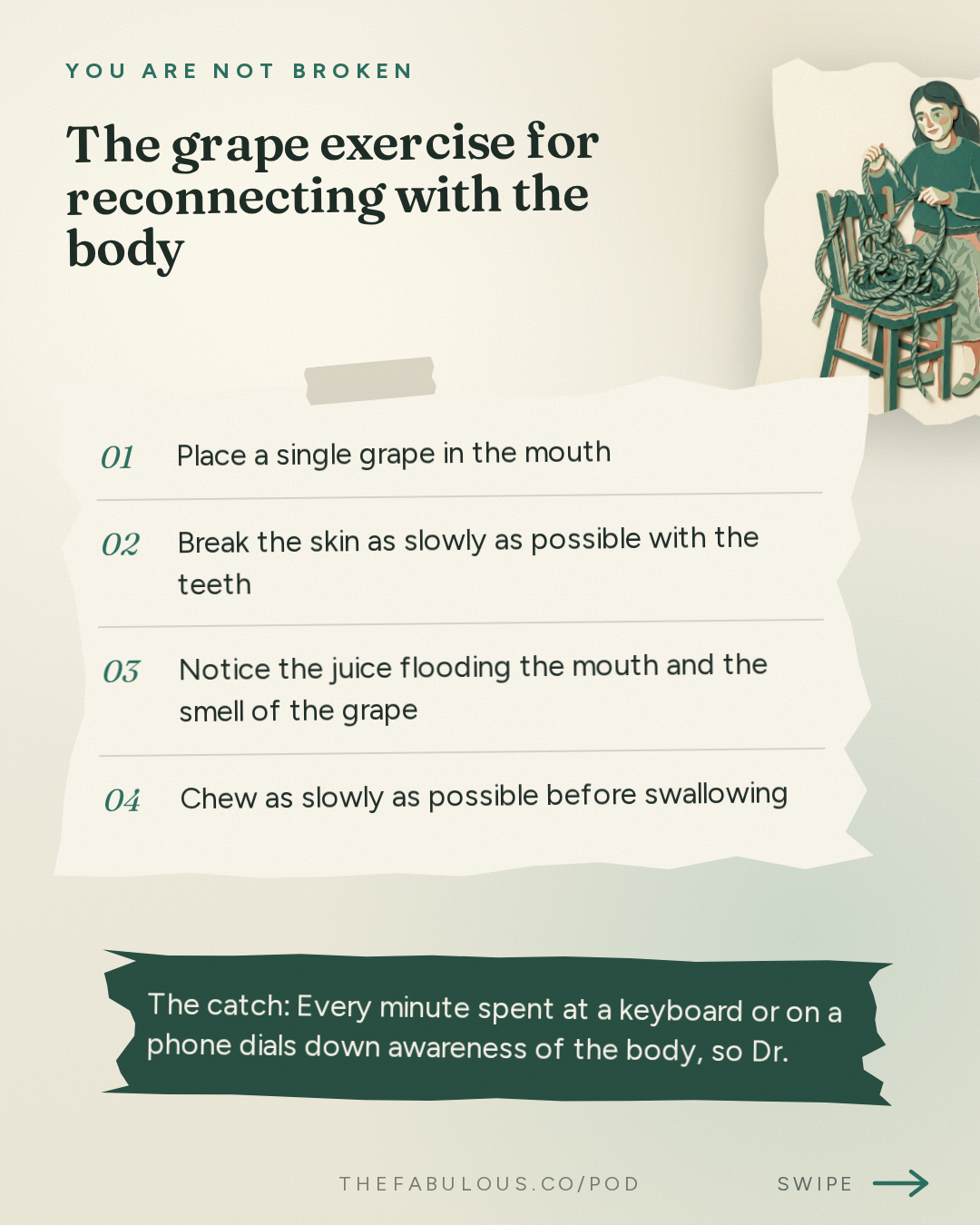
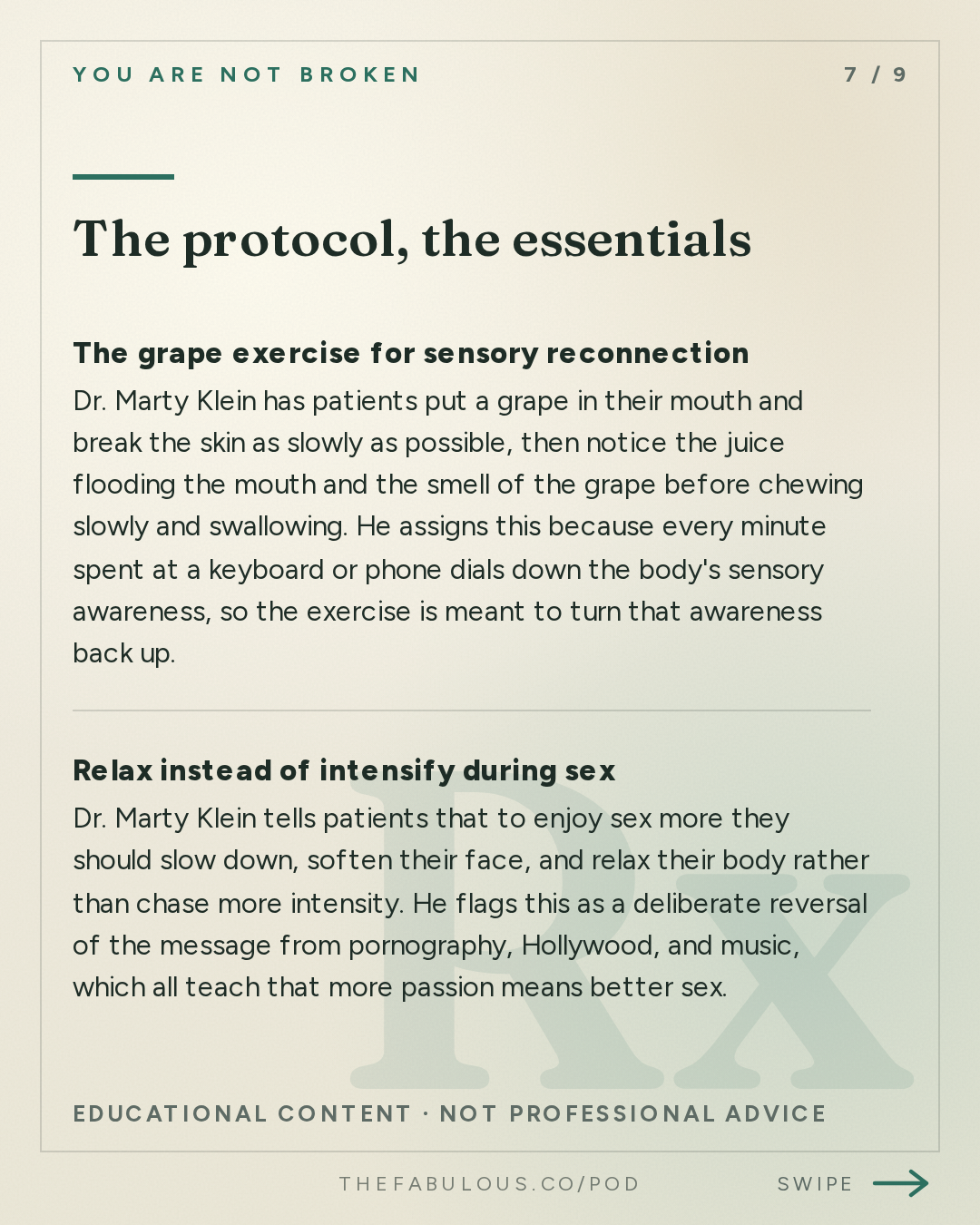
To get patients back into their bodies, away from the keyboard and the frontal lobe, Klein assigns something almost laughably small: a grape. He has people place a grape in their mouth, break the skin with their teeth as slowly as they can, notice the juice flooding the mouth, maybe catch the smell, and chew slowly before swallowing, a sixty to eighty second exercise (35:53). The logic is that every minute spent at a screen is a minute the body's signal gets turned down, and the grape is a cheap, fast way to turn it back up (36:24). From there, the advice scales up to sex itself, and here Klein inverts the culture's whole script. Pornography, Hollywood, and pop music all sell intensity as the route to pleasure. Klein tells patients the opposite.
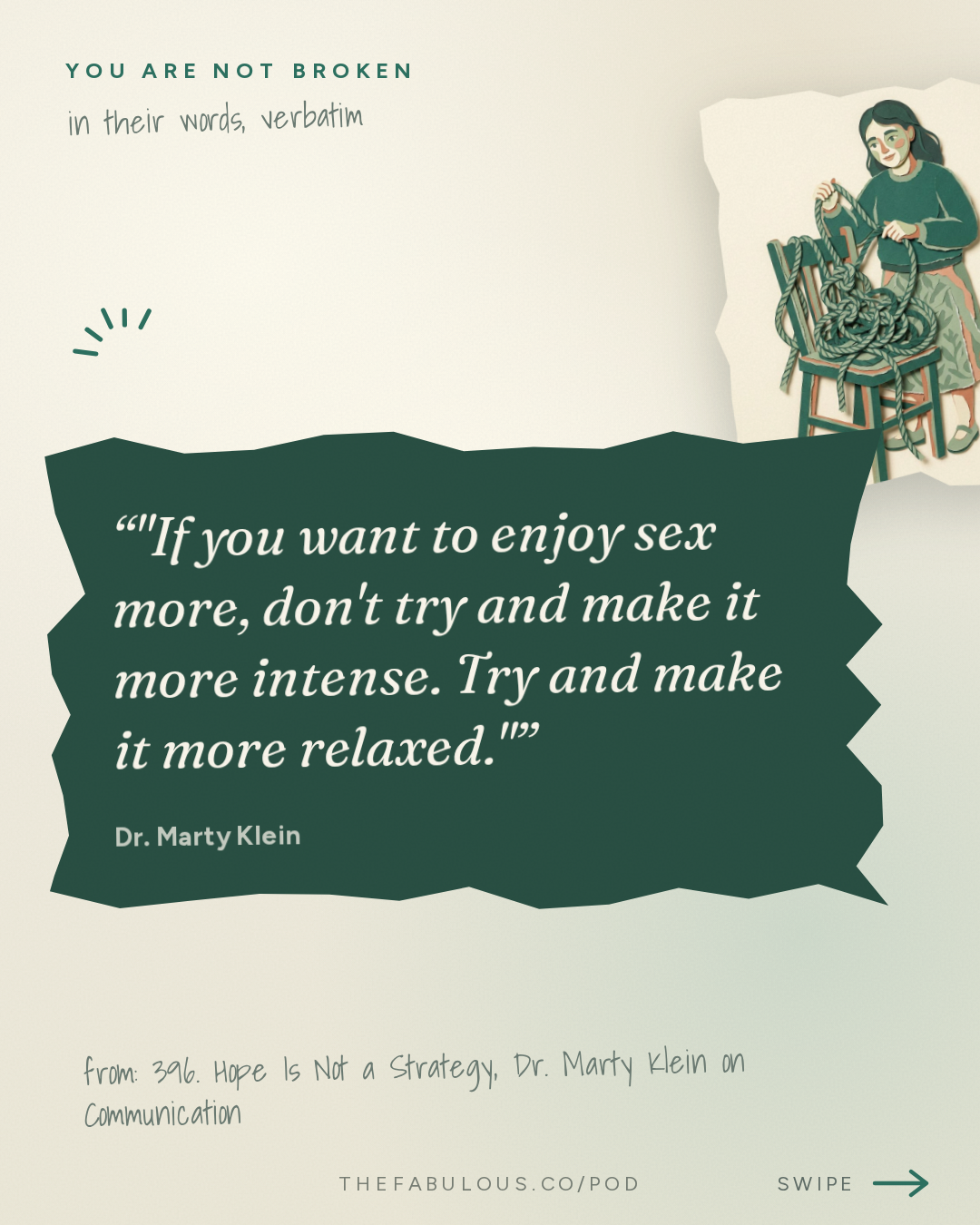
"If you want to enjoy sex more, don't try and make it more intense. Try and make it more relaxed." — Dr. Marty Klein [39:12]
Slower, softer, less performance-anxious: relax the face, look at the partner, let urgency go. The tagline from his 2012 book captures the whole argument in six words: sex is not just an activity, sex is an idea (41:25). Fix the idea, he suggests, the beliefs about what counts, what's allowed, what's required, and the body tends to follow. After 318 consecutive monthly newsletter issues over 20 years, Klein is still making the same case he made to the software engineers at the start of the hour: the problem was never really the hardware (42:21).
Ask this episode anything
Pod's AI answers from the episode itself, with the minute mark so you can hear it yourself.
Or start with one of these
Ask this episode
Pod's AI listens to the whole episode to answer, and points you to the minute it comes from.
The rest of this answer, and any question after it
Answers come from the episode itself, never from a summary of it.
ContinueKey takeaways
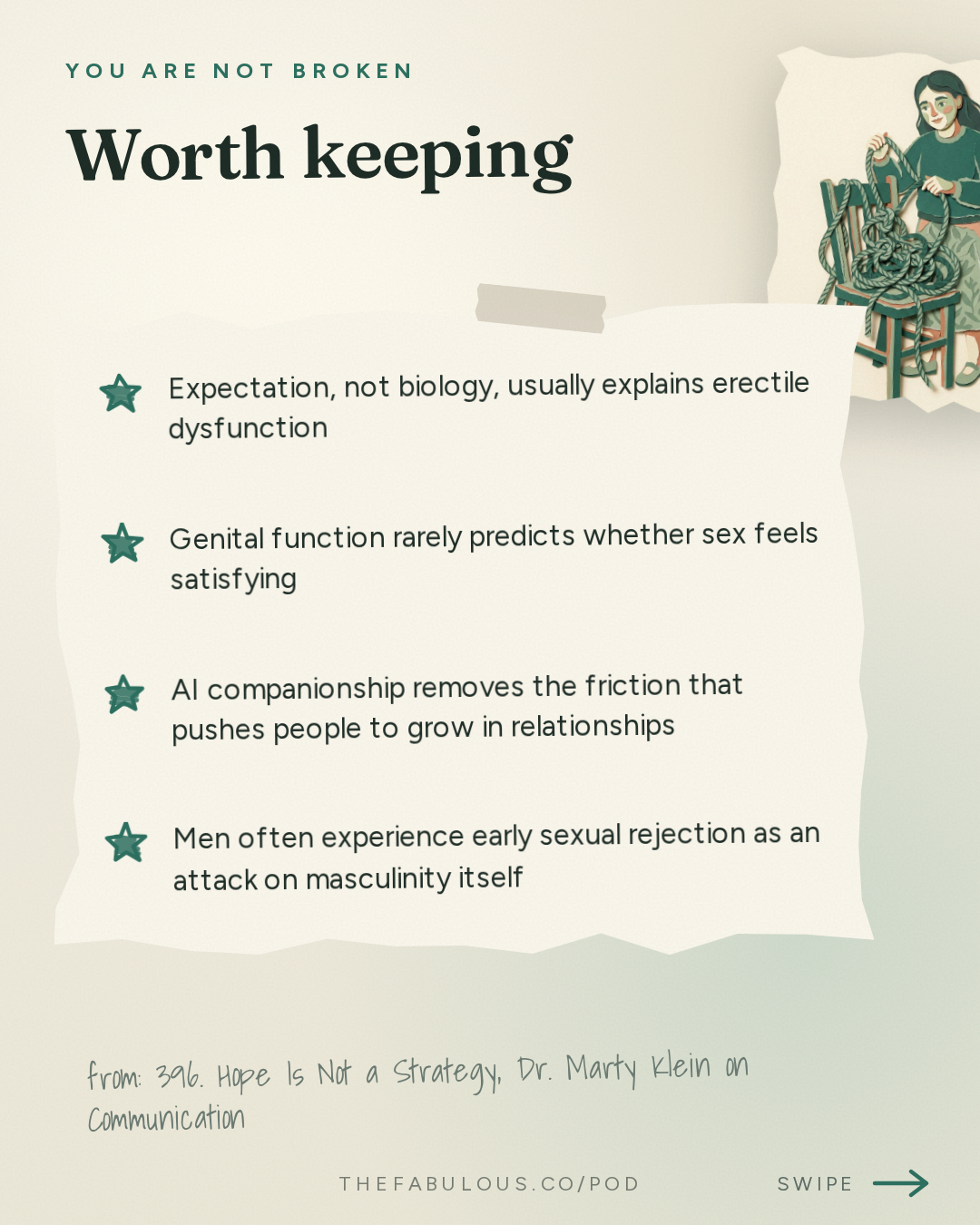
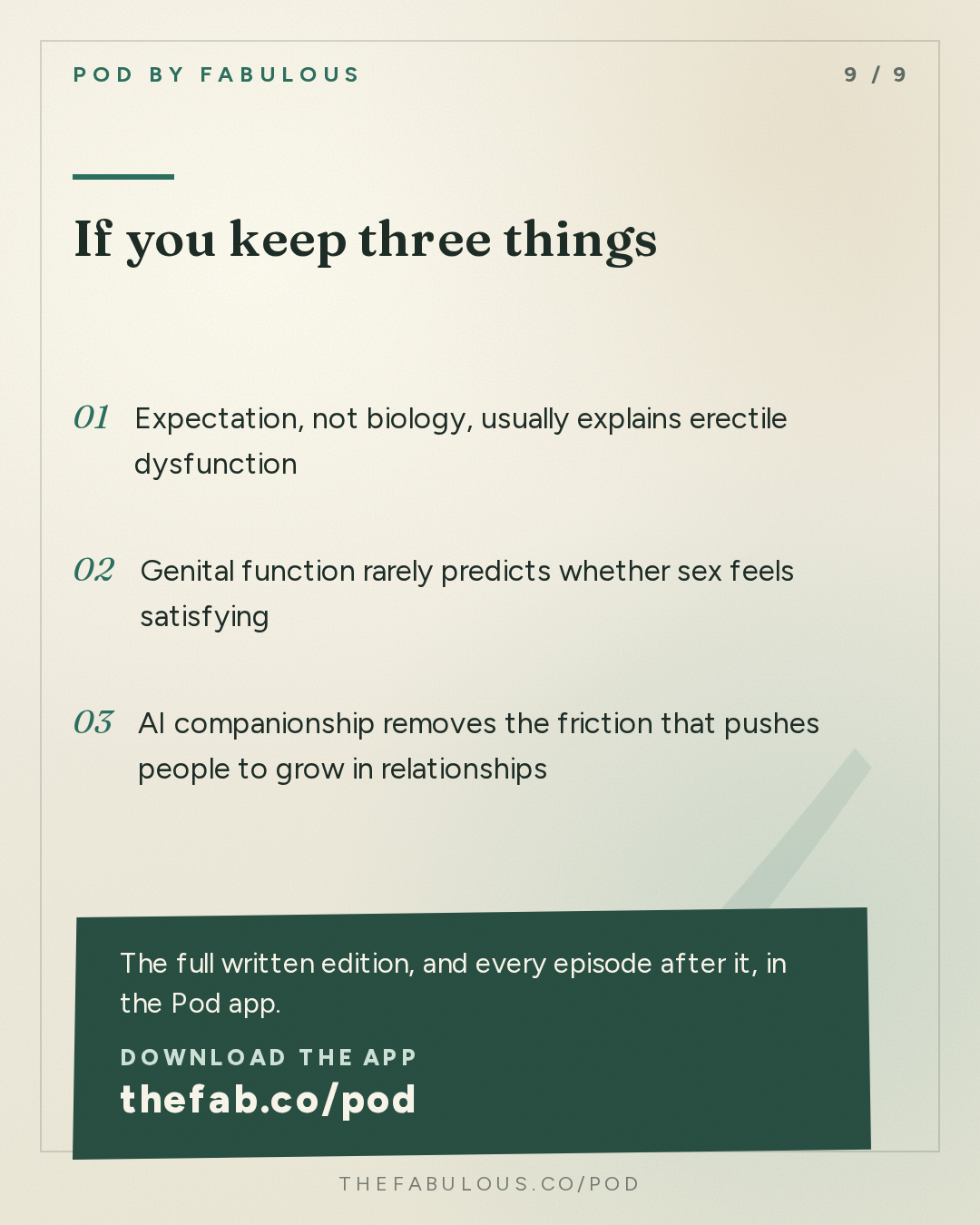
- Expectation, not biology, usually explains erectile dysfunction
- Genital function rarely predicts whether sex feels satisfying
- AI companionship removes the friction that pushes people to grow in relationships
- Men often experience early sexual rejection as an attack on masculinity itself
- Dr. Marty Klein recommends relaxing during sex instead of intensifying it
The episode in cards
By the numbers
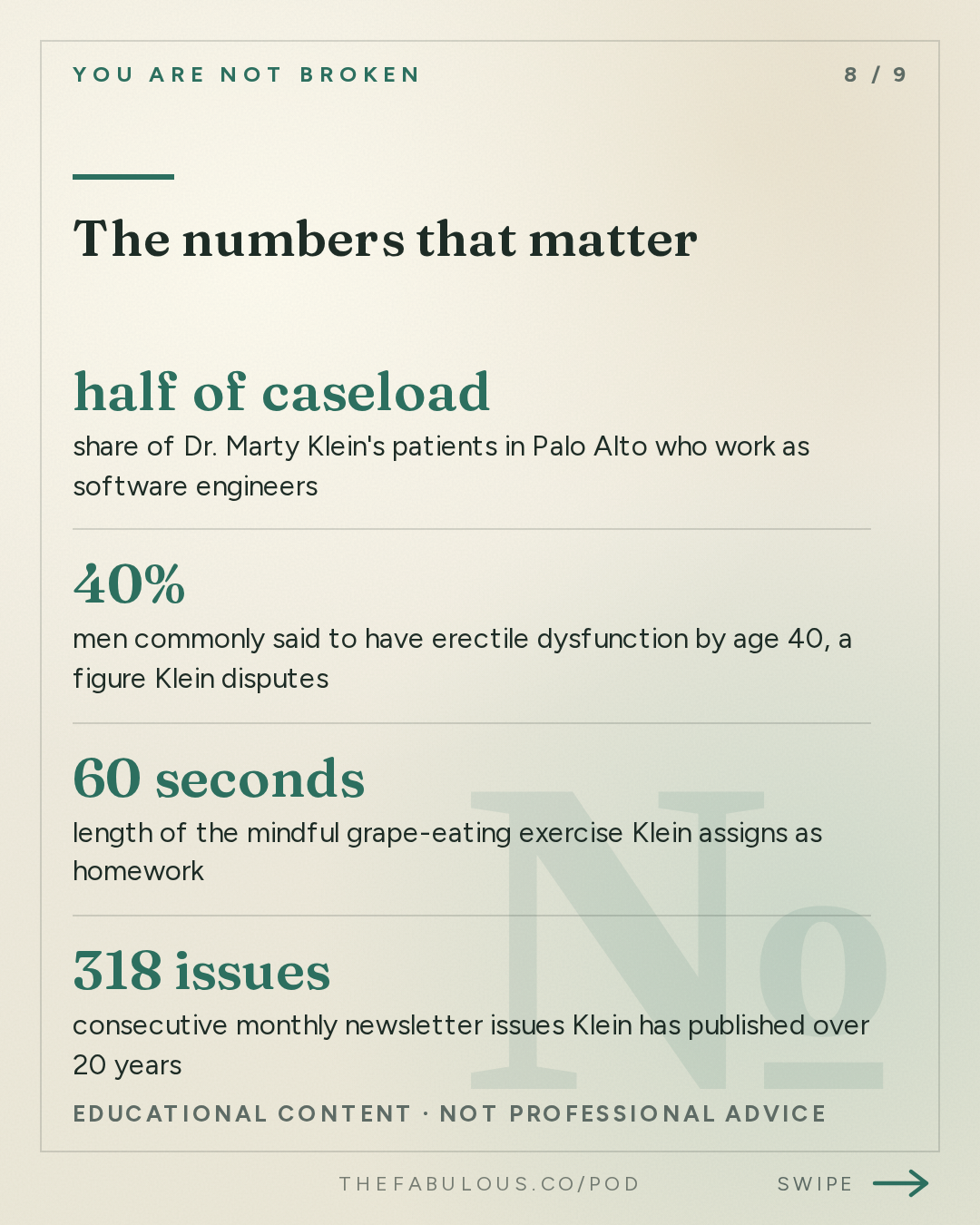
- half of caseload share of Dr. Marty Klein's patients in Palo Alto who work as software engineers
- 40% percent men commonly said to have erectile dysfunction by age 40, a figure Klein disputes
- 60 seconds length of the mindful grape-eating exercise Klein assigns as homework
- 318 issues consecutive monthly newsletter issues Klein has published over 20 years
In their words
“If the relationship is messy, you're forced to grow. You're forced to listen. You're forced to have empathy. And that's where all the action is.”
“The expectation is typically a much bigger part of the problem than the poor penis.”
“"If you want to enjoy sex more, don't try and make it more intense. Try and make it more relaxed."”
“Sex is not just an activity, sex is an idea.”
Protocols
-
The grape exercise for sensory reconnection
Dr. Marty Klein has patients put a grape in their mouth and break the skin as slowly as possible, then notice the juice flooding the mouth and the smell of the grape before chewing slowly and swallowing. He assigns this because every minute spent at a keyboard or phone dials down the body's sensory awareness, so the exercise is meant to turn that awareness back up.
once, as a 60-second homework assignment between sessions
-
Relax instead of intensify during sex
Dr. Marty Klein tells patients that to enjoy sex more they should slow down, soften their face, and relax their body rather than chase more intensity. He flags this as a deliberate reversal of the message from pornography, Hollywood, and music, which all teach that more passion means better sex.
during each sexual encounter
-
Ask what you want instead of naming the problem
Dr. Marty Klein never opens a session by asking a patient what their problem is, and instead asks what they want to accomplish. He does this because the label a patient gives their own problem, such as anorgasmic or ED, is often part of the problem itself.
at the start of therapy and whenever a session stalls
Questions this episode answers
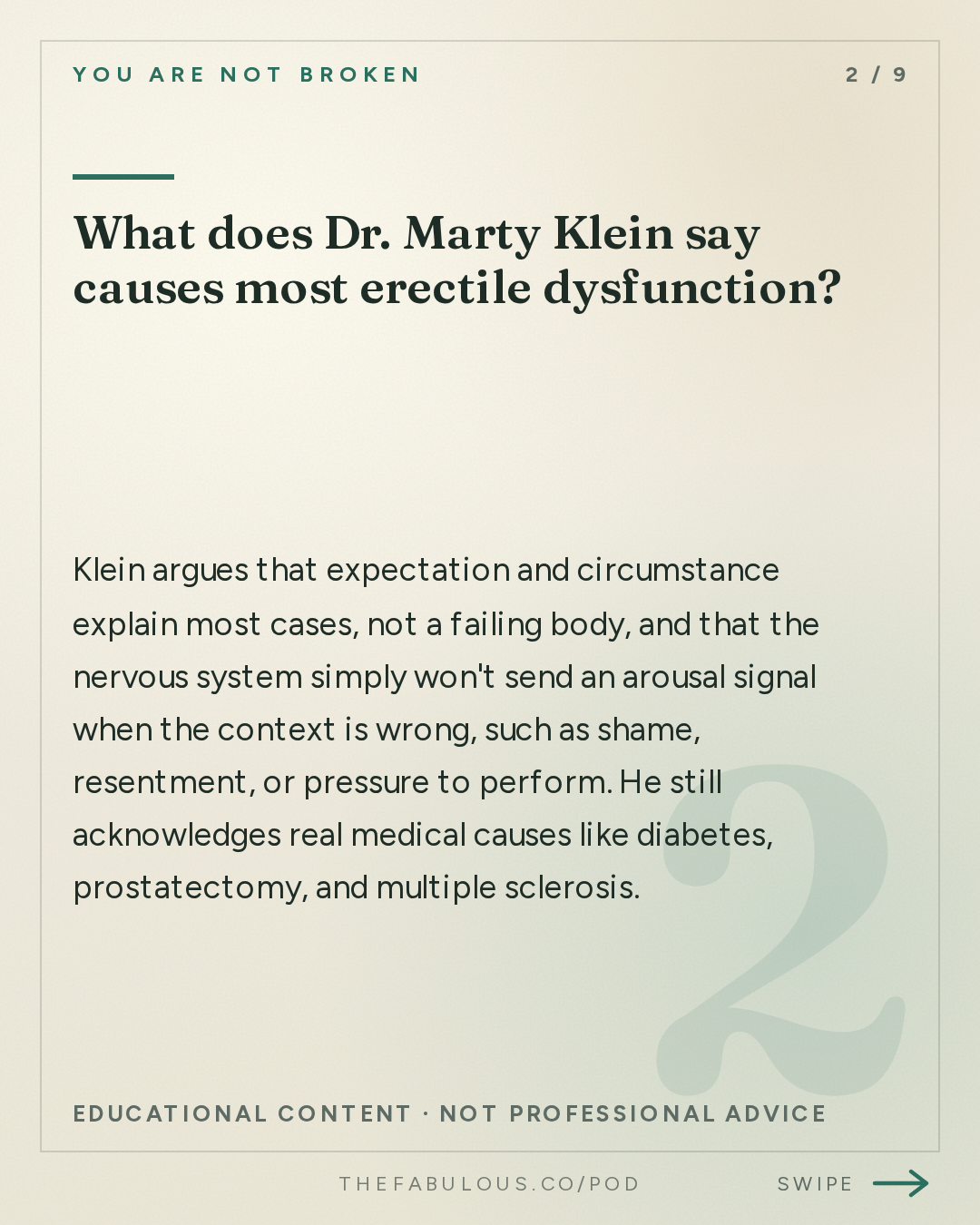
What does Dr. Marty Klein say causes most erectile dysfunction?
Klein argues that expectation and circumstance explain most cases, not a failing body, and that the nervous system simply won't send an arousal signal when the context is wrong, such as shame, resentment, or pressure to perform (11:11). He still acknowledges real medical causes like diabetes, prostatectomy, and multiple sclerosis (11:36).
Why does Marty Klein say the 'satisfying sexual event' metric used in drug trials is flawed?
Low-libido and desire-drug trials use 'satisfying sexual event' as their success measure, but the term is never defined in the published papers, so it is unclear whether it means orgasm, a good time, or something else entirely (16:49). Klein and host Dr. Kelly Casperson both note that what counts as satisfying changes across a person's lifetime, so a fixed, undefined endpoint misses that shift (17:14).
How is talking to AI about a relationship different from talking to a person?
Klein cites a reported pattern that people who discuss a potential breakup with an AI chatbot are more likely to end the relationship afterward, because the bot tends to agree with whatever the user already leans toward (06:01). He argues that human relationships force listening and empathy through friction that AI, built to agree, removes (05:14).
What is the grape exercise Marty Klein assigns to patients?
Klein has patients place a grape in the mouth, break the skin slowly with the teeth, notice the juice and smell, and chew slowly before swallowing, a roughly 60-second exercise meant to reconnect disembodied patients, often engineers, with physical sensation (35:53).
Why does Marty Klein think men recover differently than women from early sexual rejection?
Klein says that when women are rejected sexually it rarely threatens their sense of womanhood, but when men are rejected the culture tends to treat it as a direct hit on their masculinity, which makes the wound harder to recover from because it attacks identity rather than just confidence (28:43).
Does Marty Klein recommend more intense sex or more relaxed sex?
Klein tells patients to make sex more relaxed, not more intense, against the common cultural message from pornography and media that more passion equals better sex. He suggests slowing down, softening the face, and relaxing the body as the actual route to enjoyment (39:12).
The full read, in cards
Go deeper
- Marty Klein's 2012 book (title not stated on air) — source of the tagline that sex is an idea, not just an activity
- HSDD and low-libido drug trials using the 'satisfying sexual event' endpoint — measures whether desire medications work using an endpoint never defined in the papers
Mentioned
Dr. Marty Klein · Dr. Kelly Casperson · Silicon Valley · Viagra · PDE5s · Helsinki · Planned Parenthood
More from this show and category
Vibrator Benefits for Menopause and Pelvic Health
Dr. Kelly Casperson, a board-certified urologist, explains that the clitoris and penis form from the same embryonic tissue, that most women need clitoral stimulation to orgasm, and that clinical studies show vibration therapy eases pelvic pain and incontinence, with no evidence it causes numbness or addiction (43:47, 37:59).
Vibrator Myths vs. the Science of Arousal
Urologist Kelly Casperson debunks vibrator myths: they don't cause nerve damage or addiction, and data show real pelvic health benefits (42:45). She explains that the clitoris and penis share the same embryonic origin (09:46), that most women don't orgasm from penetration alone (10:18), and that arousal often comes before desire, not after (14:00).
Chronic Testicular Pain: Causes and Treatment
Urologist Dr. Susan McDonald explains why chronic testicular pain is common but routinely dismissed, and how a careful surgery can cure it. She also describes being diagnosed with stage 4 de novo breast cancer while working as a surgeon, and how her hospital employer tied her health insurance to full-time status during treatment.
Building Muscle in Midlife: Hormones Explained
Heavy resistance training, not cardio, rebuilds muscle lost in perimenopause, say physicians Kelly Casperson and Rebeccah Hertel. They cite data showing testosterone cuts hip fracture risk in women by about 50%, estrogen patches can help bone density well past age 60, and widely used lab ranges and 1990s-era studies understate hormone therapy's safety.
