
Body Composition Testing: DEXA vs BIA Accuracy
#622: Body Composition Testing: Methods & Interpretation – Prof. Grant Tinsley
The brief
No device on the market actually measures body fat; every scale, scan, or pod only estimates it from indirect signals, and a method proven accurate for a group can still mislead an individual user. Texas Tech professor Grant Tinsley explains why standardizing tests, tracking one device over time, and treating small percentage swings as noise matter more than any single number (12:49, 38:24).
Step on a scale that promises your body fat to two decimal places, 22.37 percent, and the number feels like a fact handed down from a machine that has looked inside you. It hasn't. According to Grant Tinsley, professor of human performance at Texas Tech University and director of its Energy Balance and Body Composition Laboratory, no existing technology actually measures fat mass, muscle mass, or any other body composition value in a living person. Every device estimates it.
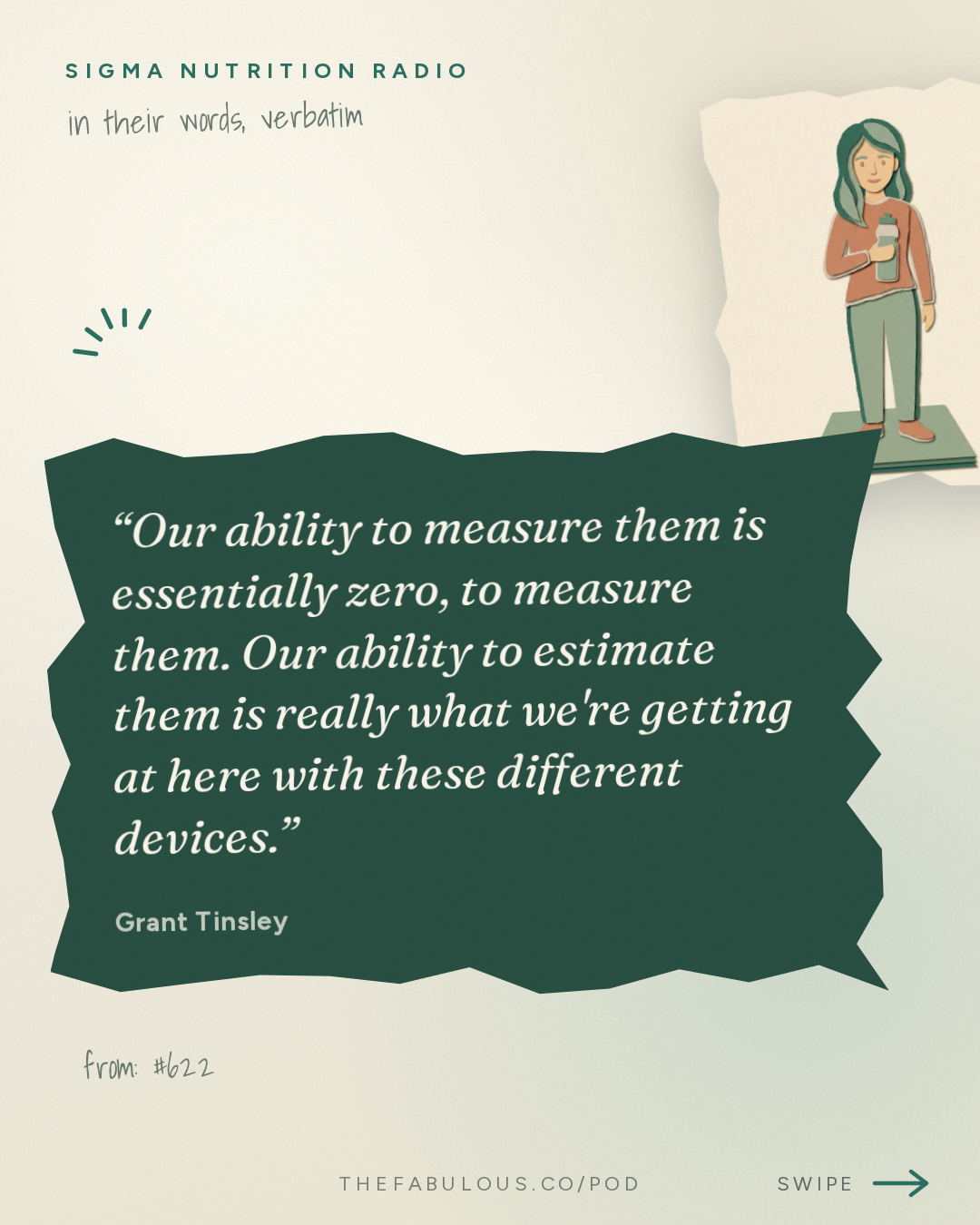
"Our ability to measure them is essentially zero, to measure them. Our ability to estimate them is really what we're getting at here with these different devices." (Grant Tinsley, [12:49])
That distinction sounds pedantic until you see what it explains. Tinsley spent a year dissecting cadavers during his master's training, the only true way to know, down to the gram, how much fat, water, protein, and mineral a body contains (04:02). Every other method, from a $20 bathroom scale to a $30,000 research-grade bioimpedance analyzer, is trying to infer that same breakdown from something indirect: how an electrical current passes through tissue, how X-rays are absorbed, how much a body displaces when submerged in water (15:56, 17:03).
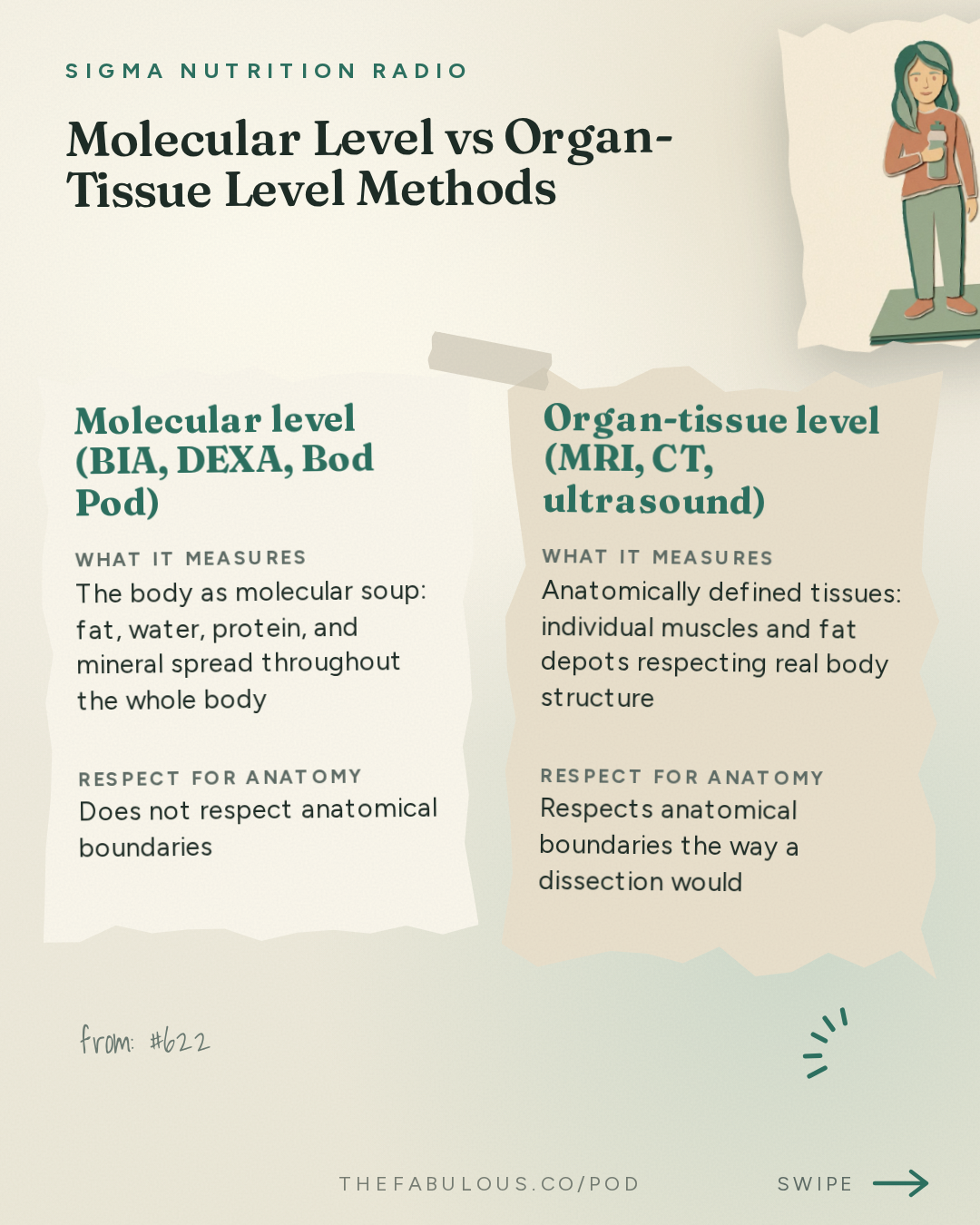
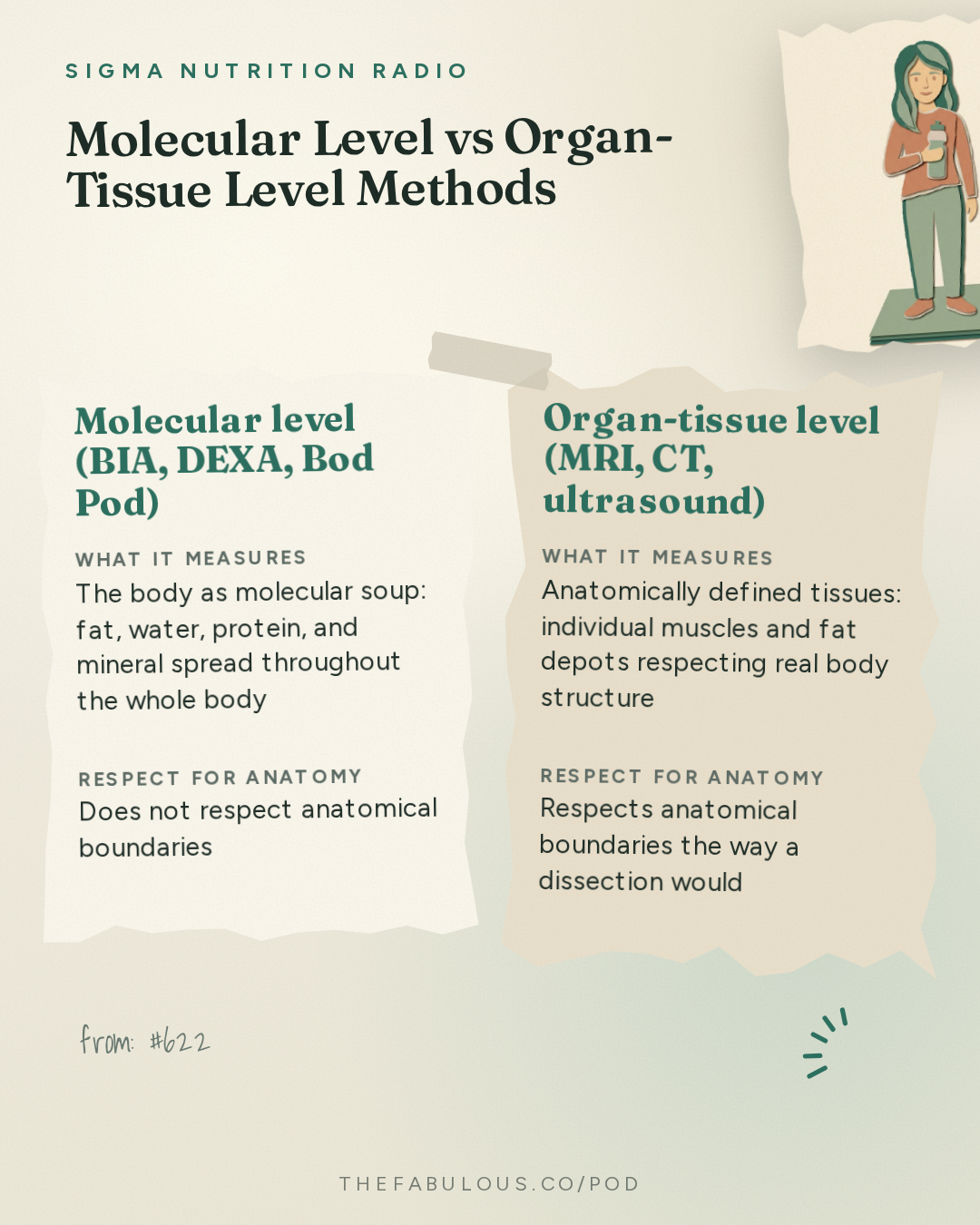
Tinsley organizes these methods by what he calls levels. The molecular level treats the body as what he describes as "molecular soup" (09:25): fat is simply non-polar lipid, and fat-free mass is everything else, water, protein, mineral, and glycogen, wherever in the body it happens to sit (10:05). Most familiar tools, including DEXA (dual-energy X-ray absorptiometry, a scan that passes two X-ray energies through the body) and bioimpedance scales (devices that estimate water and fat content by measuring how easily electrical current passes through the body), operate at this level (17:21, 15:56). The organ-tissue level is different. It respects anatomy the way a cadaver dissection does, isolating actual muscle groups and fat depots. Skeletal muscle mass, the figure athletes and lifters care about most, lives here, and only imaging tools like MRI, CT, and ultrasound can really get at it (11:17, 18:16). The two levels produce numbers that sound related but are not interchangeable, which is why a DEXA printout and an MRI-derived muscle mass figure can disagree without either being wrong.
A Good Average Can Still Fail You
The more unsettling idea in the conversation is that a device can be statistically valid and still be wrong for any one person using it. Tinsley walks through a hypothetical: a bioimpedance scale is tested against DEXA in 100 people, the group averages land within 0.2 percentage points of each other, the correlation is a strong 0.97, and the statistics all say the methods agree (25:22). Good news, on paper. But plot every individual point, he says, and the picture can turn messy: some people overestimated by 10 percent, others underestimated by the same margin, canceling out in the average while leaving no individual confident in their own reading (26:07).
"You could certainly have a device that looks or that is valid at the group level, but for you as an individual, the hard thing is you don't know what data point you are." (Grant Tinsley, [27:17])
This matters most for people at the edges of the population used to build these equations: the very lean, the very muscular, people with unusually high or low body fat. Devices calibrated on an average body tend to perform worse the further someone is from that average (29:13), and most of the drift traces back to assumptions about fat-free mass itself, specifically how much of it is water. Cadaver research suggests fat-free mass is roughly 73 percent water on average, but that figure shifts across athlete populations and life stages, and when it shifts, every method built on that assumption inherits the error (30:45).
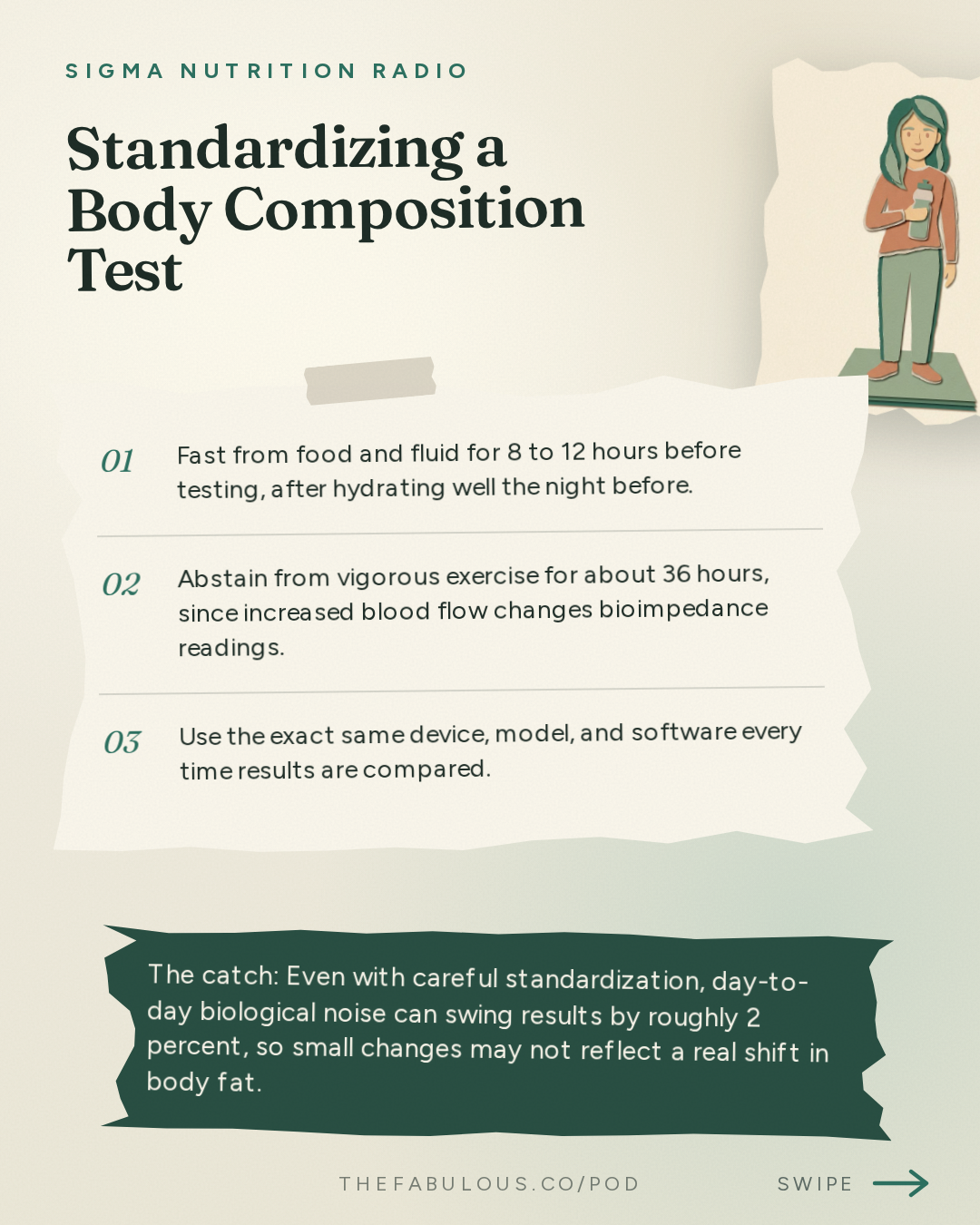
Some of that error is biological noise rather than a flaw in the device. Water, glycogen, and blood flow all move throughout a single day, so Tinsley's lab tests people after an overnight fast of 8 to 12 hours from both food and fluid, with deliberate hydration the night before (32:41). They also ask for roughly 36 hours of abstention from vigorous exercise, because something as ordinary as a leg workout changes local blood flow enough to shift a bioimpedance reading taken shortly after (33:28). When a full fast or rest period isn't realistic, in a clinic seeing patients in the afternoon, say, Tinsley's advice shifts from perfection to consistency.
"Standardize what you do at every assessment. The worst case scenario is you provide no input." (Grant Tinsley, [34:39])
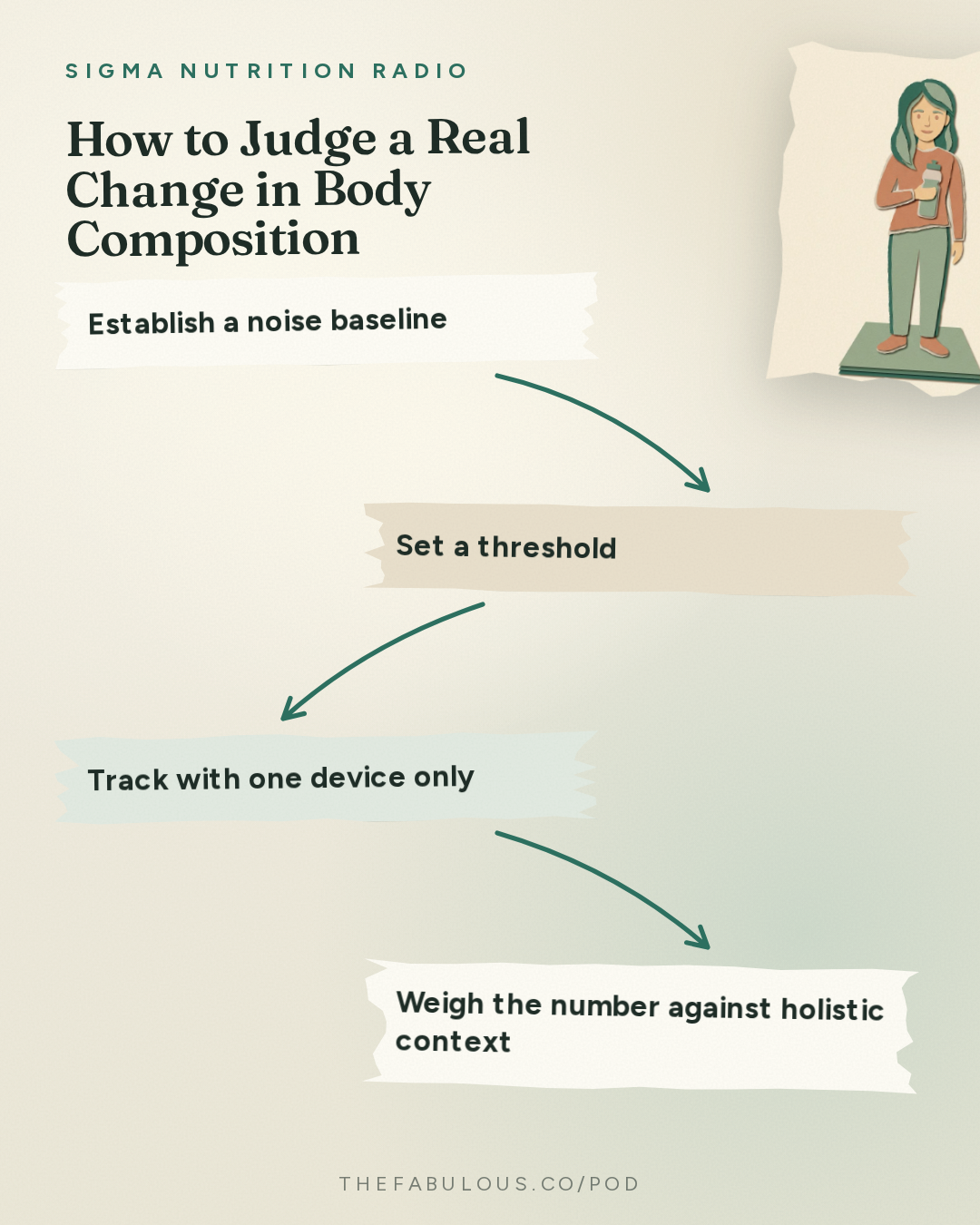
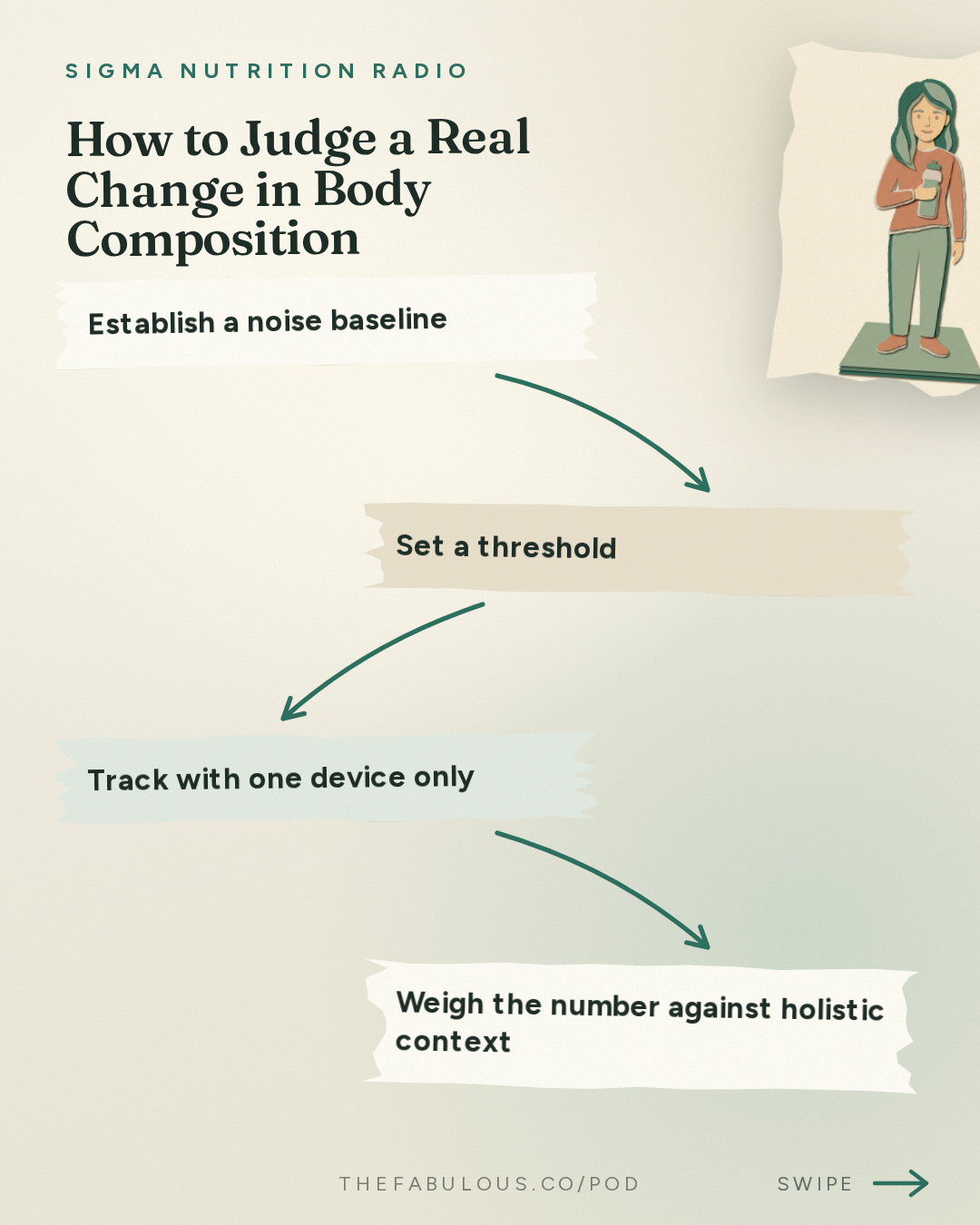
That consistency matters most when someone is trying to detect a real change over weeks or months. Tinsley recommends a simple exercise: test a small group of people twice, on separate days, following identical pre-test procedures, and see how much the numbers move even though nothing biologically changed. If the largest swing observed is 2 percent, then any change smaller than that, after eight weeks of training, say, should be read as noise, not progress or regression (38:24). A 3 percent change, by contrast, starts to look like a real signal. The threshold is not universal; it depends on the specific device, model, and facility, which is why Tinsley resists giving one number that applies everywhere (39:52).
What the Scale at Home Is Actually Doing
Consumer devices complicate this further. Tinsley's lab has tested 14 different at-home bioimpedance scales, ranging from about $20 to $300, and found results all over the map (46:41). Some performed worse than having no data at all. Others approached or even exceeded laboratory-grade accuracy, with no obvious pattern, cheap versus expensive, foot-only versus foot-and-hand electrodes, predicting which was which (47:03). A follow-up trial in roughly 200 people, focused on more established manufacturers, found the same spread (47:37).
"There were some that were predictably terrible, like worse than not having the information. There were some that were really good, approaching or even exceeding laboratory grade." (Grant Tinsley, [47:03])
Tinsley's lab also noticed something stranger: some consumer scales appear to smooth or lock results across repeated uses, possibly to stop the number from bouncing around and frustrating the owner, which is good for peace of mind but bad for anyone hoping each reading is an independent measurement (49:30). His practical rule for anyone tracking body composition at home is to never compare numbers across two different devices or technologies; switching from a DEXA scan to a home scale should reset the baseline, not continue a trend line (57:13).
Underneath the technical detail is a quieter argument about what any of this data is for. Tinsley is careful to say that for some people, especially those already attuned to how their training and nutrition are going, a body composition number adds little beyond what they already know from how clothes fit or how a lift feels (58:21). For others, particularly people undergoing significant weight change, the composition of that change, how much is fat versus fat-free mass, can flag a real problem worth addressing (52:40).
"If the measurement produces anxiety or isn't informative, doesn't seem helpful, or doesn't add any information you don't already have, then it's certainly not necessary." (Grant Tinsley, [59:46])
Asked for one piece of advice to close the conversation, Tinsley didn't return to electrodes or X-rays. He suggested, instead, making room to think about mortality, about how small a single life is against the scale of the universe, as a way of clarifying what actually deserves attention (60:50). It is a strange pivot after an hour of phase angles and fasting protocols, but it lands on the same point the whole conversation was making. A number on a scale, however precise it looks, is never the whole picture. What a person does with the number, and how much weight they give it, is the part that was always up to them.
Ask this episode anything
Pod's AI answers from the episode itself, with the minute mark so you can hear it yourself.
Or start with one of these
Ask this episode
Pod's AI listens to the whole episode to answer, and points you to the minute it comes from.
The rest of this answer, and any question after it
Answers come from the episode itself, never from a summary of it.
ContinueKey takeaways
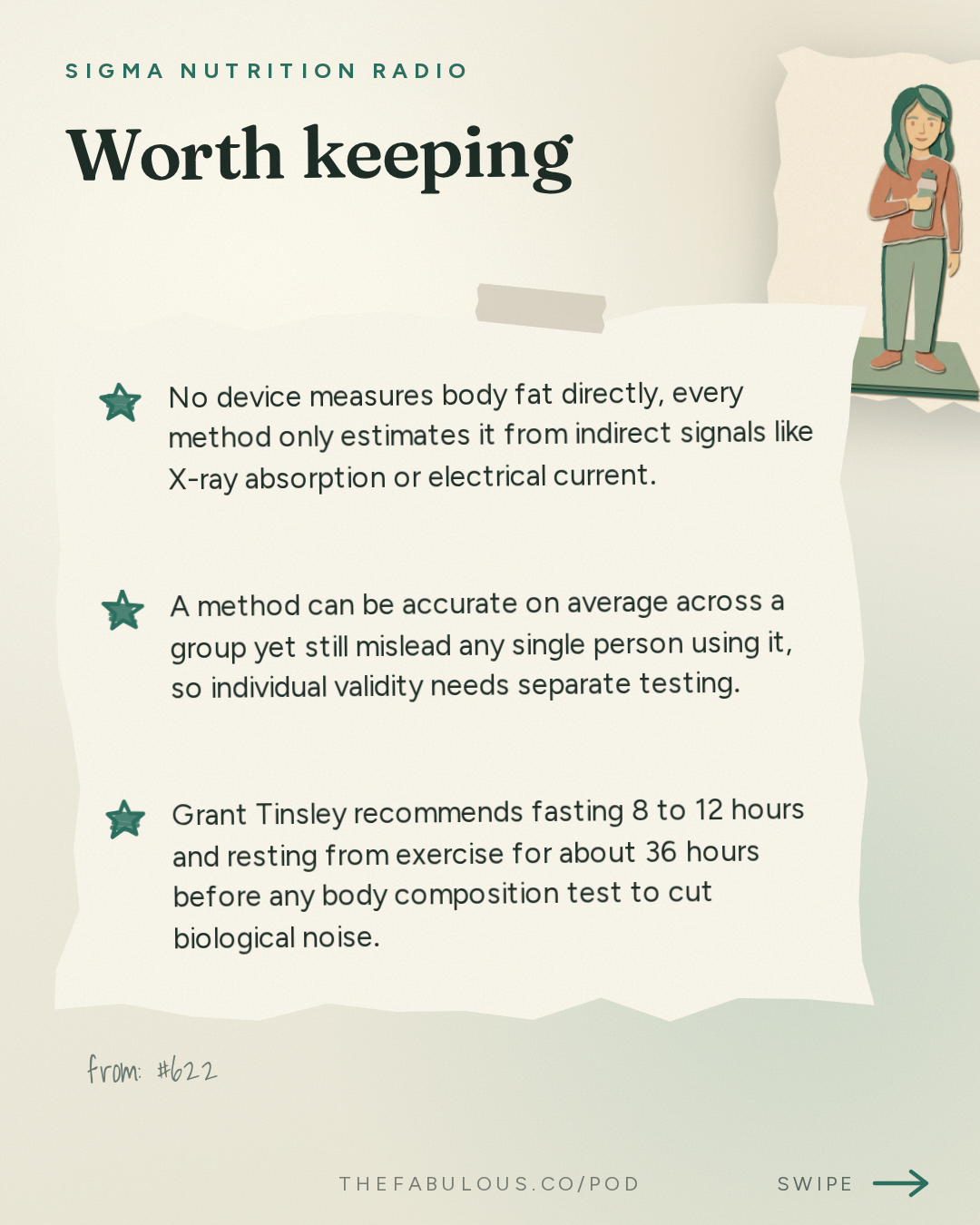
- No device measures body fat directly, every method only estimates it from indirect signals like X-ray absorption or electrical current.
- A method can be accurate on average across a group yet still mislead any single person using it, so individual validity needs separate testing.
- Grant Tinsley recommends fasting 8 to 12 hours and resting from exercise for about 36 hours before any body composition test to cut biological noise.
- Day-to-day technical and biological noise can swing results by roughly 2 percent, so small changes may not reflect a real shift in body fat.
- Consumer bioimpedance scales range from nearly useless to laboratory grade with no visible way to tell which is which before testing.
The episode in cards

By the numbers
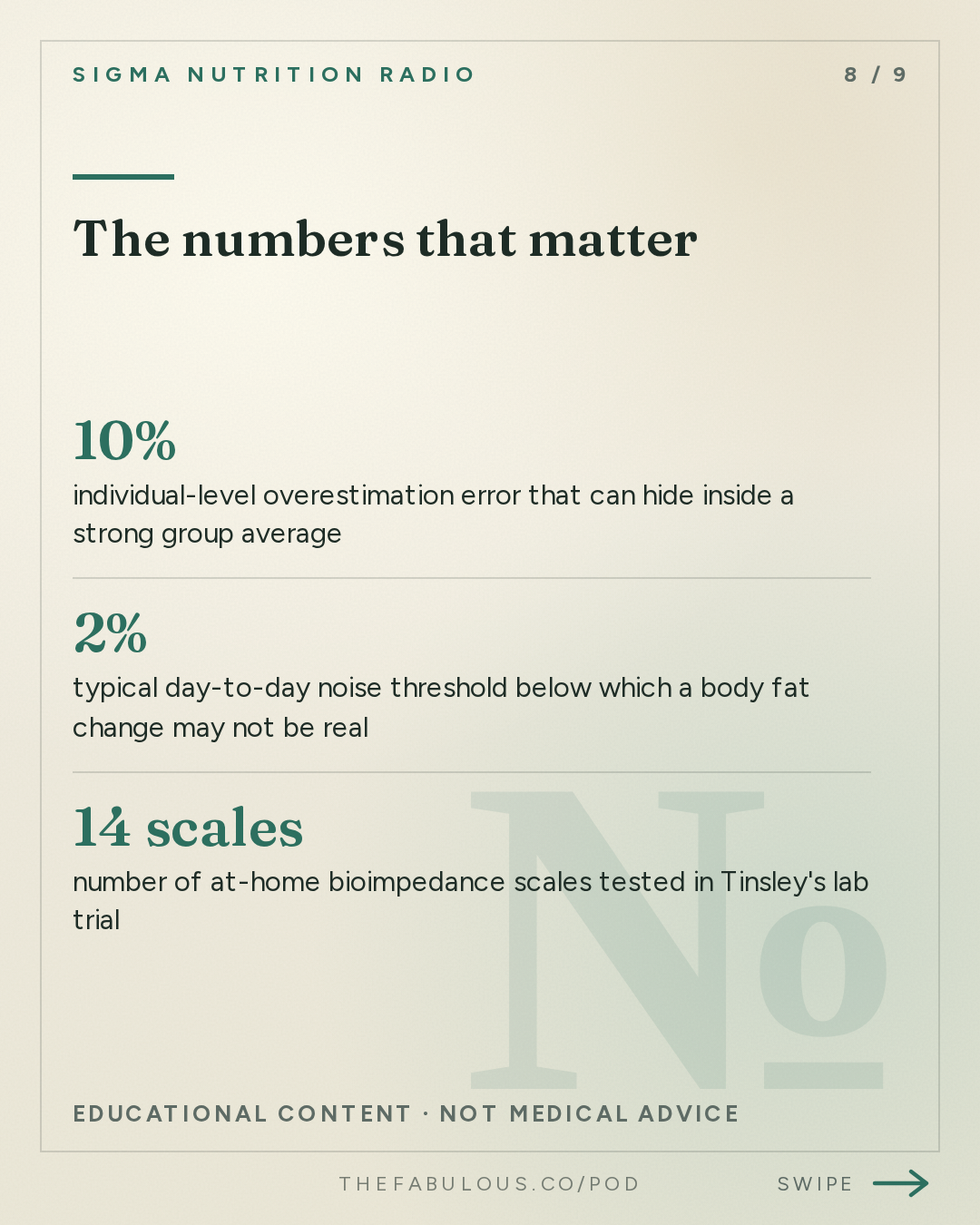
- 10% percent individual-level overestimation error that can hide inside a strong group average
- 2% percent typical day-to-day noise threshold below which a body fat change may not be real
- 14 scales number of at-home bioimpedance scales tested in Tinsley's lab trial
In their words
“Our ability to measure them is essentially zero, to measure them. Our ability to estimate them is really what we're getting at here with these different devices.”
“You could certainly have a device that looks or that is valid at the group level, but for you as an individual, the hard thing is you don't know what data point you are.”
“There were some that were predictably terrible, like worse than not having the information. There were some that were really good, approaching or in some cases even exceeding”
“If the measurement produces anxiety or isn't informative, doesn't seem helpful, or doesn't add any information you don't already have, then it's certainly not necessary.”
Protocols
-
Fast before testing
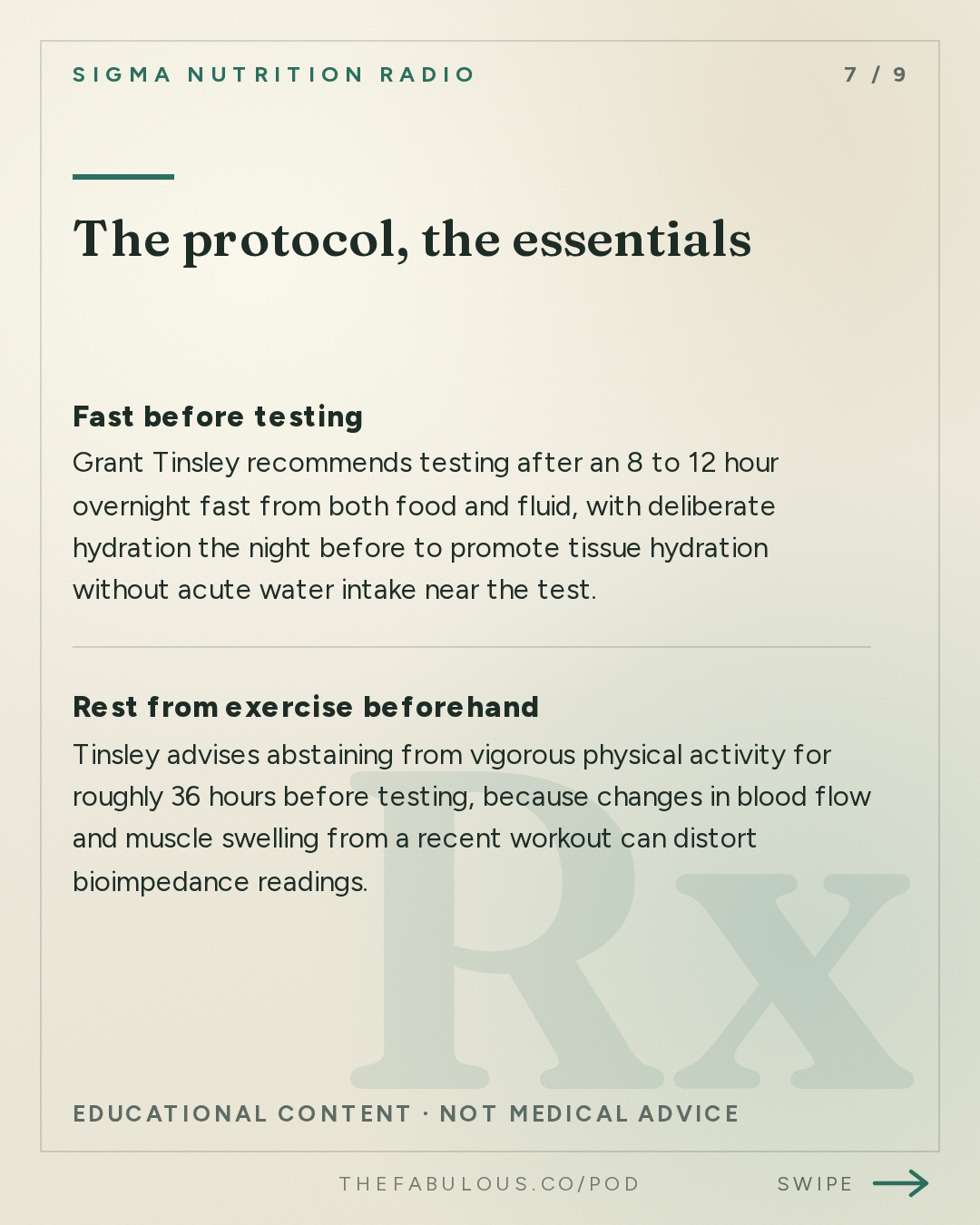
Grant Tinsley recommends testing after an 8 to 12 hour overnight fast from both food and fluid, with deliberate hydration the night before to promote tissue hydration without acute water intake near the test.
Before every body composition assessment
-
Rest from exercise beforehand
Tinsley advises abstaining from vigorous physical activity for roughly 36 hours before testing, because changes in blood flow and muscle swelling from a recent workout can distort bioimpedance readings.
In the 36 hours before each test
-
Never switch devices mid-tracking
Tinsley says to compare results only within the same device and model over time, treating a move to a new method as a fresh baseline rather than evidence of real change.
Every time tracking continues over months
-
Set a noise threshold before judging change
Tinsley recommends testing a small group twice on separate days with identical procedures to see how much results vary with no true change, then treating any later change smaller than that variation, often around 2 percent, as noise rather than progress.
Once per facility or device, then applied to every ongoing comparison
Questions this episode answers
Does any device actually measure body fat percentage?
No. Grant Tinsley, professor of human performance at Texas Tech University, explains that every method, from DEXA scans to bioimpedance scales, estimates body composition from indirect signals rather than measuring it directly; only cadaver dissection gives a true physical value (12:49).
Is DEXA more accurate than a bioimpedance (BIA) scale?
DEXA tends to be more robust against assessor error and has a stronger imaging-based theoretical foundation, but Tinsley notes it is still a molecular-level estimate, not a true measurement, and cost or access can make it impractical for frequent testing (17:21, 22:13).
Why can a body fat device look accurate in research but mislead an individual?
Tinsley describes a hypothetical study where group averages and correlations look strong (a 0.97 correlation between a scale and DEXA) while individual errors of 10 percent in opposite directions cancel out in the average, leaving any single user unsure which kind of data point they are (25:22, 26:07).
How much should body fat change before I trust it's real?
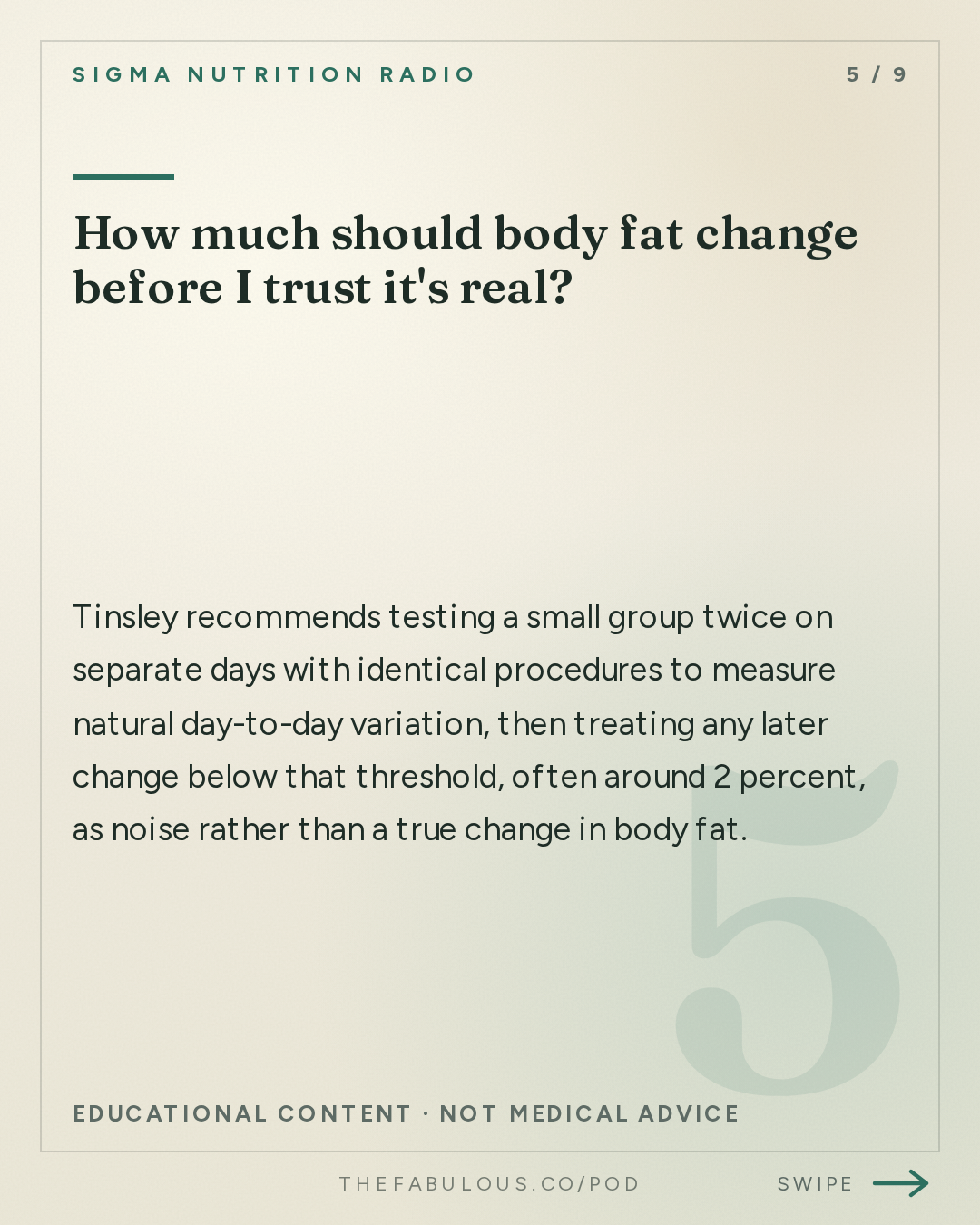
Tinsley recommends testing a small group twice on separate days with identical procedures to measure natural day-to-day variation, then treating any later change below that threshold, often around 2 percent, as noise rather than a true change in body fat (38:24).
How should I prepare for a body composition test?
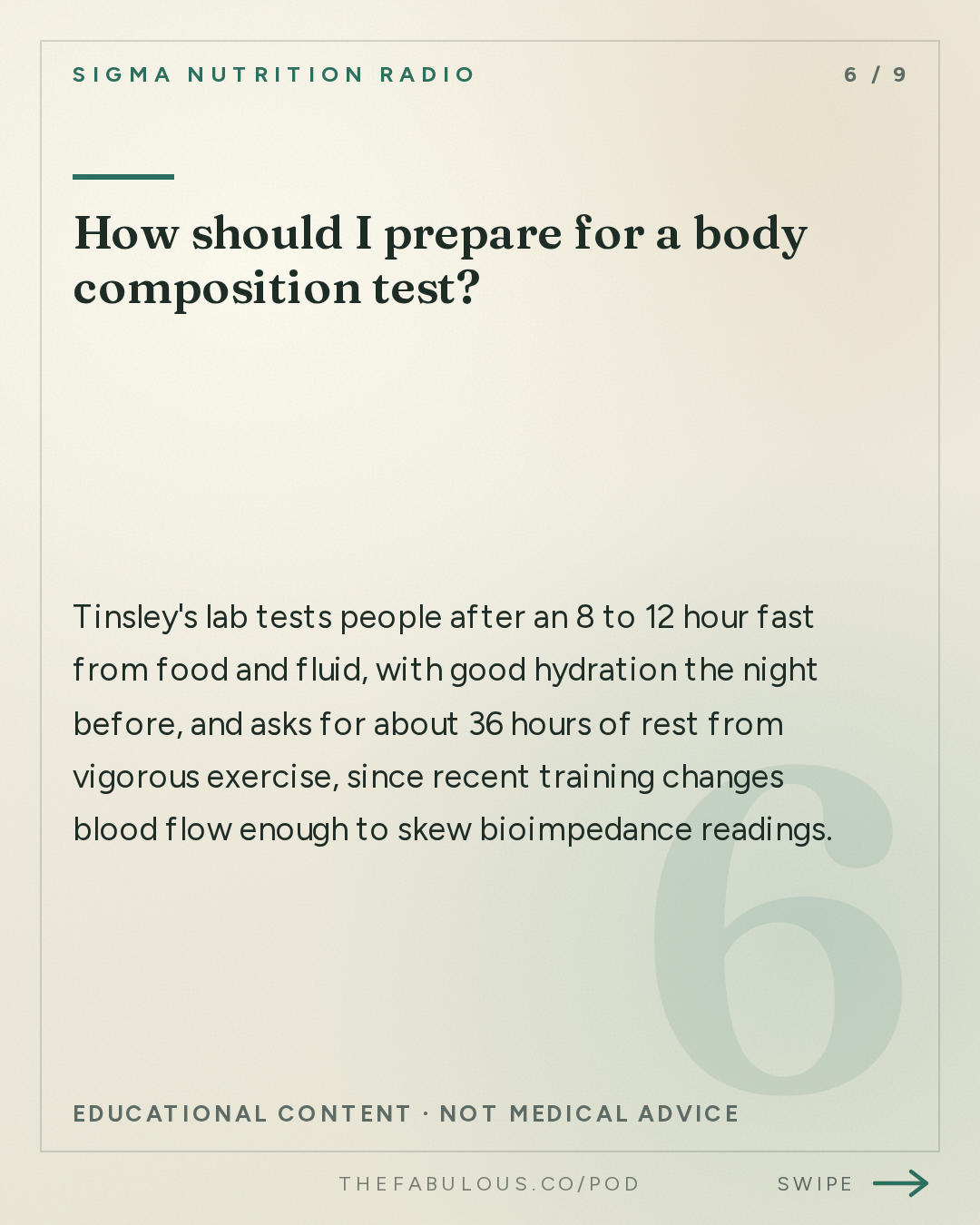
Tinsley's lab tests people after an 8 to 12 hour fast from food and fluid, with good hydration the night before, and asks for about 36 hours of rest from vigorous exercise, since recent training changes blood flow enough to skew bioimpedance readings (32:41, 33:28).
Are at-home body fat scales worth using?
Tinsley's lab tested 14 consumer bioimpedance scales priced $20 to $300 and found results ranging from worse than no data at all to laboratory-grade accuracy, with no visible feature predicting which category a given scale falls into before testing it (46:41, 47:03).
The full read, in cards
Go deeper
- Tinsley lab trial of 14 consumer bioimpedance scales — Found accuracy ranging from worse than useless to laboratory grade among at-home body fat scales priced $20 to $300
- Tinsley lab follow-up trial of consumer bioimpedance scales in over 200 people — Replicated the wide accuracy spread seen in the earlier 14-scale trial, even among established manufacturers
Mentioned
Grant Tinsley · Danny Lennon · Texas Tech University · DEXA · InBody · Bod Pod · MRI · Vineyard Health · Emily McKay
More from this show and category
Liking vs Wanting in Food Reward Psychology
Food reward splits into two separate systems: liking, the pleasure a food delivers, and wanting, the pull to eat it, which often runs on autopilot. Nutrition composition alone explains only 20% of why a food is liked (21:59); adding sensory perception explains another 40-60% (22:35), while ultra-processed classification barely moves the needle.
BPC-157 Safety and Clinical Evidence Explained
BPC-157 and similar peptide medications have almost no published human safety data, and most are sold as unregulated 'research chemicals.' Dr. Jordan Feigenbaum, founder of Barbell Medicine, explains the evidence gap, sourcing risks between research-grade chemicals and compounding pharmacies, and why pharmaceutical companies abandoned these compounds despite viral anecdotal enthusiasm.
Health Benefits of Fish vs Plant Protein
Fish shows up in nearly every national dietary guideline at roughly two servings a week, and the evidence behind that number holds up, but newer research shows the benefit depends heavily on what fish replaces and which population is eating it, and fish itself is not biologically required for good health.
How Wellness Culture Commodifies Science
Exercise physiologist Nick Tiller argues that wellness marketing borrows the language of science while discarding its standards, turning genuine findings, like vitamin D's role in immunity, into inflated, unverifiable claims. He traces the damage upstream too: low statistical power, publication bias, and admitted data manipulation in exercise science feed the misinformation industry that influencers later sell.
