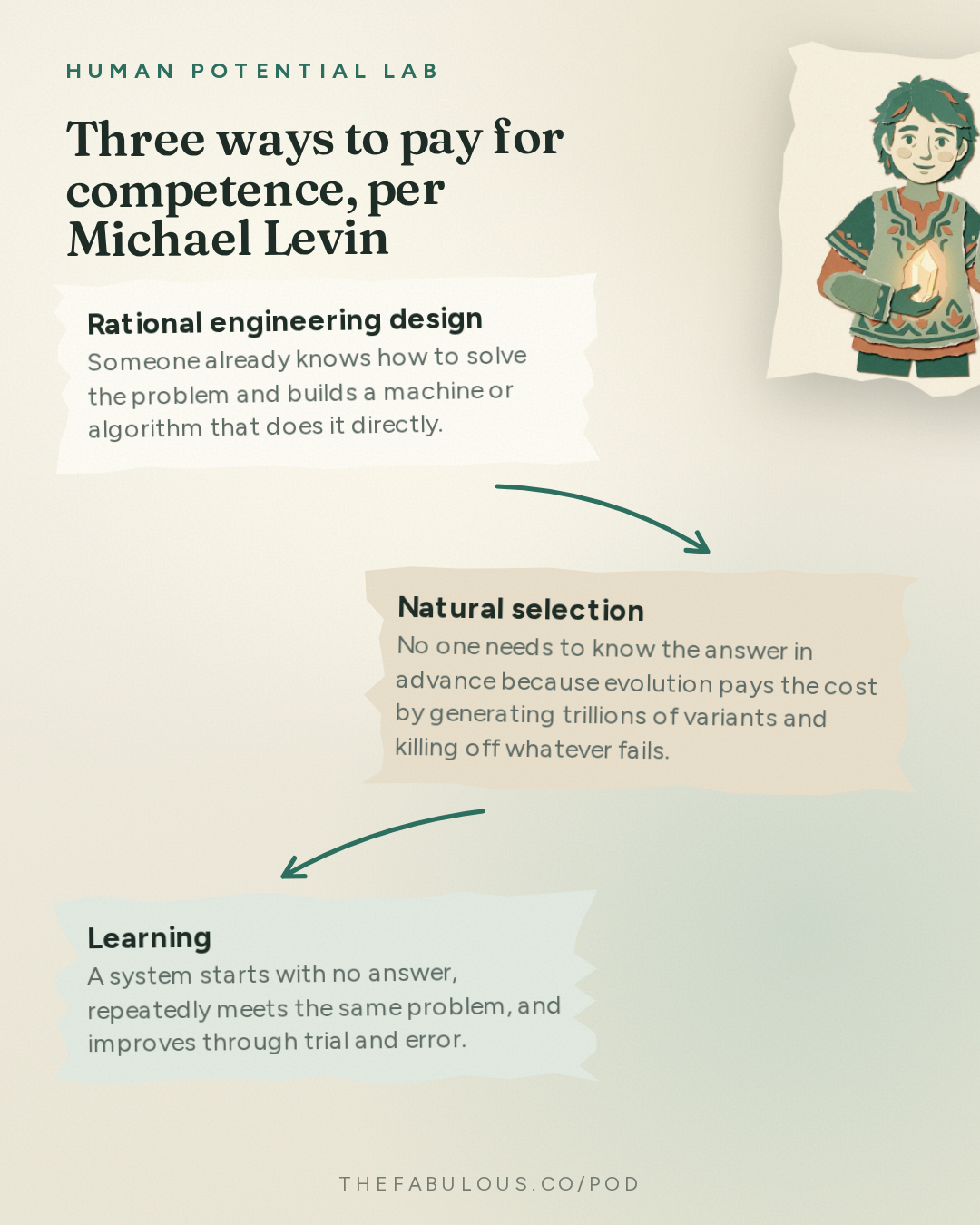
Michael Levin on Bioelectricity and Genius
Where Does Genius Come From? | Michael Levin
▶ Listen to the full episode More from The Psychology Podcast
The brief
Biologist Michael Levin argues intelligence is a spectrum of problem-solving competence found in cells, frogs, robots, and machines, not just brains. He says genius, from mathematician Srinivasa Ramanujan's theorems to lab-grown xenobots, taps a shared non-physical "Platonic space" of patterns, with bioelectric signals acting as glue that links small parts into larger goal-seeking wholes.
Picture two flatworms side by side in a dish. One has a single head, the ordinary flatworm shape. The other has two heads. Both were built from the same genome, down to the letter. Nothing in the DNA was edited. The only thing that changed was an electrical signal (21:33). That small, strange fact sits at the center of biologist Michael Levin's research, and it turns out to be an unusually good door into bigger questions: what counts as a mind, where genius comes from, and whether either biology or AI actually builds intelligence at all.
Levin starts from a plain definition. Intelligence, he says, is competence in problem-solving and ingenuity in reaching a goal as circumstances change (02:13). He applies that yardstick far past brains, to slime molds, cell clusters, and even inorganic materials. The test he uses is what he calls a cognitive light cone: the size of the biggest goal, in space and in time, that a system can actually pursue (07:01). A thermostat has a tiny one. A person planning a career has an enormous one. Levin resists drawing a hard line between intelligent and not: "Intelligence is, I think, a two-way IQ test. It's very easy to give something a low score of intelligence because we're not smart enough," he says (05:25), meaning our failure to notice a system's cleverness often says more about the limits of the observer than the limits of the system.
The glue beneath cognition
The mechanism Levin thinks does the actual work of scaling up minds is bioelectricity, the voltage patterns that cells generate using ion channels, the proteins that let charged particles in and out of a cell. Neurons use this machinery to fire signals. So, Levin points out, does nearly every other cell in the body (17:26). Single cells can track small things, like pH or hunger. But when cells link into an electrical network, the network can hold a goal no individual cell could hold alone, such as the shape of an entire limb. That is why he says, "I don't think neuroscience is about neurons at all. I think neuroscience is about cognitive glue" (17:46): the interesting question isn't the wiring diagram, it's how separate parts come to share one goal.
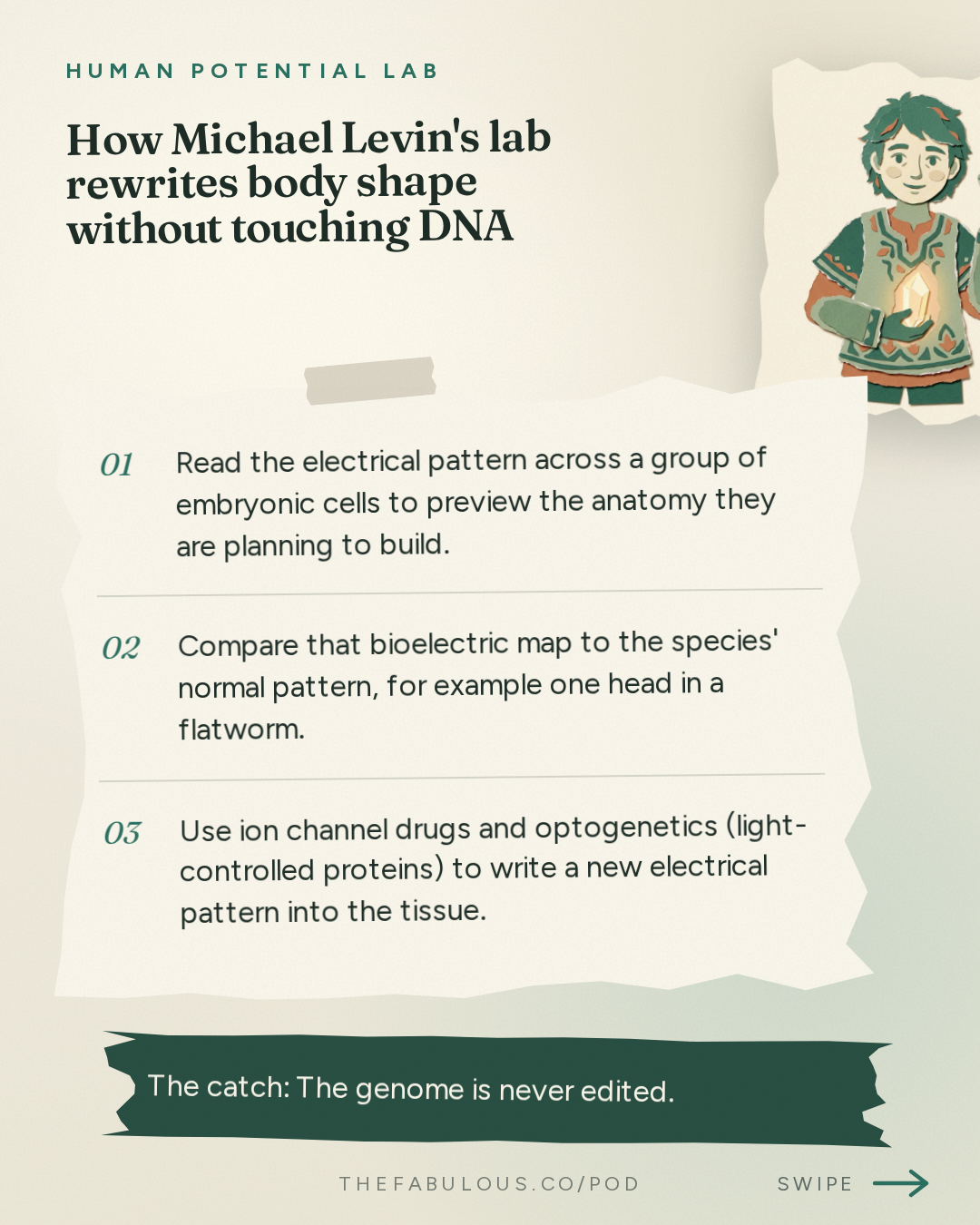
This is not a metaphor Levin leaves abstract. His lab has spent 26 years building tools to read that bioelectric pattern, essentially previewing what shape a developing embryo intends to build before the structure appears, and to write new patterns into tissue using ion channel drugs and optogenetics, a technique that uses light to switch specific proteins on or off (20:35, 21:13). That is how the two-headed flatworm happened: the electrical "memory" of the correct body plan was rewritten, and the cells built two heads instead of one, genome untouched (21:33, 21:57). The same approach has produced tadpoles with an eye on the tail. None of this has been done in a living human yet; it has been tested in animal models and in human cells grown in a dish (21:33). But it reframes genes. Levin says genes mostly specify hardware, the proteins available to build with, while the higher-level behavioral software, like what shape to build, lives somewhere else (56:46).
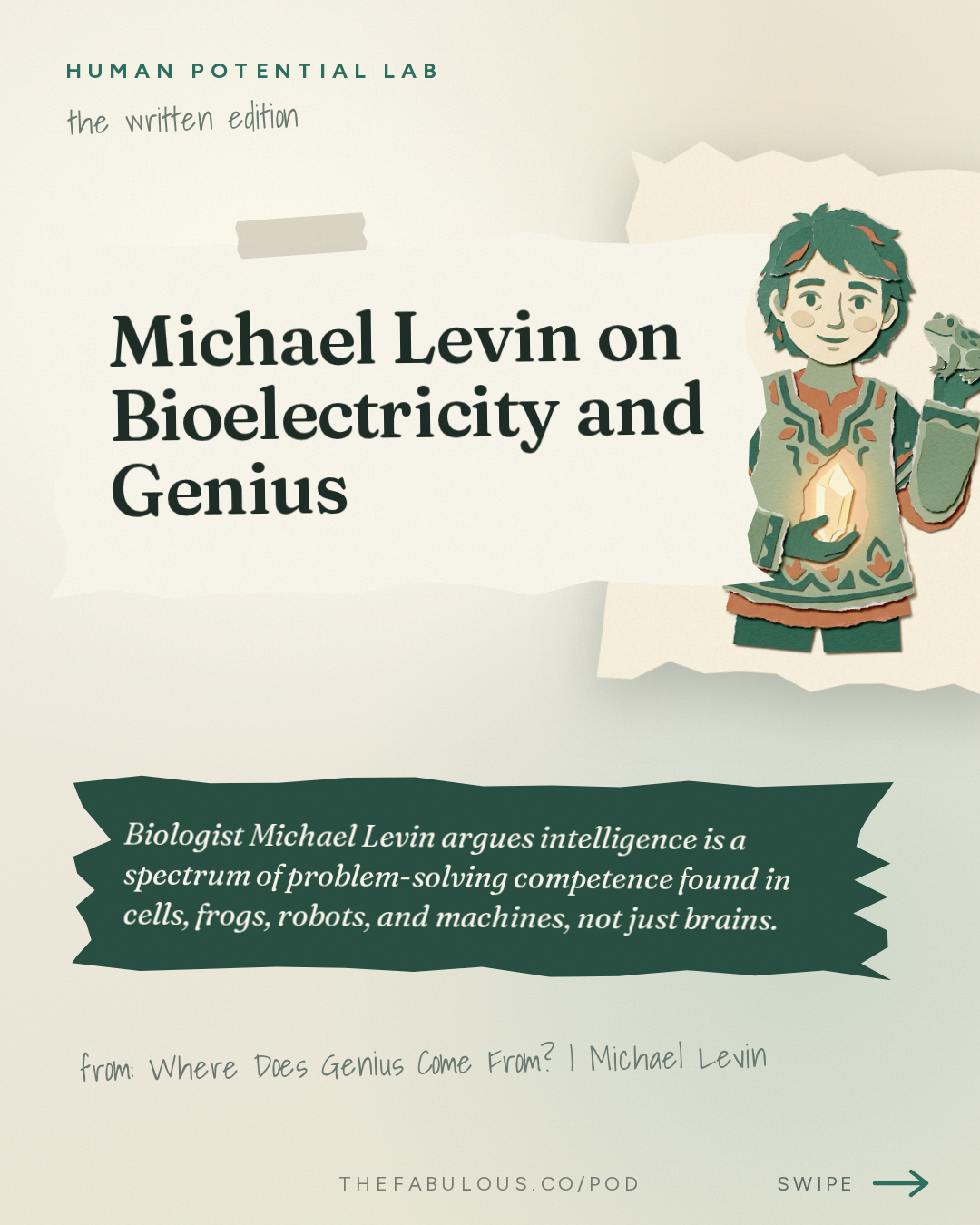
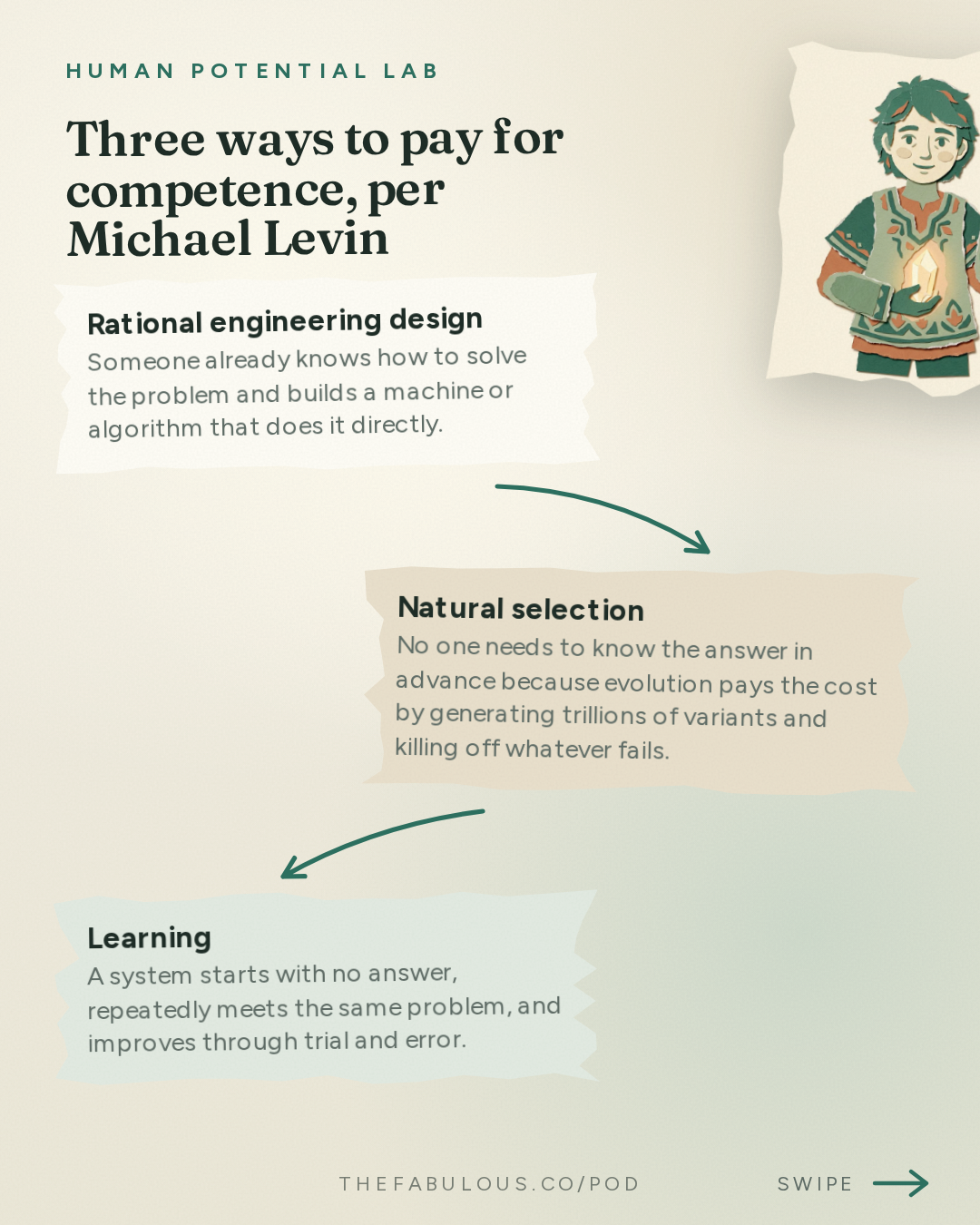
That reframing sets up the part of the conversation aimed at genius. Levin notices that competence, in science and engineering, is usually paid for in one of three ways: someone already knows the answer and designs it directly, or evolution tests trillions of variants and keeps the survivors, or a system learns through repeated trial and error (26:02, 26:25). Each method has a cost proportional to the result. But some things don't fit. Levin's lab has built xenobots, tiny organisms made from frog skin cells, and anthrobots, made from adult human tracheal cells, neither designed, evolved, nor trained to do what they do (30:18). "These are novel creatures that have never been on Earth before," he says, and some of their behaviors were never selected for by evolution because there has been no evolutionary history to select them (31:19). Somewhere, a cost was not paid in the usual currency.
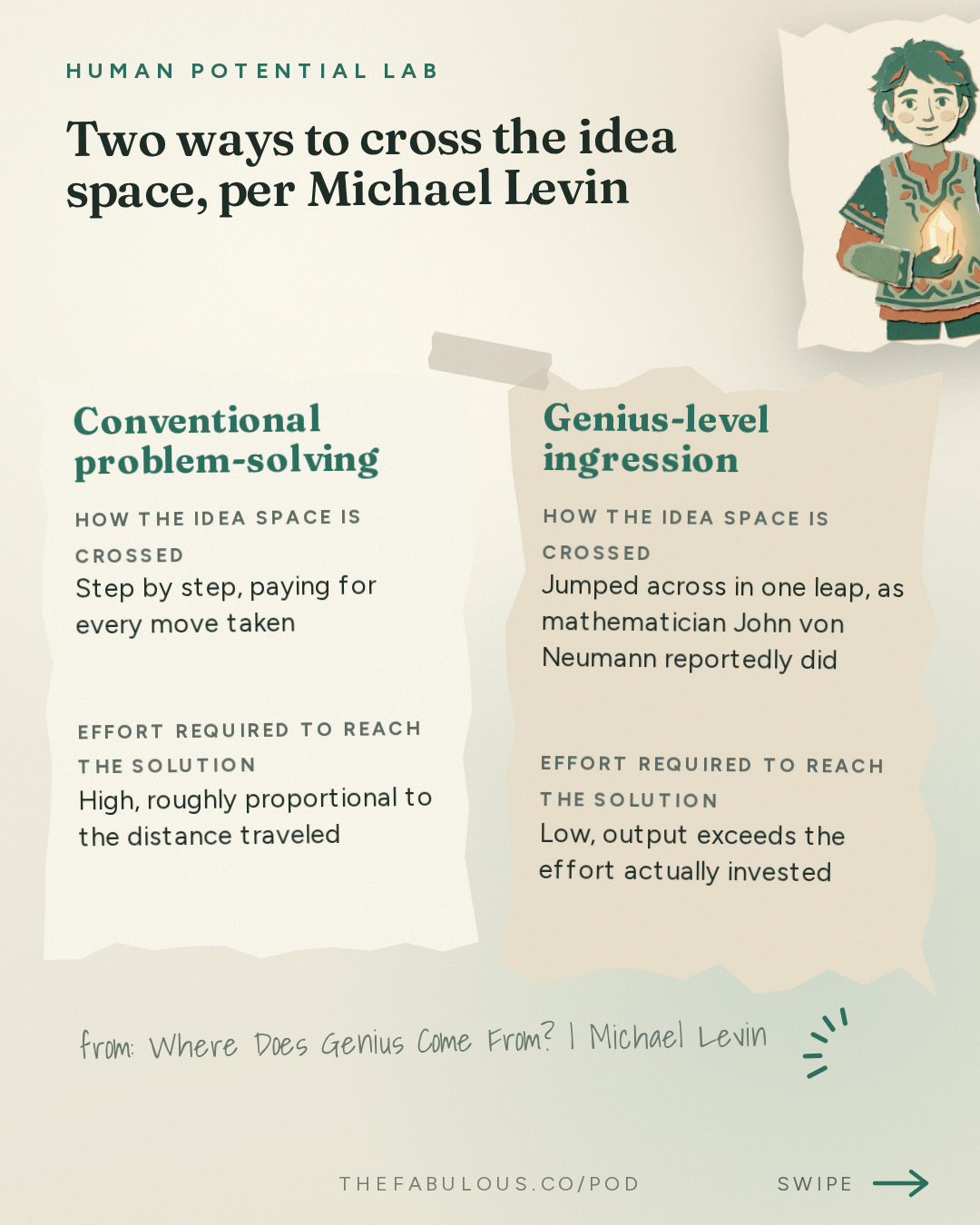
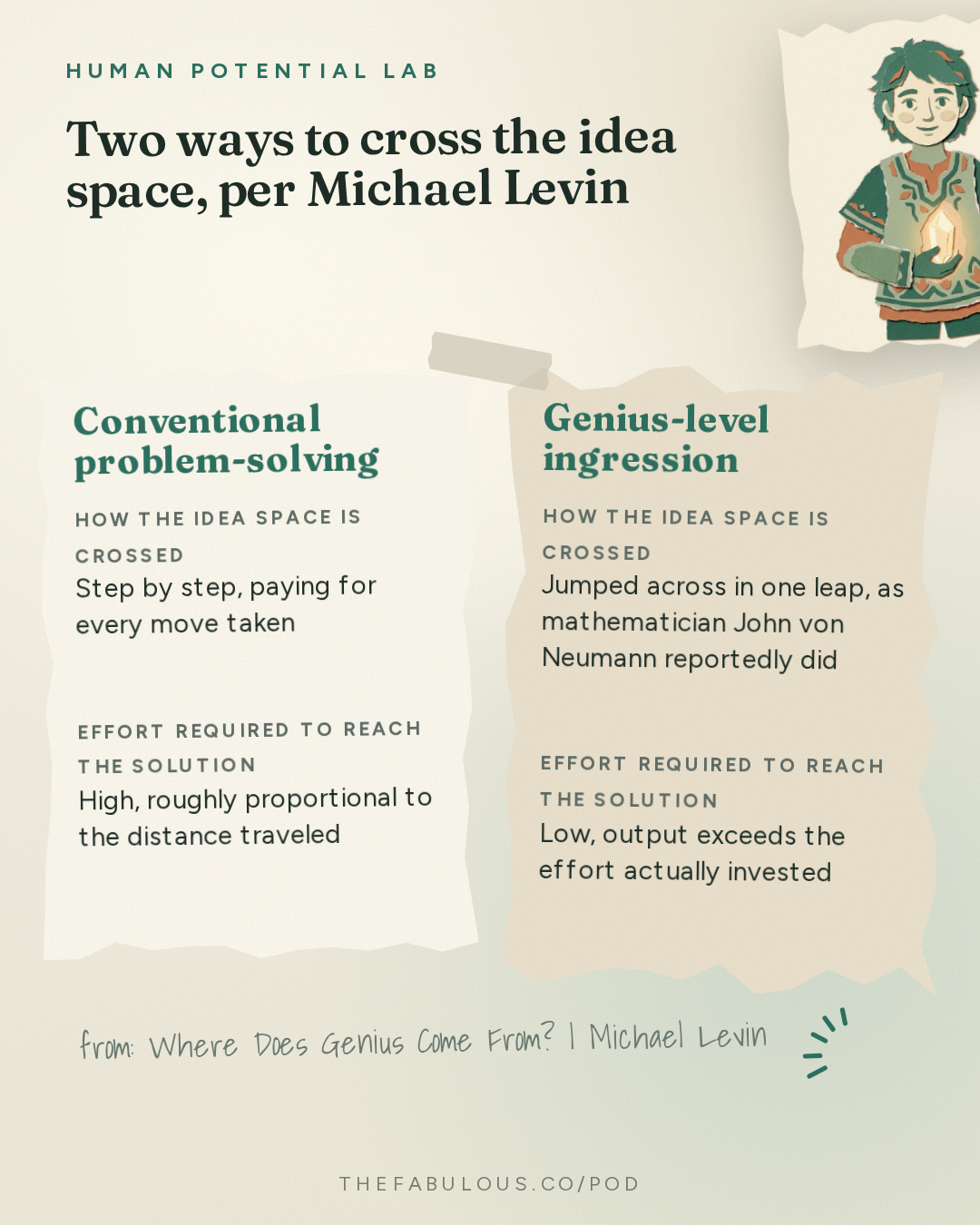
Levin maps this onto a spectrum he calls inspiration. At one end is ordinary step-by-step problem solving, where every move is earned. Further along is someone like mathematician John von Neumann, who could look at a problem and jump straight to the answer. At the far end is mathematician Srinivasa Ramanujan, who described receiving entire theorems, crediting a Hindu goddess for whispering them to him at night (33:43). Levin calls the sudden, uncaused appearance of competence an "ingression," and the word inspiration, he notes, literally means to breathe something in.
A space mathematics cannot touch
To explain where an ingression might come from, Levin reaches for an idea he names, loosely, after Plato. Mathematicians already accept that some facts are not facts of physics: nothing you could do to the universe, no tweak to any physical constant, would change the digits of the constant e, or make a formula exist for solving a fifth-degree equation when none does (38:06, 40:31). Those facts affect the physical world anyway. Levin's favorite example is the cicada, an insect that emerges from the ground in cycles of 13 or 17 years, both prime numbers, which makes it harder for predators with shorter life cycles to synchronize with them (39:03). Ask why 13 and 17, and the answer eventually lands in the math department, not biology.
Levin's addition to that old idea is a wager that this non-physical space is not only full of static facts like the digits of e. It might also hold dynamic patterns, the kind a behavioral scientist would recognize: habituation, anticipation, delayed gratification, even the shape of a mind. If so, he says, building any physical system, an embryo, a robot, a brain, is not the same as making a mind. It is building an interface that certain patterns can enter through. "I don't think minds are made, either biologically or by AI. I think what you make are interfaces," he says (44:51). The old idea that a genius is someone whose spirit is being inhabited, he adds, might be closer to literally true than people assume (45:35).
Near the end of the conversation, Levin brings up a detail from Alan Turing's famous paper proposing the Turing test, the thought experiment for judging whether a machine can imitate human conversation convincingly. Turing wrote that the test would probably fail, he says, because the evidence for telepathy was strong enough that a human could use it to detect another human, something he assumed a computer could never do (58:43). "The evidence for telepathy is really good, and humans are gonna be able to tell when they're talking to another human, but the computer definitely can't," Levin recounts (59:02). He is not defending telepathy. He is pointing out that even Turing, writing the founding document of machine intelligence, carried an unexamined assumption about what bodies can do that silicon cannot.
That is the thread running under everything Levin says: humility about where the boundary sits, because every time someone draws a hard line around minds, intelligence, or genius, the data has a habit of crossing it. The flatworm with two heads did not know it was breaking a rule. It just followed the instructions it was given, in a language that had nothing to do with genes.
Ask this episode anything
Pod's AI answers from the episode itself, with the minute mark so you can hear it yourself.
Or start with one of these
Ask this episode
Pod's AI listens to the whole episode to answer, and points you to the minute it comes from.
The rest of this answer, and any question after it
Answers come from the episode itself, never from a summary of it.
ContinueKey takeaways
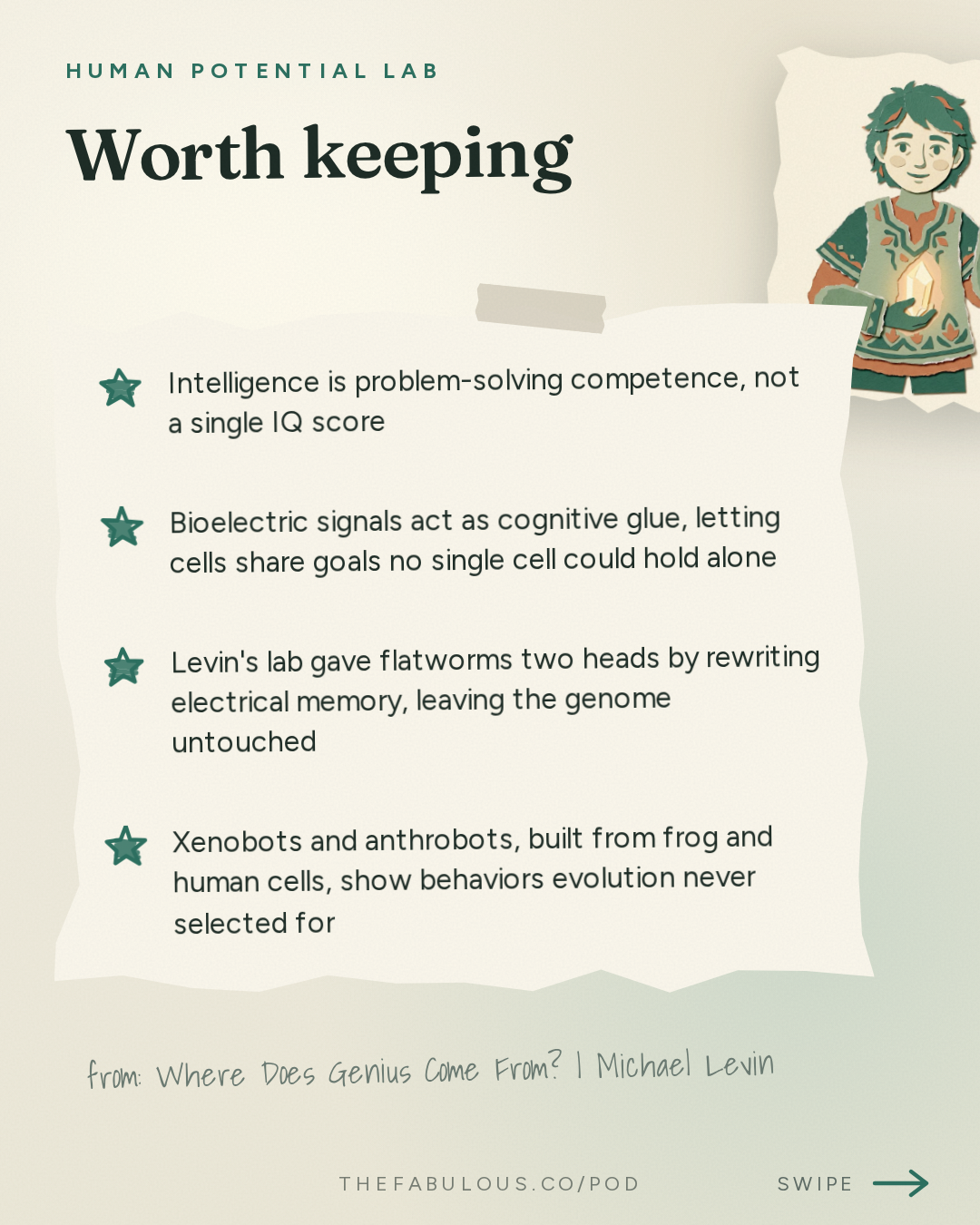
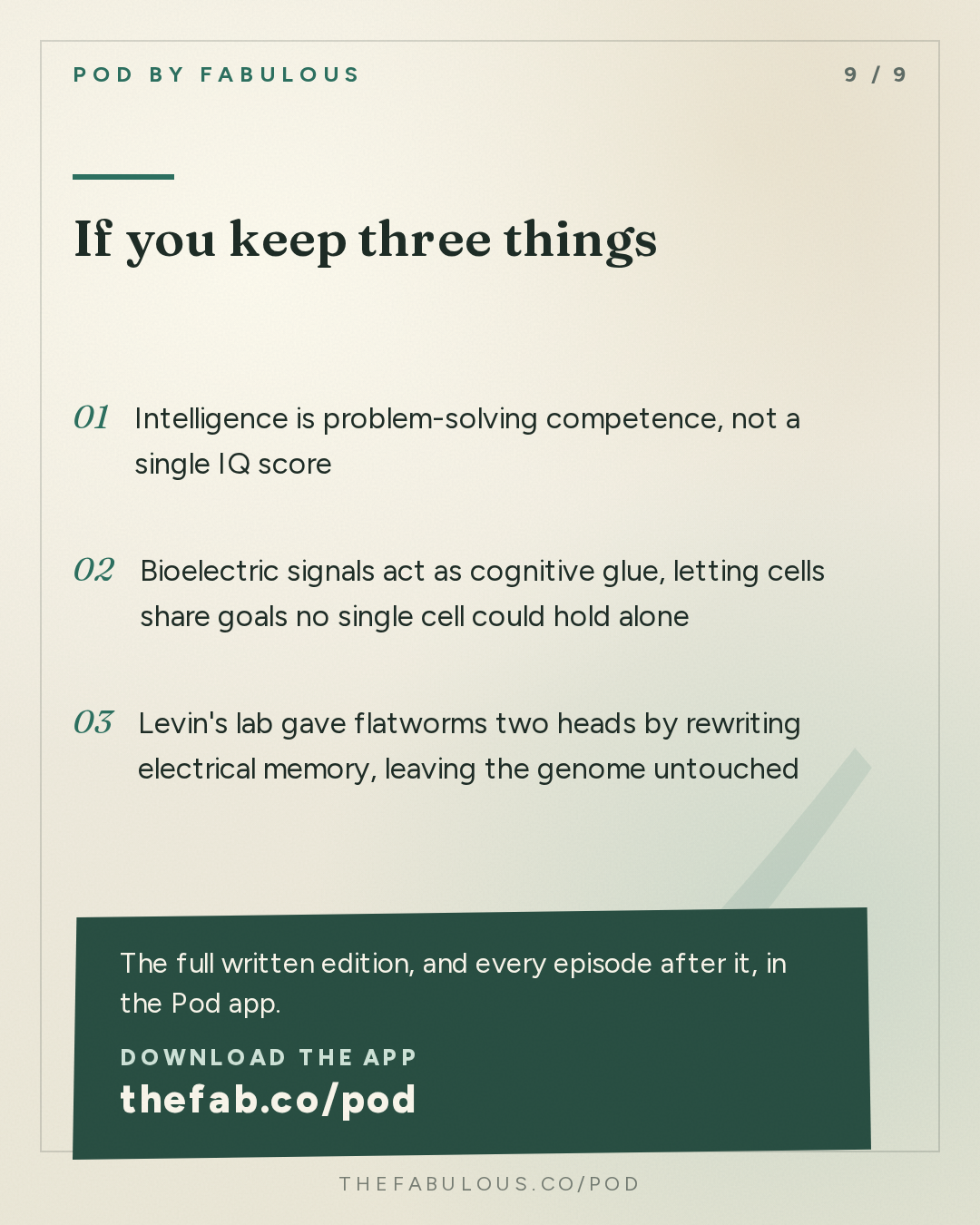
- Intelligence is problem-solving competence, not a single IQ score
- Bioelectric signals act as cognitive glue, letting cells share goals no single cell could hold alone
- Levin's lab gave flatworms two heads by rewriting electrical memory, leaving the genome untouched
- Xenobots and anthrobots, built from frog and human cells, show behaviors evolution never selected for
- Levin argues genius is an interface letting a non-physical Platonic space of patterns enter the physical world
The episode in cards
By the numbers
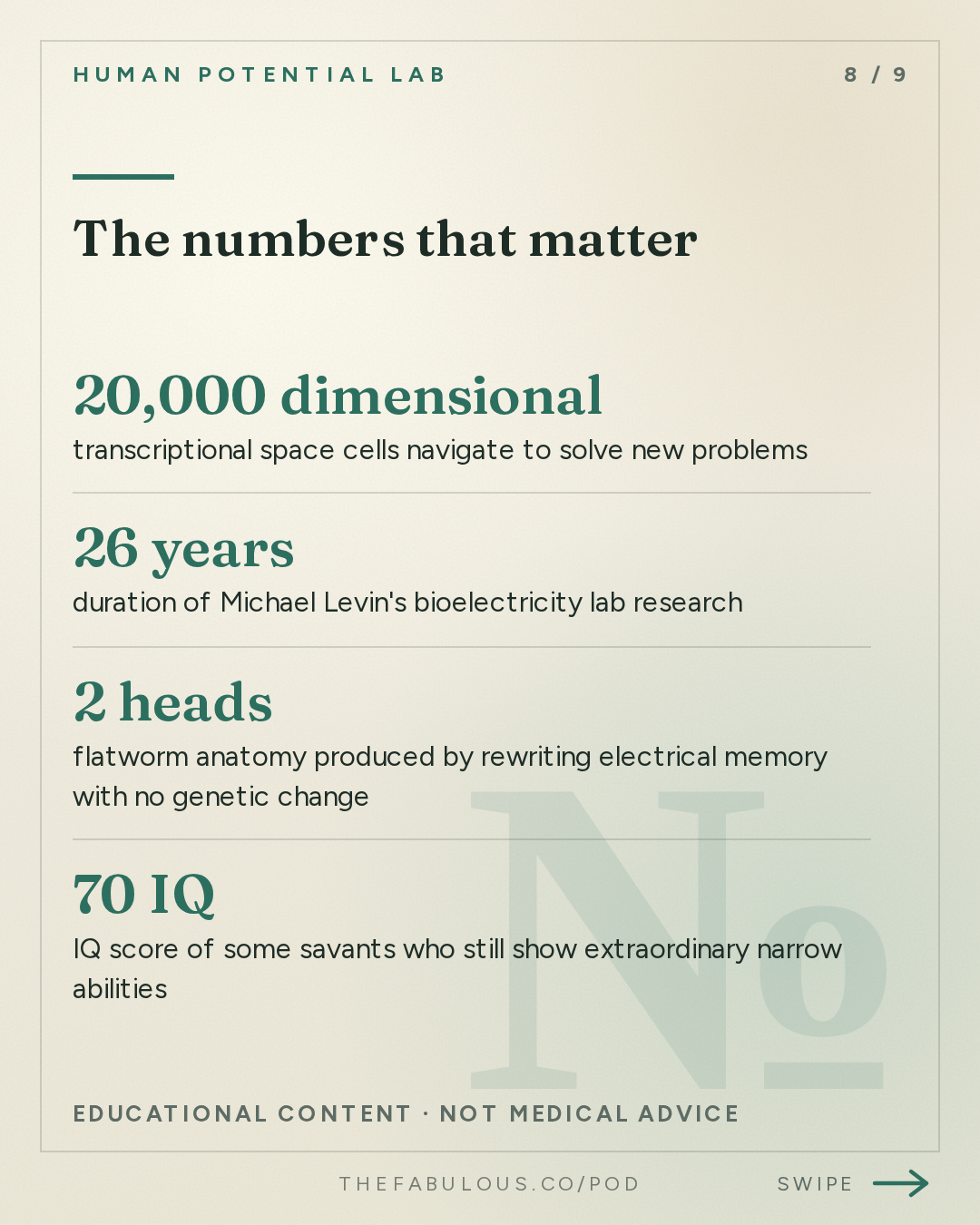
- 20,000 dimensional transcriptional space cells navigate to solve new problems
- 26 years duration of Michael Levin's bioelectricity lab research
- 2 heads flatworm anatomy produced by rewriting electrical memory with no genetic change
- 70 IQ IQ score of some savants who still show extraordinary narrow abilities
- 13 and 17 years cicada emergence cycles, tied to prime numbers rather than biology
In their words
“I actually don't think neuroscience is about neuron at all. I think, I think neuroscience is about cognitive glue”
“I don't think minds are made, either biologically or by AI. I don't think you make them. I think what you make are interfaces”
“Intelligence is, I think, a two-way IQ test, so it's very easy to, to give something a low score of intelligence because we're not smart enough”
“The evidence for telepathy is really good, and humans are gonna be able to tell when they're talking to another human, but the r- but the, but the computer definitely can't”
Protocols
-
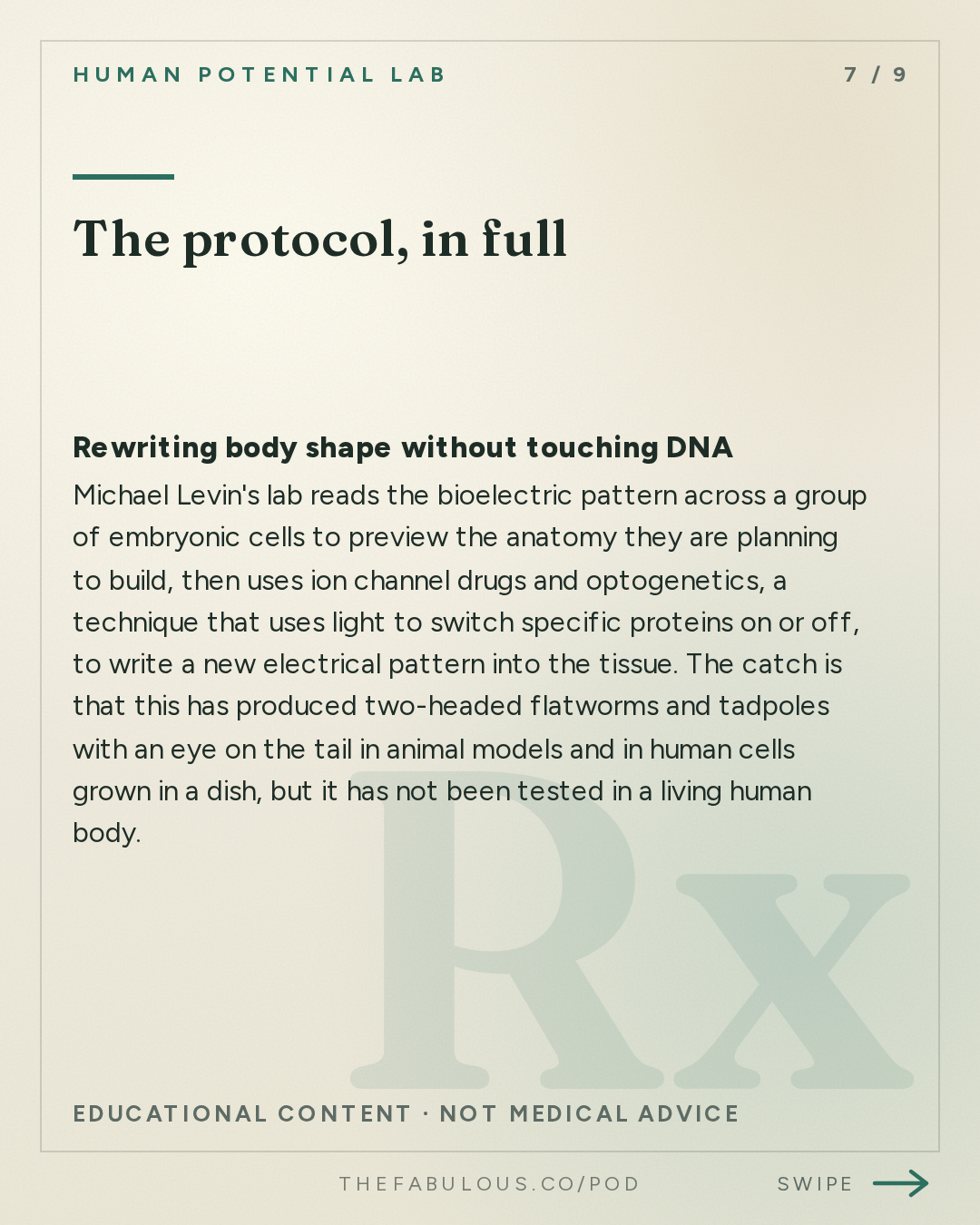
Rewriting body shape without touching DNA
Michael Levin's lab reads the bioelectric pattern across a group of embryonic cells to preview the anatomy they are planning to build, then uses ion channel drugs and optogenetics, a technique that uses light to switch specific proteins on or off, to write a new electrical pattern into the tissue. The catch is that this has produced two-headed flatworms and tadpoles with an eye on the tail in animal models and in human cells grown in a dish, but it has not been tested in a living human body.
experimental, lab research only as of this recording
Questions this episode answers
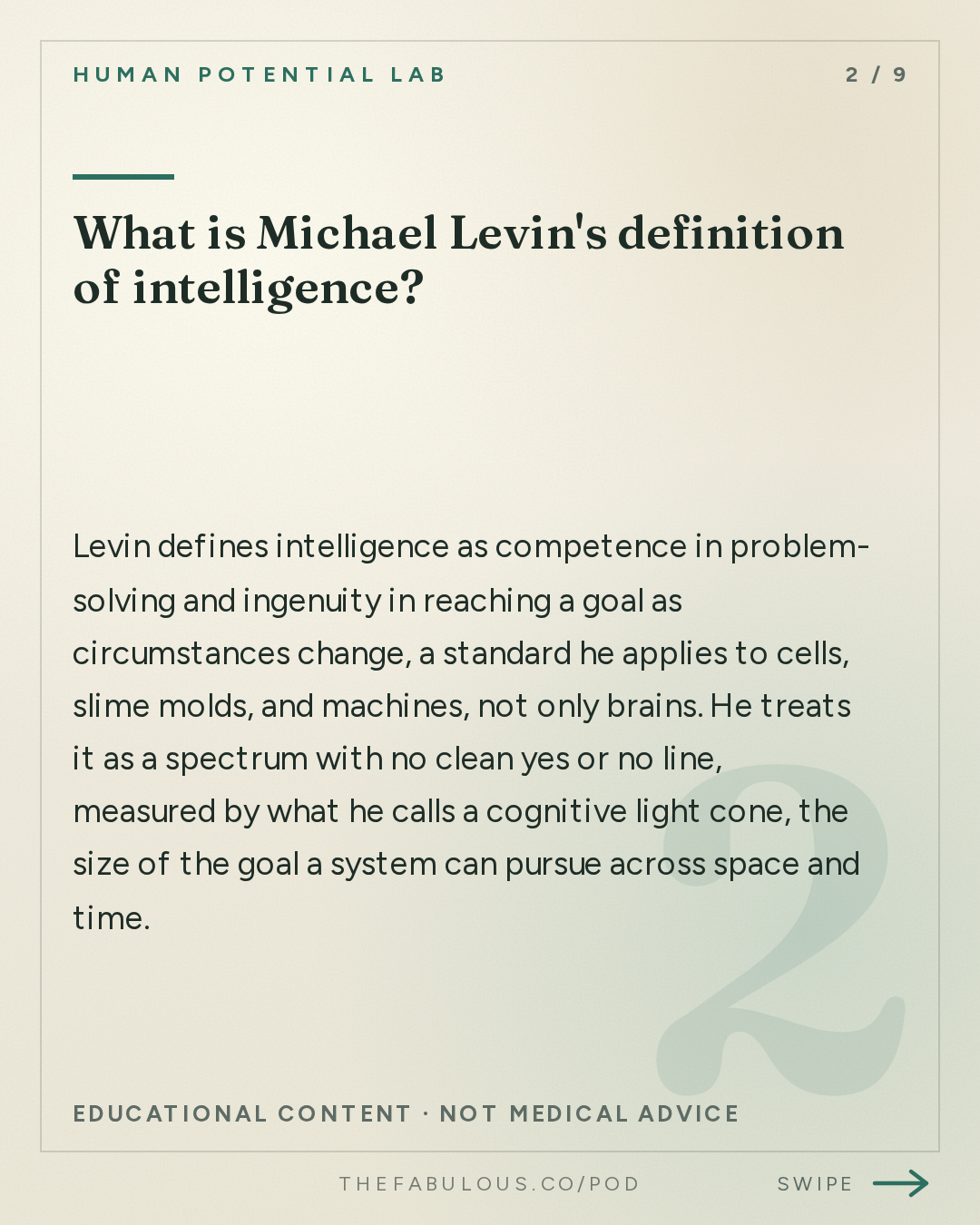
What is Michael Levin's definition of intelligence?
Levin defines intelligence as competence in problem-solving and ingenuity in reaching a goal as circumstances change, a standard he applies to cells, slime molds, and machines, not only brains (02:13). He treats it as a spectrum with no clean yes or no line, measured by what he calls a cognitive light cone, the size of the goal a system can pursue across space and time (07:01).
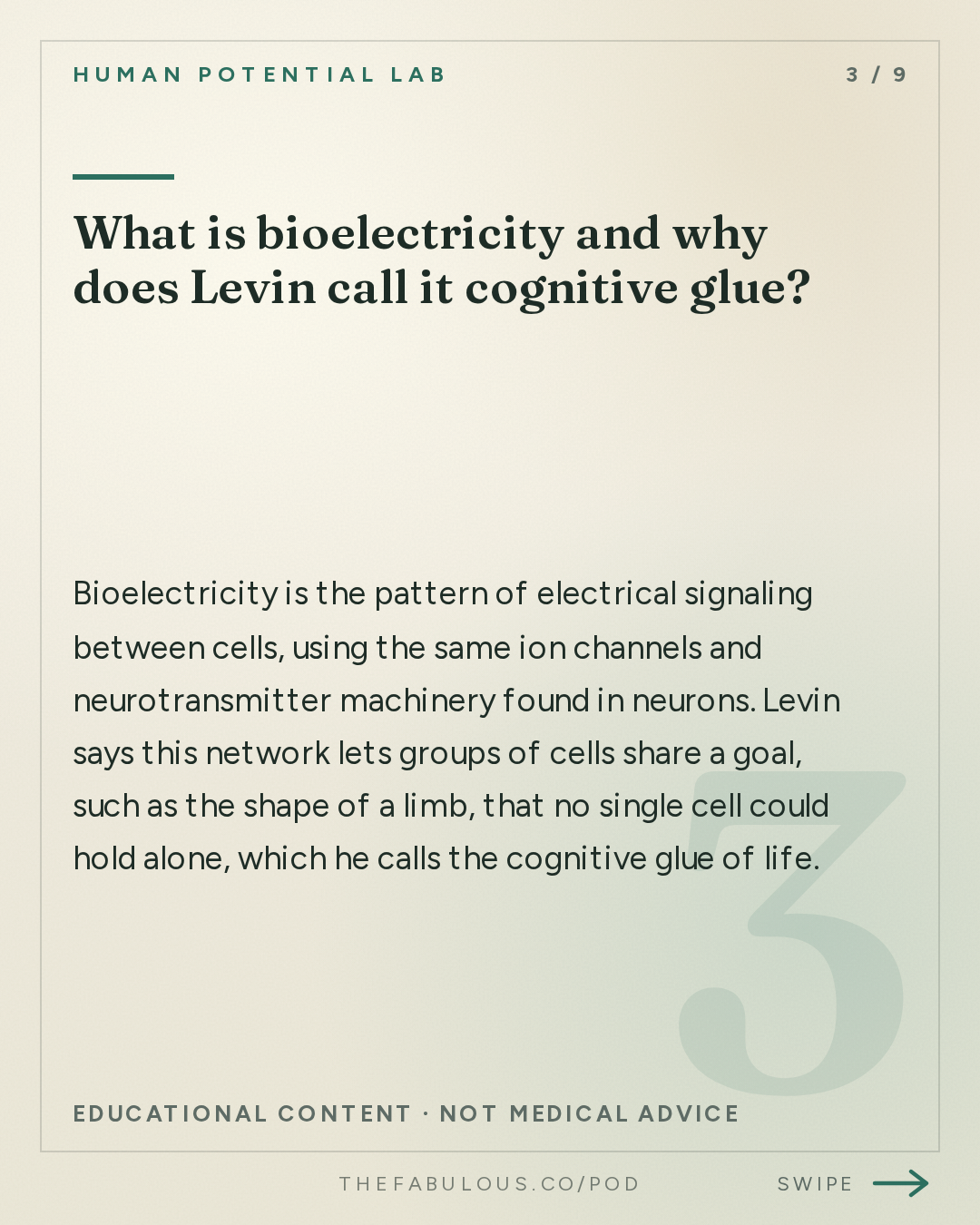
What is bioelectricity and why does Levin call it cognitive glue?
Bioelectricity is the pattern of electrical signaling between cells, using the same ion channels and neurotransmitter machinery found in neurons (17:26). Levin says this network lets groups of cells share a goal, such as the shape of a limb, that no single cell could hold alone, which he calls the cognitive glue of life (17:46).
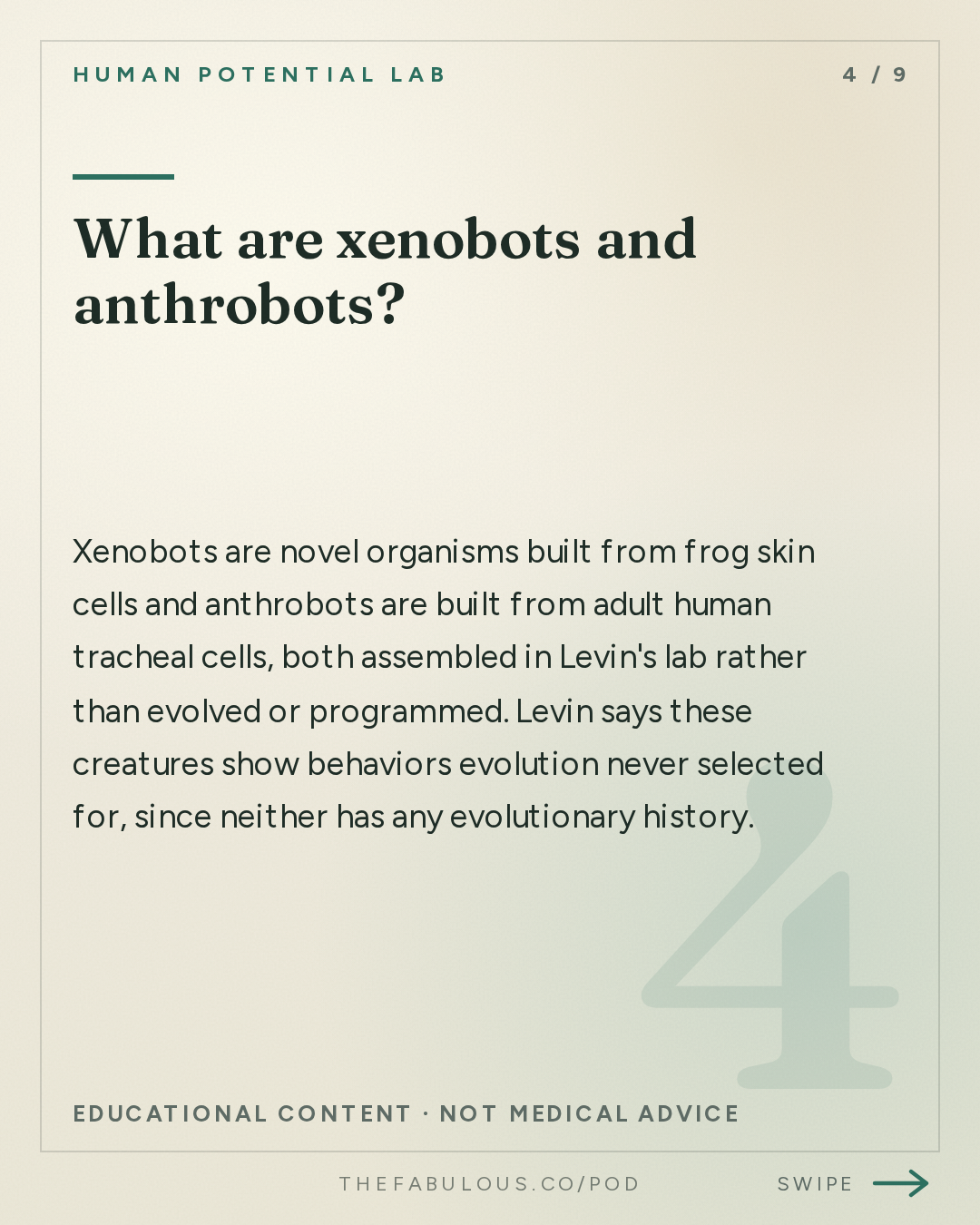
What are xenobots and anthrobots?
Xenobots are novel organisms built from frog skin cells and anthrobots are built from adult human tracheal cells, both assembled in Levin's lab rather than evolved or programmed (30:18). Levin says these creatures show behaviors evolution never selected for, since neither has any evolutionary history (31:19).
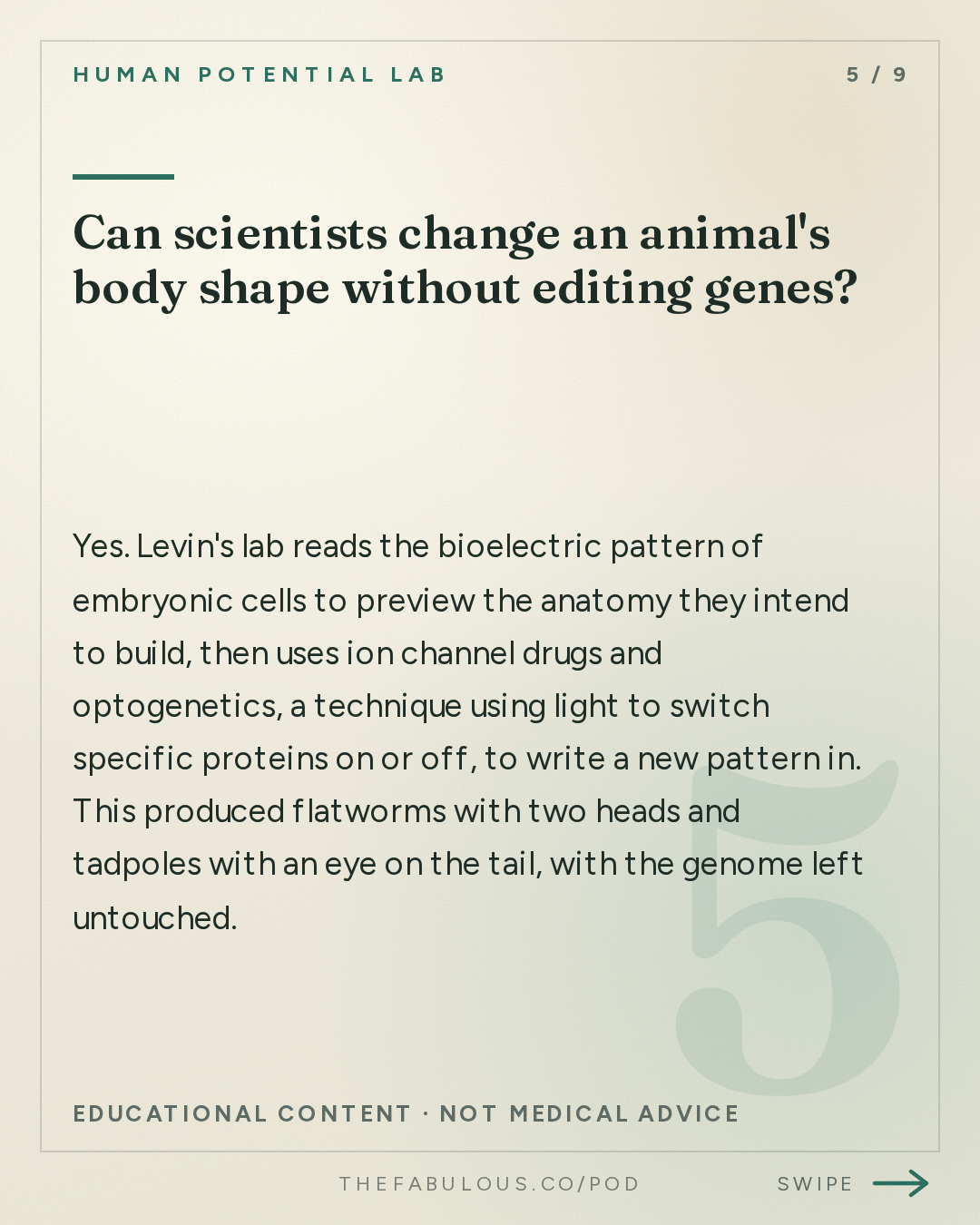
Can scientists change an animal's body shape without editing genes?
Yes. Levin's lab reads the bioelectric pattern of embryonic cells to preview the anatomy they intend to build, then uses ion channel drugs and optogenetics, a technique using light to switch specific proteins on or off, to write a new pattern in (21:13). This produced flatworms with two heads and tadpoles with an eye on the tail, with the genome left untouched (21:33).
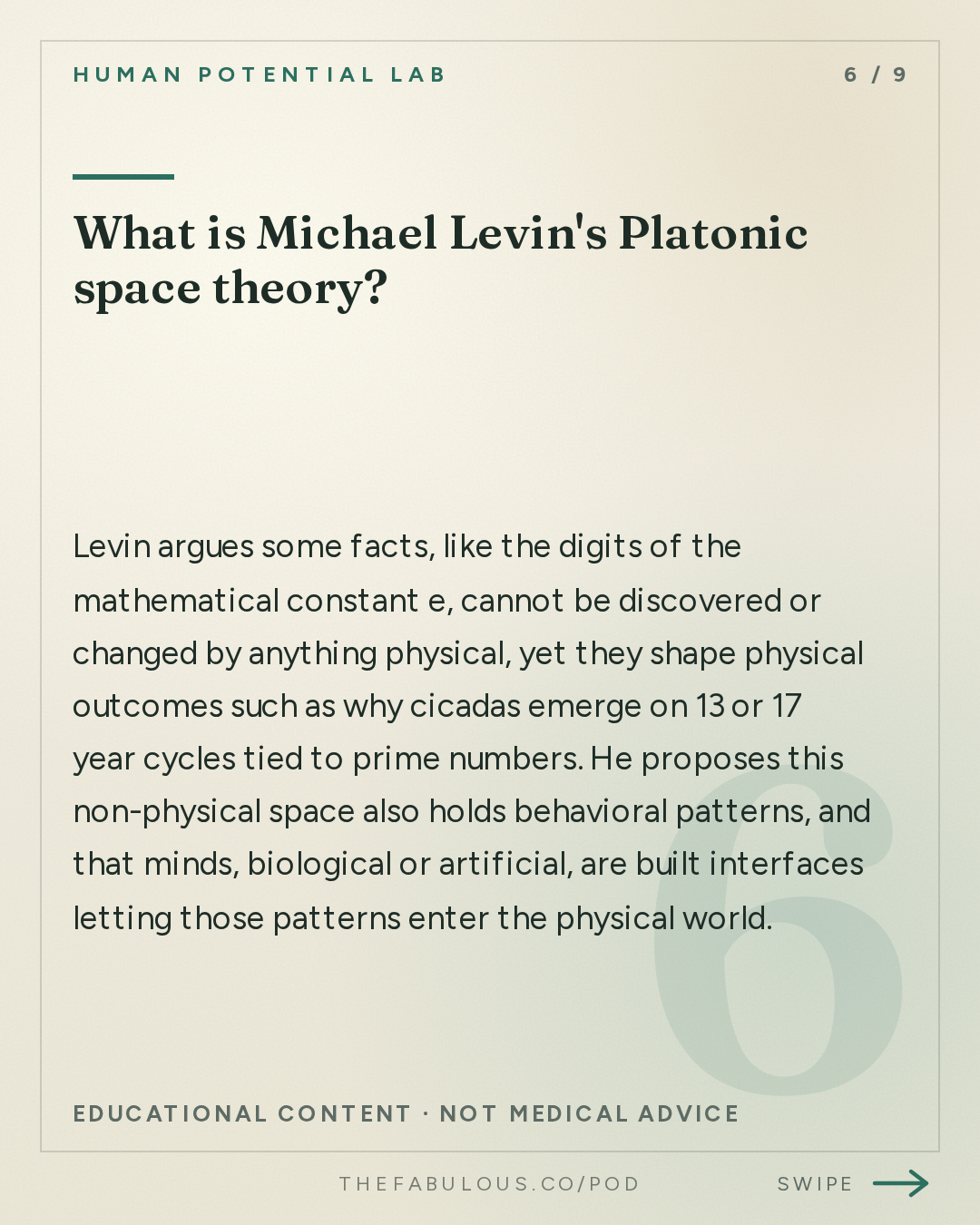
What is Michael Levin's Platonic space theory?
Levin argues some facts, like the digits of the mathematical constant e, cannot be discovered or changed by anything physical, yet they shape physical outcomes such as why cicadas emerge on 13 or 17 year cycles tied to prime numbers (39:03). He proposes this non-physical space also holds behavioral patterns, and that minds, biological or artificial, are built interfaces letting those patterns enter the physical world (44:51).
Did Alan Turing believe computers could never match human minds?
In his paper proposing the Turing test, mathematician Alan Turing wrote that the test would likely fail because the evidence for telepathy was strong enough that a human could use it to detect another human, something he assumed a computer could not do (58:43). Levin cites this as an example of a brilliant, open-minded scientist carrying an unexamined assumption into his own theory (59:02).
The full read, in cards
Go deeper
- Islands of Genius — Daryl Treffert's study of savant syndrome, which Scott Barry Kaufman calls one of his favorite books
Mentioned
Michael Levin · Scott Barry Kaufman · Xenobots · Anthrobots · William James · Chris Fields · Charles Darwin · John von Neumann · Srinivasa Ramanujan · Plato · Pythagoras · Daryl Treffert · Islands of Genius · Alan Turing
More from this show and category
L.A. Paul on Transformative Experience and AI
Philosopher L.A. Paul says a transformative experience changes what you care about most, and only living it reveals what it's like (03:55, 05:12). She argues this same logic breaks AI alignment, since human values shift as people interact with new technology, making alignment a target that keeps moving (45:13, 46:19).
Scott Barry Kaufman's 7 Lessons from 11 Years of Podcasting
Scott Barry Kaufman closes 11 years and 478 episodes of The Psychology Podcast with seven lessons on human potential, personality change, and creativity. He argues neuroticism is the easiest Big Five trait to shift and openness the hardest, and that lasting change comes from habits, not willpower (09:06, 15:22).
Alia Crum on How Mindset Shapes Stress and Hunger
Stanford psychologist Alia Crum finds that beliefs about food, stress, illness, and genes can alter body chemistry itself. Labeling an identical milkshake indulgent rather than sensible triples the drop in the hunger hormone ghrelin (12:37), and believing one carries a low-efficiency exercise gene lowers real oxygen conversion regardless of actual genotype (47:10).

Ellen Vora: Heal Gut, Hormones, Anxiety
Psychiatrist Ellen Vora says gut, hormone, and anxiety struggles often trace back to suppressed truth, estrogen dominance, and mistaking fear for intuition. She offers concrete fixes: daily bowel habits and magnesium glycinate for hormone balance, and a simple tone-test (intuition is quiet, fear is loud) for telling real guidance from anxious noise.
