L.A. Paul on Transformative Experience and AI
The Person You Become | L.A. Paul
▶ Listen to the full episode More from The Psychology Podcast
The brief
Philosopher L.A. Paul says a transformative experience changes what you care about most, and only living it reveals what it's like (03:55, 05:12). She argues this same logic breaks AI alignment, since human values shift as people interact with new technology, making alignment a target that keeps moving (45:13, 46:19).
There is a question philosophers like to ask: could you know what it is like to taste a fruit you have never eaten, just because someone describes it to you in perfect detail? No. You would still have to put it in your mouth. Philosopher L.A. Paul has spent years turning that small, stubborn fact into a theory of how people change, and in conversation with psychologist Dr. Scott Barry Kaufman, she used it to explain parenthood, addiction, moral decline, and why artificial intelligence may never be fully controlled.
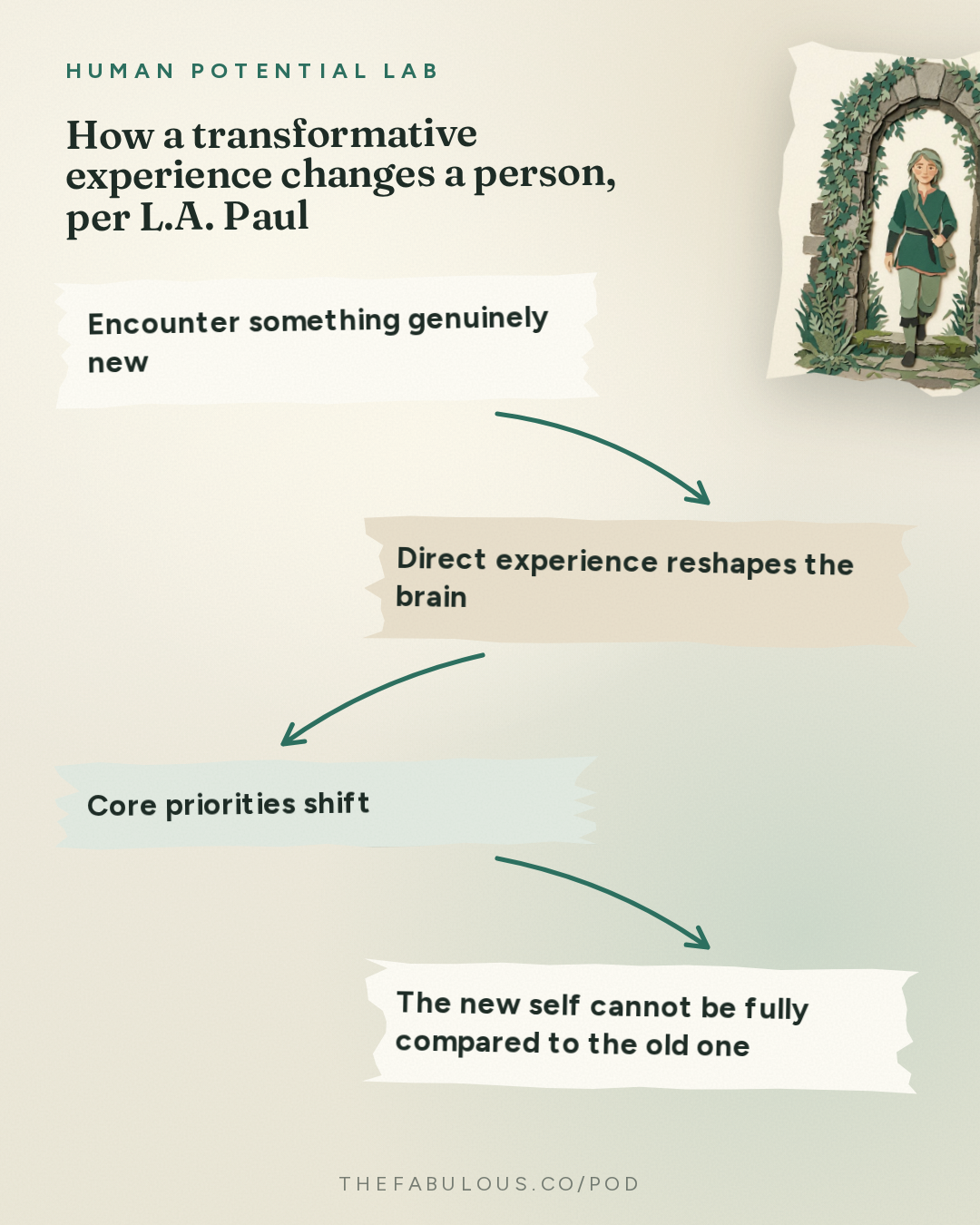
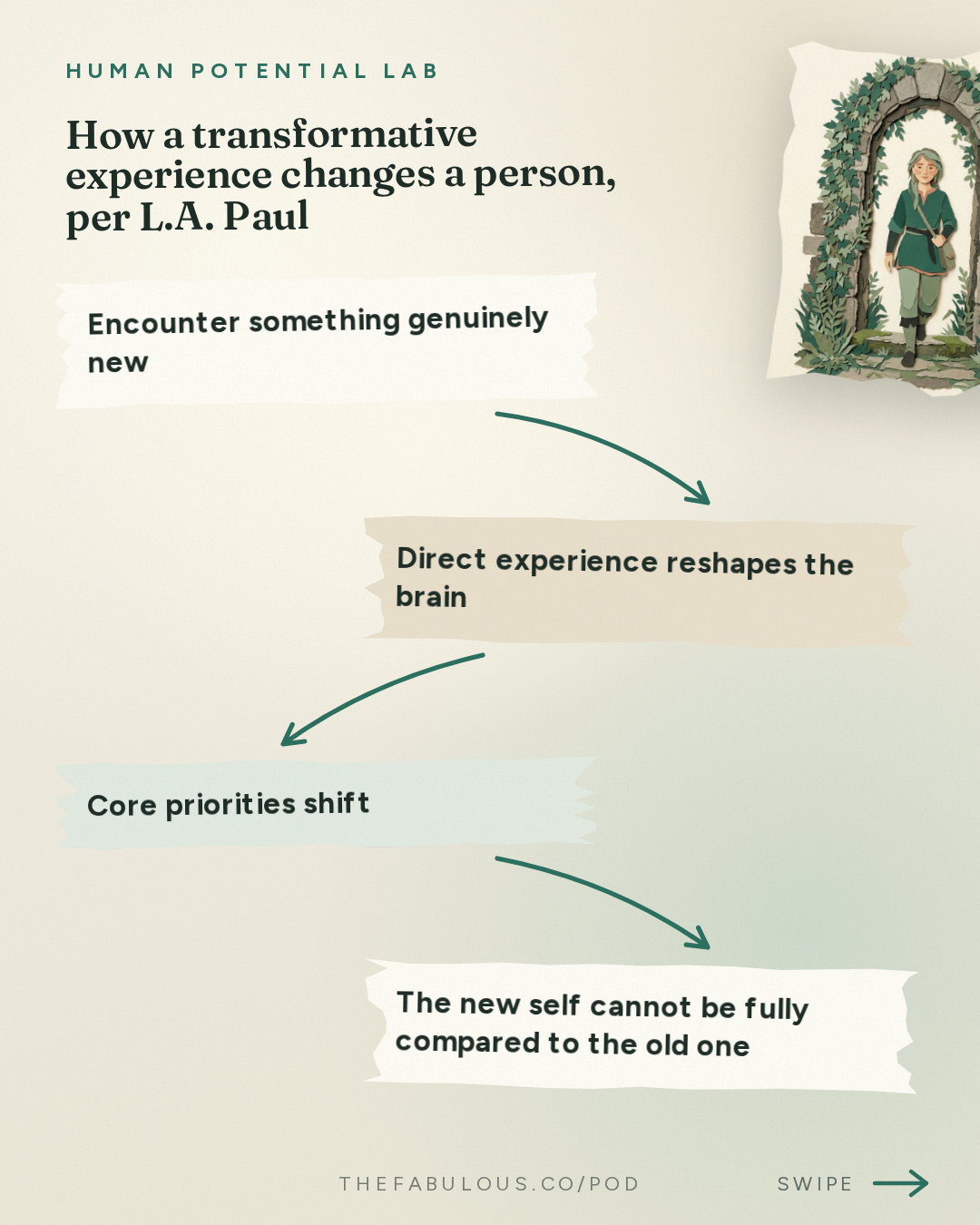
Paul calls these events transformative experiences, and the term does two jobs at once. First, an experience is epistemically transformative when a person cannot know what it will be like for them until they have it (03:55). Seeing color for the first time, or watching a child discover language, both qualify. No amount of testimony from someone else can substitute. Second, the same experience is personally transformative when it changes what a person cares about most, something close to the center of character and identity (05:12).
"I think of it as changing what you care about most or something that you care about very deeply, something that's kind of core with respect to your character and your integrity." — L.A. Paul [05:12]
Size does not matter here. A single sentence in a book, a conversation on a street corner, even a podcast episode, could in principle trigger the kind of shift that counts as transformation (07:22). What matters is not how big the triggering moment looks from the outside, but whether the resulting change crosses a line, from a small preference tweak into something that remakes what a person values (07:54).
Kaufman pushes Paul on a live controversy in his own field: post-traumatic growth. Researchers often find that people report feeling more resilient or purposeful after trauma, even when standardized before-and-after tests show little objective change (09:45). Paul's answer is that self-perceived growth is not nothing. Subjective experience is notoriously hard to measure, she says, and fields under pressure to produce clean data for funders tend to drift toward whatever is easiest to quantify, a habit with roots in old-school behaviorism (11:09, 11:43).
This leads into one of the conversation's sharper distinctions: the difference between a simple causal chain and a complex one. If event A caused event B, and B caused something good, that does not mean a person has to wish A had happened (15:35). Paul, who also teaches a course on time travel, points out that any coherent story about changing time still has to leave the past fixed. You can go back and visit it, but you cannot erase it (17:45). Applied to grief, this means a person can say the hard thing that happened led them somewhere valuable, without endorsing the hard thing itself.
"Celebrating the fact that a particular causal step along a painful process brought something good does not entail endorsement of the whole by any means." — L.A. Paul [19:38]
The same logic, run the other direction, explains something darker: how ordinary people slide into complicity. Paul reaches for the Sorites paradox, the old puzzle about a heap of sand (21:05). Remove one grain and it is still a heap. Remove another, still a heap. Eventually there is no heap left, but no single grain marked the moment it disappeared. Moral drift works the same way, she suggests: each small step looks harmless, yet the steps add up to a different person entirely.
Addiction gets the same treatment. People early in recovery often report being 99 percent certain there is no going back, a number that tends to fall across the course of treatment (24:28). Paul compares this to Thomas Nagel's famous argument that a person can never fully know what it is like to be a bat: the sober self is, from inside active addiction, a kind of different species, not because of weak will but because the brain has not yet been reshaped to represent that possibility (25:50, 26:43).
"Experience changes the way that your brain works, the way that you're able to represent things. That's just the way it works for us as human thinkers." — L.A. Paul [27:03]
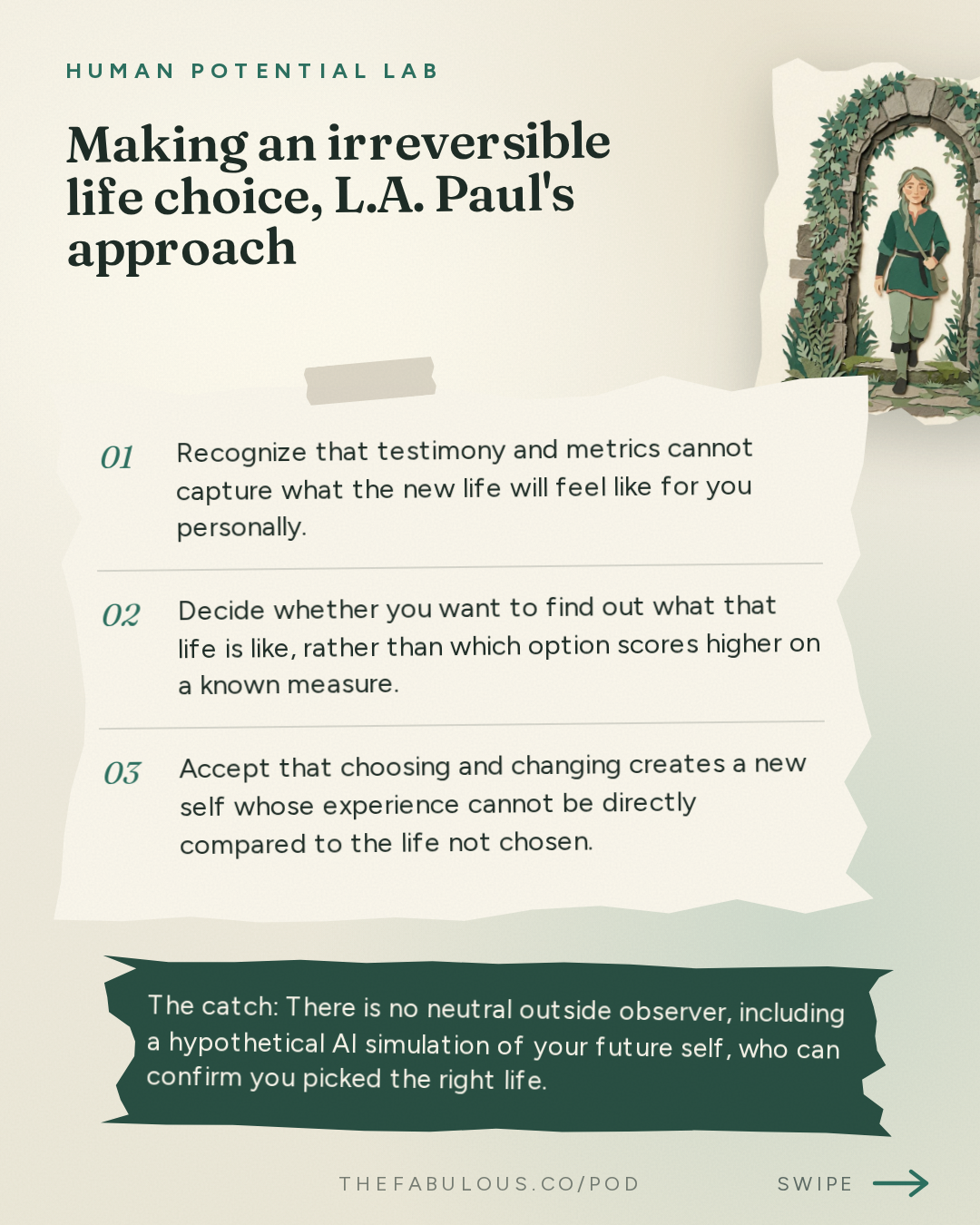
This is also Paul's objection to what Kaufman calls the age of hyper-optimization, the push to track and maximize every variable in a life. For decisions like whether to have a child, or whether to move abroad for years, Paul argues that testimony and metrics simply run out. Some things, she says, are not apt to measure in the ordinary way. A person has to find out what the life is like by living it (28:45, 30:12). Her example is blunt: moving to Kyoto for five years to learn a new language and culture is not a problem to be solved with a spreadsheet. It is an experience to be found out (30:37).
The paradox of empathy
Paul's newer work turns this same idea toward belief itself. In a paper called The Paradox of Empathy, she argues that fully opening your mind to a worldview you think is wrong, say, a religious conviction if you are an atheist, or a political conviction you consider a conspiracy theory, carries real risk. If that worldview is compelling enough, trying it on honestly might change your own mind (34:46). Paul calls the fear of that outcome mental corruption, and she thinks it is often rational rather than closed-minded: refusing to fully empathize can be a defense of a framework a person is already committed to, not evidence of moral failure (35:43).
She applies a related idea to cognitive decline. Reading a lecture by the writer Jorge Luis Borges about his family's blindness, Paul was struck by his line that courage is not genetic, even if the condition causing it is (38:30). People losing their memory or their old competencies, she argues, face a version of the same challenge: find a way to be brave and redefine the self once the old markers of identity, the crossword solver, the financially astute parent, are gone (39:46, 40:17).
Why AI alignment is chasing a moving target
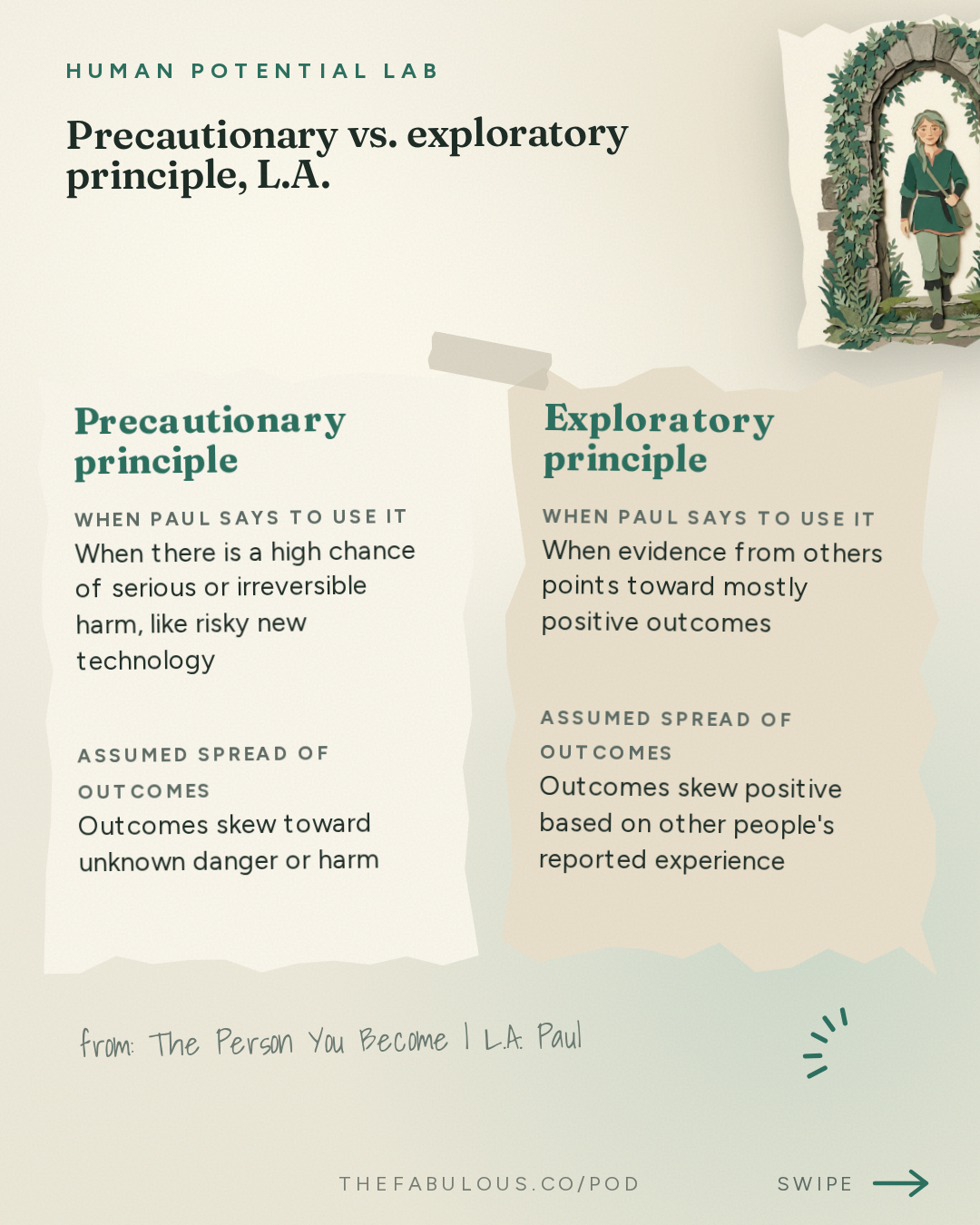
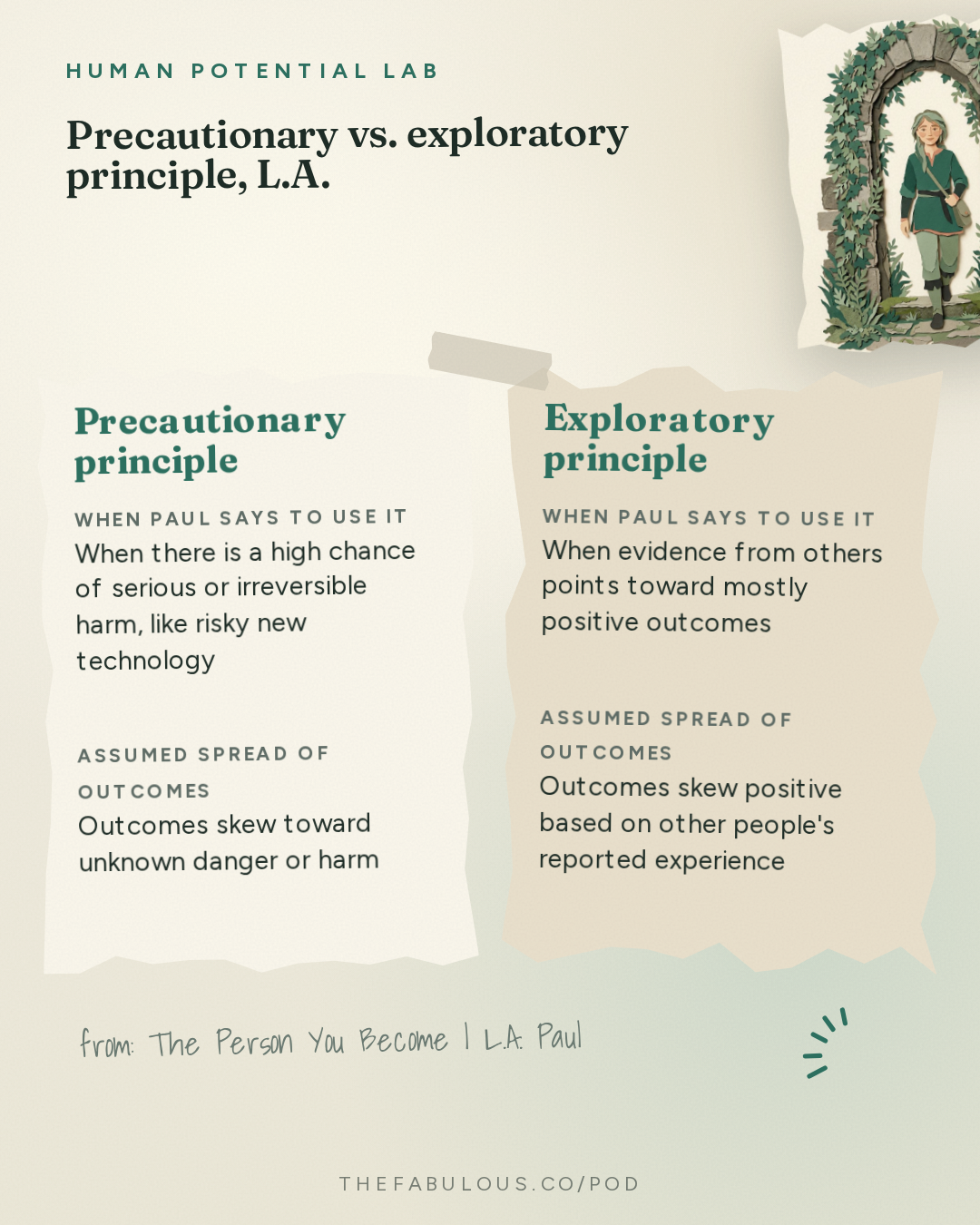
The second half of the conversation turns to artificial intelligence, and Paul's framework turns out to double as a critique of how the field thinks about safety. She distinguishes a precautionary principle, used when the range of possible outcomes skews toward serious and irreversible harm, from an exploratory principle, appropriate when testimony suggests good outcomes are likely, as with parenthood or relocation (42:30). Rapid, high-stakes technological change, she argues, calls for precaution, not exploration (43:01).
Her sharpest claim is about alignment itself, the effort to make AI systems follow human values. Kaufman puts it directly:
"Can you even align a system to a moving target that the system itself is moving?" — Dr. Scott Barry Kaufman [45:13]
Paul agrees. Human values are exactly what transformative experience rewrites, she says: a new parent does not keep their pre-child priorities, and a species that builds advanced AI will not keep its pre-AI values either (44:54). If alignment assumes a fixed target, and the target is always moving, no fixed set of rules will hold. Experience has a causal effect on any sufficiently flexible system's character, human or artificial, and rules written in advance cannot anticipate every situation that effect will create (46:19). Kaufman's pointed aside is that most alignment researchers are computer scientists, not psychologists or philosophers, and the field needs both (46:51).
The conversation closes on machine selfhood and psychedelics. Paul's research with AI labs suggests current systems lack the metacognitive capacity to locate themselves as a distinct entity in a new situation, something she compares to needing both a full map and a sense of where you are standing on it (49:42). Psychedelics, she notes, can dissolve the boundary between self and world without erasing the first-person perspective entirely, a state she likens to Buddhist accounts of the "no-self" view: the boundary softens, but someone is still home (51:59).
Asked, at the end, whether humanity's own transformation looks positive or negative, Paul does not resolve it. She wonders aloud whether current alarm is proportionate, or whether having more information than any previous generation simply makes ordinary uncertainty feel like a unique emergency (54:17). It is a fittingly open answer from someone whose whole argument is that some things cannot be known from the outside. The only way to find out is to live through it.
Ask this episode anything
Pod's AI answers from the episode itself, with the minute mark so you can hear it yourself.
Or start with one of these
Ask this episode
Pod's AI listens to the whole episode to answer, and points you to the minute it comes from.
The rest of this answer, and any question after it
Answers come from the episode itself, never from a summary of it.
ContinueKey takeaways
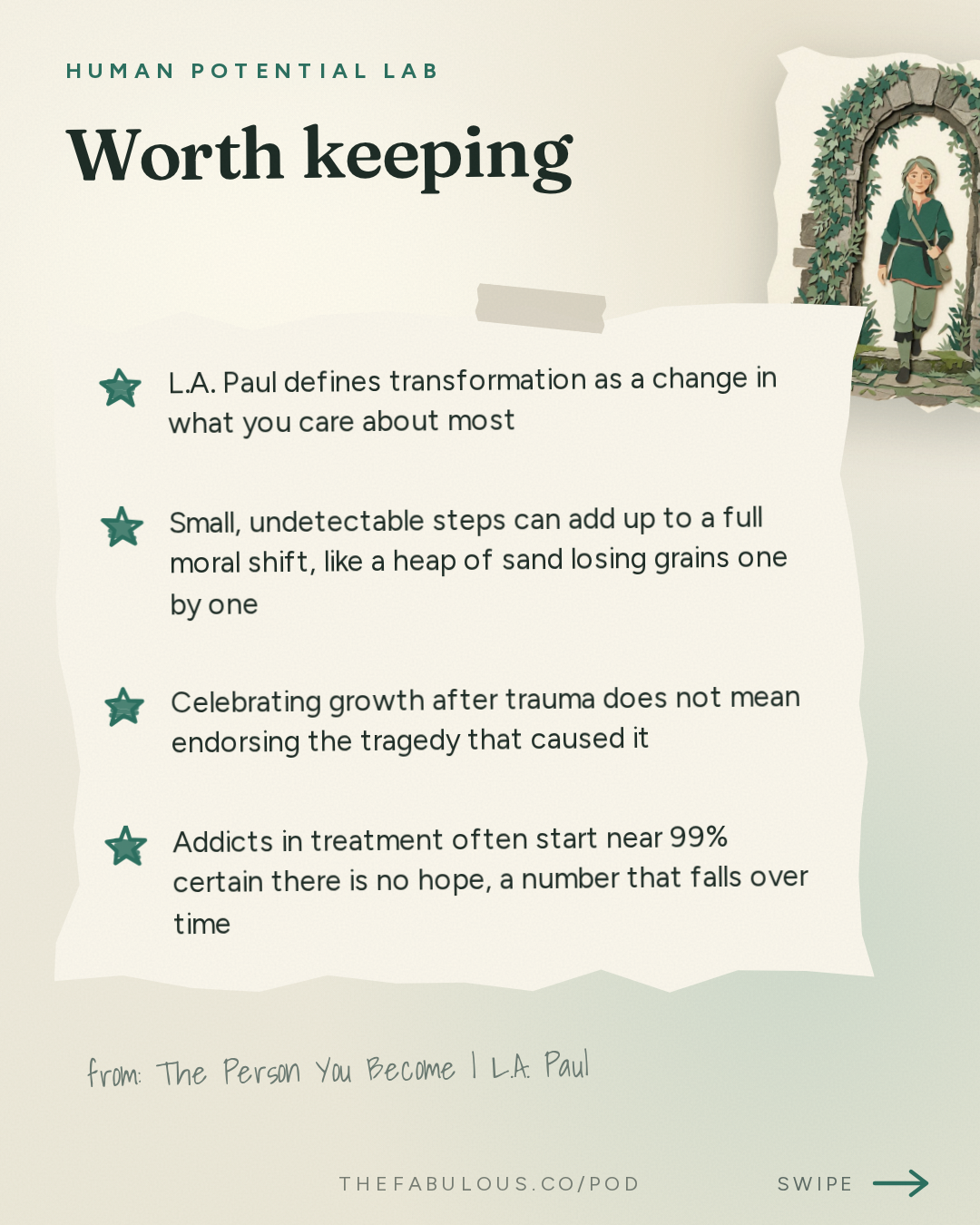
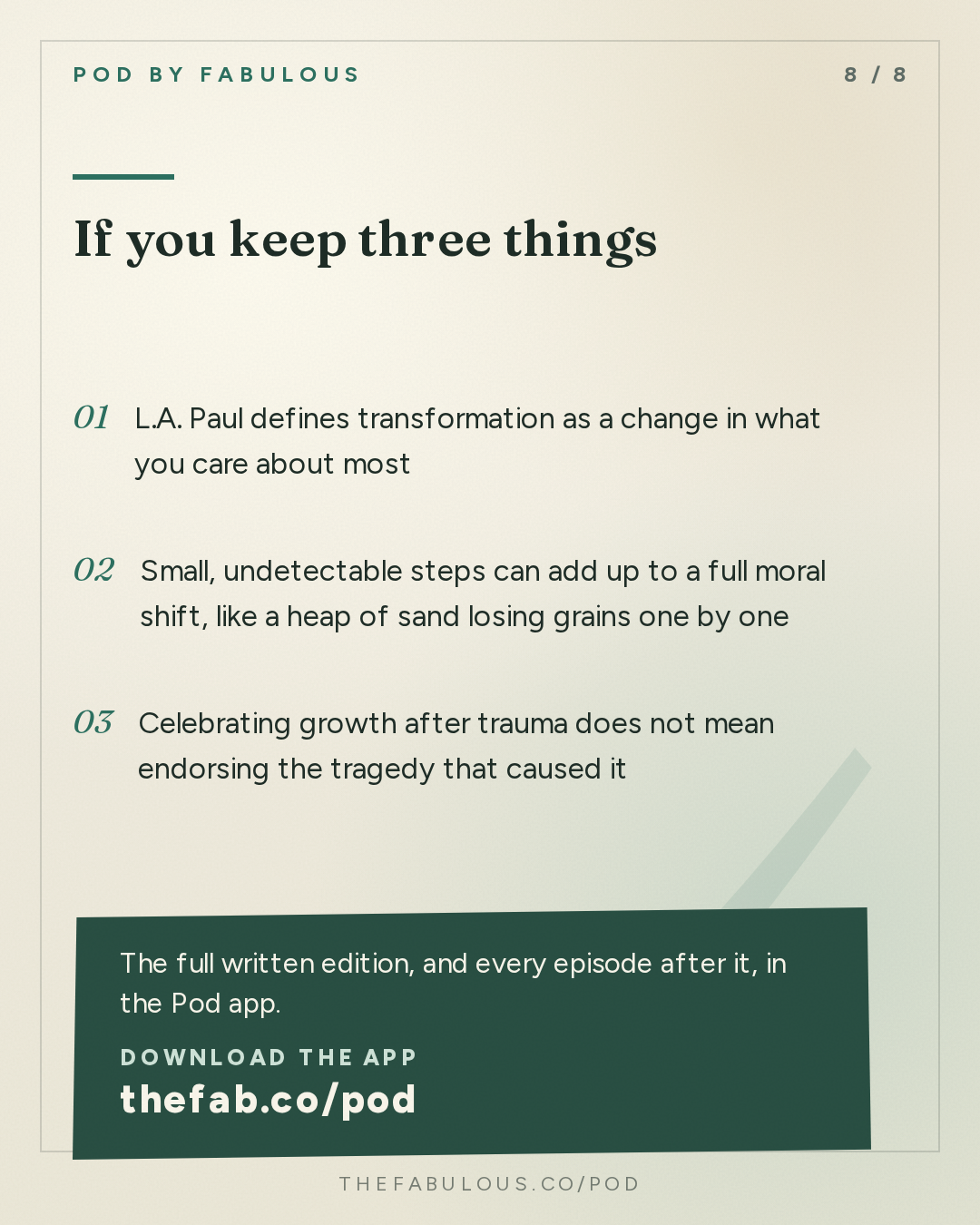
- L.A. Paul defines transformation as a change in what you care about most
- Small, undetectable steps can add up to a full moral shift, like a heap of sand losing grains one by one (22:11)
- Celebrating growth after trauma does not mean endorsing the tragedy that caused it (19:38)
- Addicts in treatment often start near 99% certain there is no hope, a number that falls over time (24:28)
- Paul argues AI alignment is flawed because human values shift as people interact with new technology (45:13)
The episode in cards
By the numbers
- 100 emails/day messages L.A. Paul receives from self-described metaphysicians
- 99% percent certainty addicts report early in treatment that there is no going back
In their words
“Celebrating the fact that a s- a particular causal step along a painful process brought something good does not entail, like, endorsement of, of the whole”
“Courage is not genetic even if the blindness is. And I think courage comes from understanding that, um, living involves pain just as much as it involves”
“Can you even align a system to a moving target- No ... that the system itself is moving?”
Protocols
-
Default to the precautionary principle for risky technological change
L.A. Paul says a society should act with precaution, assuming a wide range of unknowns, whenever a technology or decision has a high chance of unleashing serious or irreversible harm, reserving open exploration for situations where testimony from others points toward mostly positive outcomes. The catch, she notes, is that heavy financial and political stakes push some actors toward an exploratory stance even when caution is the better fit.
Case by case, applied before large irreversible changes
-
Treat major life choices as something to find out, not optimize
L.A. Paul advises treating irreversible life decisions, such as becoming a parent or relocating abroad for years, as experiences to be lived rather than problems to be solved with metrics or other people's testimony, because no outside measurement can tell someone what the new life will feel like from the inside. The catch is that once the choice is made and the person changes, there is no way to directly compare the new self's experience against the path not taken.
For one-time, irreversible decisions
Questions this episode answers
What is a transformative experience according to L.A. Paul?
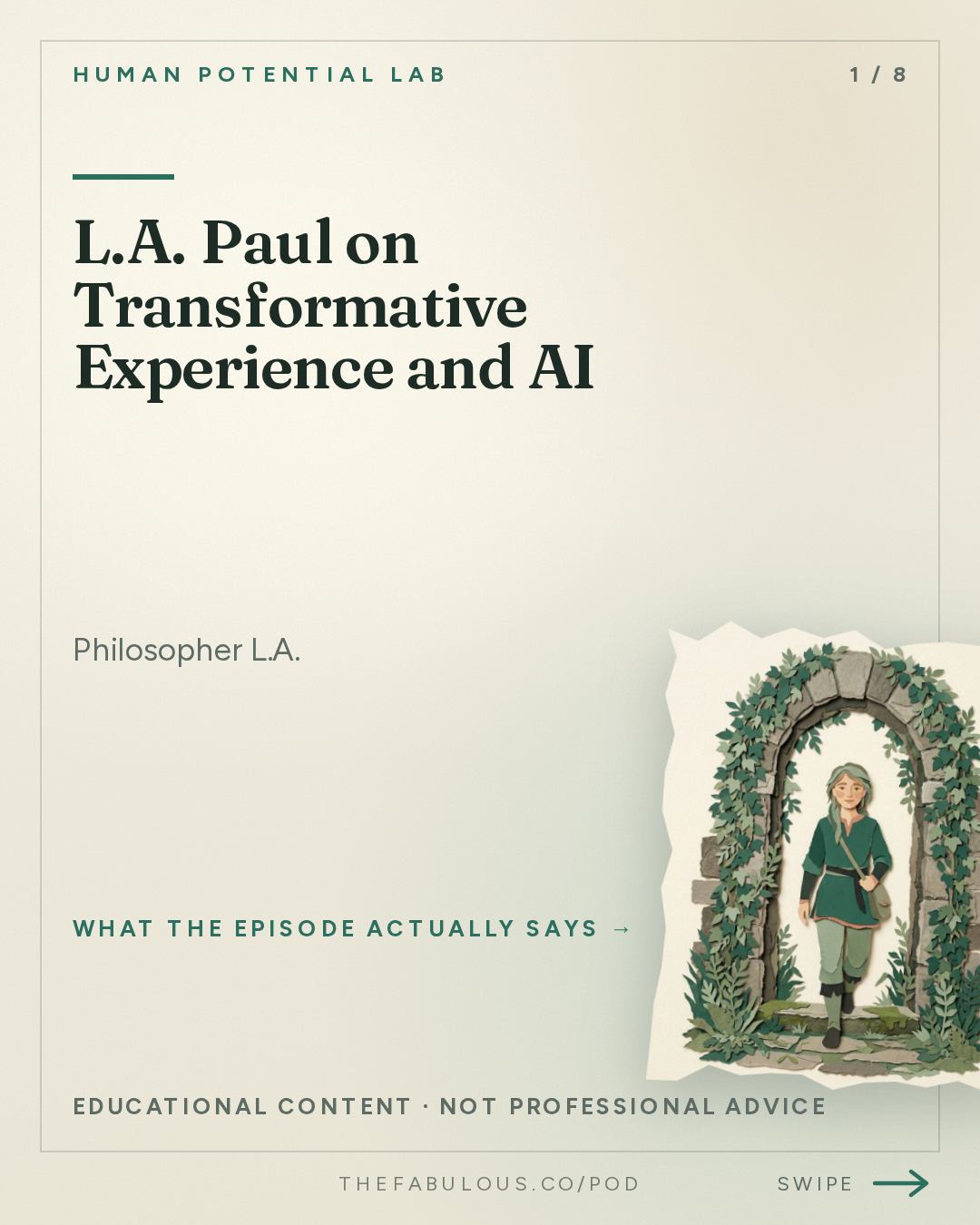
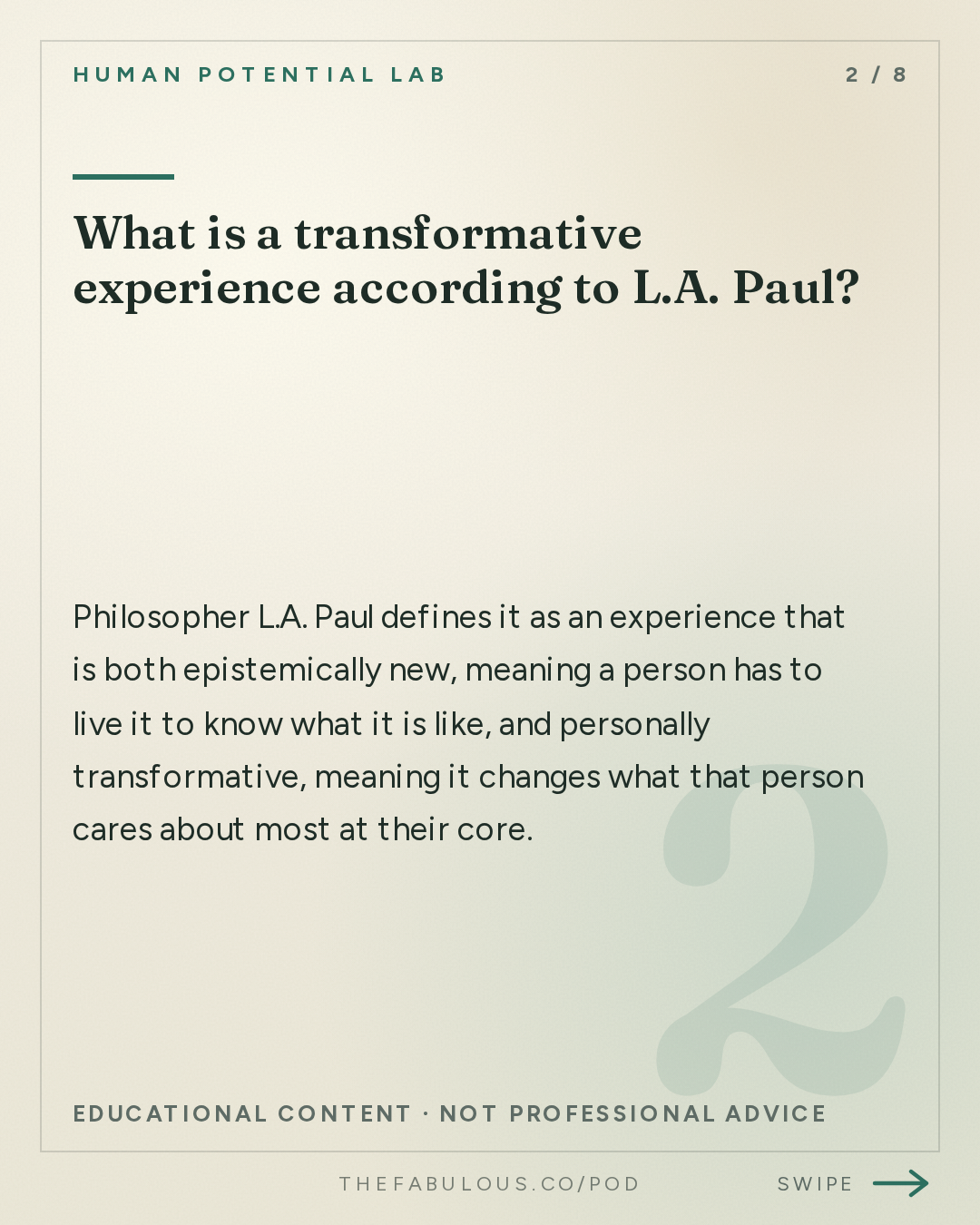
Philosopher L.A. Paul defines it as an experience that is both epistemically new, meaning a person has to live it to know what it is like, and personally transformative, meaning it changes what that person cares about most at their core (03:55, 05:12).
Can a small event cause a major personal transformation?
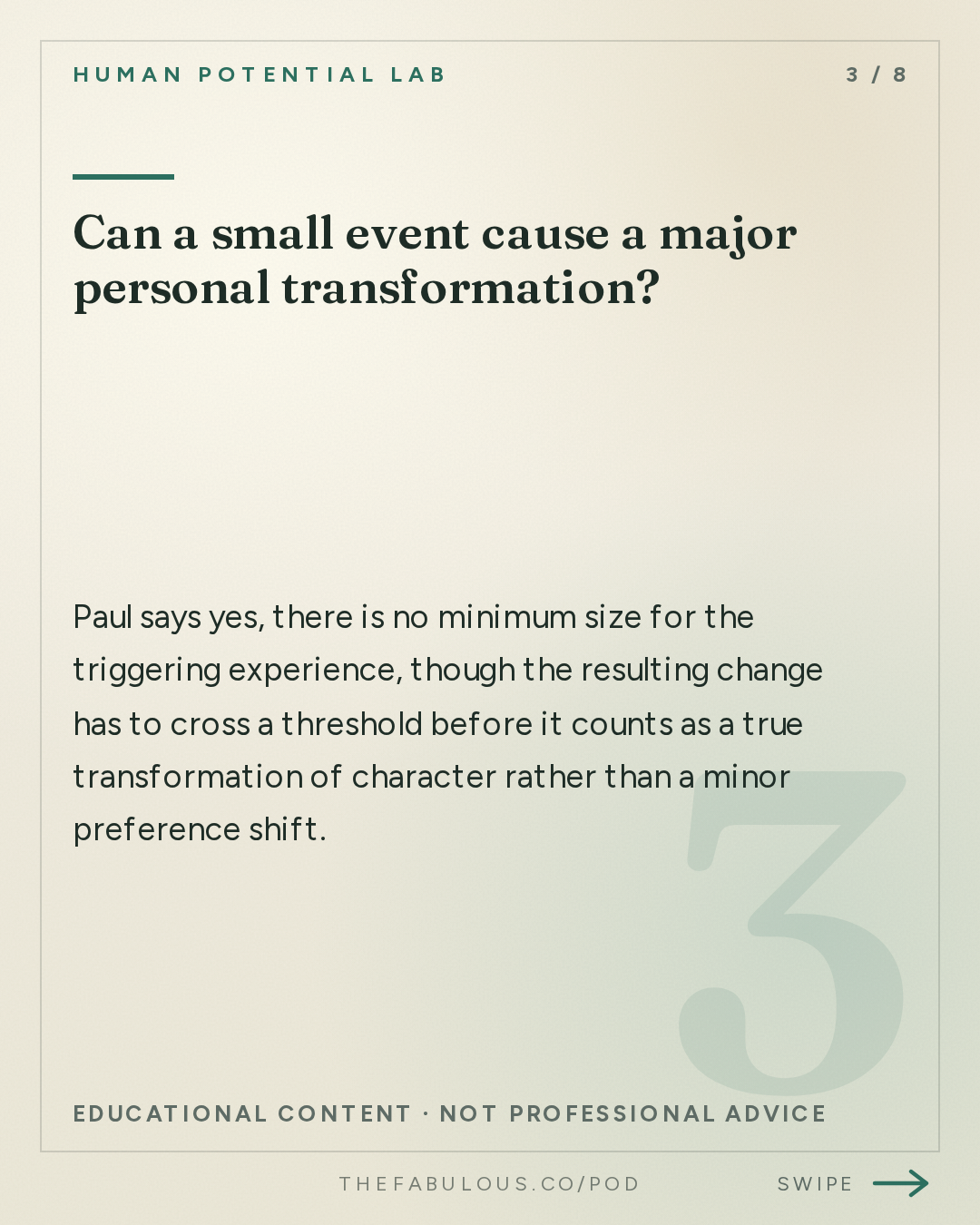
Paul says yes, there is no minimum size for the triggering experience, though the resulting change has to cross a threshold before it counts as a true transformation of character rather than a minor preference shift (07:54).
Is post-traumatic growth real if it does not show up on objective tests?
Paul argues self-perceived growth is not nothing, even when it diverges from standardized before-and-after measures, because inner experience is inherently hard to quantify and research fields under funding pressure often default to easily measurable proxies rather than more accurate but messier self-report (09:45, 11:09).
Why does L.A. Paul think AI alignment cannot fully work?
She argues that direct experience causally reshapes character the same way it reshapes human values, so any AI system flexible enough to handle new situations will develop responses that fixed rules written in advance cannot anticipate, making alignment a target that keeps moving (45:58, 46:19).
What is the paradox of empathy L.A. Paul describes?
In her paper The Paradox of Empathy, Paul argues that fully empathizing with a worldview you believe is wrong, such as an opposing religious or political belief, risks changing your own beliefs, so refusing that empathy can be a rational defense of one's existing framework rather than simple closed-mindedness (34:46, 35:43).
The full read, in cards
Go deeper
- Transformative Experience — L.A. Paul's framework defining experiences as both epistemically and personally transformative
- What Is It Like to Be a Bat? — Thomas Nagel's argument that some experiences cannot be known without living them, used to explain addiction recovery
- The Mary's Room thought experiment — Frank Jackson's example of a scientist who has never seen color, cited as a model for epistemic transformation
- The Paradox of Empathy — L.A. Paul's paper on why fully empathizing with an opposing worldview risks changing one's own beliefs
Mentioned
L.A. Paul · Dr. Scott Barry Kaufman · Thomas Nagel · Frank Jackson · Jorge Luis Borges · Irvin Yalom · Rabbi Harold Kushner · OpenAI · Sorites paradox · Transformative Experience · The Paradox of Empathy
More from this show and category
Michael Levin on Bioelectricity and Genius
Biologist Michael Levin argues intelligence is a spectrum of problem-solving competence found in cells, frogs, robots, and machines, not just brains. He says genius, from mathematician Srinivasa Ramanujan's theorems to lab-grown xenobots, taps a shared non-physical "Platonic space" of patterns, with bioelectric signals acting as glue that links small parts into larger goal-seeking wholes.
Scott Barry Kaufman's 7 Lessons from 11 Years of Podcasting
Scott Barry Kaufman closes 11 years and 478 episodes of The Psychology Podcast with seven lessons on human potential, personality change, and creativity. He argues neuroticism is the easiest Big Five trait to shift and openness the hardest, and that lasting change comes from habits, not willpower (09:06, 15:22).
Alia Crum on How Mindset Shapes Stress and Hunger
Stanford psychologist Alia Crum finds that beliefs about food, stress, illness, and genes can alter body chemistry itself. Labeling an identical milkshake indulgent rather than sensible triples the drop in the hunger hormone ghrelin (12:37), and believing one carries a low-efficiency exercise gene lowers real oxygen conversion regardless of actual genotype (47:10).

Ellen Vora: Heal Gut, Hormones, Anxiety
Psychiatrist Ellen Vora says gut, hormone, and anxiety struggles often trace back to suppressed truth, estrogen dominance, and mistaking fear for intuition. She offers concrete fixes: daily bowel habits and magnesium glycinate for hormone balance, and a simple tone-test (intuition is quiet, fear is loud) for telling real guidance from anxious noise.
