Scott Barry Kaufman's 7 Lessons from 11 Years of Podcasting
End of an Era — Reflections on 11 Years of The Psychology Podcast w/ Annie Murphy Paul
▶ Listen to the full episode More from The Psychology Podcast
The brief
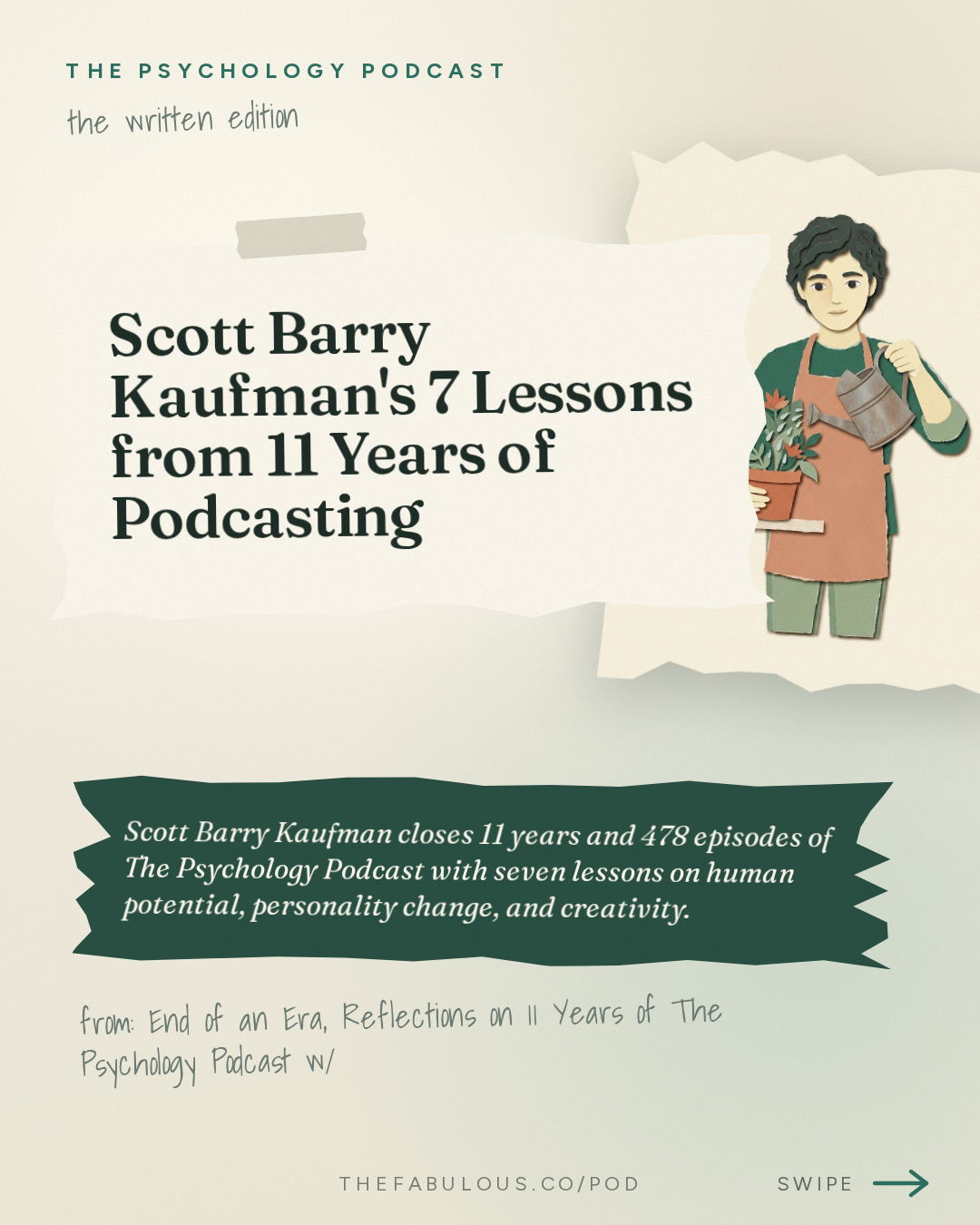
Scott Barry Kaufman closes 11 years and 478 episodes of The Psychology Podcast with seven lessons on human potential, personality change, and creativity. He argues neuroticism is the easiest Big Five trait to shift and openness the hardest, and that lasting change comes from habits, not willpower (09:06, 15:22).
Toward the end of his eleventh year interviewing psychologists for a living, Scott Barry Kaufman did something a little uncomfortable. He went back and listened to episode one of his own show, recorded in November 2014 with the science writer Annie Murphy Paul. What he heard made him wince. He was, he admitted on the finale, "a little lap dog," agreeing with everything, hungry for approval (12:03). Eleven years and 478 episodes later, on the last episode of The Psychology Podcast, the same two people sat down again, and Kaufman used his own change as evidence for the first thing he wanted listeners to take away: personalities are not fixed sculptures. They are patterns that can be re-carved.
The episode is structured as a retrospective, seven insights pulled from a decade of conversations with researchers, but it plays more like an exit interview with himself. The first claim is the broadest: human potential is not what standard tests measure (05:31). Kaufman has spent much of his career arguing that IQ and conventional achievement, the accolades and the likes, capture only a sliver of what a person can become. He ran a recurring series on the podcast called the Human Potential Lab specifically to push past those metrics (07:19), and the finale opens by restating that as a kind of thesis for everything that follows.
The second claim is more technical, and more useful. Psychologists used to describe personality as a fixed score: you are, say, a 7 out of 10 on introversion, full stop. Kaufman prefers a newer model in which each trait is a density distribution, a range of behavior a person moves through all day. An introvert has extroverted hours. The trait is really just the pattern you land on most often.
"Personality really is just your habitual patterns of states. Traits are just habitual patterns of states. You can change your personality by changing your habitual pattern of states." — Scott Barry Kaufman [08:28]
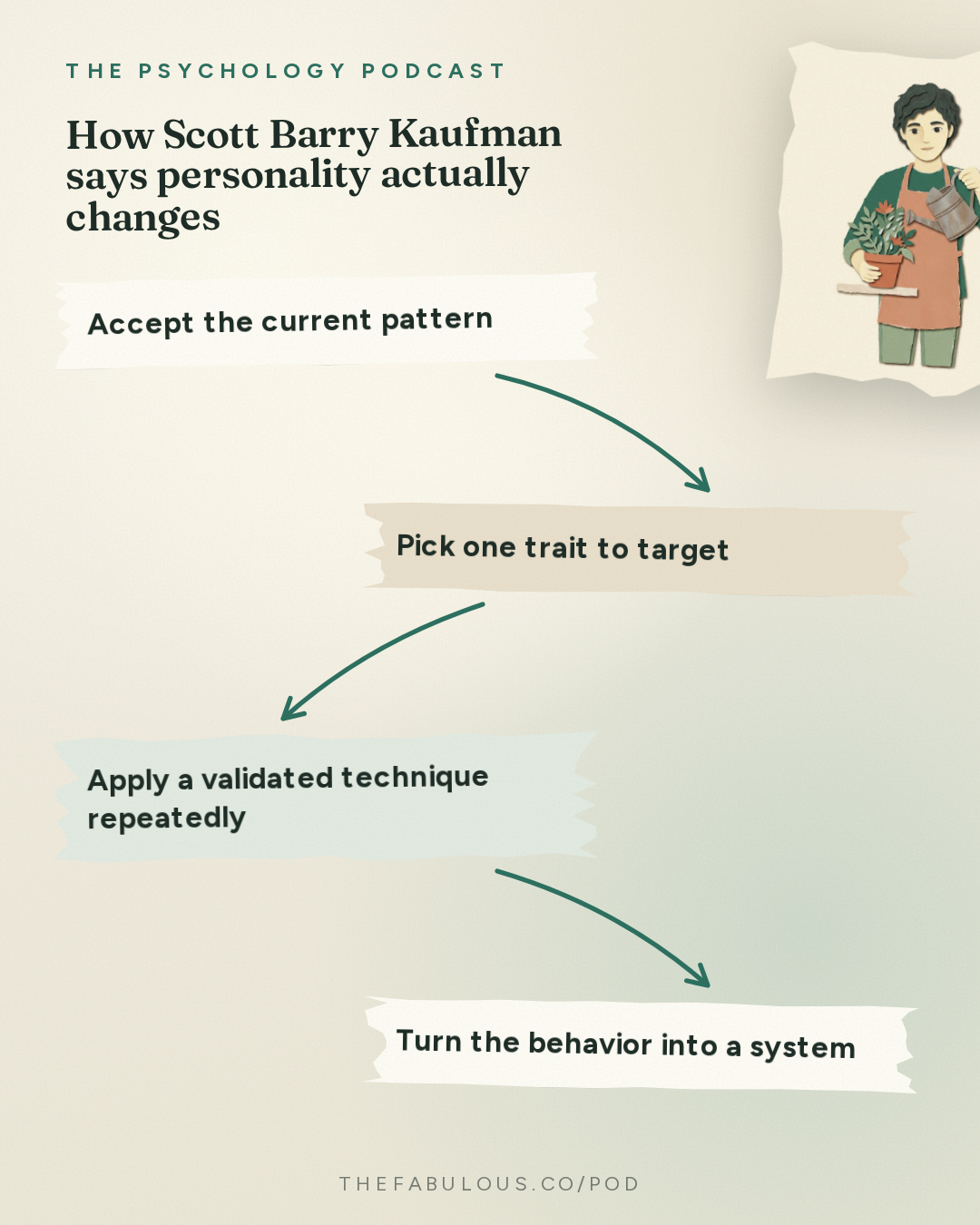
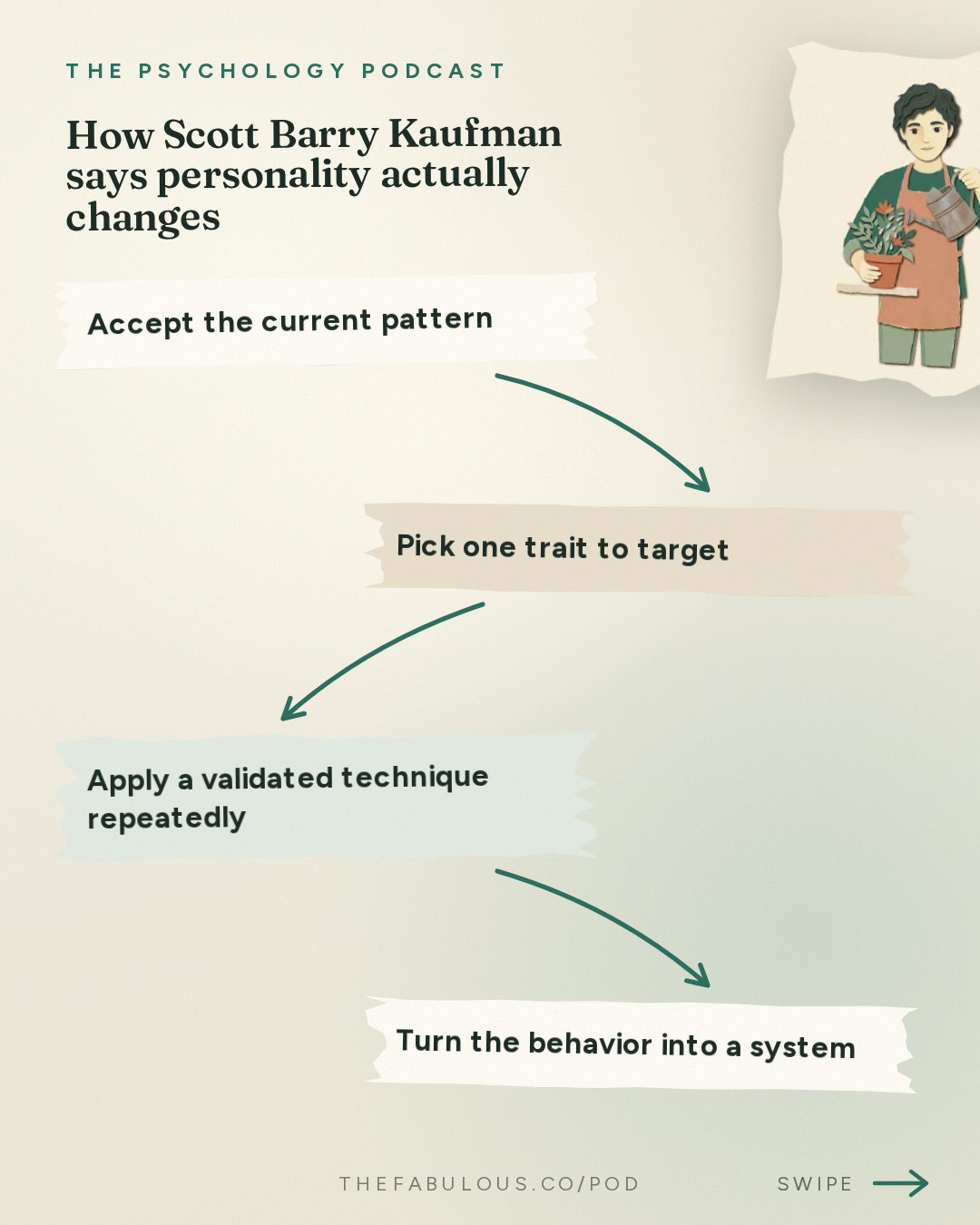
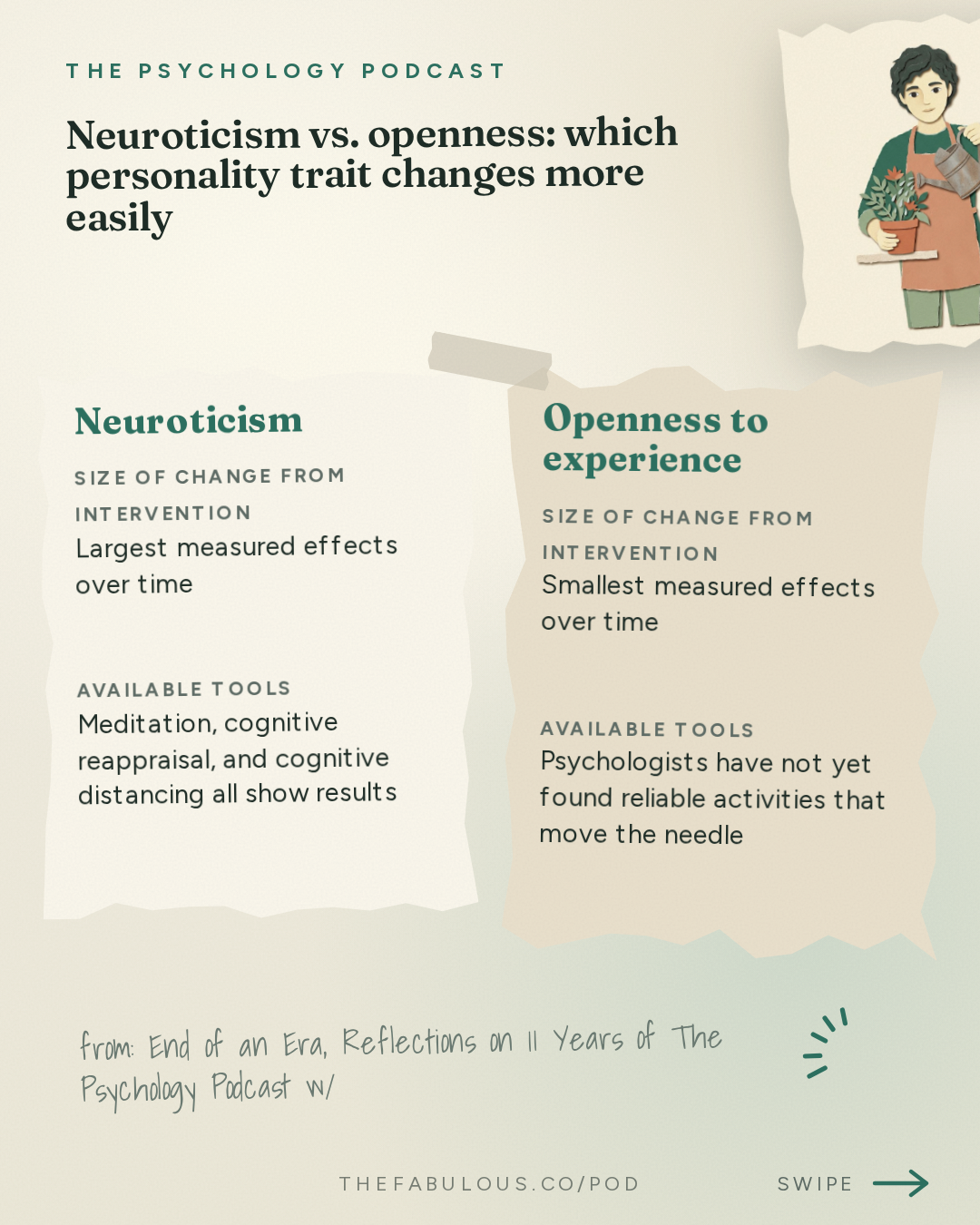
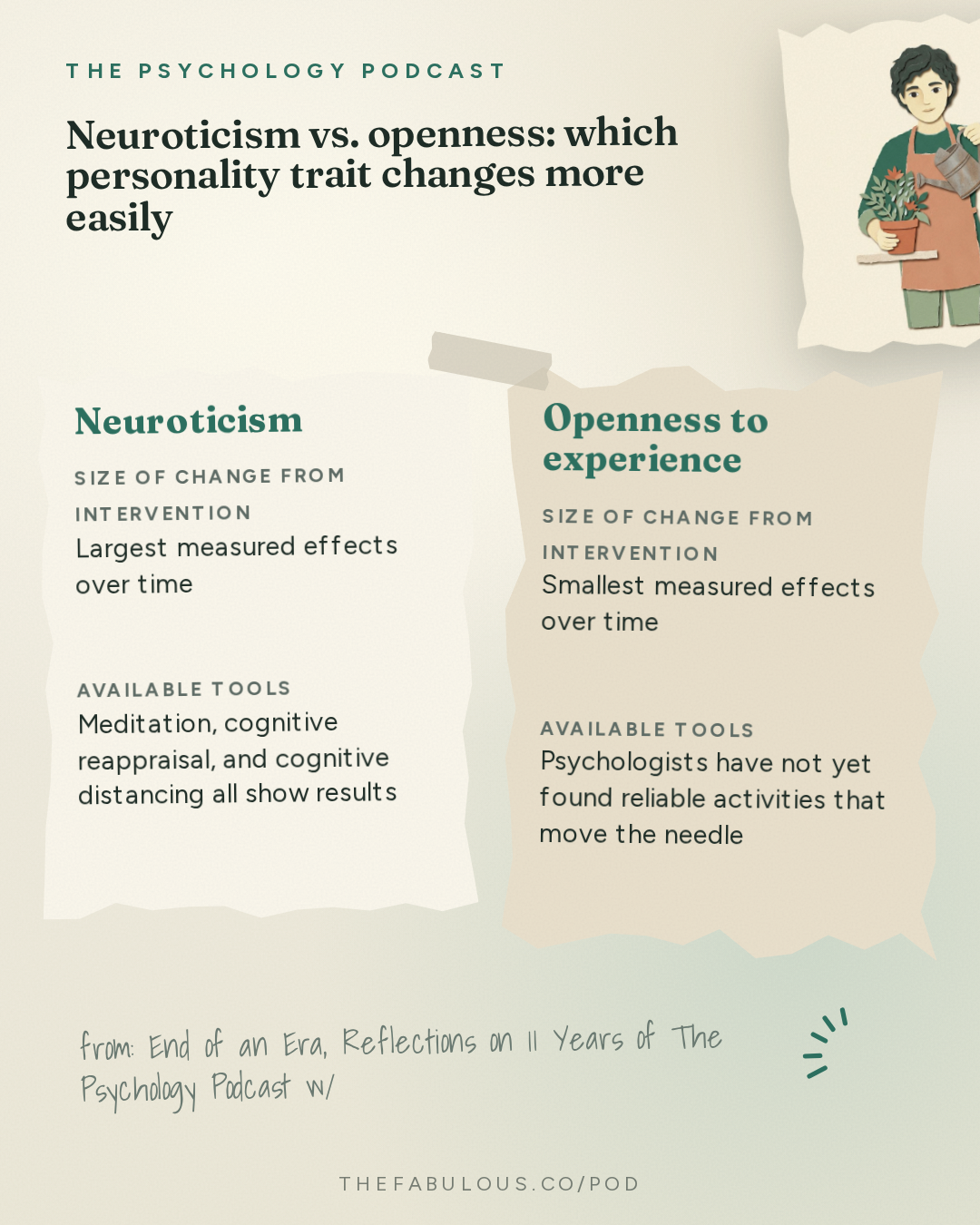
That reframing matters because it turns personality from a fact about you into a set of habits, and habits can be worked on. Kaufman runs a classroom exercise at Barnard College where students pick one Big Five trait (the five broad dimensions psychologists use to describe personality: openness, conscientiousness, extraversion, agreeableness, and neuroticism) and try to shift it using validated interventions. The results are uneven in a telling way. Neuroticism, the tendency toward anxiety and emotional instability, shows the largest change over time, helped along by ordinary tools: meditation, cognitive reappraisal (consciously reframing a stressful thought), and a distancing trick where you ask whether a problem will matter in fifty years (09:06, 09:51). Openness to experience, by contrast, barely budges (10:22). Kaufman's explanation is not that openness is biologically locked in, but that psychology has not yet built good tools for changing it. That gap matters more than it sounds, because openness is, in his words, "the number one best predictor of creativity" (11:18). If the field wants to teach creativity, it may first need to figure out how to teach curiosity.
Kaufman's own life supplies the counter-evidence to any claim that traits are frozen. He estimates his neuroticism has dropped by roughly half since 2014, back when he lived in Philadelphia and describes walking around "in a state of constant anxiety and panic attacks" (18:29). He credits five years in California, regular meditation, and, only half-joking, marijuana on the beach in Santa Monica (18:12). He also says he has become noticeably less agreeable, in a good way, no longer needing to appease people the way he did in that first 2014 interview (11:36). The line he reaches for to explain why self-acceptance had to come before either shift is Carl Rogers's, the humanistic psychologist whose work Kaufman returns to throughout the episode.
"The curious paradox is that once we accept who we are, then we can change." — Scott Barry Kaufman, citing psychologist Carl Rogers [14:55]
Acceptance is the precondition, not the mechanism. The actual mechanism, Kaufman's third insight, is habits and systems (15:22). Here he credits guests whose temperaments are nothing like his own: the productivity writer James Clear, and Tim Ferriss, who Kaufman says builds "very systematic habits" (15:42). Kaufman calls himself a member of the "dreamy, openness to experience camp," a daydreamer by disposition, but says he has learned real value from the more rigid, consistency-obsessed personality type that tracks everything and sets SMART goals (16:10, 16:31). His own example is exercise, which he made stick not through discipline but through a small daily payoff: finishing a morning workout lets him tell himself, whatever else happens, he already conquered one thing that day (17:33). The lesson underneath the anecdote is that trait change is not a mystical shift in identity. It is the accumulation of repeated, structured behavior, done often enough that it becomes the new default state.
The Cornerstone Freud Missed
Kaufman's fourth insight is where he gets the most animated, and it involves rewriting Sigmund Freud. Freud famously said the two cornerstones of a well-lived life are love and work. Kaufman rejects half of that formula outright.
"I don't think work is a cornerstone of humanness. I think creativity is. I think it's love and creativity." — Scott Barry Kaufman [21:05]
His case rests on a specific definition of creativity: not talent in art or music, but divergent thinking, the ability to generate many possible solutions to a problem, as opposed to convergent thinking, which converges on the one correct answer (22:14). He is careful to note that not every domain wants divergent thinkers turned loose, citing airline pilots and tax accountants as places where you want the convergent kind (21:54). But he argues that the more overlooked half of creativity is not solution-generation at all, it is problem-finding: noticing an issue that everyone else has walked past without seeing (22:35). He points to Steve Jobs as an example of someone unusually good at spotting problems nobody else registered as problems (22:54).
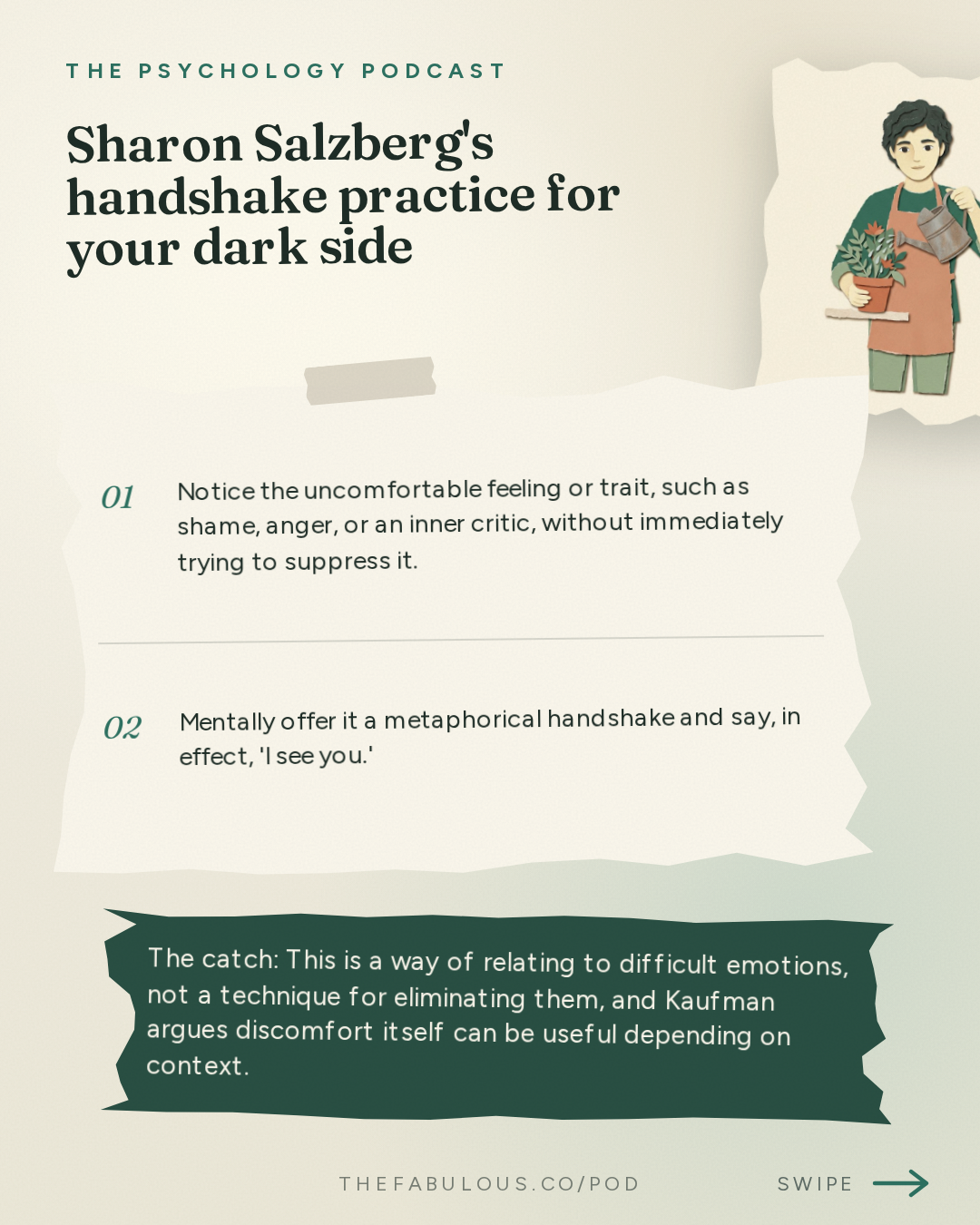
The fifth insight turns from the bright side of personality to the dark one, and it draws on Kaufman's own research validating what he calls the "light triad" of personality traits, work that required him to first study its opposite, the "dark triad" of narcissism, Machiavellianism, and psychopathy (27:02, 27:27). His broader argument is that positive psychology's habit of sorting emotions into "positive" and "negative" bins is a distortion. He prefers describing feelings as comfortable or uncomfortable, since fear or anger can serve a person well depending on context (28:16). The practical advice he borrows from guests is almost tender: the meditation teacher Sharon Salzberg's practice of a metaphorical handshake with your "beautiful monsters," acknowledging an inner demon rather than fighting it (29:06), and the therapist Richard Schwartz's approach of asking a difficult inner part what role it is actually trying to play in your life (29:29). Self-compassion, in this framing, is not indulgence. It is a more accurate map of how the mind works.
The sixth insight is about other people. Kaufman insists that relationships and social context continually reshape the mind, citing conversations with researchers including Sonja Lyubomirsky and neuroscientist Ben Rein on the biology of connection (34:27, 34:49). His sharpest distinction here is between belonging and intimacy. Belonging, he says, is often conditional: you belong to a group as long as you agree with it, and dissent gets you cast out. Real relatedness requires mutual growth and room to disagree without losing the relationship (35:08). It is a useful corrective to a culture that treats "belonging" as the finish line rather than a floor.
From Pyramid to Sailboat
The seventh and final insight is the one Kaufman built a book around: Transcend, his reinterpretation of the psychologist Abraham Maslow's hierarchy of needs. The famous pyramid, Kaufman notes, is not something Maslow ever actually drew (38:16). Kaufman replaces it with a sailboat: the hull represents basic needs like safety and security, which must stay patched, while the sail represents growth, exploration, and purpose, which only catches wind if it is raised (38:25).
"If you don't have a clear vision of what port you wanna sail to, you're not gonna be moving in that direction at all." — Scott Barry Kaufman [38:43]
Some days, he says, the right move is to close the sail and just plug the holes in the boat, and that is not failure, it is maintenance (39:09). His own stated purpose, distilled, is to help people contact what he calls "the most alive, unique, creative center of their being," a phrase he borrows from the psychoanalyst Karen Horney (39:52, 40:02). Looking back across nearly five hundred episodes, he resists naming any single guest as the most important, arguing instead that the value sits in the pattern across all of them, what he jokingly calls the seven-factor result of running a factor analysis (a statistical technique for finding hidden patterns across many data points) on eleven years of conversation (42:13). What remains, as the feed goes quiet, is less a highlight reel than a working theory of what a full human life requires: acceptance before change, systems before willpower, curiosity before creativity, and a sail raised toward some chosen port, even when the water is rough.
Ask this episode anything
Pod's AI answers from the episode itself, with the minute mark so you can hear it yourself.
Or start with one of these
Ask this episode
Pod's AI listens to the whole episode to answer, and points you to the minute it comes from.
The rest of this answer, and any question after it
Answers come from the episode itself, never from a summary of it.
ContinueKey takeaways
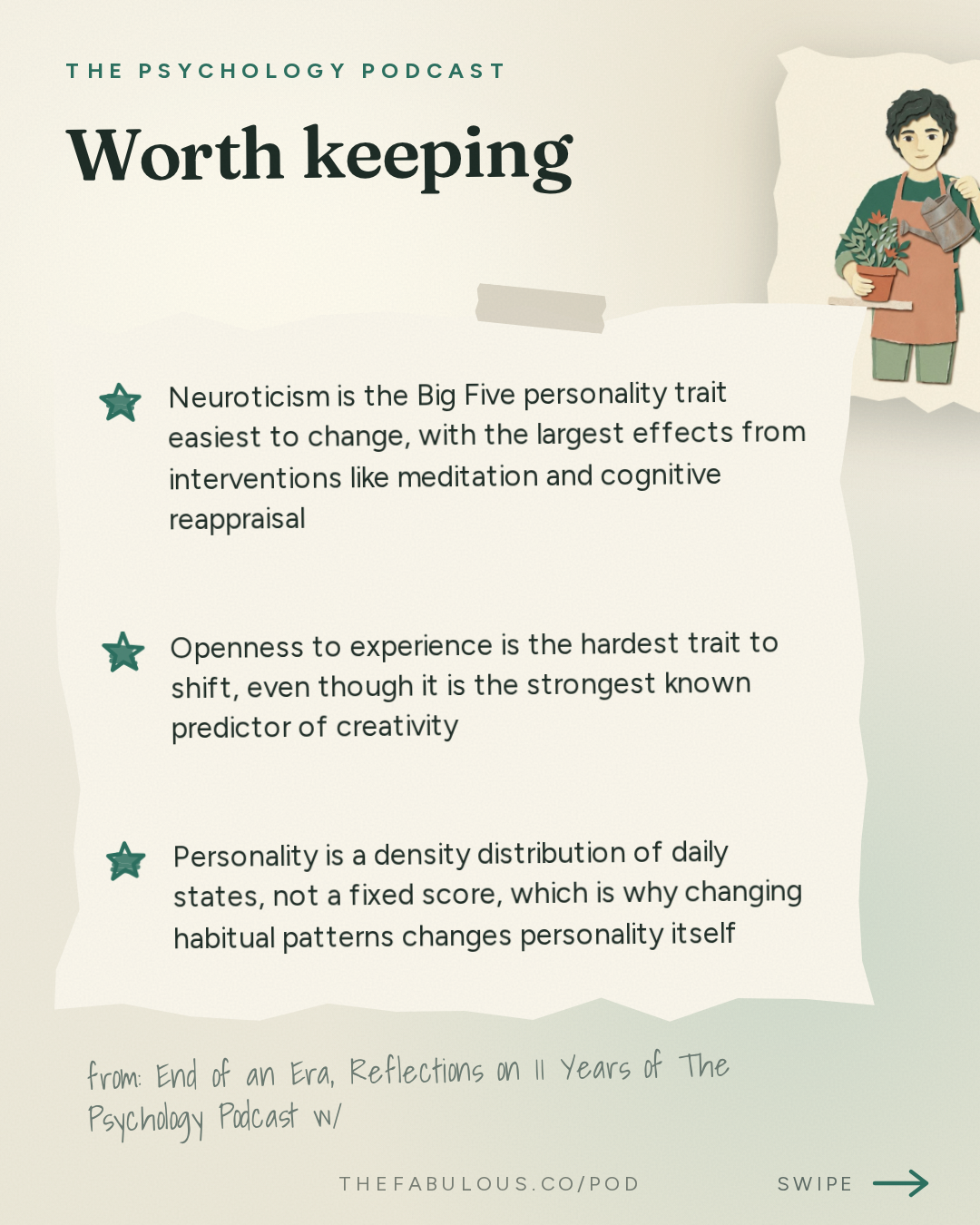
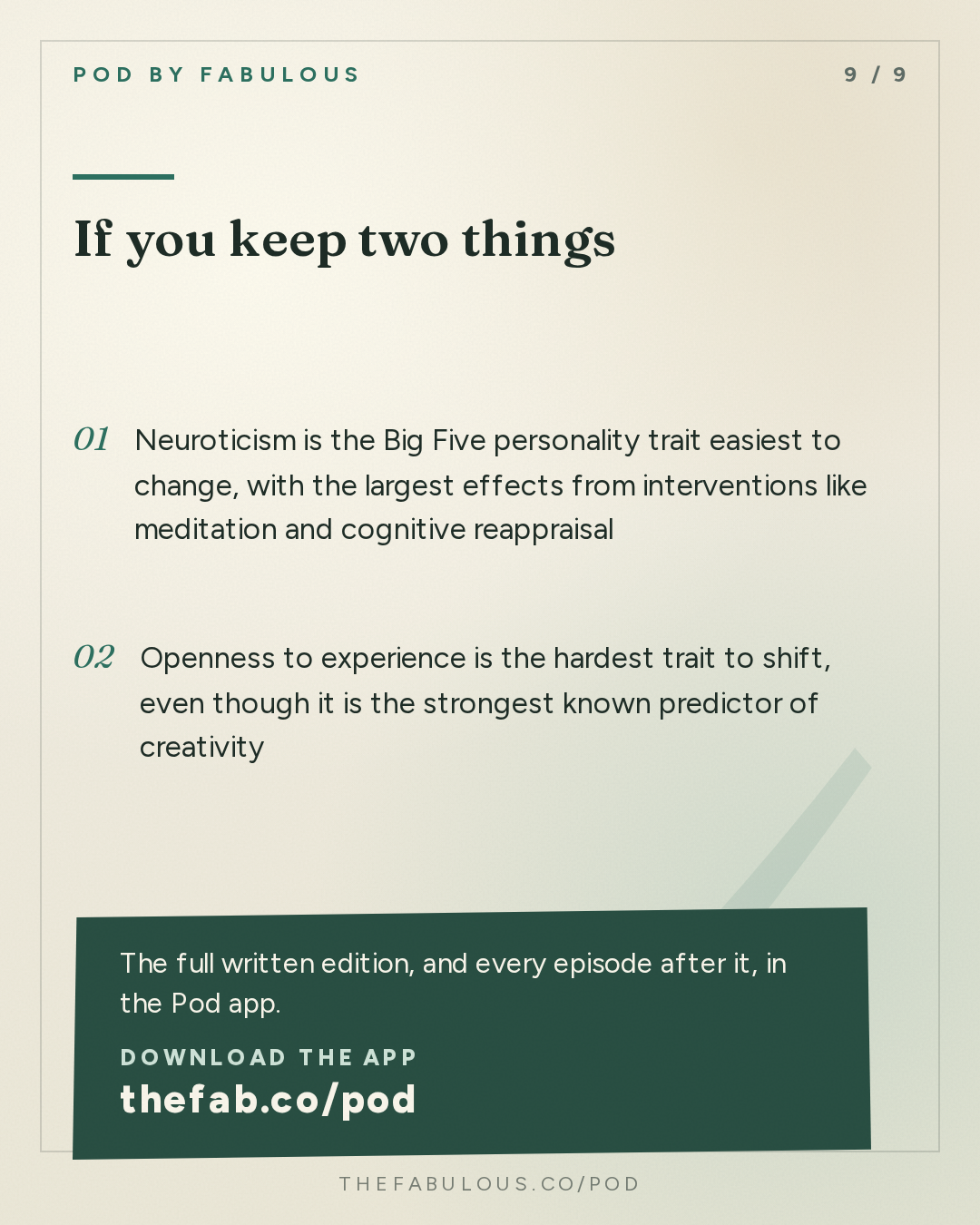
- Neuroticism is the Big Five personality trait easiest to change, with the largest effects from interventions like meditation and cognitive reappraisal
- Openness to experience is the hardest trait to shift, even though it is the strongest known predictor of creativity
- Personality is a density distribution of daily states, not a fixed score, which is why changing habitual patterns changes personality itself
- Lasting change relies on habits and systems rather than willpower, a lesson Scott Barry Kaufman credits to guests James Clear and Tim Ferriss
- Belonging to a group is not the same as intimacy, since true relatedness allows mutual growth and the freedom to dissent
The episode in cards
By the numbers
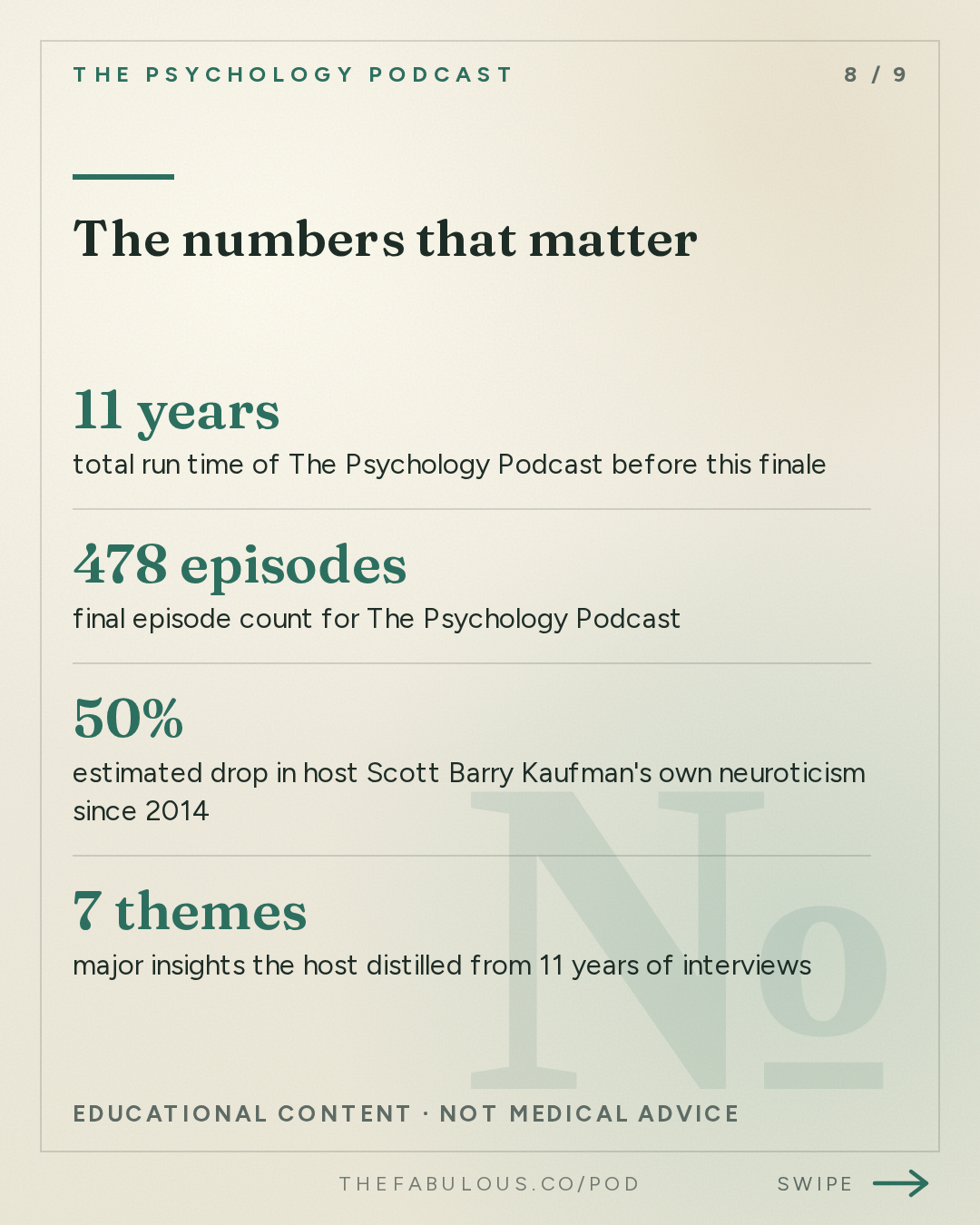
- 11 years total run time of The Psychology Podcast before this finale
- 478 episodes final episode count for The Psychology Podcast
- 50% percent estimated drop in host Scott Barry Kaufman's own neuroticism since 2014
- 7 themes major insights the host distilled from 11 years of interviews
In their words
“The curious paradox is that once we accept who we are, then we can ch-”
Protocols
-
Reduce neuroticism with emotional regulation techniques
Scott Barry Kaufman recommends meditation, cognitive reappraisal (consciously reframing a stressful thought), and cognitive distancing, which means asking whether the thing upsetting you now will still matter in fifty years.
as needed during moments of anxiety, and as an ongoing practice
-
Choose one trait and run a structured intervention
Scott Barry Kaufman has his Barnard College students pick a single Big Five personality trait they want to change and apply scientifically validated interventions to shift it, since he has found effects are largest for neuroticism and weakest for openness to experience.
over a semester-length period
-
Build long-lasting change through habits and systems, not willpower
Scott Barry Kaufman says meaningful personality change depends on repeated behaviors and structured systems, citing guests James Clear and Tim Ferriss as models, and he personally used a small daily win, a morning workout, to make the habit intrinsically rewarding.
daily
-
Acknowledge your dark side instead of suppressing it
Scott Barry Kaufman recommends the practice, drawn from meditation teacher Sharon Salzberg, of metaphorically shaking hands with your inner demons and saying 'I see you,' then asking, as therapist Richard Schwartz suggests, what role that difficult part is trying to play in your life.
whenever shame or discomfort arises
Questions this episode answers
Can personality traits actually change over time?
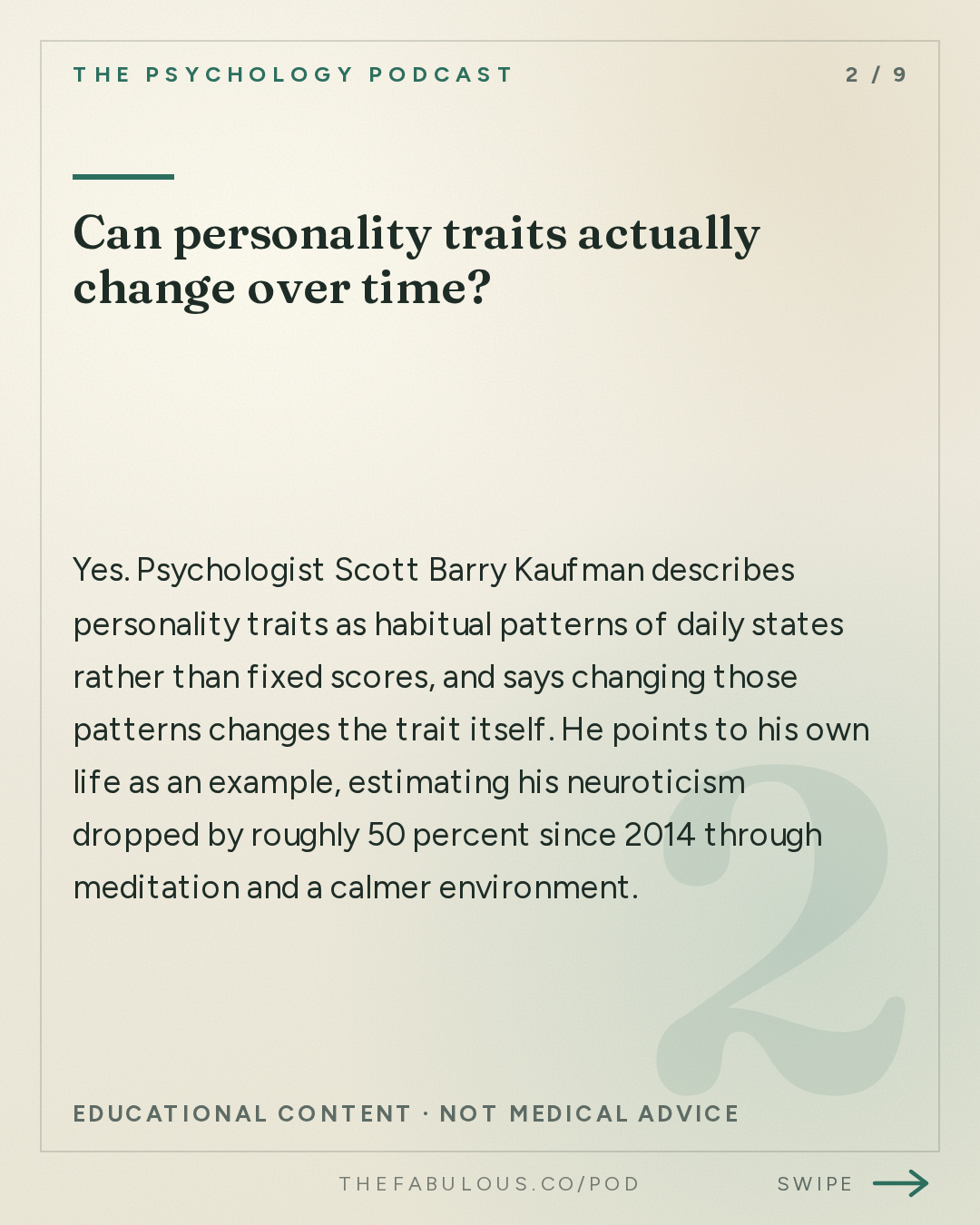
Yes. Psychologist Scott Barry Kaufman describes personality traits as habitual patterns of daily states rather than fixed scores, and says changing those patterns changes the trait itself (08:28). He points to his own life as an example, estimating his neuroticism dropped by roughly 50 percent since 2014 through meditation and a calmer environment (18:29).
Which Big Five personality trait is easiest to change?
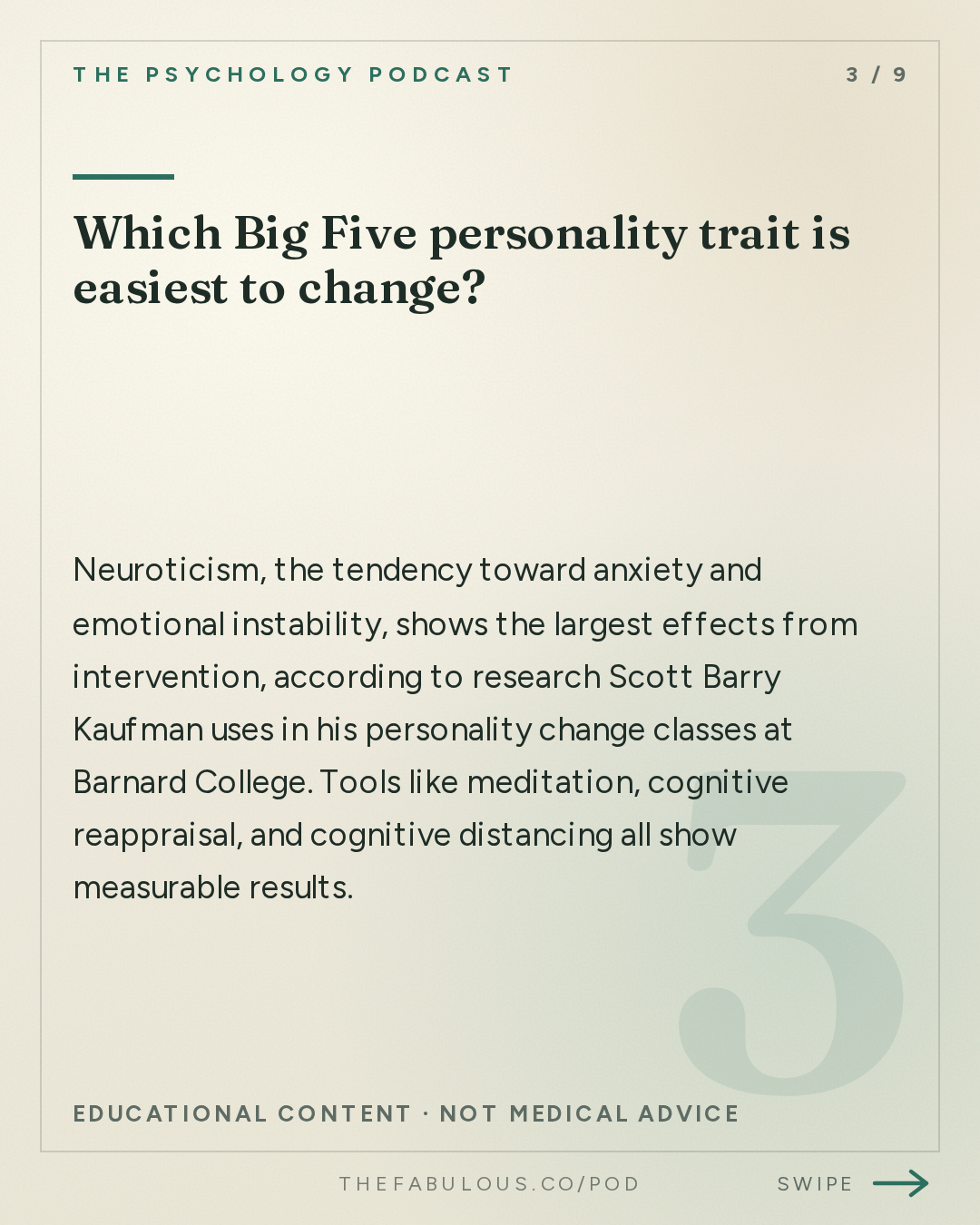
Neuroticism, the tendency toward anxiety and emotional instability, shows the largest effects from intervention, according to research Scott Barry Kaufman uses in his personality change classes at Barnard College (09:06). Tools like meditation, cognitive reappraisal, and cognitive distancing all show measurable results.
Why is openness to experience hard to change?
Scott Barry Kaufman says psychologists have not yet developed reliable activities that shift openness to experience, unlike traits such as extraversion or conscientiousness (10:22). This matters because openness is, in his words, the single best predictor of creativity among the Big Five traits (11:18).
What is Scott Barry Kaufman's sailboat metaphor for Maslow's hierarchy of needs?
In his book Transcend, Kaufman replaces Abraham Maslow's pyramid, which Maslow himself never actually drew, with a sailboat where the hull represents basic needs like security and the sail represents growth and purpose (38:16, 38:25). He argues some days call for closing the sail to patch the boat rather than chasing growth.
What is the difference between belonging and intimacy according to this episode?
Scott Barry Kaufman distinguishes belonging, which can be conditional on agreement with a group, from intimacy or relatedness, which requires mutual growth and the freedom to dissent without being cast out (35:08). He argues true connection needs both people to be able to disagree and stay in relationship.
The full read, in cards
Go deeper
- Transcend — Scott Barry Kaufman's book reimagining Maslow's hierarchy of needs as a sailboat instead of a static pyramid
- The Upside of Your Dark Side — Book by Todd Kashdan and Robert Biswas-Diener on the value of accepting uncomfortable emotions
- Ungifted — Scott Barry Kaufman's first general-audience book on recognizing overlooked strengths and talents
Mentioned
Scott Barry Kaufman · Annie Murphy Paul · Angela Duckworth · James Clear · Tim Ferriss · Carl Rogers · Sharon Salzberg · Richard Schwartz · Sonja Lyubomirsky · Abraham Maslow · Karen Horney · Todd Kashdan · Scientific American
More from this show and category
Alia Crum on How Mindset Shapes Stress and Hunger
Stanford psychologist Alia Crum finds that beliefs about food, stress, illness, and genes can alter body chemistry itself. Labeling an identical milkshake indulgent rather than sensible triples the drop in the hunger hormone ghrelin (12:37), and believing one carries a low-efficiency exercise gene lowers real oxygen conversion regardless of actual genotype (47:10).

How Sleep Deprivation Affects Decisions
Sleep deprivation degrades ethical judgment and decision-making in novel situations, contributing to disasters from train crashes to BP's 2005 explosion. Chronic pain, meanwhile, is reshaped by fear, relationships, and mindset as much as by tissue damage, per sleep researcher Chris Barnes and pain psychologist Rachel Zoffness.

5 Skin Habits From a Mayo Clinic Dermatologist
Mayo Clinic dermatologist Saranya Wyles argues skin is a check engine light for the whole body, not a beauty scorecard, and shares five pillars (sleep, diet, movement, stress, topicals) that measurably change how skin ages, from barrier recovery after sleep to facial volume loss on GLP-1 drugs.
The One Skill That Makes People Like You More
Mel Robbins says empathy means understanding, not mind-reading, and everyone gets nine daily chances to practice it (07:19). She outlines four habits: asking instead of guessing, sending small gestures called pebbling, offering concrete help without being asked, and waving first, drawing on research from Harvard, Stanford, and the University of Toronto.
