
The One Skill That Makes People Like You More
This One Skill Makes Every Relationship Better
▶ Listen to the full episode More from The Mel Robbins Podcast
The brief
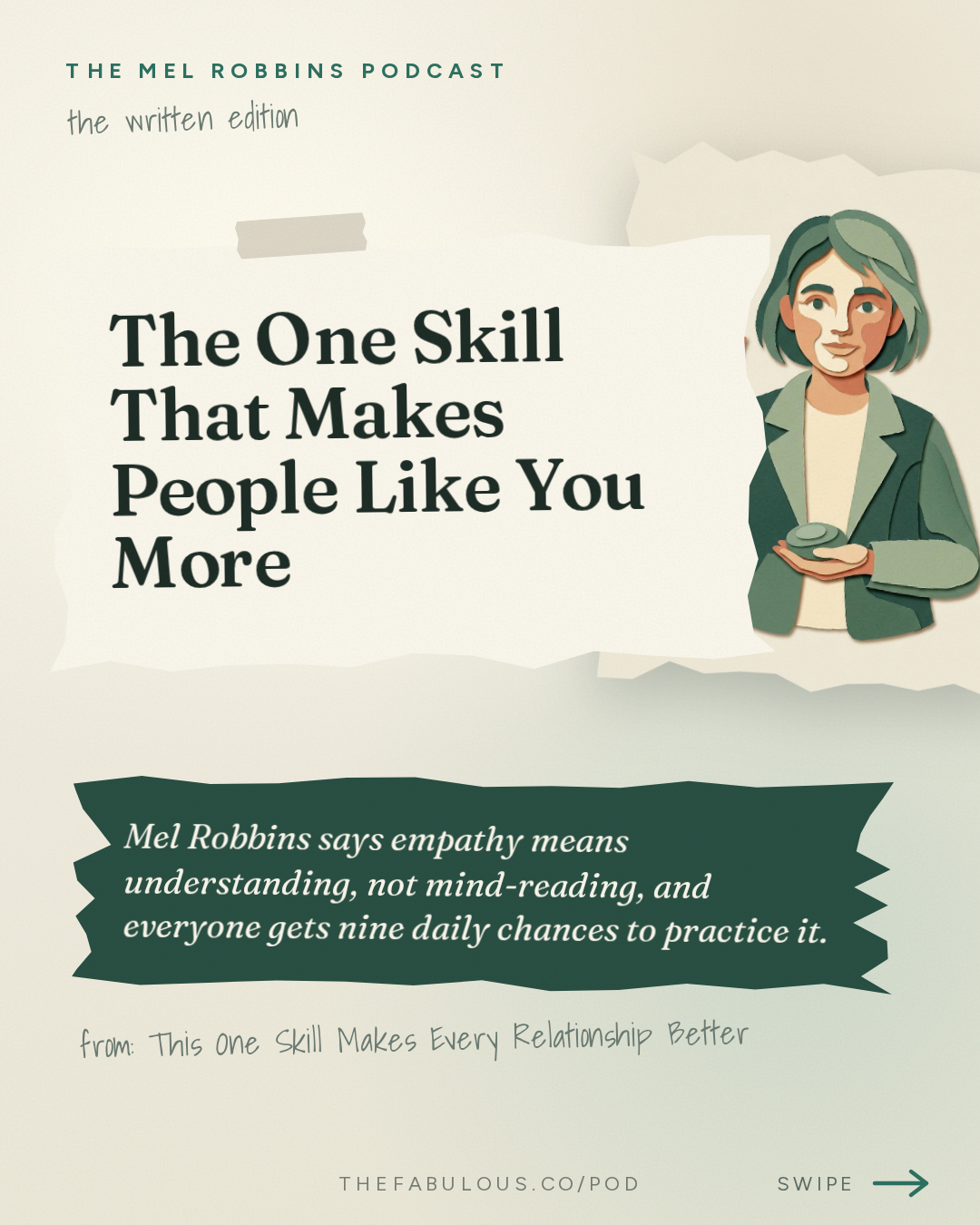
Mel Robbins says empathy means understanding, not mind-reading, and everyone gets nine daily chances to practice it (07:19). She outlines four habits: asking instead of guessing, sending small gestures called pebbling, offering concrete help without being asked, and waving first, drawing on research from Harvard, Stanford, and the University of Toronto.
Hold a door for a stranger and watch what happens next. Nine times out of ten, the next person through holds it for someone else. Psychologists call this the law of reciprocity: a hardwired impulse to repay kindness with kindness (04:12). Host Mel Robbins uses that small, automatic gesture as the starting point for a larger argument. Empathy, the skill of trying to understand what someone else feels before judging them, fixing them, or offering an opinion, is not a soft trait reserved for people who lack power. It is, she says, one of the most practical tools available for building a life full of people who like you back (02:27).
The science behind the intuition is concrete. Watch a character cry in a movie and feel your own throat tighten: that is a mirror neuron firing, producing in you a version of the same emotional response you are witnessing in someone else (05:51). Robbins credits this neural overlap, sometimes described as a bridge between one brain and another, with explaining why empathy spreads once someone starts it. She also borrows a single word from Harvard Medical School psychologist Dr. Stuart Ablon, who has spent 30 years running a clinical program for children called Think Kids at Massachusetts General Hospital. Asked to define empathy, Ablon answered with one word: understanding (06:43). Not fixing. Not guessing. Understanding what someone is feeling and dealing with, before anything else happens.
That distinction matters because of how often the chance to use it shows up. Researchers at the University of Toronto, publishing in the Journal of Psychological Science, measured how many opportunities an average person gets each day to practice empathy, meaning any moment where a little care would make someone feel understood. Their count: nine (07:19). Nine small windows daily, most of them easy to miss while driving to the grocery store or half-listening to a coworker.
Stop Guessing, Start Asking
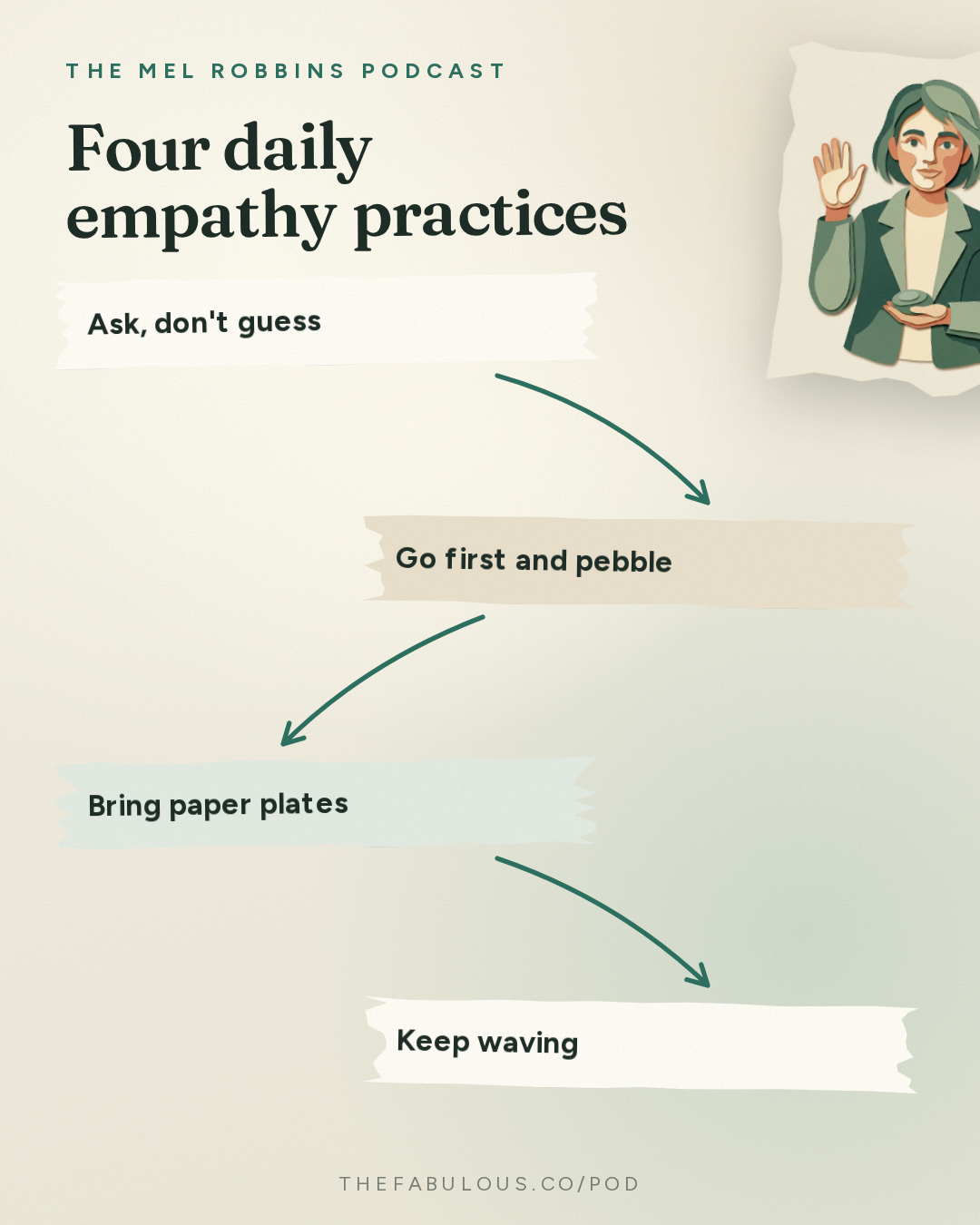
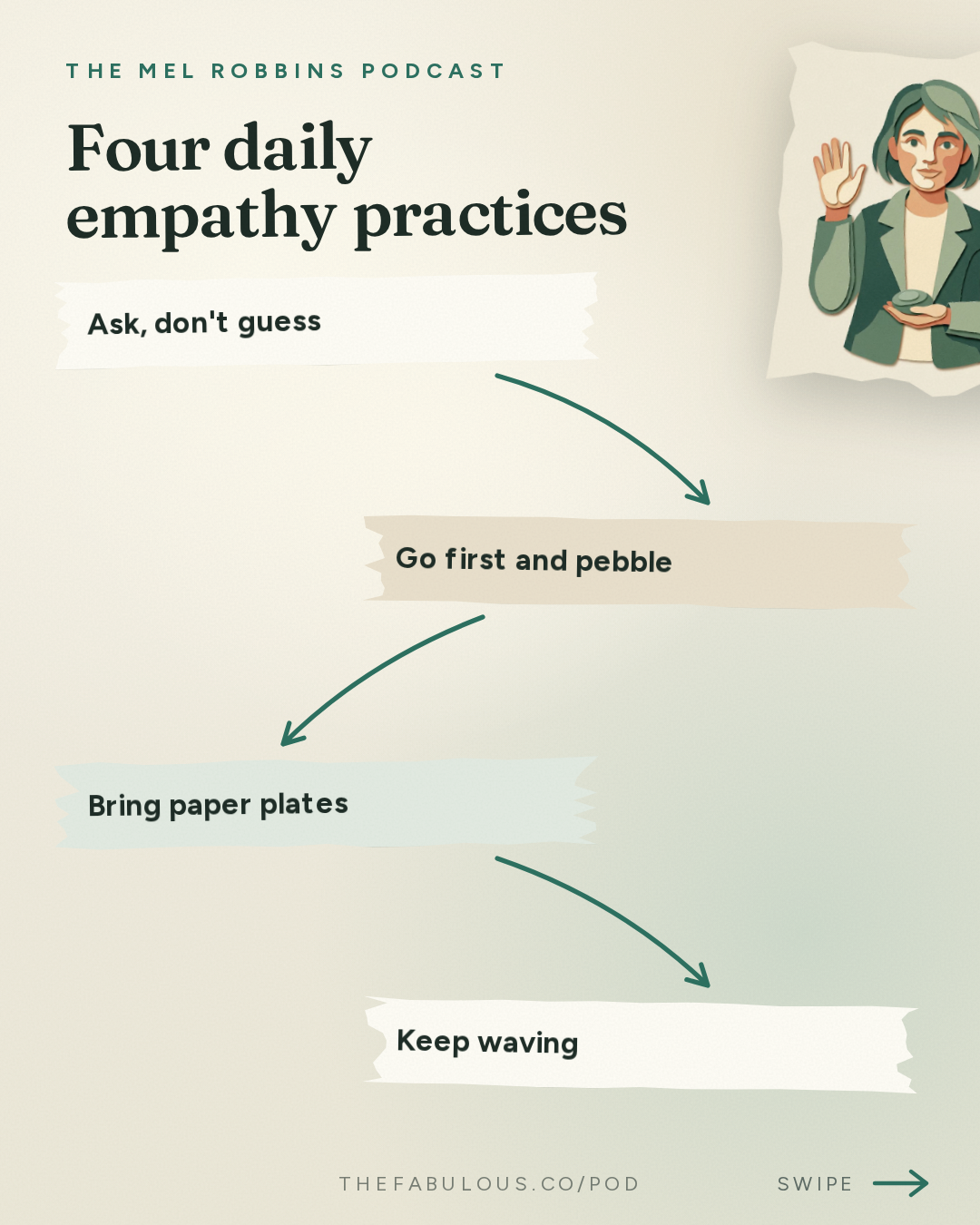
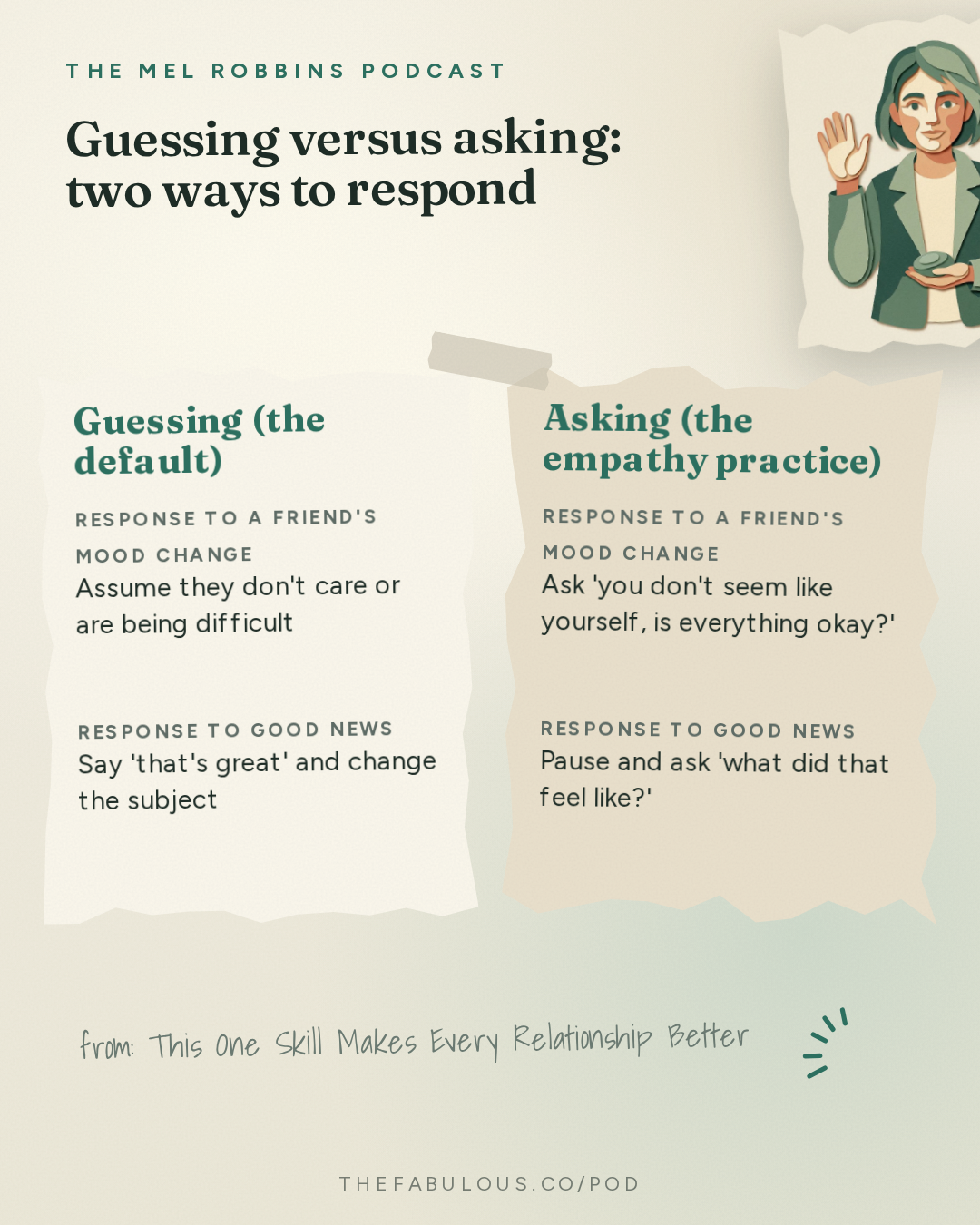
Robbins's first practice is simple to state and hard to live by: ask, don't guess. For most of her adult life, she assumed empathy meant imagining her way into someone else's shoes and intuiting what they needed. That assumption, she argues now, runs backward.
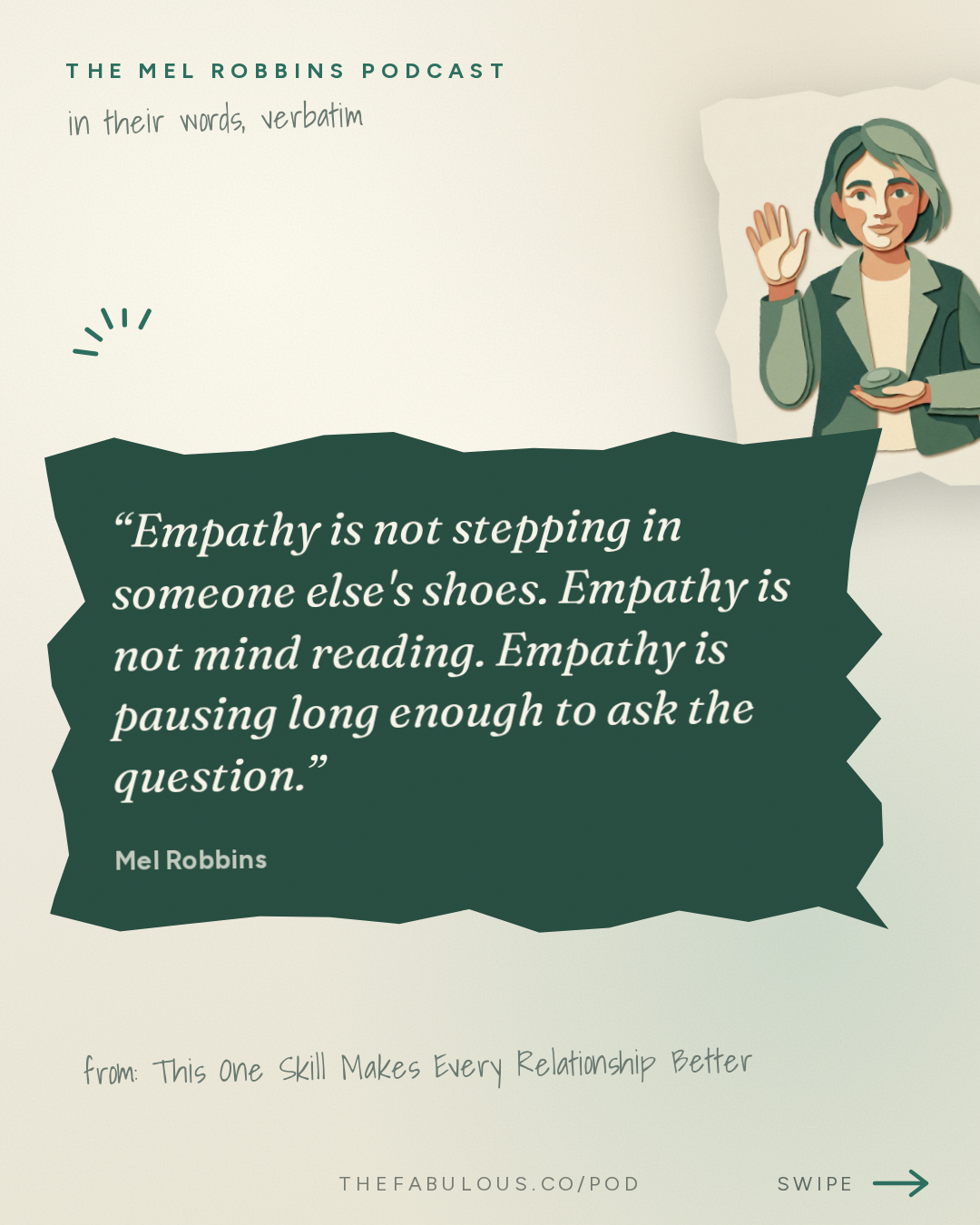
"Empathy is not stepping in someone else's shoes. Empathy is not mind reading. Empathy is pausing long enough to ask the question." — Mel Robbins [11:00]
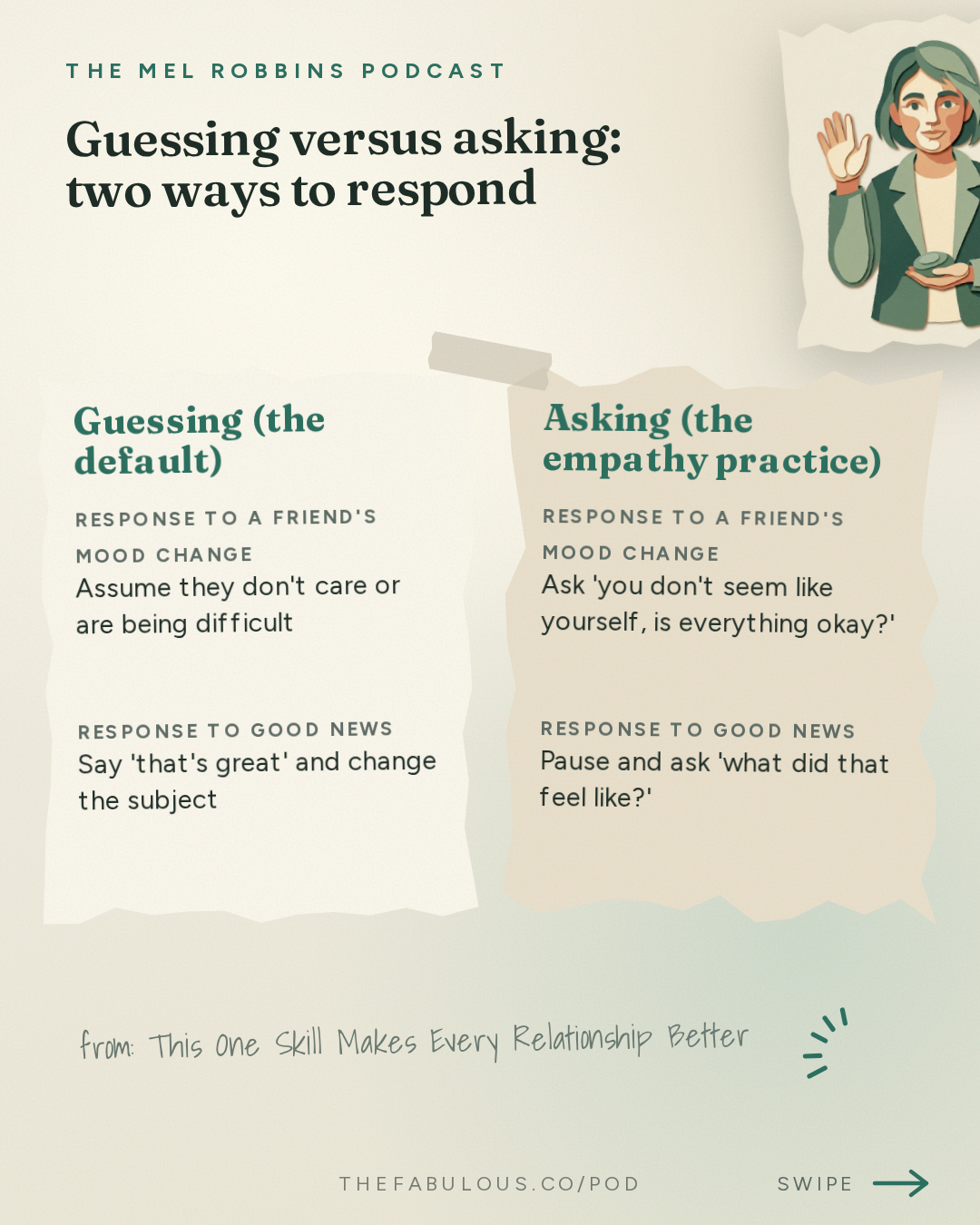
She illustrates the cost of guessing with a story from her own parenting. When her son struggled in school in fourth grade, before anyone understood he had dyslexia, dysgraphia, and ADHD, Robbins reacted the way she says she reacts to most fear: she became, in her words, a bulldozer, jumping straight into problem-solving mode (12:10). The fixing made things worse, she admits, because what her son needed first was not a plan. He needed to feel understood. The better move, she says now, would have been one open question: help me understand what's hard (13:02). That phrase becomes her stand-in for the whole practice, and it works as well for good news as for bad. When a friend calls with something exciting and gets a quick "that's great" before the conversation moves on, the chance to ask what that felt like has already closed (14:24). People do not only want company in their pain, she says. They want company in their joy too (14:53).
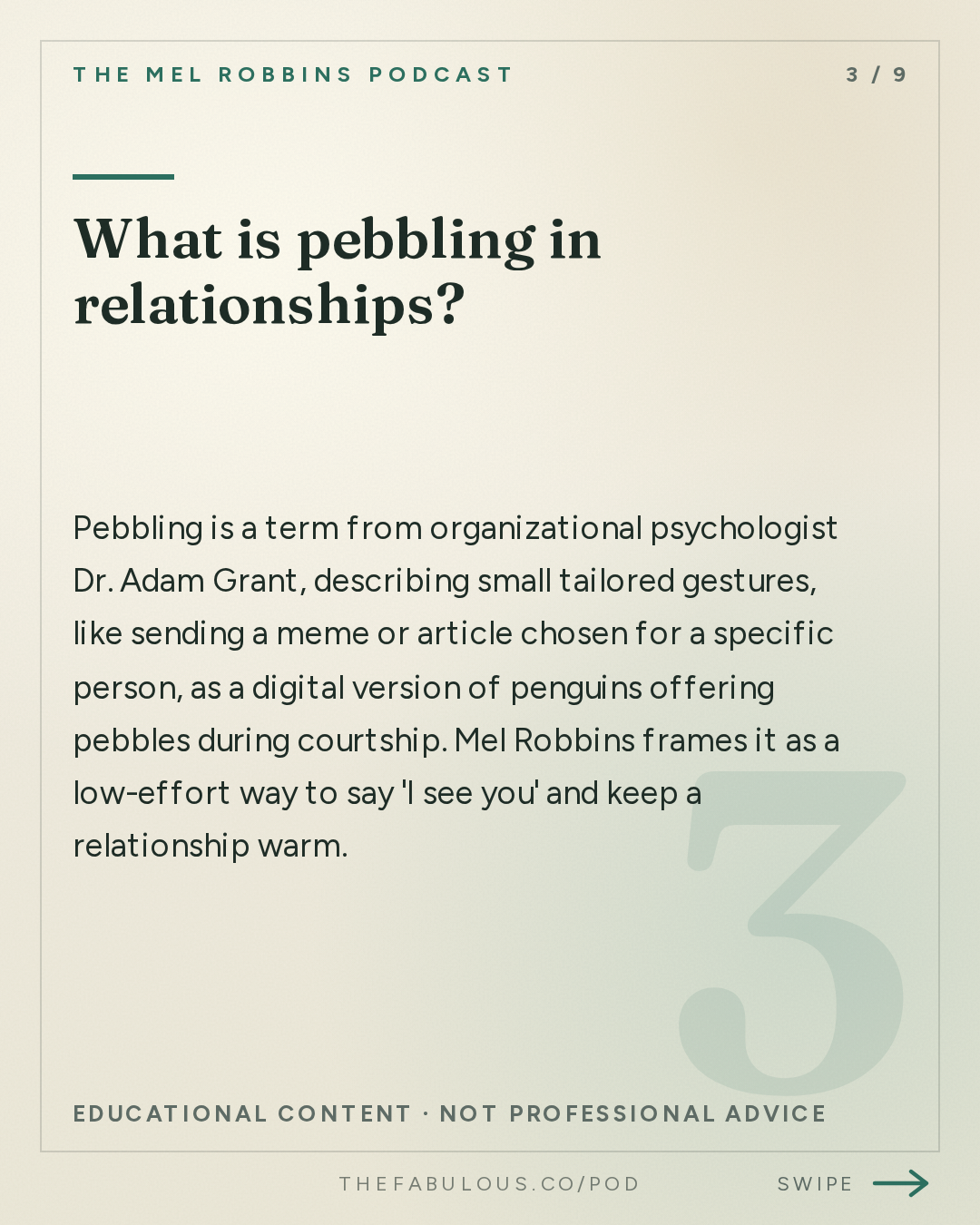
The second practice builds on the first: go first. Most people carry a backlog of good intentions, a text to a sick friend never sent, a congratulations never said, because the moment right before acting fills up with second-guessing about whether it will be awkward or unwanted (19:05). The problem with hesitation is that intention is invisible; a sister cannot feel a text that never gets sent (19:54). To make going first concrete, Robbins turns to organizational psychologist Dr. Adam Grant of the Wharton School of Business, who introduced the idea of pebbling. The term comes from penguins, which court mates by presenting smooth, shiny pebbles (21:17). The digital version is sending someone a meme, an article, or a clip chosen because it fits their specific sense of humor: a low-effort signal that says, in effect, I thought of you.
"Every pebble is a bid for connection." — Dr. Adam Grant [21:48]
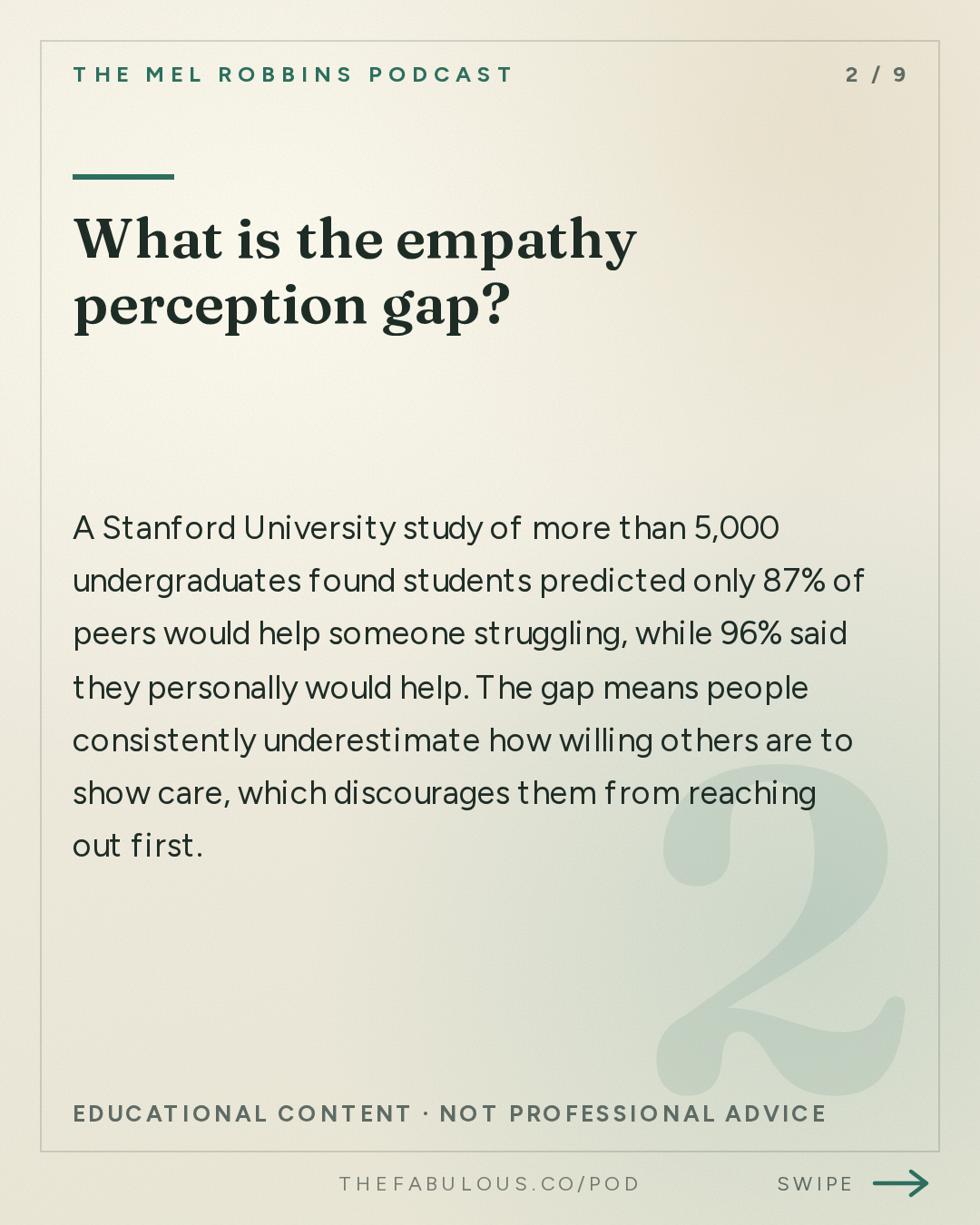
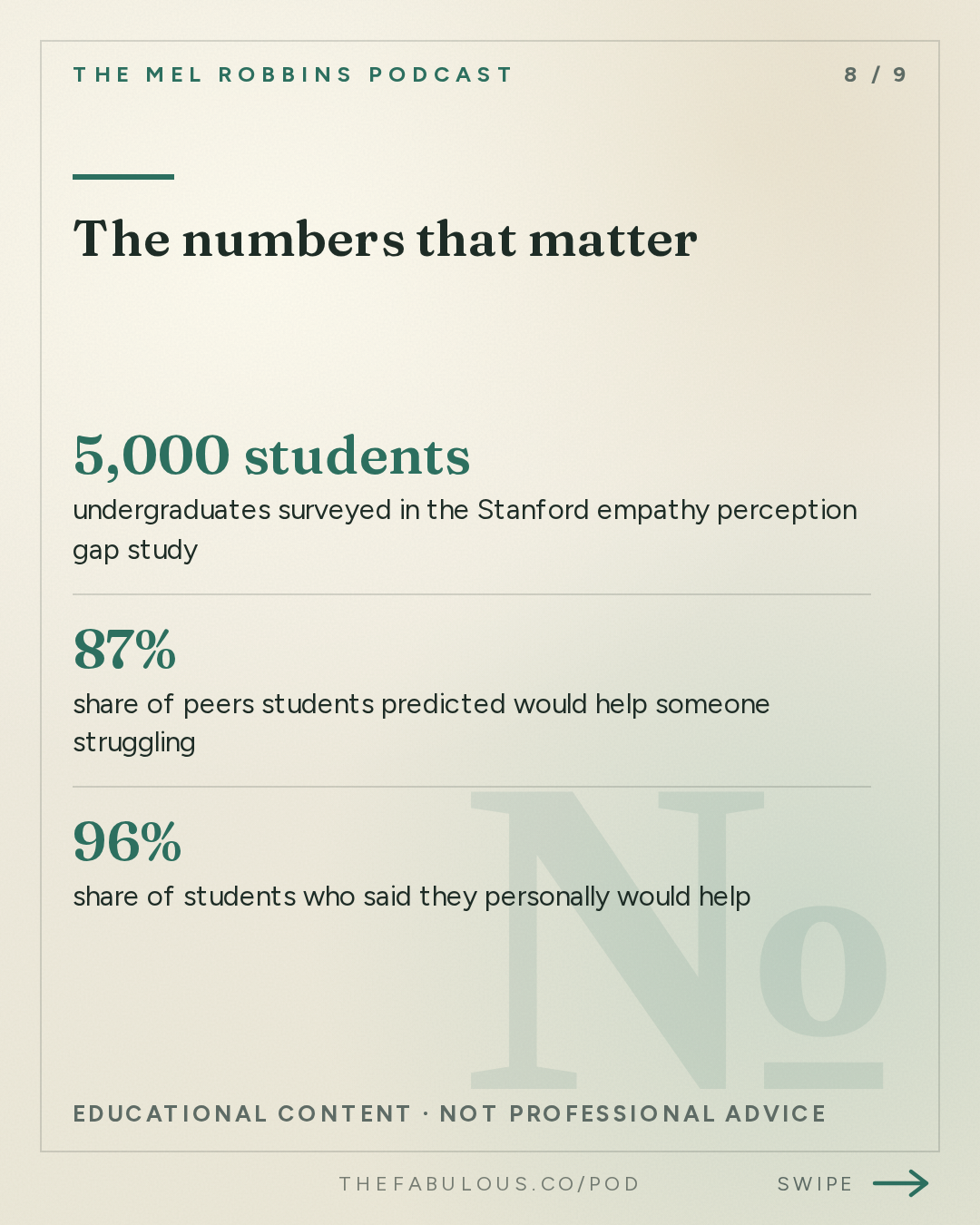
Why don't more people send the pebble, make the call, or wave first? Robbins points to a study out of Stanford University that surveyed more than 5,000 undergraduates and documented what researchers called the empathy perception gap (25:13). Students guessed that roughly 87% of their peers would stop to help someone having a hard time. Asked whether they personally would help, 96% said yes (25:39). The gap between those two numbers is really a gap between how warm people assume others are and how warm people actually are. When students later learned the real figures, they began reaching out more, and months afterward their social networks had grown (26:06). The barrier to connection usually is not a lack of caring. It is the belief that nobody else cares first.
Showing Up Without Being Asked
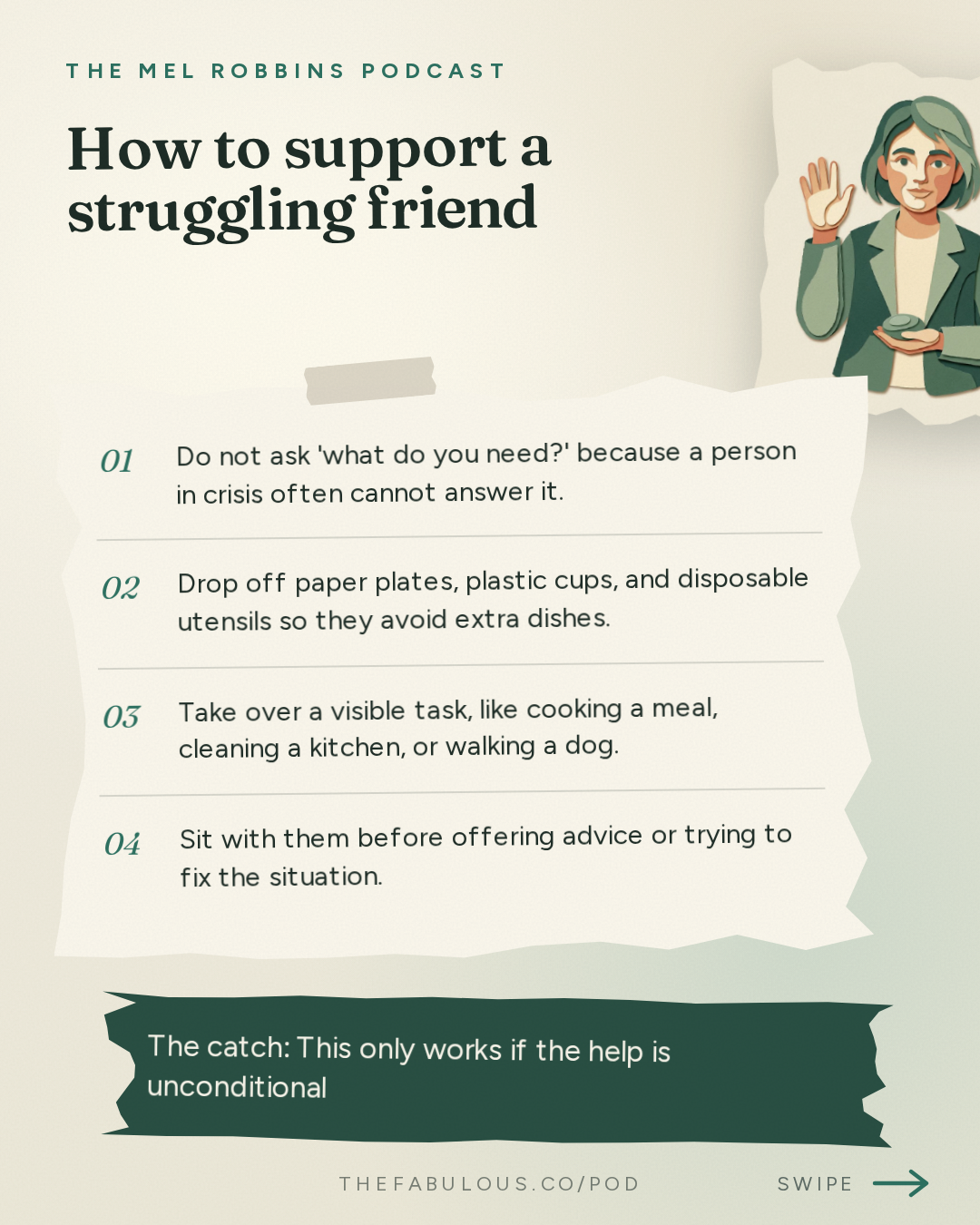
The third practice Robbins teaches is what she calls paper plates, a phrase borrowed from therapist KC Davis, who told her that the worst question to ask someone in crisis is "what do you need?" (29:22). A person in the middle of a hard week often cannot answer that question; they may not know what day it is, let alone what would help. Davis's advice is to skip the question and drop off paper plates, plastic cups, and disposable utensils, so the person is not left with a sink of dishes they have no energy to wash (30:11). Robbins describes living out her own version of this during a summer she spent sick in bed while fourteen houseguests filled her home. Not one of them asked what she needed. They cleaned the kitchen, cooked the meals, walked the dogs, and she found herself cared for without having to ask for a single thing (31:36).
The clearest illustration of action over inquiry comes from the late Judge Frank Caprio, the Rhode Island municipal judge known worldwide for his gentleness on the bench, who died at 88 after a thirty year career (33:04, 33:31). Caprio told Robbins about his first day in court, when a woman with four children and a boot on her car could not pay her fines. He held firm and kept the boot on, feeling, in his words, like the boss (33:52). His father, watching from the gallery, was furious afterward: how could Frank not see that without a car she could not get her kids to school? That single rebuke reset how Caprio approached every case for the next thirty years.
"The lesson was that being a judge is much more about the person in front of you... than it is about the law." — Judge Frank Caprio [35:49]
The fourth practice, Robbins's favorite, needs no plan at all: keep waving. She tells a story first reported by CBS News correspondent Steve Hartman about a four-year-old named Roman in Concord, North Carolina, whose parents had separated and who spent his afternoons waving at everyone who passed his house (38:35). A neighbor named Wade eventually walked over and introduced himself. Other neighbors followed. Roman started inviting them to his soccer games, his swimming lessons, his birthday party, and a boy who had been lonely ended up with a street full of adopted grandparents, built on nothing more than a gesture repeated until someone waved back (40:27).
That story is really the whole episode in miniature. Reciprocity, mirror neurons, and the empathy perception gap describe the same mechanism from different angles: other people are usually more willing to connect than anyone assumes, and someone has to go first. Robbins closes on the number nine, the nine chances a day to ask instead of guess, to send a pebble, to show up with paper plates, to wave (44:02). None of the four practices require money, talent, or spare time. They require noticing the chance while it is still open, and taking it.
Ask this episode anything
Pod's AI answers from the episode itself, with the minute mark so you can hear it yourself.
Or start with one of these
Ask this episode
Pod's AI listens to the whole episode to answer, and points you to the minute it comes from.
The rest of this answer, and any question after it
Answers come from the episode itself, never from a summary of it.
ContinueKey takeaways
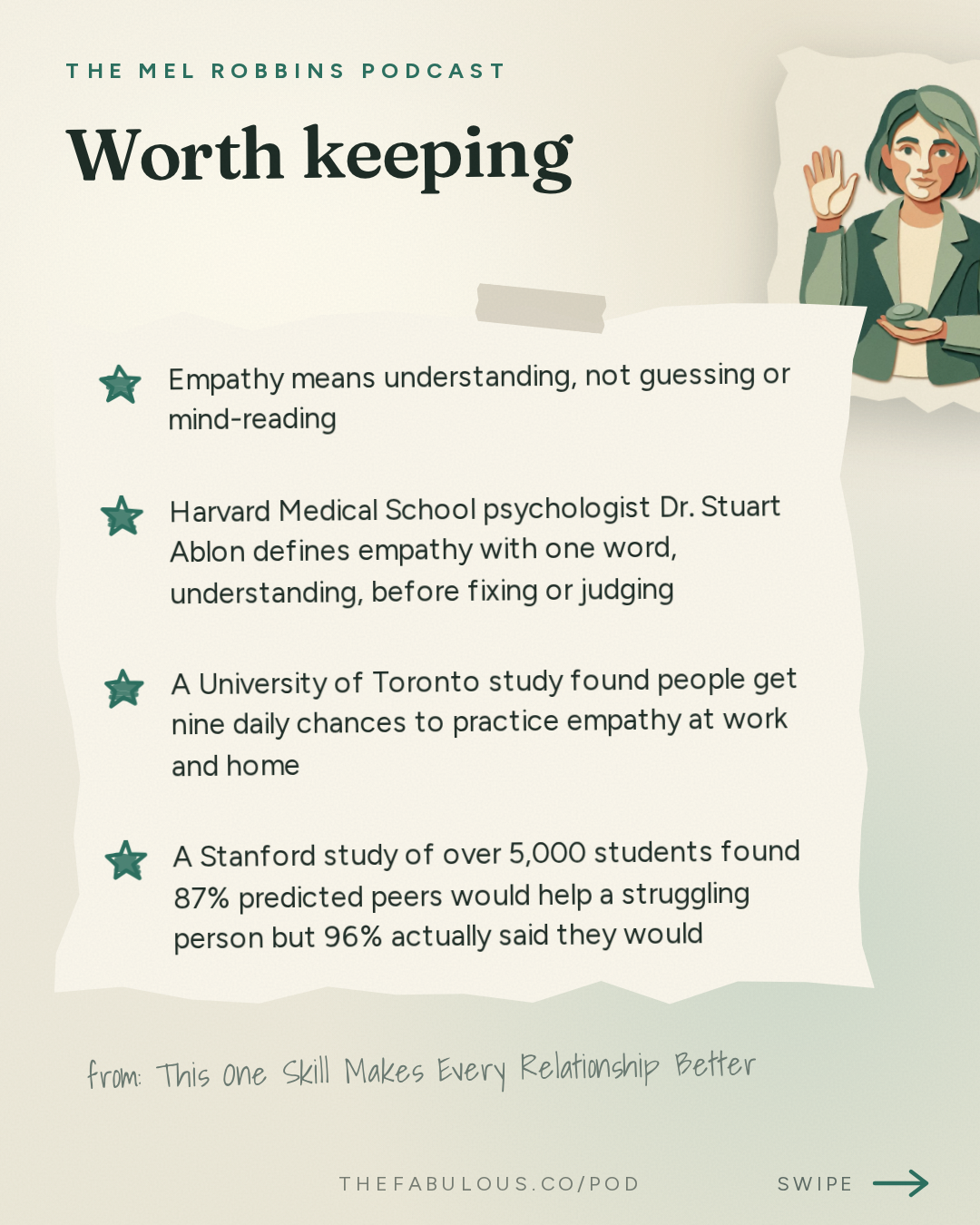
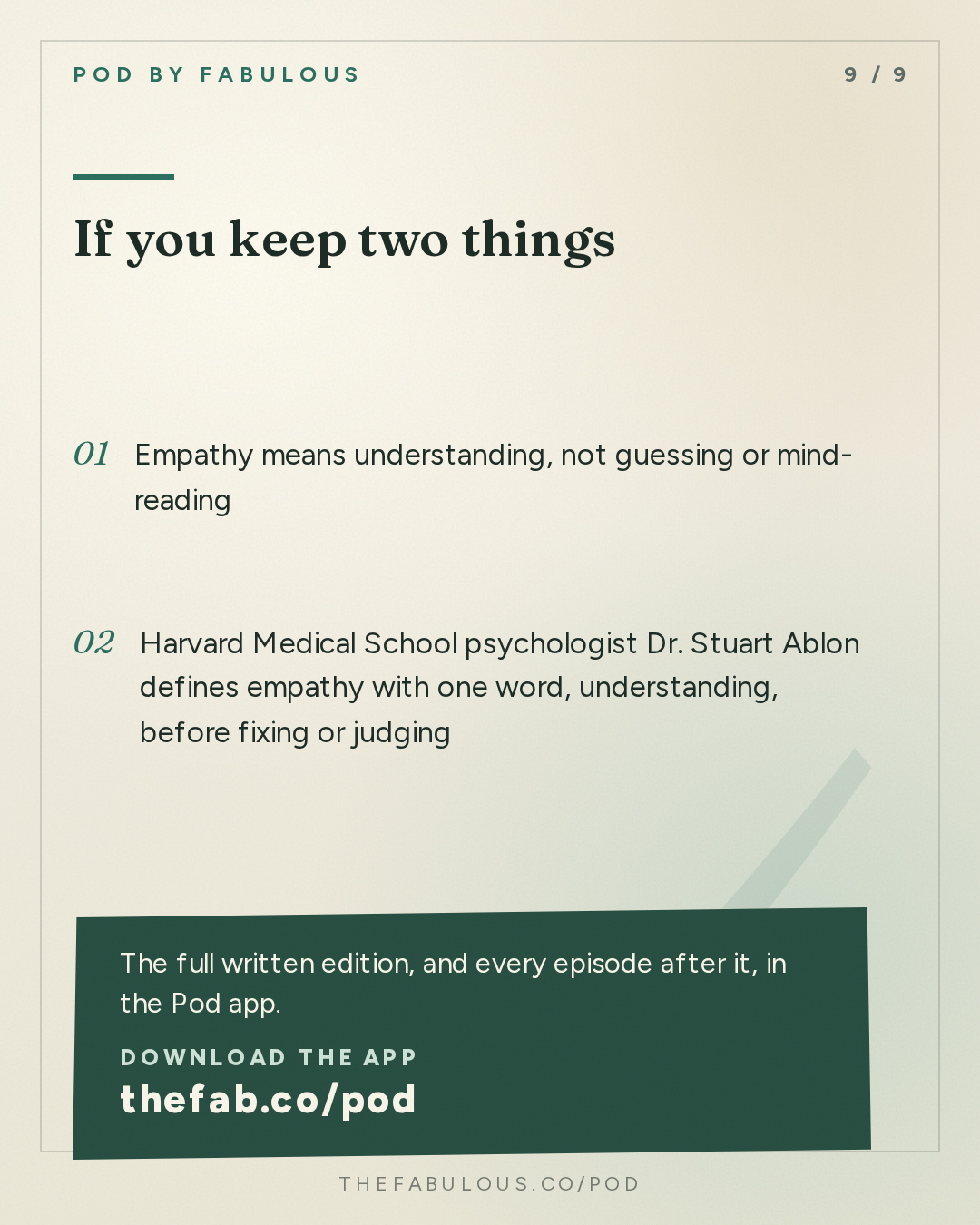
- Empathy means understanding, not guessing or mind-reading
- Harvard Medical School psychologist Dr. Stuart Ablon defines empathy with one word, understanding, before fixing or judging (06:43)
- A University of Toronto study found people get nine daily chances to practice empathy at work and home (07:19)
- A Stanford study of over 5,000 students found 87% predicted peers would help a struggling person but 96% actually said they would (25:39)
- Therapist KC Davis says to skip asking a struggling friend what they need and instead bring concrete help like paper plates (29:22)
The episode in cards
By the numbers
- 5,000 students undergraduates surveyed in the Stanford empathy perception gap study
- 87% percent share of peers students predicted would help someone struggling
- 96% percent share of students who said they personally would help
In their words
“People do not remember what you do, they remember how you made them feel.”
“Empathy is not stepping in someone else's shoes. Empathy is not mind reading. Empathy is pausing long enough to ask the question.”
“Every pebble is a bid for connection.”
“"The lesson was that being a judge is much more about the person in front of you- Right ... than it is about the law”
Protocols
-
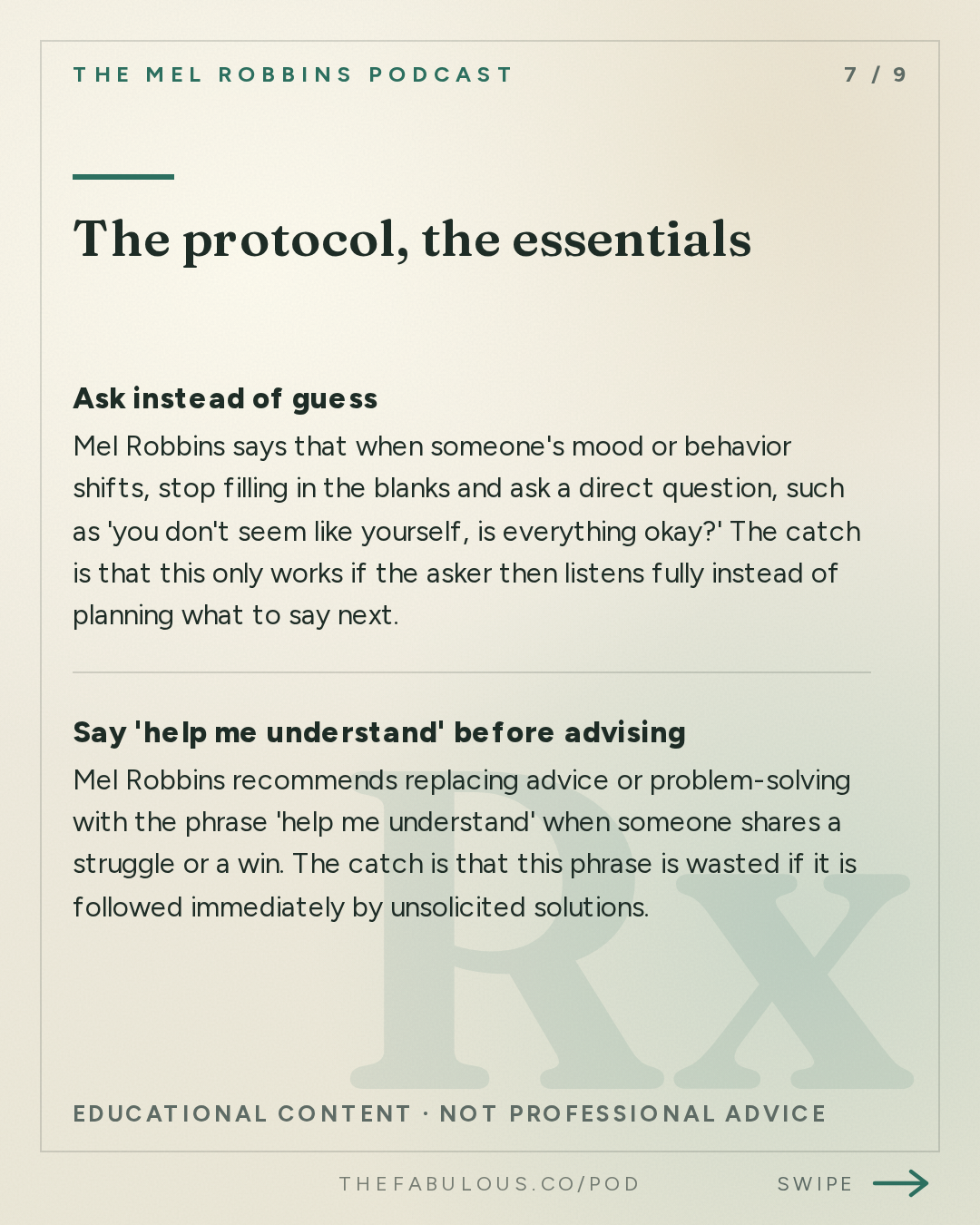
Ask instead of guess
Mel Robbins says that when someone's mood or behavior shifts, stop filling in the blanks and ask a direct question, such as 'you don't seem like yourself, is everything okay?' The catch is that this only works if the asker then listens fully instead of planning what to say next.
Whenever someone's mood, energy, or behavior changes noticeably
-
Say 'help me understand' before advising
Mel Robbins recommends replacing advice or problem-solving with the phrase 'help me understand' when someone shares a struggle or a win. The catch is that this phrase is wasted if it is followed immediately by unsolicited solutions.
In hard conversations and in celebratory ones
-
Send a pebble
Dr. Adam Grant, an organizational psychologist at the Wharton School of Business, suggests sending a person a meme, article, or clip chosen specifically because it matches their humor or interests, as a small signal that says 'I see you.' The catch is that generic forwards do not count; the gesture has to be tailored to that specific person.
Whenever someone comes to mind, including people not spoken to in years
-
Bring paper plates instead of asking what's needed
Mel Robbins, citing therapist KC Davis, says to skip asking a struggling friend what they need and instead drop off paper plates, plastic cups, and disposable utensils so they avoid extra dishes. The catch is that this works because people in crisis often cannot answer 'what do you need,' so concrete action replaces the question entirely.
When someone is in crisis, overwhelmed, or recovering
Questions this episode answers
What is the empathy perception gap?
A Stanford University study of more than 5,000 undergraduates found students predicted only 87% of peers would help someone struggling, while 96% said they personally would help (25:39). The gap means people consistently underestimate how willing others are to show care, which discourages them from reaching out first.
What is pebbling in relationships?
Pebbling is a term from organizational psychologist Dr. Adam Grant, describing small tailored gestures, like sending a meme or article chosen for a specific person, as a digital version of penguins offering pebbles during courtship (21:17). Mel Robbins frames it as a low-effort way to say 'I see you' and keep a relationship warm.
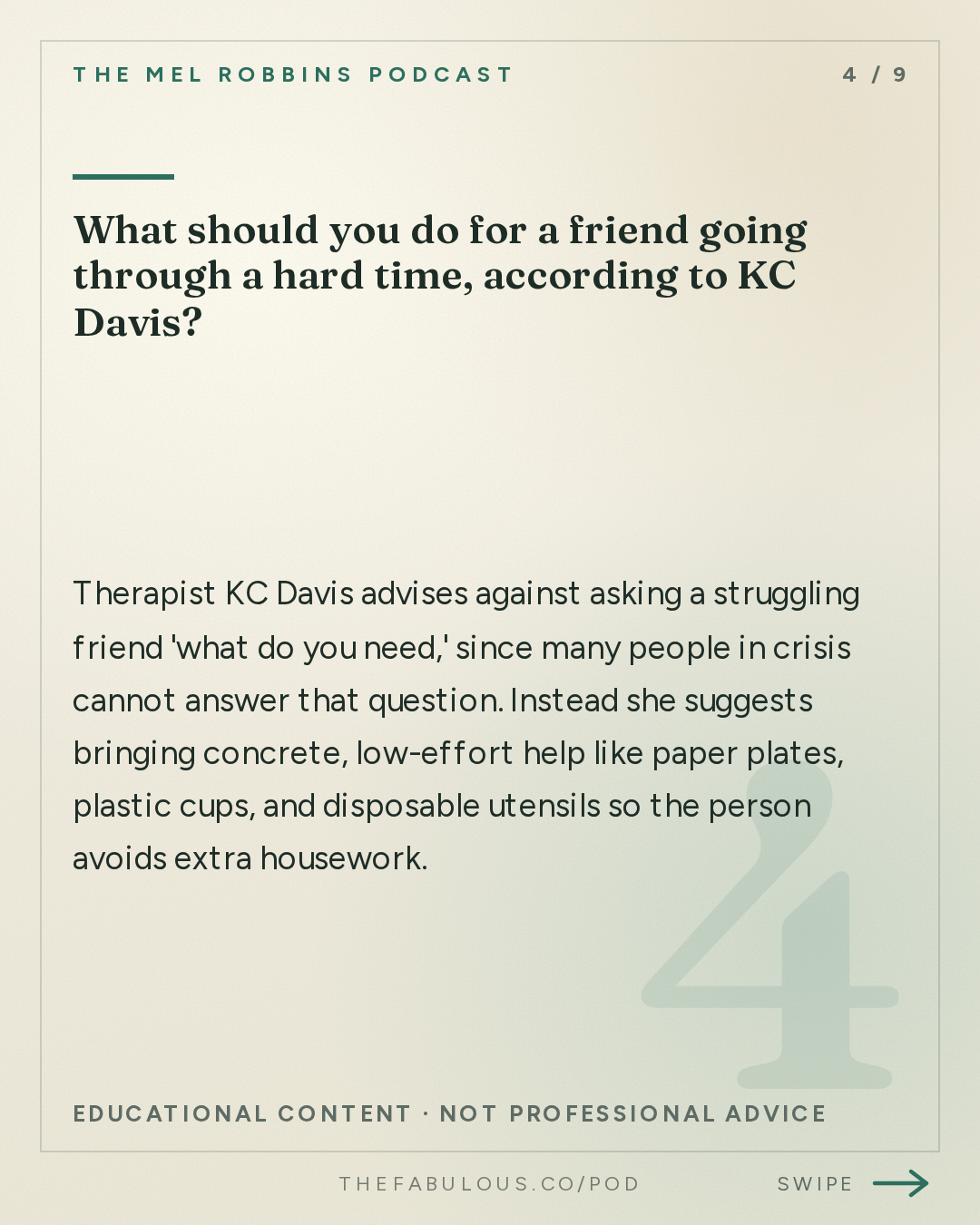
What should you do for a friend going through a hard time, according to KC Davis?
Therapist KC Davis advises against asking a struggling friend 'what do you need,' since many people in crisis cannot answer that question (29:22). Instead she suggests bringing concrete, low-effort help like paper plates, plastic cups, and disposable utensils so the person avoids extra housework.
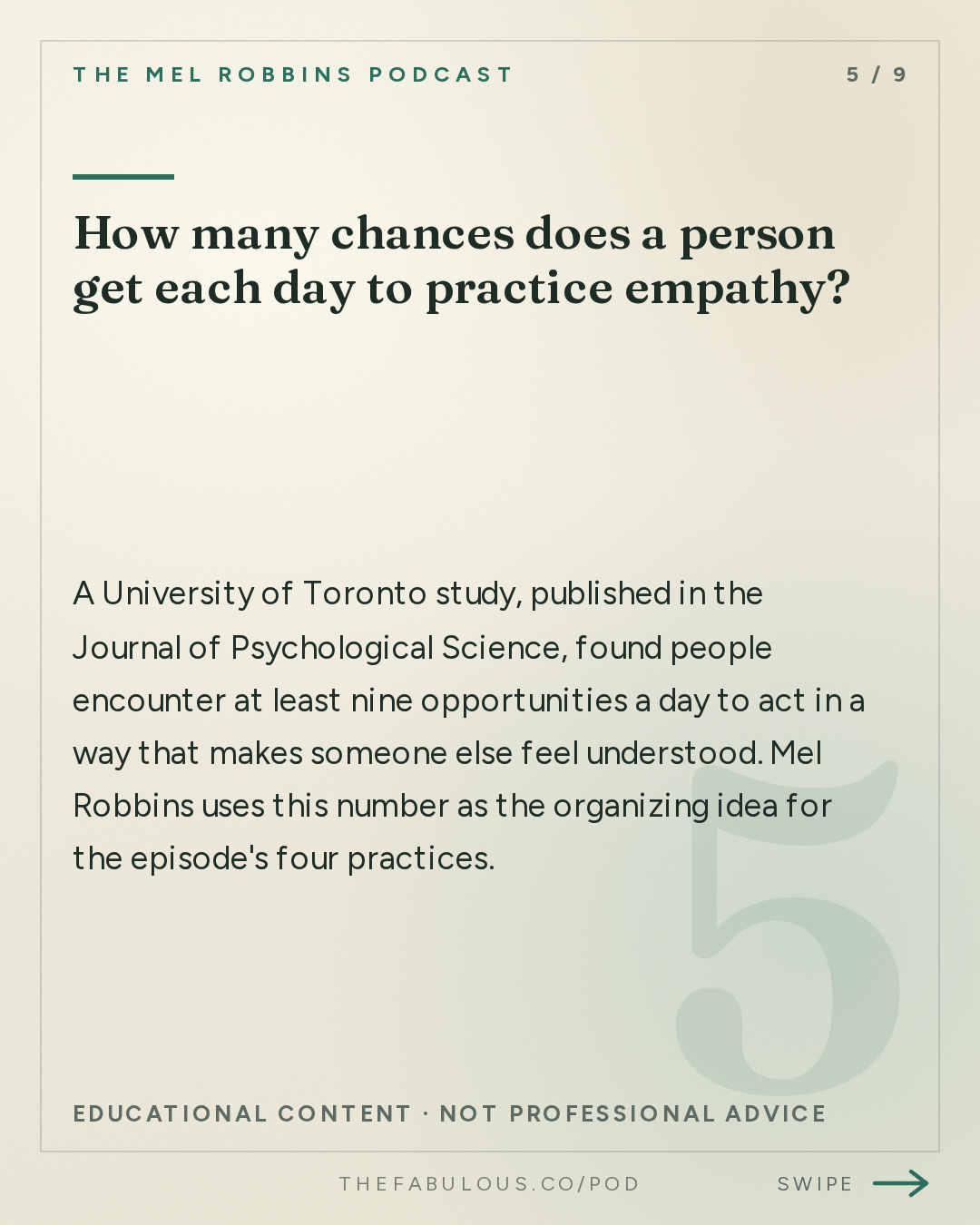
How many chances does a person get each day to practice empathy?
A University of Toronto study, published in the Journal of Psychological Science, found people encounter at least nine opportunities a day to act in a way that makes someone else feel understood (07:19). Mel Robbins uses this number as the organizing idea for the episode's four practices.
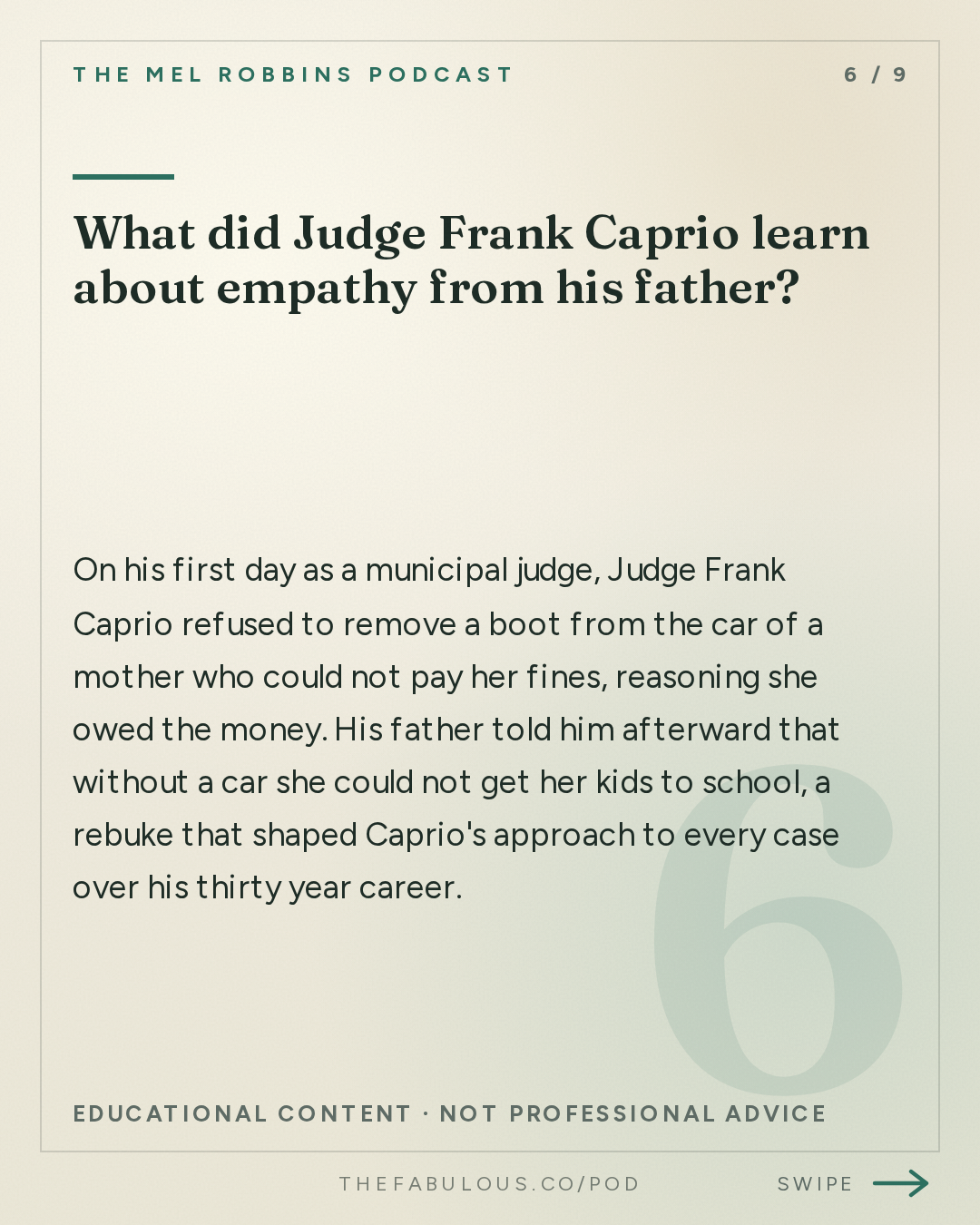
What did Judge Frank Caprio learn about empathy from his father?
On his first day as a municipal judge, Judge Frank Caprio refused to remove a boot from the car of a mother who could not pay her fines, reasoning she owed the money (34:15). His father told him afterward that without a car she could not get her kids to school, a rebuke that shaped Caprio's approach to every case over his thirty year career (33:31, 35:49).
The full read, in cards
Go deeper
- University of Toronto study, published in the Journal of Psychological Science — found people get at least nine daily chances to practice empathy
- Stanford University empathy perception gap study — surveyed over 5,000 students and found people underestimate how willing peers are to help
- Pebbling concept — Dr. Adam Grant's idea that small, tailored gestures signal connection the way penguins offer pebbles in courtship
- KC Davis's paper plates advice — therapist's suggestion to give struggling people concrete help instead of asking what they need
Mentioned
Dr. Stuart Ablon · Harvard Medical School · Think Kids · Dr. Adam Grant · Wharton School of Business · University of Toronto · KC Davis · Judge Frank Caprio · Journal of Psychological Science · Stanford University · Maya Angelou · Steve Hartman · Roman · Wade
More from this show and category
Ina Garten's Advice for Career Reinvention
Ina Garten left a federal budget job at 30 to buy a 400-square-foot Hamptons food store that grossed just $87 on its first day, and calls her approach working scared. On Mel Robbins's podcast, the Barefoot Contessa founder explains why jumping in before you feel ready, reframing boring tasks, and running small experiments beat waiting for a perfect plan.
Dr. Lara Boyd on How to Rewire Your Brain
Neuroscientist Lara Boyd says experience, not any drug, is the brain's biggest driver of change. Her research shows plasticity peaks when a task is hard enough to succeed only half the time, and that sleep, exercise, and lower cortisol all expand the brain's capacity to rewire at any age.
How to Stop Being Overlooked at Work
Emory University marketing professor Marina Cooley argues that good work alone rarely gets noticed; in an attention economy of thousands of daily messages, people need a sticky personal brand and the habit of saying their achievements out loud. Her research shows what moves pay differs by gender, and simple scripts like asking a boss what success looks like outperform guessing.
Male Hormone Health: A Stanford Doctor's Guide
Stanford urologist Michael Eisenberg says male hormone health is a window into long-term health, not just sex or fertility. He covers testosterone's normal range, the lifestyle habits that raise or lower it, erectile dysfunction treatments, and why global sperm counts keep falling, with evidence that an active sex life and a steady partner both predict a longer life.
