
Male Hormone Health: A Stanford Doctor's Guide
The Ultimate Guide to Male Hormones & Men’s Health
▶ Listen to the full episode More from The Mel Robbins Podcast
The brief
Stanford urologist Michael Eisenberg says male hormone health is a window into long-term health, not just sex or fertility. He covers testosterone's normal range, the lifestyle habits that raise or lower it, erectile dysfunction treatments, and why global sperm counts keep falling, with evidence that an active sex life and a steady partner both predict a longer life.
In 1980, at a urology convention, a pharmacologist gave his scheduled lecture, then lowered his trousers and invited the room to look. He had injected a new drug into himself back in his hotel room to test it, and he wanted his colleagues to see, not just hear, that it worked. Stanford urologist Michael Eisenberg, who leads Stanford's Male Reproductive Medicine and Surgery program, tells this story (59:36) almost as a founding myth for his specialty: the moment a man chose evidence over shame in front of an audience of people whose job is to think about exactly that organ. It sets the tone for the hour he spends on the Mel Robbins Podcast, because nearly everything he says afterward is a variation on the same move: take something men are taught to hide, and hand it back as data.
Eisenberg's framing claim is simple. A man's hormones are not a private inconvenience. They are a preview.
"Men's hormone health is a window into his future health." Michael Eisenberg (00:53)
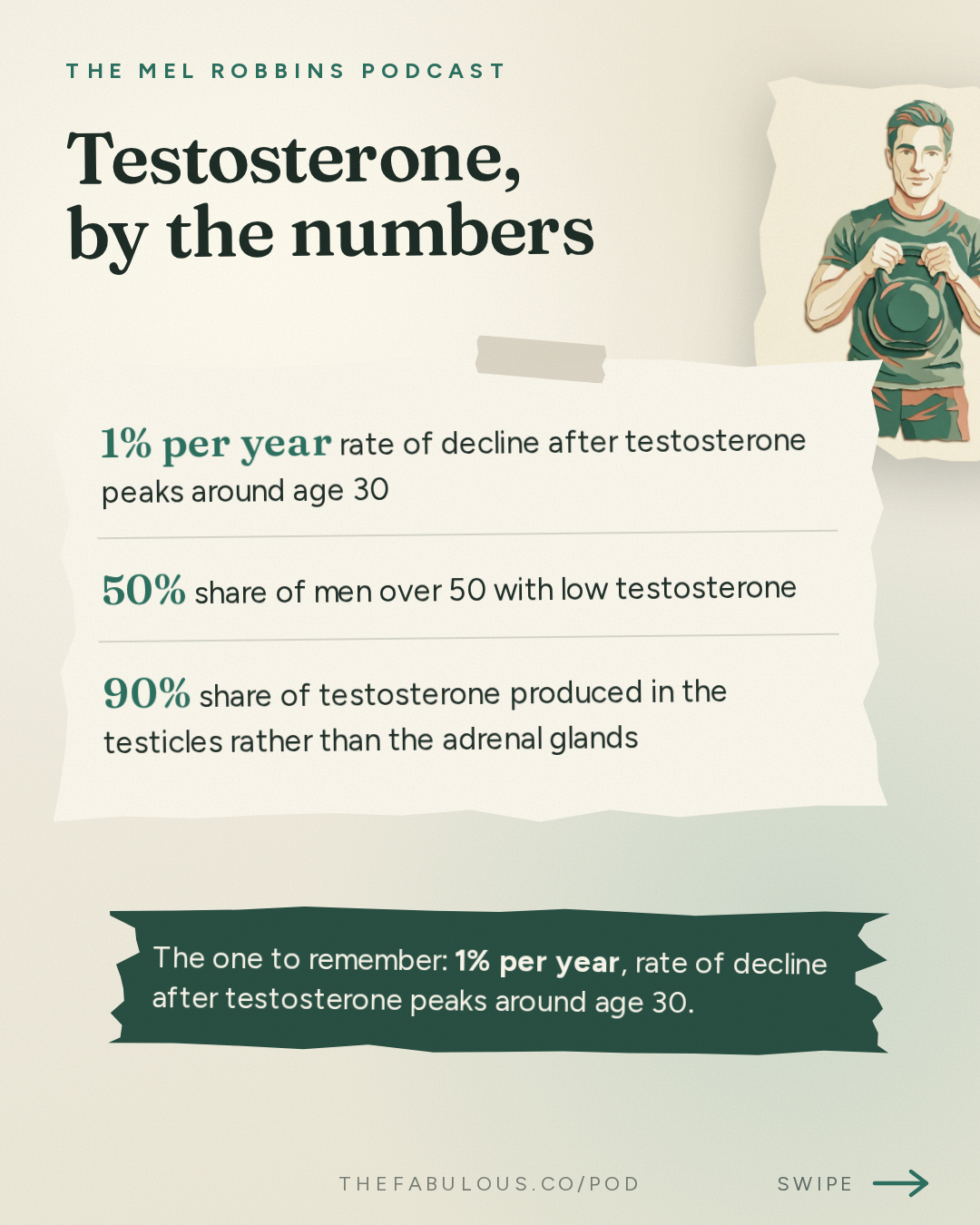
The anchor hormone is testosterone, and Eisenberg starts by resizing it. The normal range runs from roughly 300 to 390 nanograms per deciliter (08:11), which is wide enough that two healthy men can sit far apart on it. Levels rise through puberty, peak somewhere between ages 20 and 30, then drift down about 1 percent a year (09:00). The decline compounds quietly: about 10 to 20 percent of men in their 40s and 50s test low, climbing to 20 percent in the 60s, 30 percent in the 70s, and by the 80s, roughly half (09:28). That last figure, half of older men running low, is the one Eisenberg wants every man to sit with, because the symptoms it produces (low energy, low libido, poor mood, poor sleep, trouble concentrating) are so vague that most men blame something else: work, age, a bad week.
What Actually Moves the Needle
What struck me about this section of the conversation is how unglamorous the levers turn out to be. Poor sleep blunts the feedback loop between brain and testicle, flattening the normal rhythm of higher testosterone in the morning (18:07), which is why Eisenberg recommends seven to nine hours a night as a baseline for hormonal health (18:33). Excess body fat converts testosterone into estradiol, effectively pulling it out of circulation (19:33), so losing weight through diet and exercise, or through bariatric surgery or GLP-1 medication, reliably nudges levels back up (20:48). Chronic stress triggers cortisol, which tells the body to prioritize survival over everything Eisenberg calls "longevity mode" (21:31), testosterone production included. Heavy drinking blunts the same signaling chain (26:36). None of this is exotic. It is closer to a cardiovascular checklist than an endocrinology one, which is exactly Eisenberg's point when he says, "anything that's good for your heart is good for testosterone" (21:00).
That overlap matters because of what he says next, and it cuts against the current wave of testosterone-clinic marketing. Men with normal levels who go on testosterone anyway are not becoming better versions of themselves, he says; military trials testing testosterone as a performance enhancer found no edge in strength or recovery over placebo once baseline levels were already normal (38:35). What they do get is real risk: lower sperm counts (testosterone was literally tested by the World Health Organization as a male contraceptive, suppressing sperm production about 90 percent of the time, at 35:09), acne, hair loss, breast growth, and higher red blood cell counts that raise clotting risk (39:16). The upside case, for men who are actually deficient, got a major boost from the Traverse Trial, a study of about 5,000 men that found testosterone therapy did not raise the risk of prostate cancer or heart attacks, debunking two fears that had shaped prescribing guidance for years (37:15). The lesson Eisenberg keeps repeating is less a slogan than a filter: get tested, confirm it twice, and treat the number, not the mood.
Beyond the Bedroom
The second half of the conversation turns to erectile dysfunction, and the scale of it surprised even Mel Robbins. The Massachusetts Male Aging Study, run roughly 20 years ago, found that over half of men over 40 have some degree of erectile dysfunction, with prevalence climbing each decade: about 40 percent in the 40s, 50 percent in the 50s, 60 percent in the 60s, 70 percent in the 70s (42:56). Even men in their 20s and 30s show up at 15 to 20 percent (42:56). The mechanism is mostly plumbing: an erection is blood flowing into the penis and staying there, triggered by a chemical called cyclic GMP that dilates blood vessels. Anything that damages blood flow elsewhere, like smoking, diabetes, or high cholesterol, damages it here too (43:35).
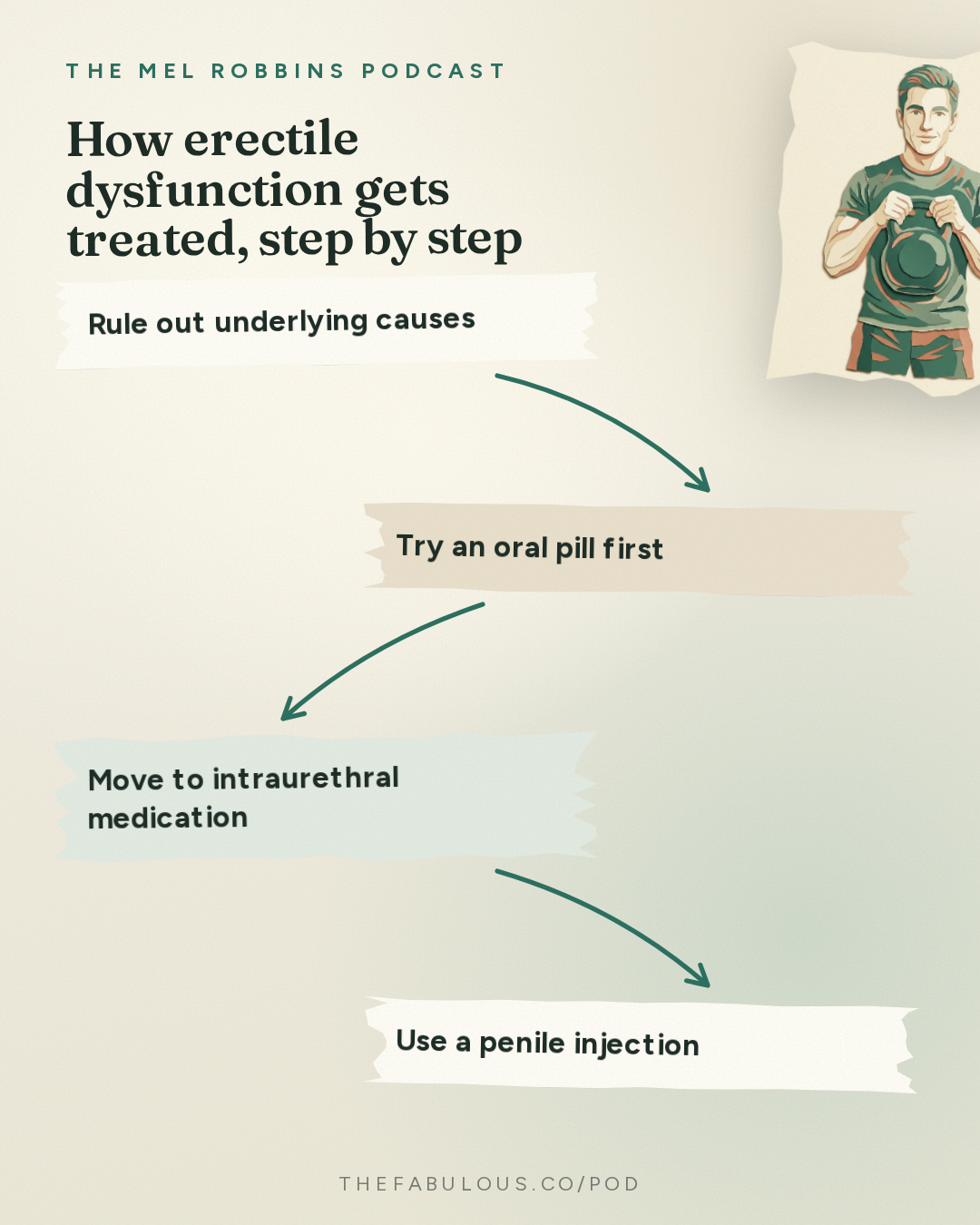
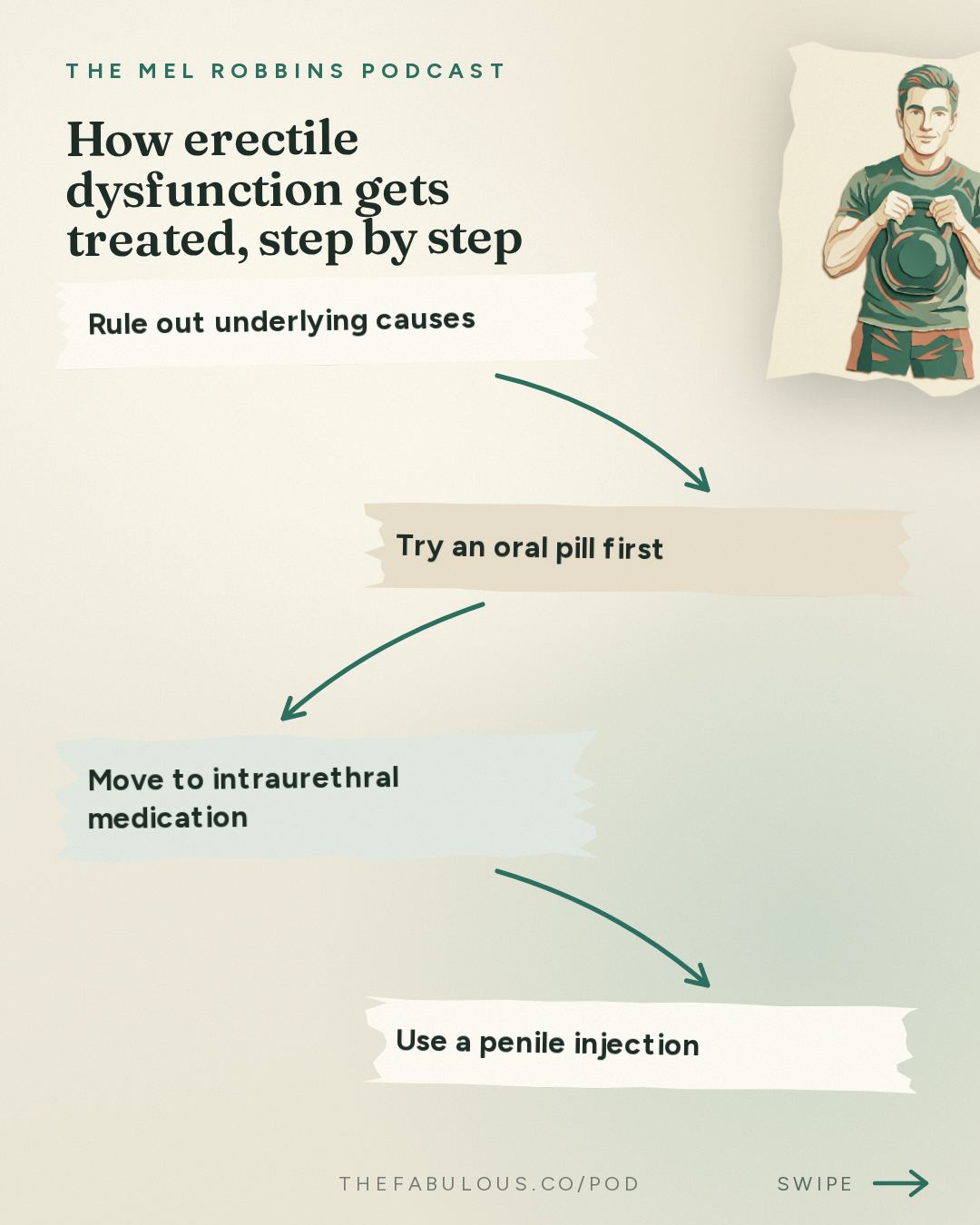
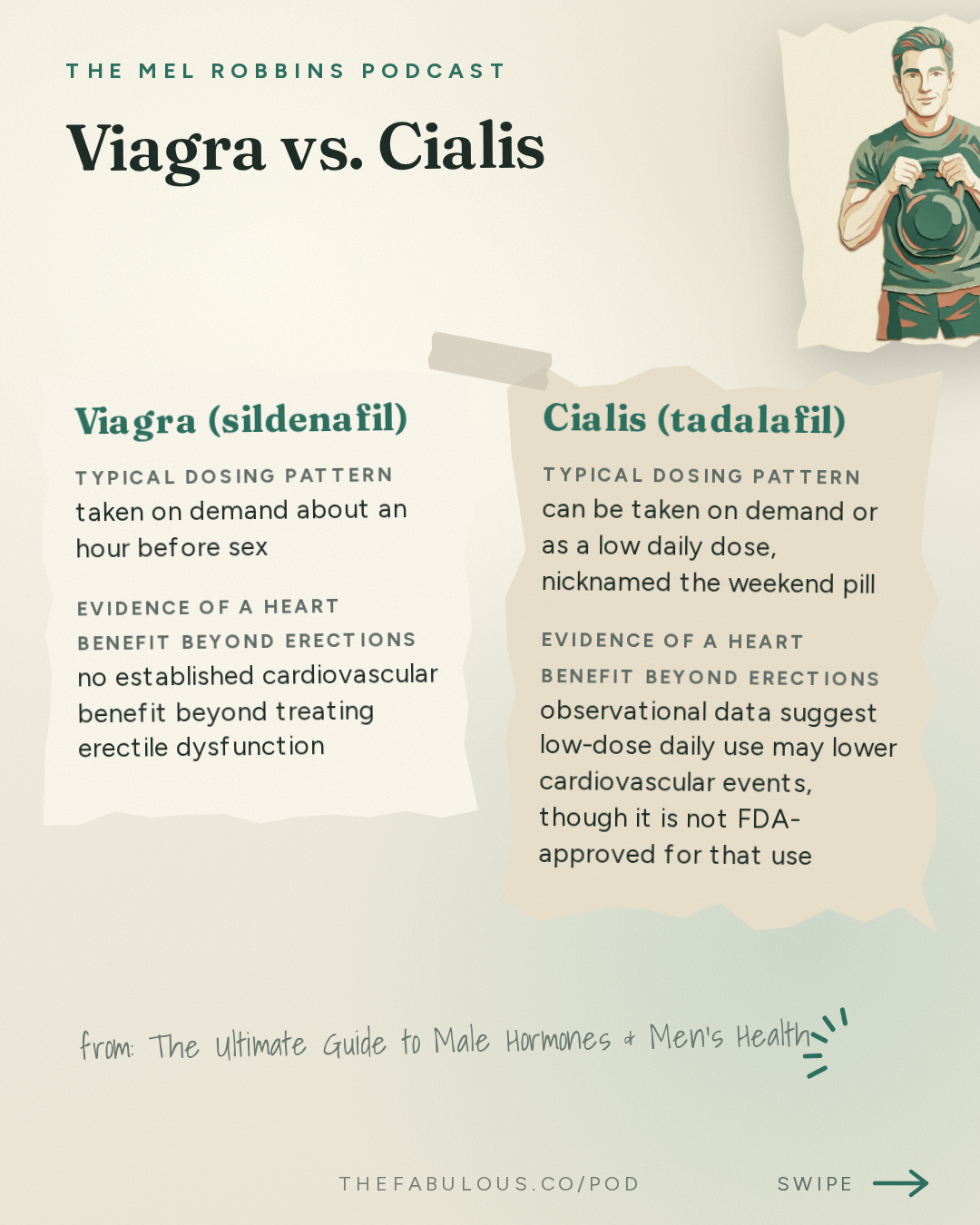
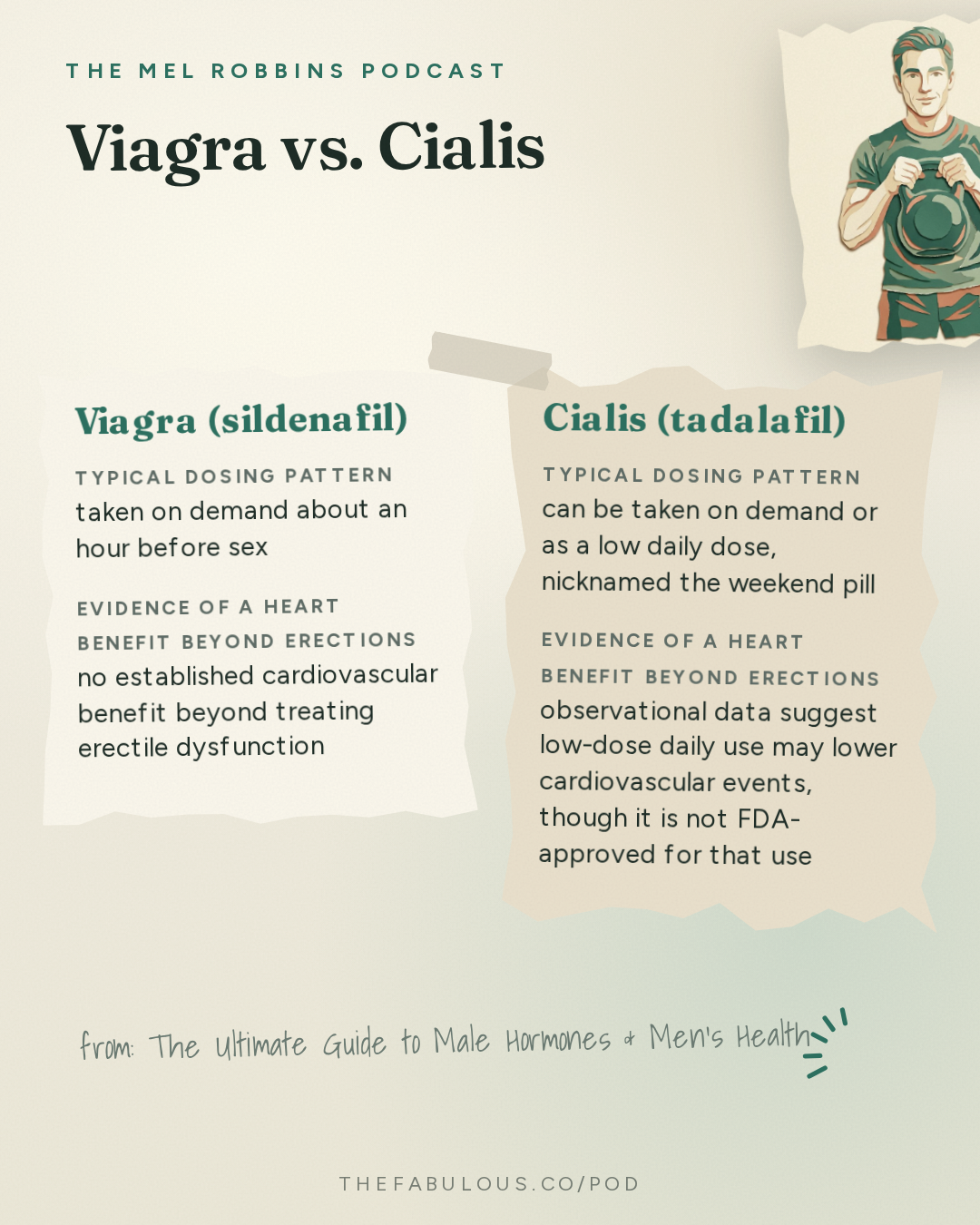
Treatment runs in a clear escalation. Pills like Viagra (sildenafil) and Cialis (tadalafil) work first, by blocking the breakdown of that same cyclic GMP (53:49). Cialis lasts far longer in the body, with a half-life of 16 to 18 hours versus Viagra's 6 to 8 (56:00), which is why it is marketed as the weekend pill and why some men take a low dose daily, with emerging observational data (not yet FDA-approved as an indication) suggesting it may be mildly protective for the heart (56:19). If pills fail, a gel or pellet placed in the urethra works 60 to 80 percent of the time (58:19). If that fails, a self-injected vasodilator works about 90 percent of the time (58:52). Eisenberg's bottom line, delivered almost as reassurance, is blunt: "as long as you have a penis, we can always make it hard" (47:32).
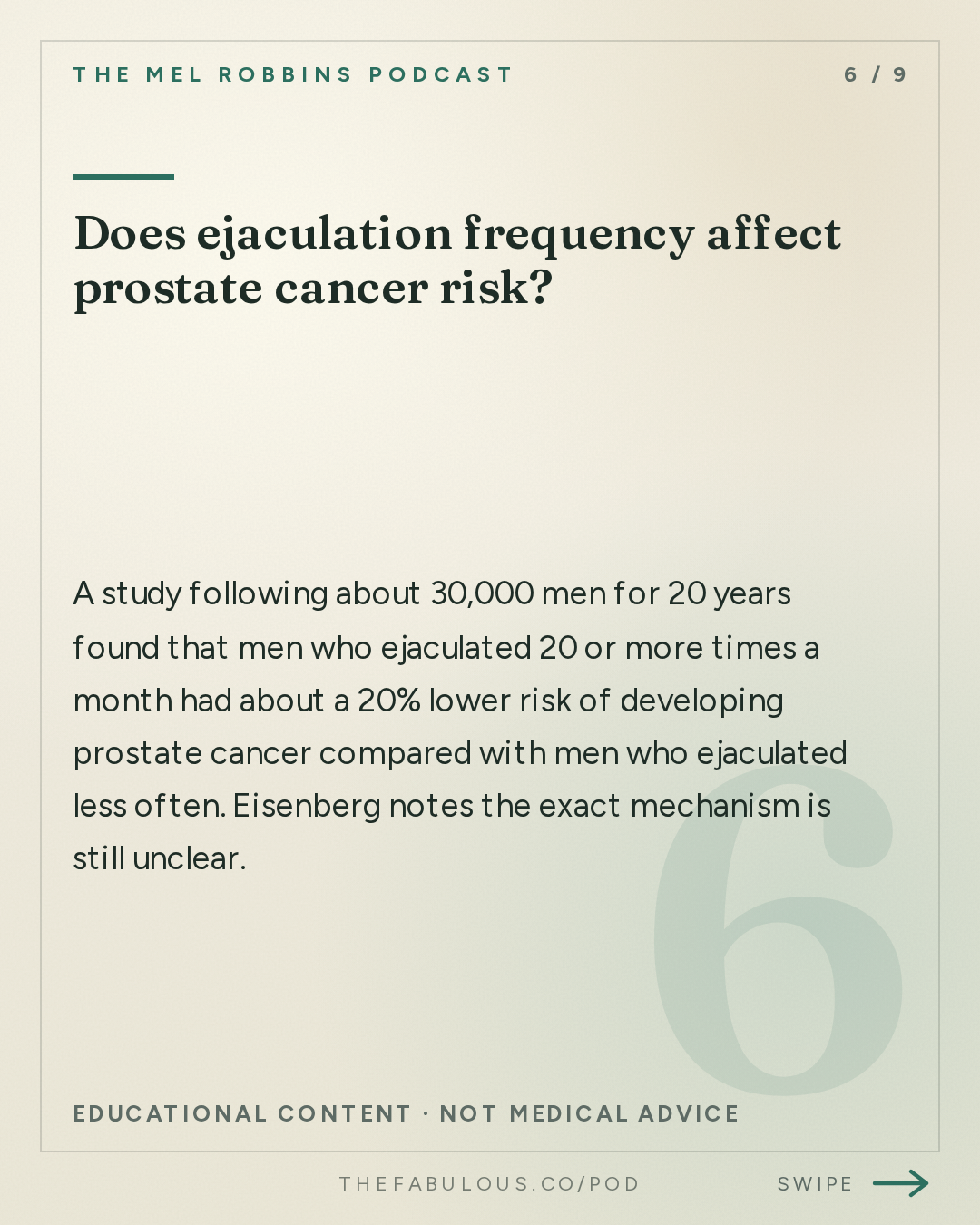
He treats sexual function less as a convenience and more as an instrument panel. Men who ejaculate 20 or more times a month show about a 20 percent lower risk of prostate cancer than men who ejaculate less, a pattern seen across a study of roughly 30,000 men followed for 20 years (61:58). Men who have sex once or twice a week tend to live longer than men who rarely do (63:01). And a set of Scandinavian birth-and-death registries found that men without a live-in partner face a 60 percent higher risk of death, men without children face the same 60 percent increase, and men with neither face nearly triple the risk (65:14). Fertility gets the same reframing: sperm counts are falling worldwide, and the rate of decline looks like it is accelerating over the last 20 years (66:43), while a male factor contributes to roughly half of all couples' fertility struggles, a fact that gets lost because, as Eisenberg notes, "usually everybody thinks that all fertility is related to female partner issues" (67:41). Even urination gets folded into the same logic: an enlarged prostate narrowing the urethra explains most nighttime trips to the bathroom, and waking once a night is normal aging, while three or four times is worth a doctor's visit (72:57).
By the end, the throughline is less about testosterone or erections specifically than about a habit of attention. Eisenberg's closing advice is almost anti-climactic: get a baseline blood pressure, cholesterol, and testosterone check, notice what changes, and treat small symptoms as information rather than embarrassment (74:57). The 1980 urologist walking the convention aisles was making an extreme version of the same argument: the fastest way to fix a problem men are ashamed to name is to stop treating the shame as data.
Ask this episode anything
Pod's AI answers from the episode itself, with the minute mark so you can hear it yourself.
Or start with one of these
Ask this episode
Pod's AI listens to the whole episode to answer, and points you to the minute it comes from.
The rest of this answer, and any question after it
Answers come from the episode itself, never from a summary of it.
ContinueKey takeaways
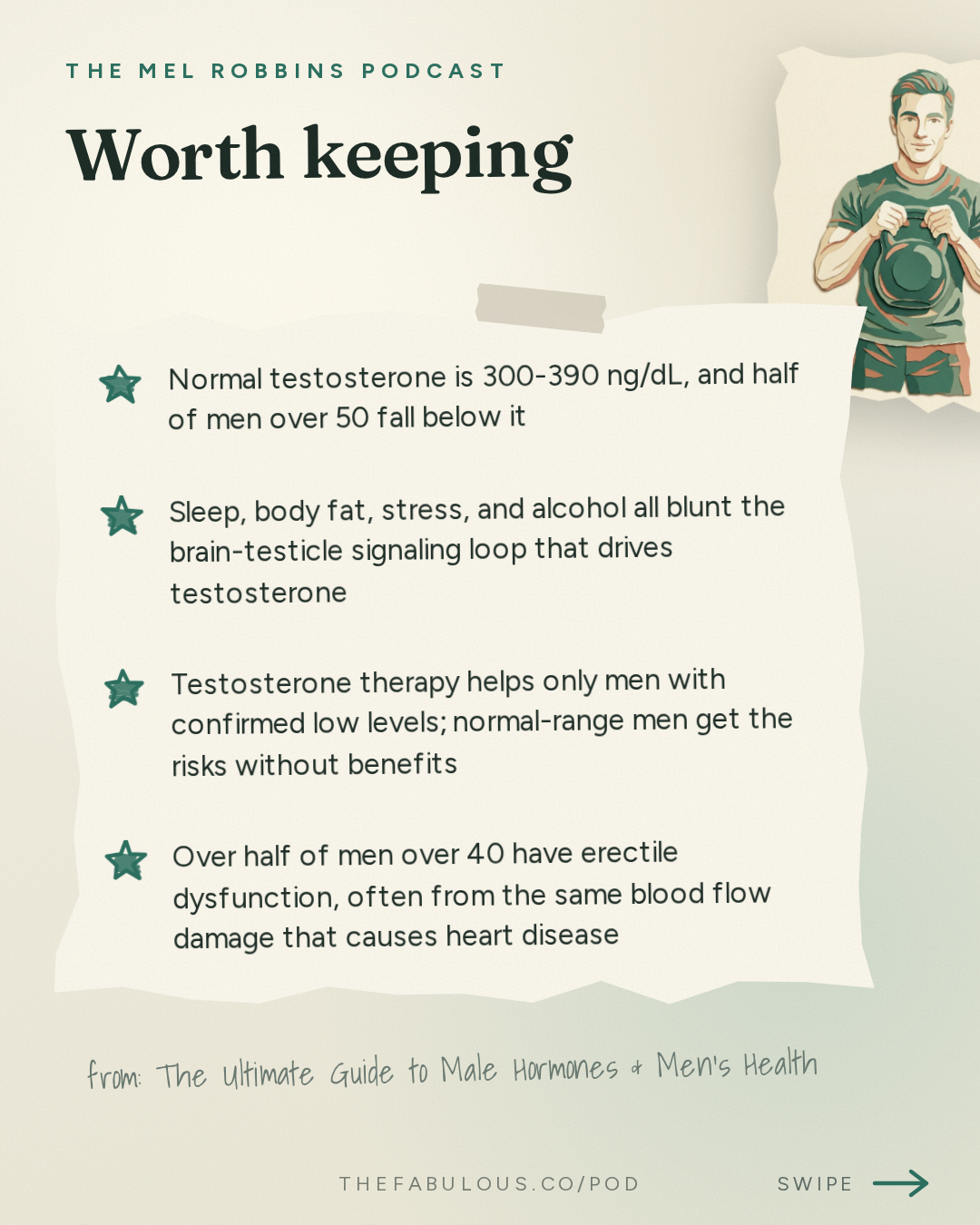
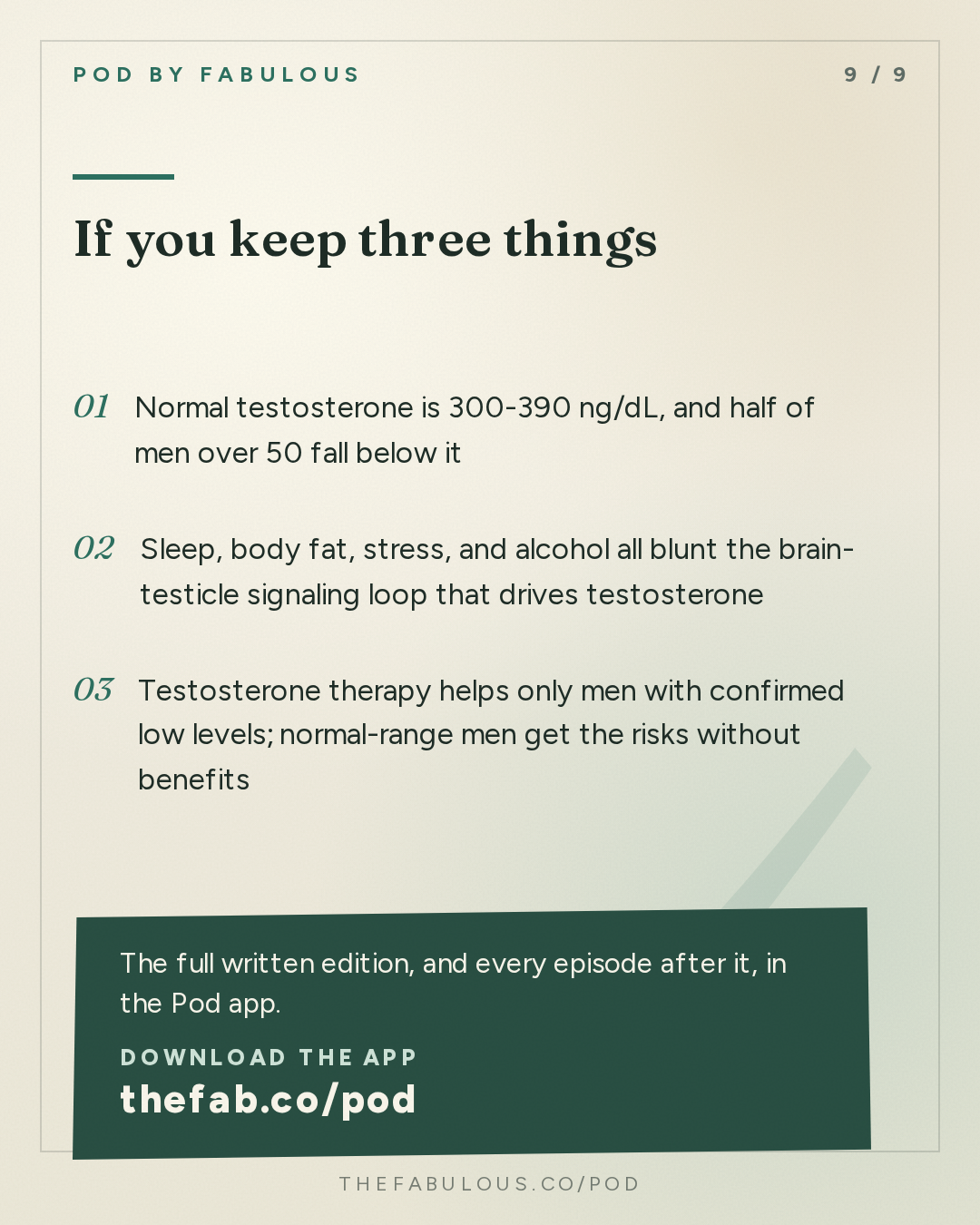
- Normal testosterone is 300-390 ng/dL, and half of men over 50 fall below it
- Sleep, body fat, stress, and alcohol all blunt the brain-testicle signaling loop that drives testosterone
- Testosterone therapy helps only men with confirmed low levels; normal-range men get the risks without benefits
- Over half of men over 40 have erectile dysfunction, often from the same blood flow damage that causes heart disease
- Sperm counts are falling worldwide and the decline is accelerating, and a male factor causes half of fertility problems
The episode in cards


By the numbers
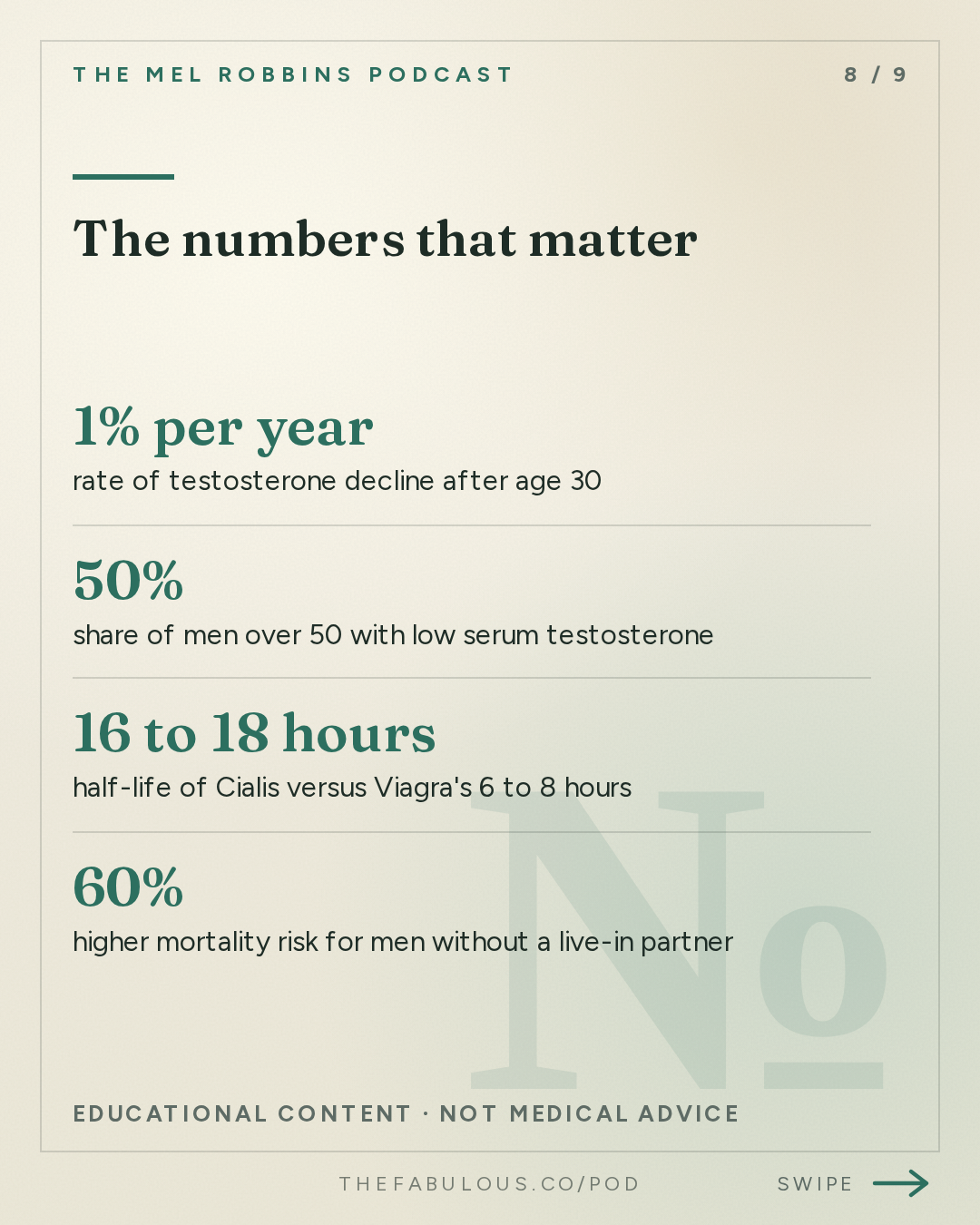
- 1% per year rate of testosterone decline after age 30
- 50% percent share of men over 50 with low serum testosterone
- 16 to 18 hours half-life of Cialis versus Viagra's 6 to 8 hours
- 60% percent higher mortality risk for men without a live-in partner
In their words
“Men's hormone health is a window into his future health.”
“Anything that's good for your heart is good for testosterone.”
“As long as you have a penis, we can always make it hard.”
“About half the time there's a male factor. But at a societal level, usually everybody thinks that all fertility is related to female partner issues.”
Protocols
-
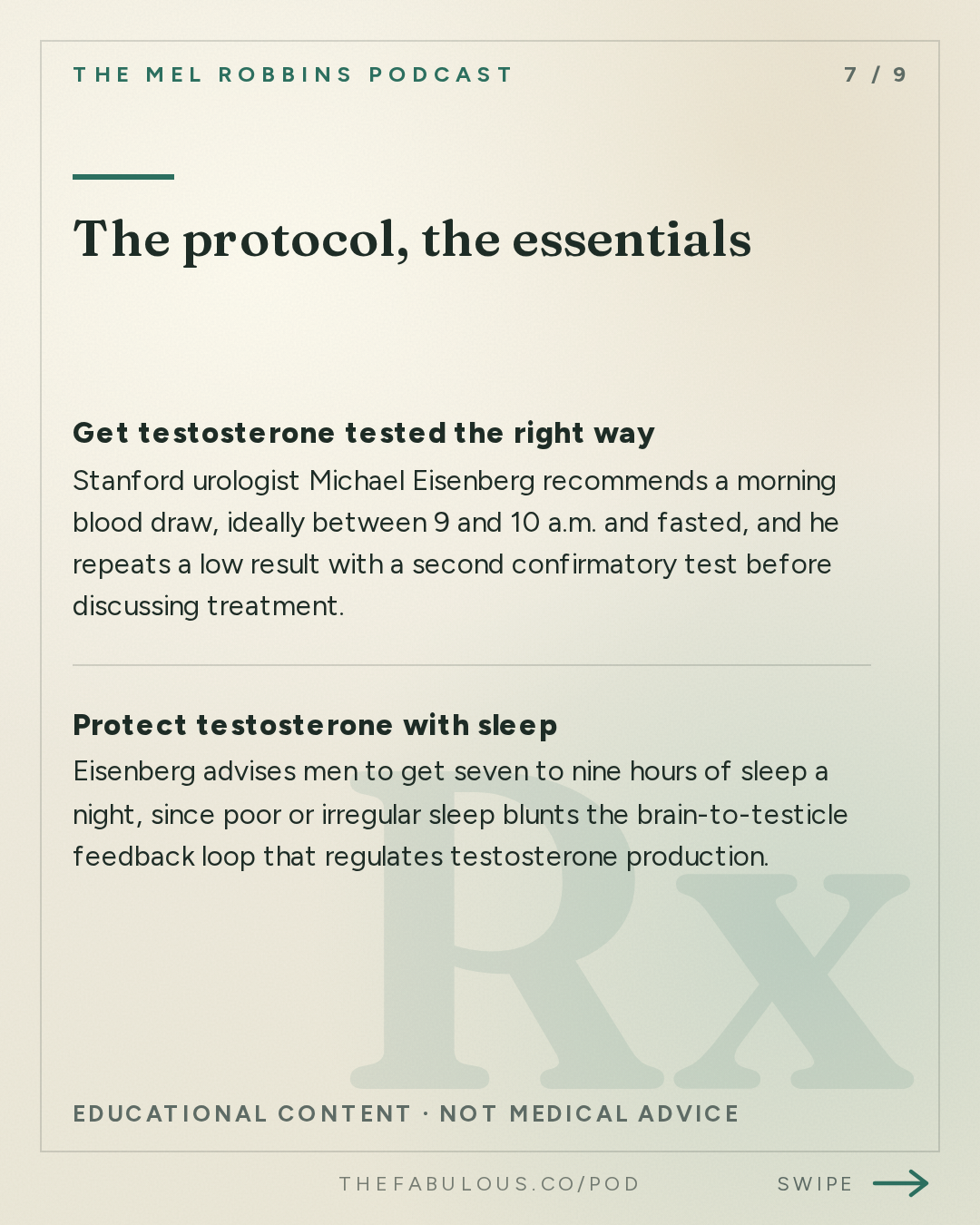
Get testosterone tested the right way
Stanford urologist Michael Eisenberg recommends a morning blood draw, ideally between 9 and 10 a.m. and fasted, and he repeats a low result with a second confirmatory test before discussing treatment.
once, then repeated if the first result is low
-
Protect testosterone with sleep
Eisenberg advises men to get seven to nine hours of sleep a night, since poor or irregular sleep blunts the brain-to-testicle feedback loop that regulates testosterone production.
nightly
-
Treat testosterone therapy as a trial, not a lifetime sentence
For men who still produce some of their own testosterone, Eisenberg starts treatment as a defined trial, checks blood levels to confirm a therapeutic range, and stops the therapy after six months to a year if the man reports no improvement in symptoms.
reassessed at 6 to 12 months
-
Screen the prostate on a schedule
Eisenberg recommends starting an annual or semiannual PSA blood test in your 50s to screen for prostate cancer, moving earlier if there is a strong family history.
annual or semiannual starting around age 50
Questions this episode answers
What is a normal testosterone level for men?
Stanford urologist Michael Eisenberg says the normal range runs roughly 300 to 390 nanograms per deciliter, and it varies a lot between individuals (08:11). Testosterone typically peaks between ages 20 and 30, then declines about 1% a year after that (09:00).
What are the symptoms of low testosterone?
Eisenberg lists low energy, low sex drive, poor mood, poor sleep, and poor concentration as the main signs, along with physical markers like low blood counts (anemia) and low bone mineral density (10:25). These symptoms are non-specific, so he recommends a blood test to confirm rather than guessing.
Does testosterone replacement therapy raise the risk of prostate cancer or heart attack?
The Traverse Trial, which followed about 5,000 men given testosterone or a placebo, found no increase in prostate cancer or cardiovascular events, debunking both long-standing fears (37:15). The finding is prompting the FDA to revisit old warning labels on testosterone products.
How common is erectile dysfunction?
The Massachusetts Male Aging Study found that over half of men over 40 report some degree of erectile dysfunction, with prevalence rising by roughly 10 percentage points each decade of life, and even 15 to 20% of men in their 20s and 30s affected (42:56).
Does ejaculation frequency affect prostate cancer risk?
A study following about 30,000 men for 20 years found that men who ejaculated 20 or more times a month had about a 20% lower risk of developing prostate cancer compared with men who ejaculated less often (61:58). Eisenberg notes the exact mechanism is still unclear.
Why are sperm counts declining around the world?
Global studies, updated most recently a few years ago, show sperm counts falling on every continent, with the rate of decline appearing to speed up over the last 20 years (66:43). Eisenberg says the cause is not fully understood, but the trend tracks alongside falling testosterone levels and changes in pubertal timing.
The full read, in cards
Go deeper
- Traverse Trial — followed about 5,000 men on testosterone or placebo and found no increased risk of prostate cancer or heart attack, debunking earlier warnings
- Massachusetts Male Aging Study — found over half of men over 40 have some degree of erectile dysfunction, rising with each decade of life
- Ejaculation frequency and prostate cancer study — followed about 30,000 men for 20 years and found men ejaculating 20 or more times a month had a 20% lower prostate cancer risk
- Swedish population birth and death registry study — found men without a partner or without children face 60% higher mortality risk, and nearly triple the risk with neither
Mentioned
Michael Eisenberg · Stanford University · American Urologic Association · Endocrine Society · Traverse Trial · Massachusetts Male Aging Study · Viagra · Cialis · International Azoospermia Center · World Health Organization
More from this show and category
Mel Robbins' Best Life Advice for Listeners
Mel Robbins turns a full episode of listener questions into concrete rules: move once, eat more protein and fiber, and wait 30 days after a breakup. She covers passion as energy, the 90-second rule for emotional flooding, and a heart-versus-head framework for career and relationship decisions.
John Grisham's Morning Writing Routine Explained
John Grisham credits two unplanned "golden moments" for redirecting his path, first toward law school, then toward writing A Time to Kill and The Firm. He built his career on writing one page a day at 5 a.m. for 30 years, absorbed 28 rejections, and then watched a bootleg manuscript trigger a $600,000 film deal and 52 straight bestsellers.
How to Stop Living Paycheck to Paycheck
Vivian Tu, a former JP Morgan trader known online as your rich BFF, argues that living paycheck to paycheck is a system problem, not a willpower problem. She lays out a pay-yourself-first savings rule, the avalanche method for debt, a formula for calculating financial independence, and why automating money beats relying on discipline.
Body Language Tricks for Instant Confidence
Behavioral researcher Vanessa Van Edwards explains how tiny, testable body-language and language cues (ear-to-shoulder distance, hand steeples, priming words) shift how confident and likable people perceive us, and how an A-B-C-D task audit stops burnout by clarifying which work and relationships actually deserve energy.
