
Vinh Giang's 9 Habits for Clearer Speaking
#1 Communication Expert: 9 Habits for Clearer Speaking (I Wish I Knew Sooner)
▶ Listen to the full episode More from The Mel Robbins Podcast
The brief
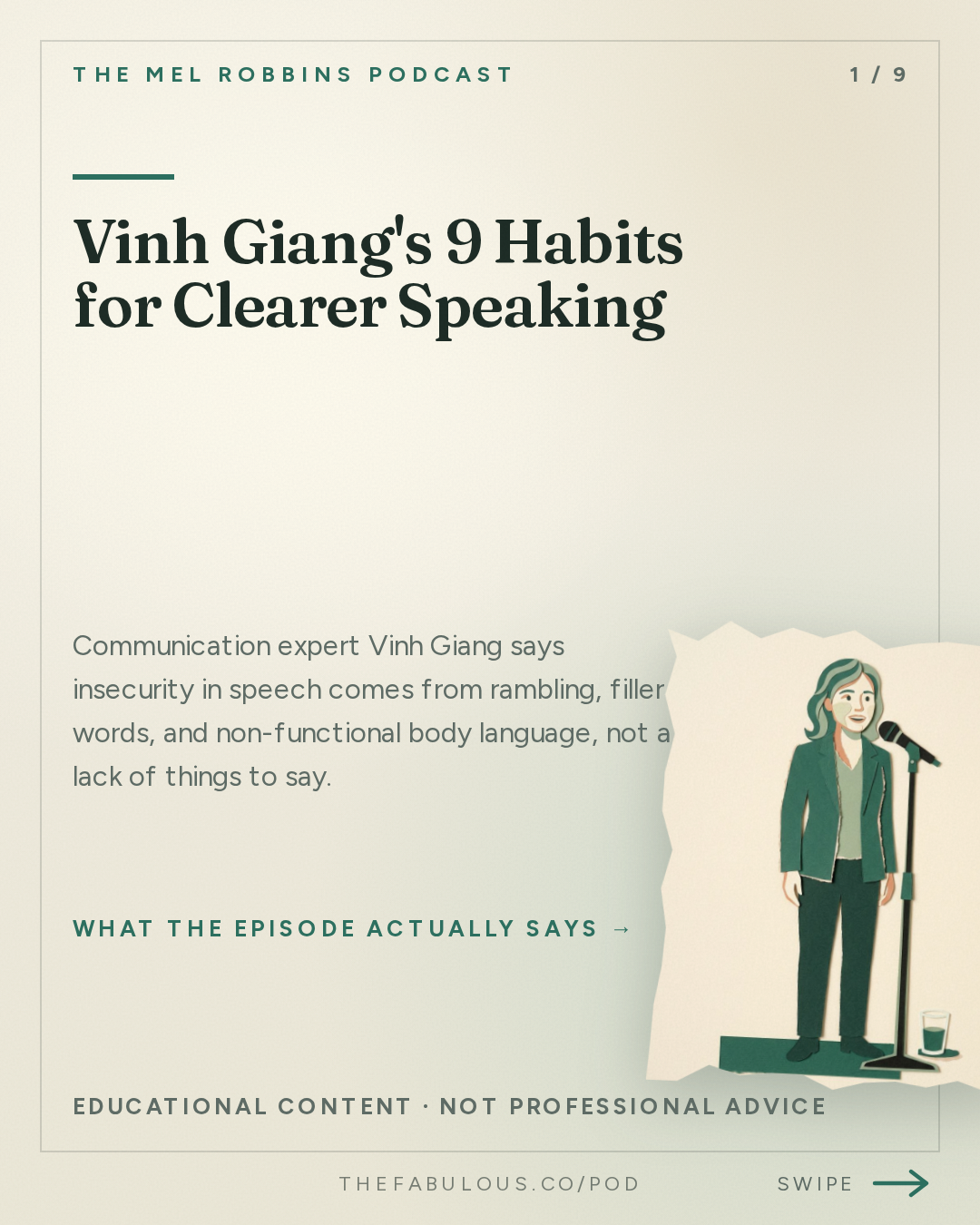
Communication expert Vinh Giang says insecurity in speech comes from rambling, filler words, and non-functional body language, not a lack of things to say. He teaches a 3-2-1 framework for structuring answers, a 3 to 5 second pause before tough questions, and control of posture, volume, and vocal melody so speakers sound, then feel, confident.
Vinh Giang spent his teenage years locked in a bedroom, perfecting card tricks. He told Mel Robbins that the better he got technically, the more invisible he became (12:05). The missing ingredient wasn't skill. It was what magicians call showmanship, which Giang defines simply as communication (12:32). That small correction, from a hobby most people treat as trivia, turns into the spine of the conversation: a technically brilliant person with poor communication skills gets perceived as poor at their job, no matter how good they actually are.
Giang, who learned English as a third language in his early teens after his family fled Vietnam, now teaches executives, athletes, and what he calls everyday people to speak with less friction and more weight (04:34, 14:23). His argument isn't about charisma as a fixed trait. It treats communication as a set of separable, mechanical habits involving pauses, hands, posture, and volume, each one noticeable and changeable on its own.
Start with what makes a speaker sound insecure in the first place. Giang lists it fast: rambling, speaking in circles, letting the voice rise at the end of a sentence, and what he calls non-functional body language and auditory clutter, meaning the ums and ahs people repeat without noticing (03:59). None of this requires actually being unsure. Even a confident person, doing these things, reads as less confident from the outside (04:22).
The fix for filler words doesn't start with willpower. It starts with awareness. Giang's own early mentor, David Griggs, used to sit across from him and clap every time he said um, really, or do you know what I mean (05:56). The clap wasn't punishment. It dragged a habit that had sunk from conscious to subconscious back into the light (06:17). Once a filler word is visible, the instruction is mechanical: replace it with a pause, not another word (05:38). Giang also recommends recording five minutes of talking, pulling the transcript, and running it through an AI tool with a blunt question: what words here add no value (08:51). Robbins tried this on her own podcast transcripts and found she had been saying actually and like far more than she realized (10:06).
Rambling, Giang says, comes from a different place: the belief that more words equal more value. A big part of the reason people do this is the assumption that more information makes them more valuable (10:51). The counter to that belief sits inside the episode's most practical tool.
A Frame for the Blank Mind
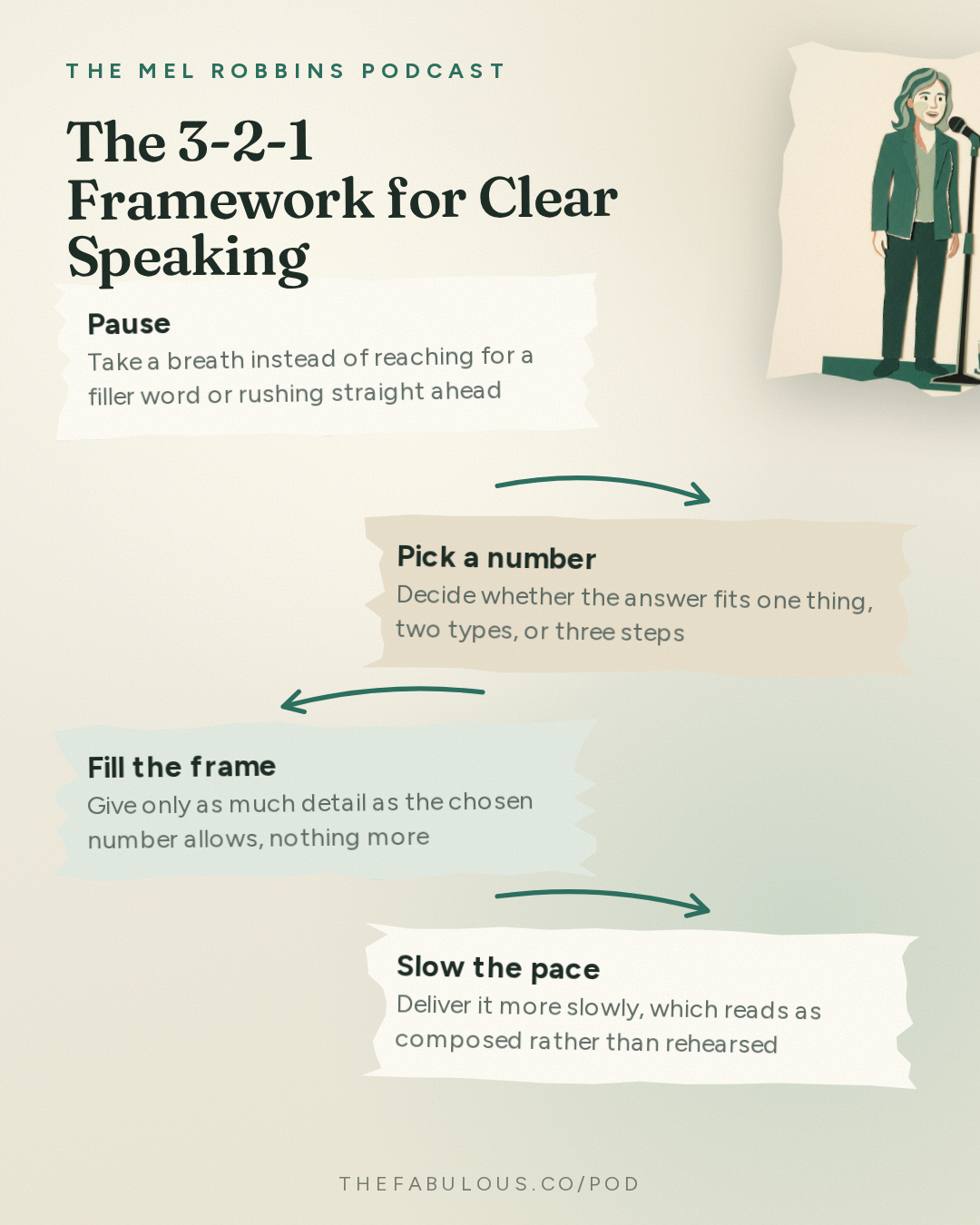
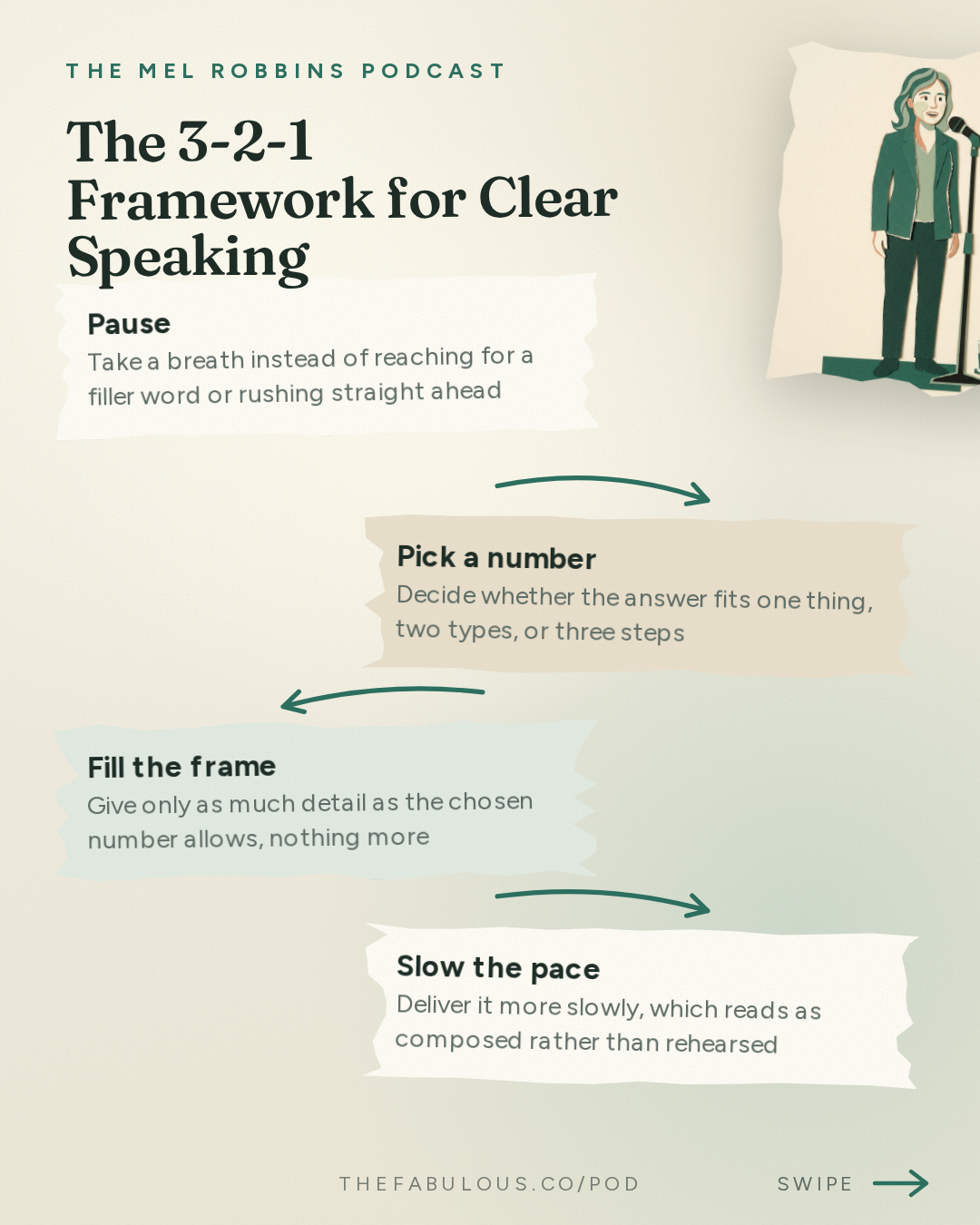
Giang calls it the 3-2-1 framework, and its appeal is its stinginess. Put on the spot, a speaker answers in three steps, two types, or one thing (31:46). Robbins demonstrates it live, cold, on the word travel: the one thing is that she travels too much, logging 156 nights a year in hotels, the two types are personal and professional, the three steps are plan for comfort, enjoy the silence, and make it personal (33:23, 33:43, 34:50). None of those answers were planned. What made them sound composed wasn't the content. It was the container.
The mechanism, Giang explains, is that constraint forces packaging. Without a numerical limit, a knowledgeable person free-associates every relevant fact, so a question about high performance sprawls into apps, sleep, nutrition, and random supplements, and the listener loses the thread (30:45). "Value doesn't just come in the form of word vomit. Clarity and conciseness and coherency, that is also a form of value," Giang says (31:18). The same logic explains why some people go blank instead of rambling: too many competing thoughts, no structure to pick one, and the result is a kind of analysis paralysis (37:16).
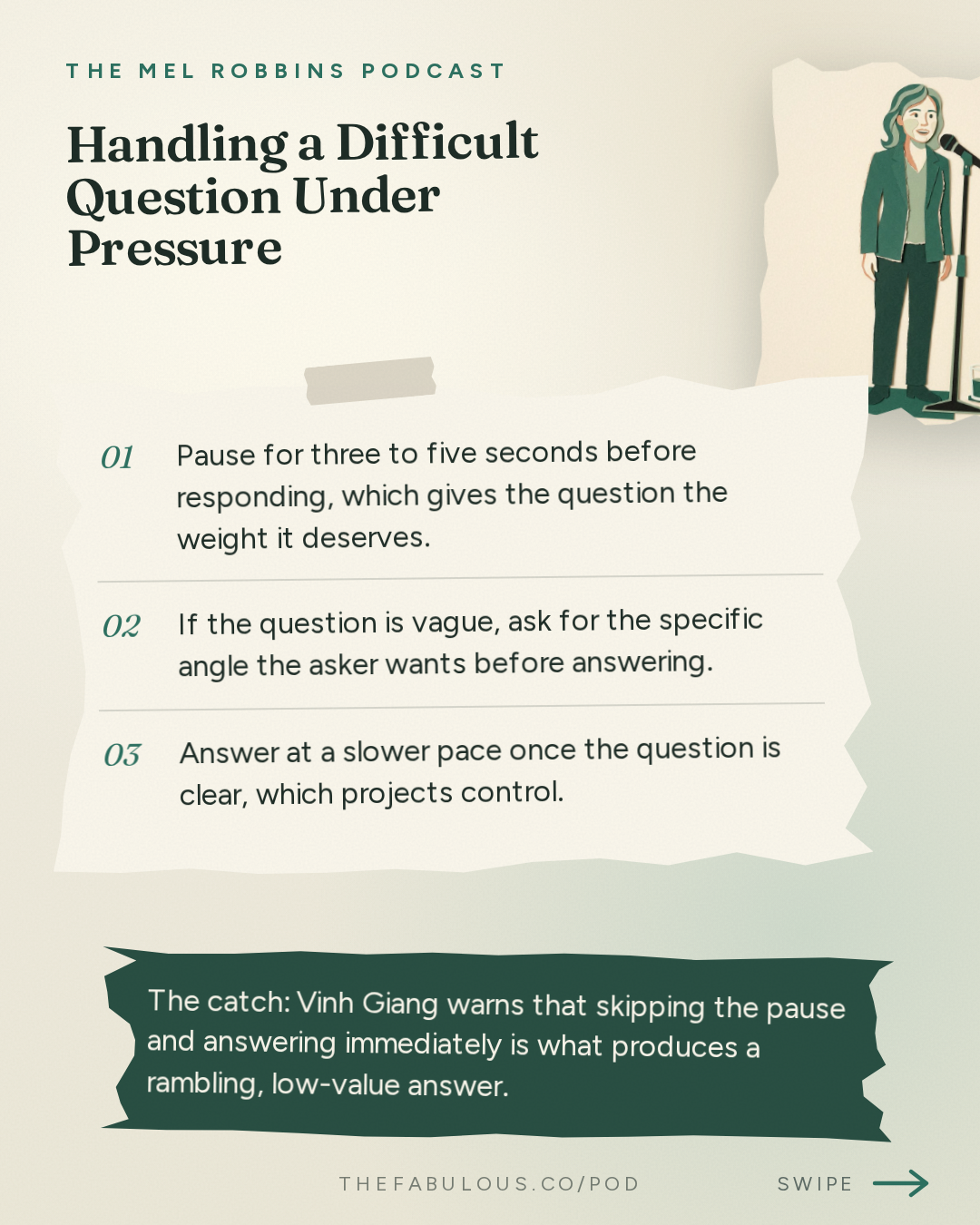
The same architecture applies to answering a hard question on the spot. Giang's sequence: pause for three to five seconds, which buys processing time and, counterintuitively, signals that the question deserves weight rather than evasion (43:26). If the question was genuinely unclear, ask for the specific angle before answering at all, since a vague question produces a vague, rambling answer by default (44:17). Then answer slowly. The deliberate pace, paired with the earlier pause, is what reads as control rather than panic.
The Body Doesn't Lie
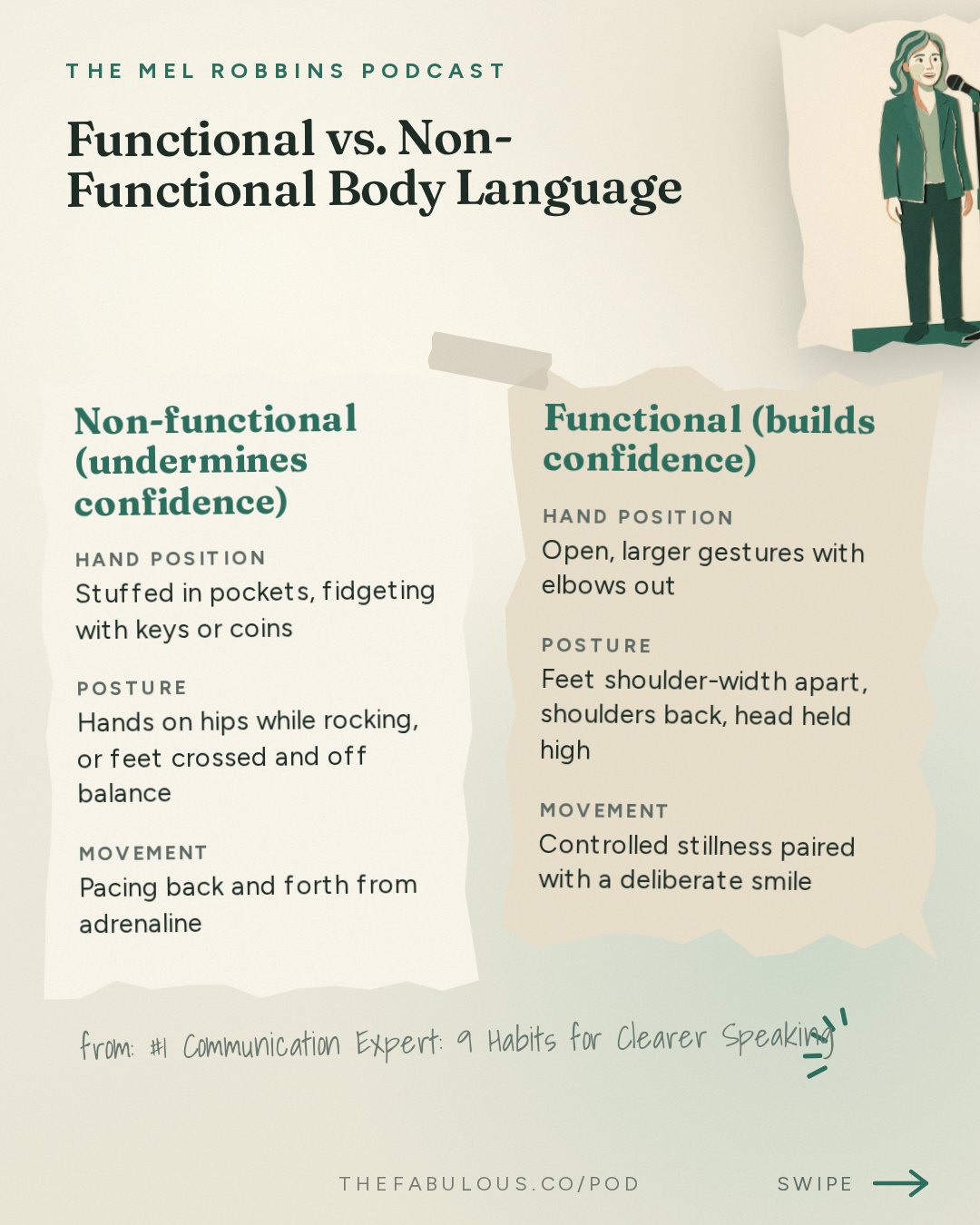
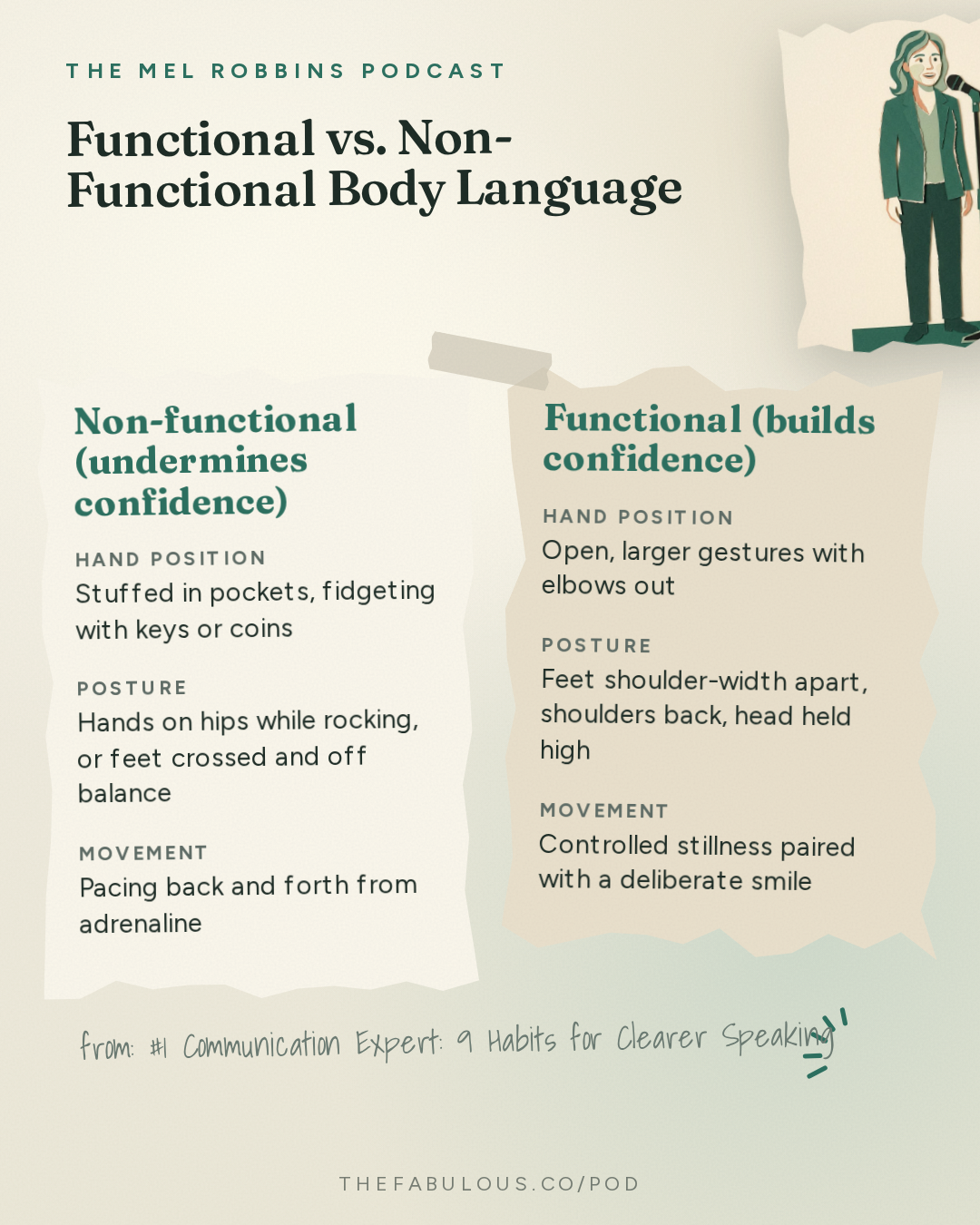
Giang's second claim is less about words than about what the body does while the words come out. He calls certain gestures non-functional, meaning they add nothing to the message: hands shoved in pockets and fidgeting with keys, hands on the hips that turn into rocking, prayer-position hands that become nervous rubbing, hands clasped behind the back paired with rocking, pacing without purpose (46:48, 47:09, 47:46, 48:04, 48:22). Mel Robbins admits her own first TEDx talk, 14 years earlier, was a 21-minute-long panic attack of pacing (49:05).
The reason this matters, in his framing, is a three-part chain: look, feel, sound. How a person looks affects how they feel, and how they feel leaks into how they sound (47:58). The fix isn't to chase the feeling directly, since feelings are the hardest variable to control. It is to control the two things upstream and downstream of it, posture and voice. Concretely: feet shoulder-width apart, shoulders down and back, head held high, larger gestures with elbows out, and a deliberate smile, since Giang says he didn't realize he had a resting blank face that read as displeasure even when he felt fine (51:35, 54:08).
Hand position does something specific to the voice, and Giang demonstrates it on the spot. He names two gestures borrowed from family therapist Virginia Satir: placator, palms open and facing up, which reads as inviting but lacks authority, and leveler, palms facing down, which reads as assertive (52:46). He has Robbins say the same line, Yolo, leave it, first with palms up and then with palms down. Her own voice changes without her trying to change it. Your body communicated to your voice, Giang tells her (53:22, 53:41). The same logic applies to volume: raising volume without also raising vocal melody, the rise and fall of pitch across a sentence, doesn't read as confident. It reads as angry (55:20).
"Every time you open your mouth, you are composing. When you speak, you are singing, because the melody that you use in your voice, there's an undercurrent for what it means." Vinh Giang, [56:56]
A shaking voice gets the same treatment, not a mystery but a mechanism. The voice shakes because the body shakes, and the body shakes because of excess adrenaline from a fight-or-flight response (50:04). Giang's prescription is physical, not psychological: 20 star jumps, what Americans call jumping jacks, push-ups, or a brisk walk, done right before speaking, to burn off the adrenaline before it reaches the vocal cords (50:23).
None of this would carry the same weight without the story underneath it. Giang's parents escaped Vietnam by boat: a wrecked first attempt, a crossing timed to the stormiest night, when the Viet Cong didn't patrol, a run past pirates after his father shaved the family's heads and carved rifles out of wood to pose as armed men, and a rescue by an oil-rig captain who could not speak their language and instead drew hearts and peace signs until the message landed (18:23, 20:56, 22:09). The family spent two years on the refugee island of Pulau Bidong before resettling in Australia (22:36). Giang has the entire sequence tattooed on his arm.
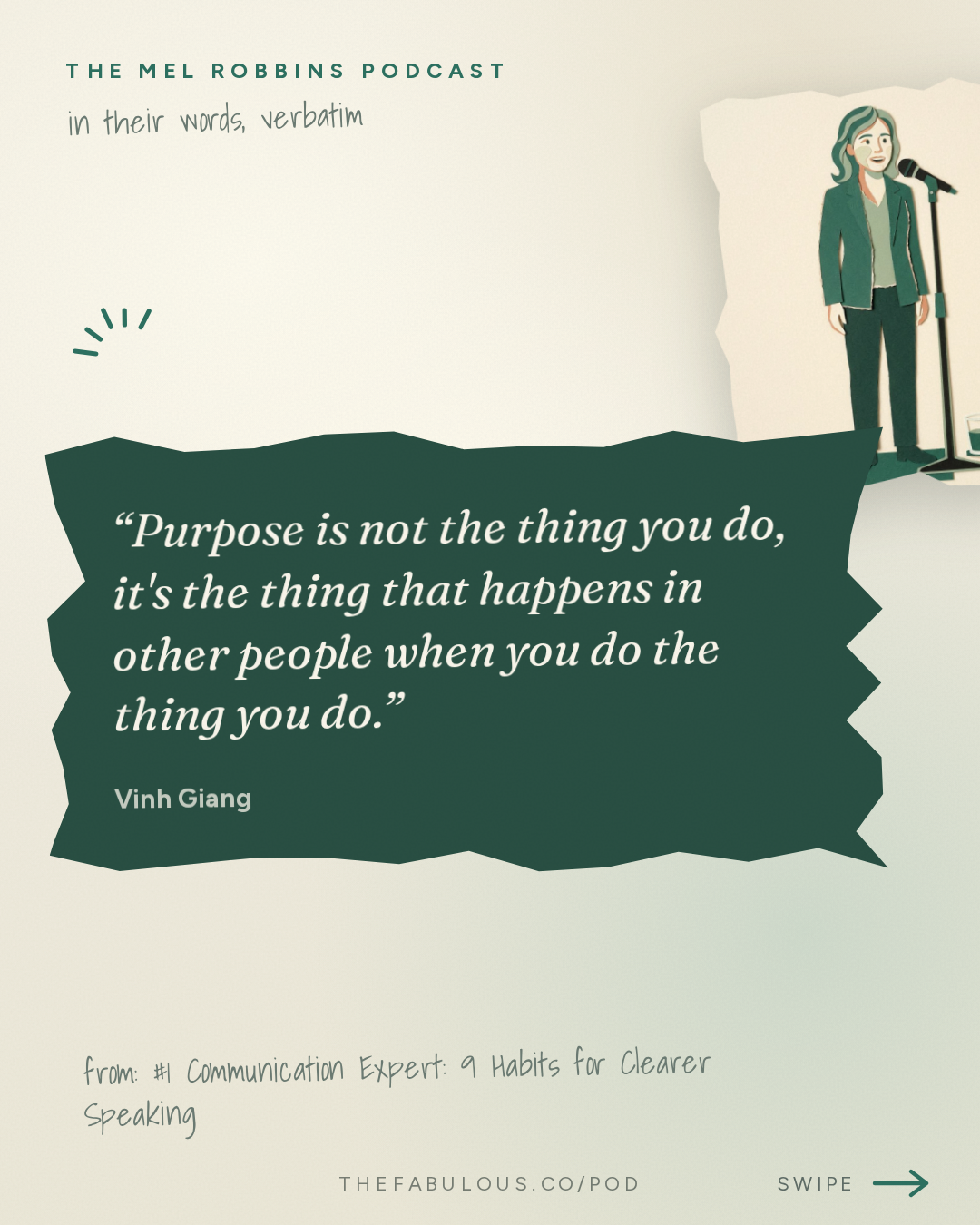
"Purpose is not the thing you do, it's the thing that happens in other people when you do the thing you do." Vinh Giang, [24:53]
That story reframes everything around it. The habits, the pause instead of the um, the 3-2-1 structure, the palm-down gesture, aren't tricks for sounding impressive. They are, in Giang's account, the same tool that got a frightened family off a sinking boat: a way of making sure what's inside a person actually reaches the person in front of them. You are only as good as you can communicate, Giang says, and as communication skills improve, a person becomes able to show the world the gifts and talents already inside them (13:17). Skill without transmission is invisible. The habits are just the plumbing.
What makes the episode useful rather than merely inspiring is that almost every claim resolves into something testable within a minute: pause three seconds before answering, try a sentence with palms up and then palms down, do the jumping jacks before the next hard conversation. Giang's closing argument is that people avoid the exercise for an unglamorous reason: they convince themselves the problem is complicated. The answers to many questions in life tend to be rather simple, he says, but people love to overcomplicate things so they can use the complexity as an excuse (58:29). The evidence, in this case, is a man who learned English in his teens and now gets flown across oceans to teach the mechanics of his own recovery.
Ask this episode anything
Pod's AI answers from the episode itself, with the minute mark so you can hear it yourself.
Or start with one of these
Ask this episode
Pod's AI listens to the whole episode to answer, and points you to the minute it comes from.
The rest of this answer, and any question after it
Answers come from the episode itself, never from a summary of it.
ContinueKey takeaways
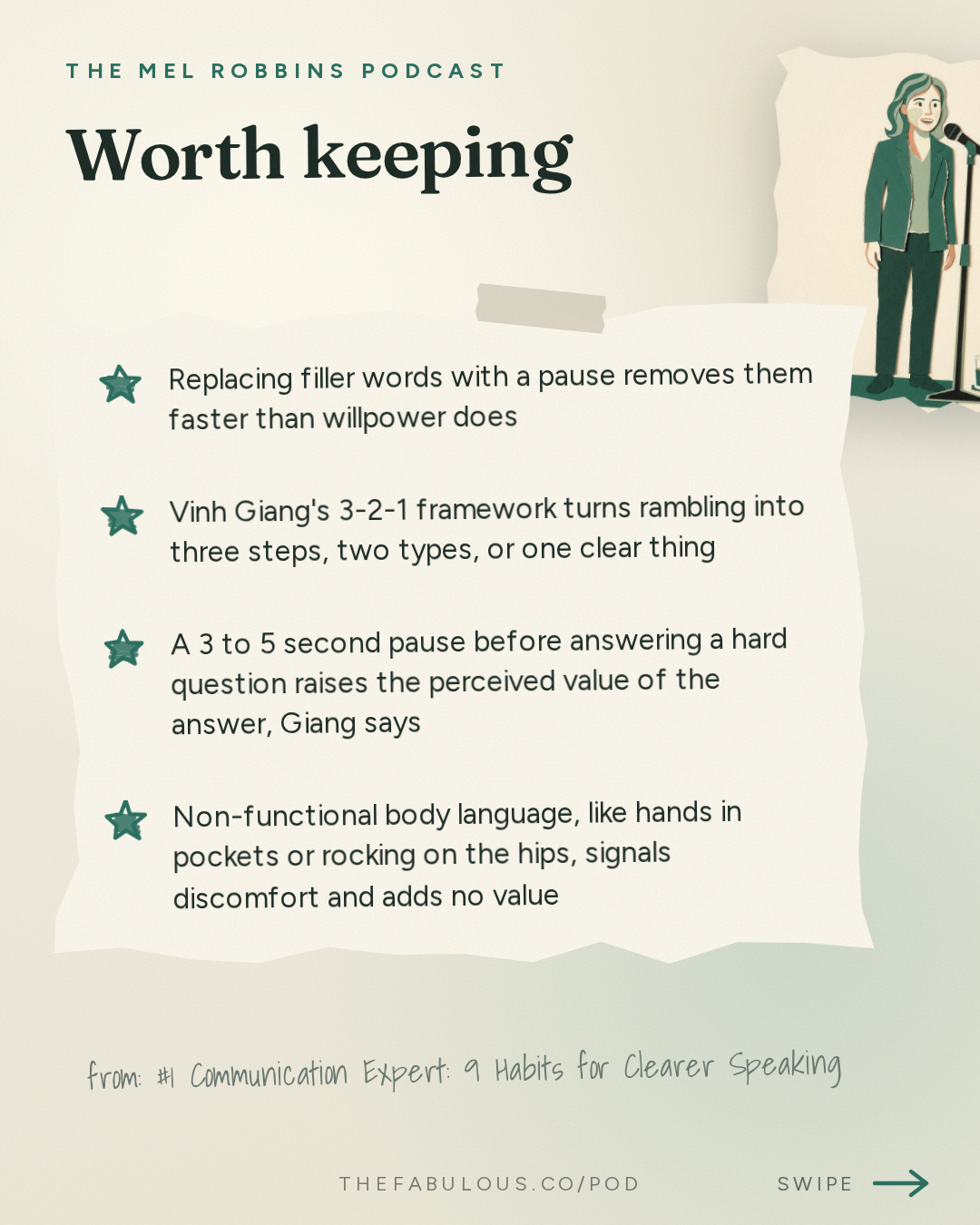
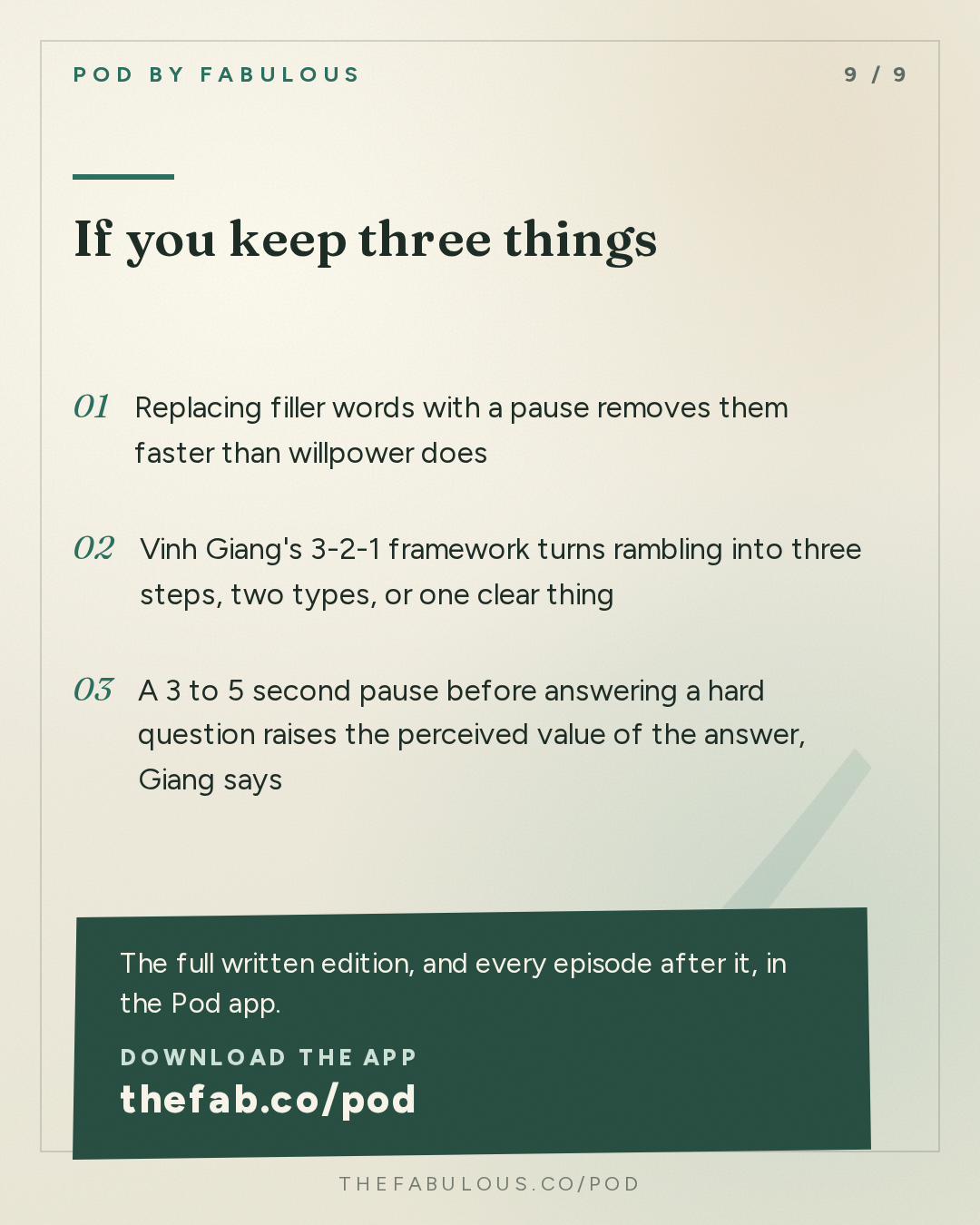
- Replacing filler words with a pause removes them faster than willpower does
- Vinh Giang's 3-2-1 framework turns rambling into three steps, two types, or one clear thing
- A 3 to 5 second pause before answering a hard question raises the perceived value of the answer, Giang says
- Non-functional body language, like hands in pockets or rocking on the hips, signals discomfort and adds no value
- Doing 20 jumping jacks before speaking can drain the adrenaline that makes a voice shake, Giang says
The episode in cards
By the numbers
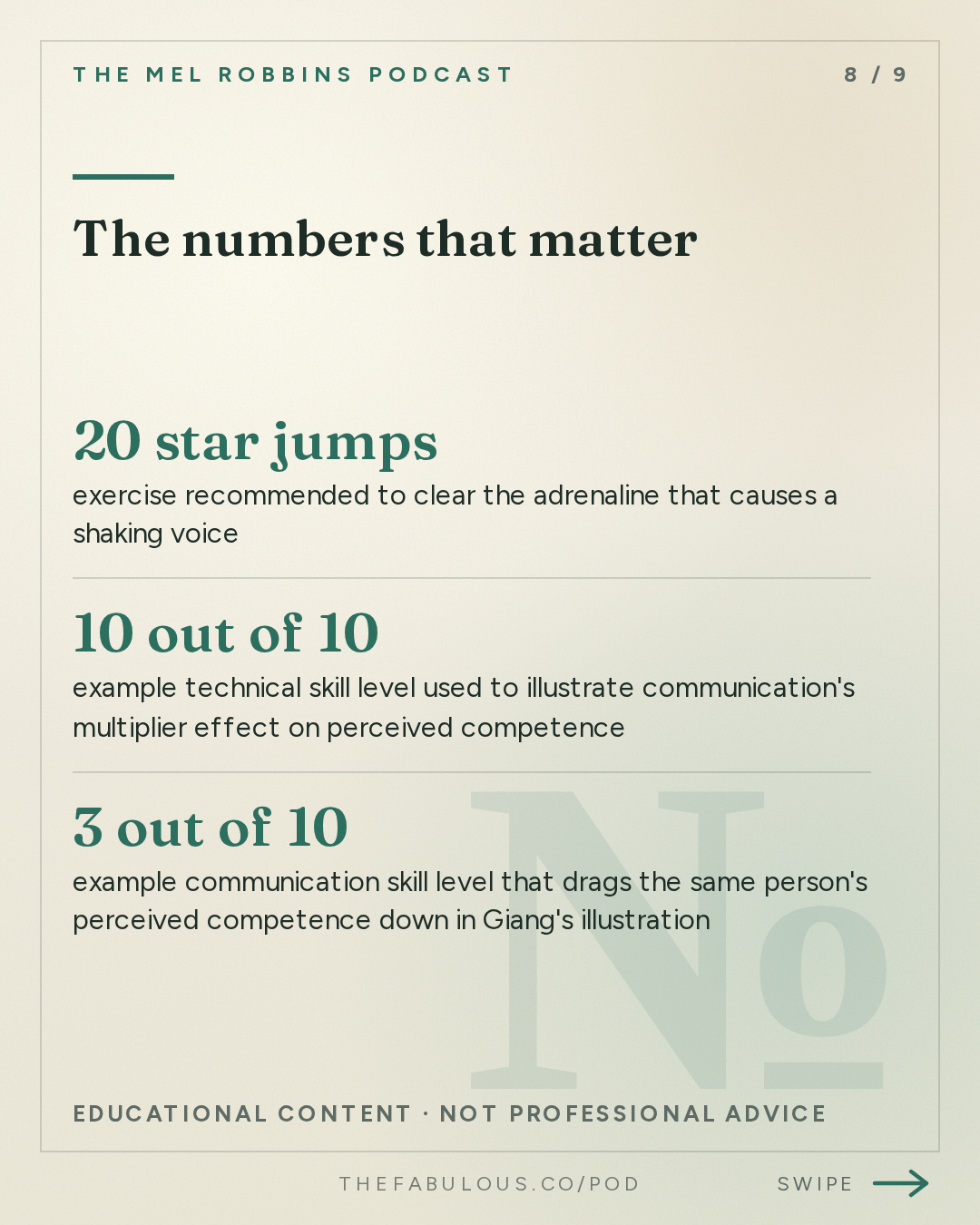
- 20 star jumps exercise recommended to clear the adrenaline that causes a shaking voice
- 10 out of 10 example technical skill level used to illustrate communication's multiplier effect on perceived competence
- 3 out of 10 example communication skill level that drags the same person's perceived competence down in Giang's illustration
In their words
“You are only as good as you can communicate, and as you level up your communication skills, you're now able to show the world all the gifts and talents that you have inside.”
“Purpose is not the thing you do, it's the thing that happens in other people when you do the thing you do.”
“Value doesn't just come in the form of word vomit. Clarity and conciseness and coherency, that is also a form of value”
Protocols
-
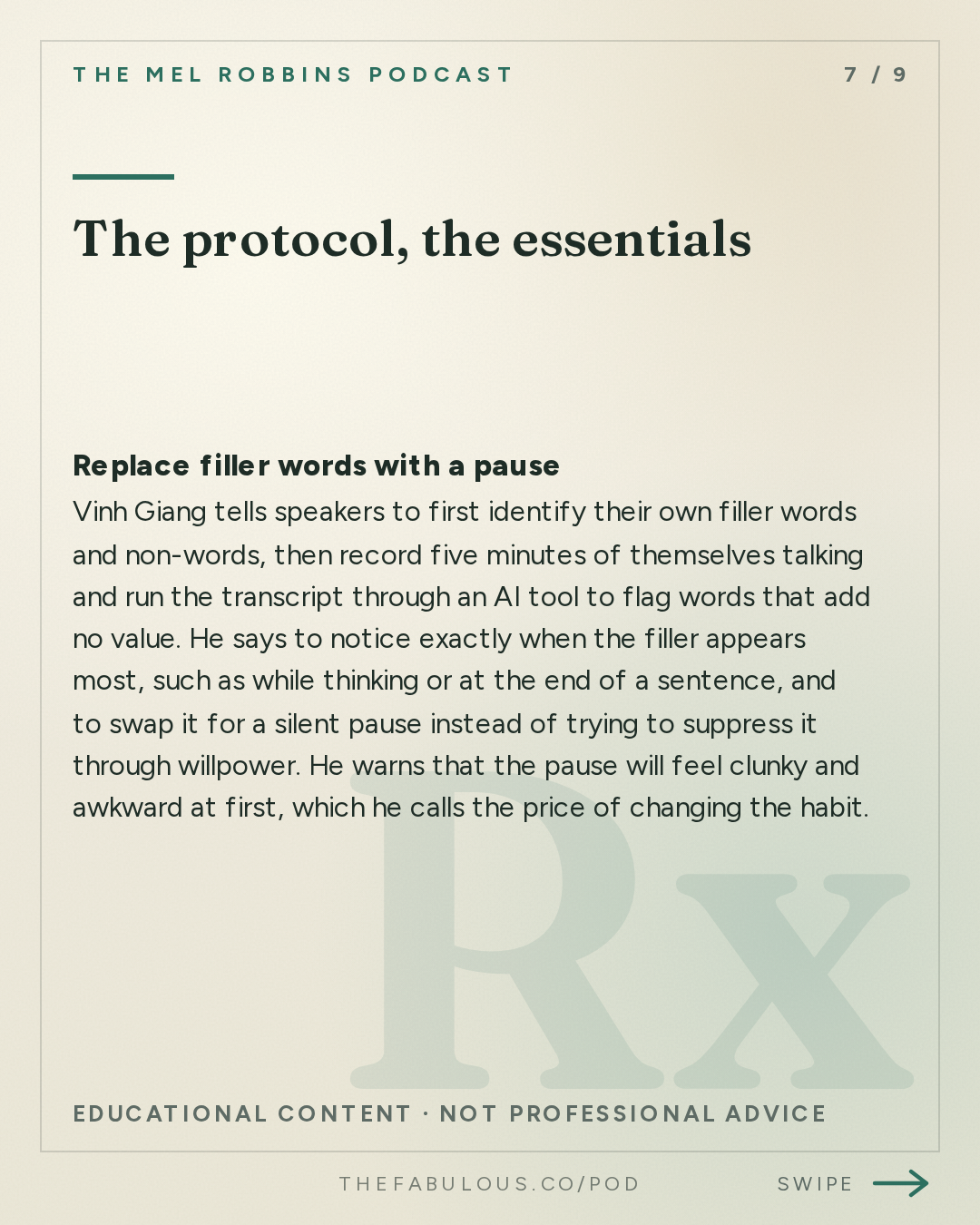
Replace filler words with a pause
Vinh Giang tells speakers to first identify their own filler words and non-words, then record five minutes of themselves talking and run the transcript through an AI tool to flag words that add no value. He says to notice exactly when the filler appears most, such as while thinking or at the end of a sentence, and to swap it for a silent pause instead of trying to suppress it through willpower. He warns that the pause will feel clunky and awkward at first, which he calls the price of changing the habit.
Repeat whenever a filler word surfaces, until the pause replaces it automatically
-
Pause before answering a hard question
Vinh Giang advises pausing for three to five seconds before answering a difficult question, since the extra time signals that the question deserves thought rather than evasion. He says to ask for the specific angle the question is aimed at if it feels unclear, before attempting an answer. He recommends answering at a slower pace once the question is clear, which reads as composed rather than rehearsed.
Every time a tough or unexpected question comes up
-
Burn off adrenaline before speaking
Vinh Giang recommends doing 20 star jumps, known as jumping jacks outside Australia, push-ups, or a brisk walk right before a high-stakes talk. He says a shaking voice is caused by a shaking body, and a shaking body is caused by excess adrenaline from the fight-or-flight response, so clearing the adrenaline physically removes the shake at its source.
Right before any talk or conversation that triggers nerves
-
Use the 3-2-1 framework when put on the spot
Vinh Giang advises structuring an impromptu answer around one thing, two types, or three steps rather than voicing every related thought. He says the constraint forces information into a clear package and prevents both rambling and the blank-mind freeze that comes from too many competing thoughts.
Any time a question arrives without warning
Questions this episode answers
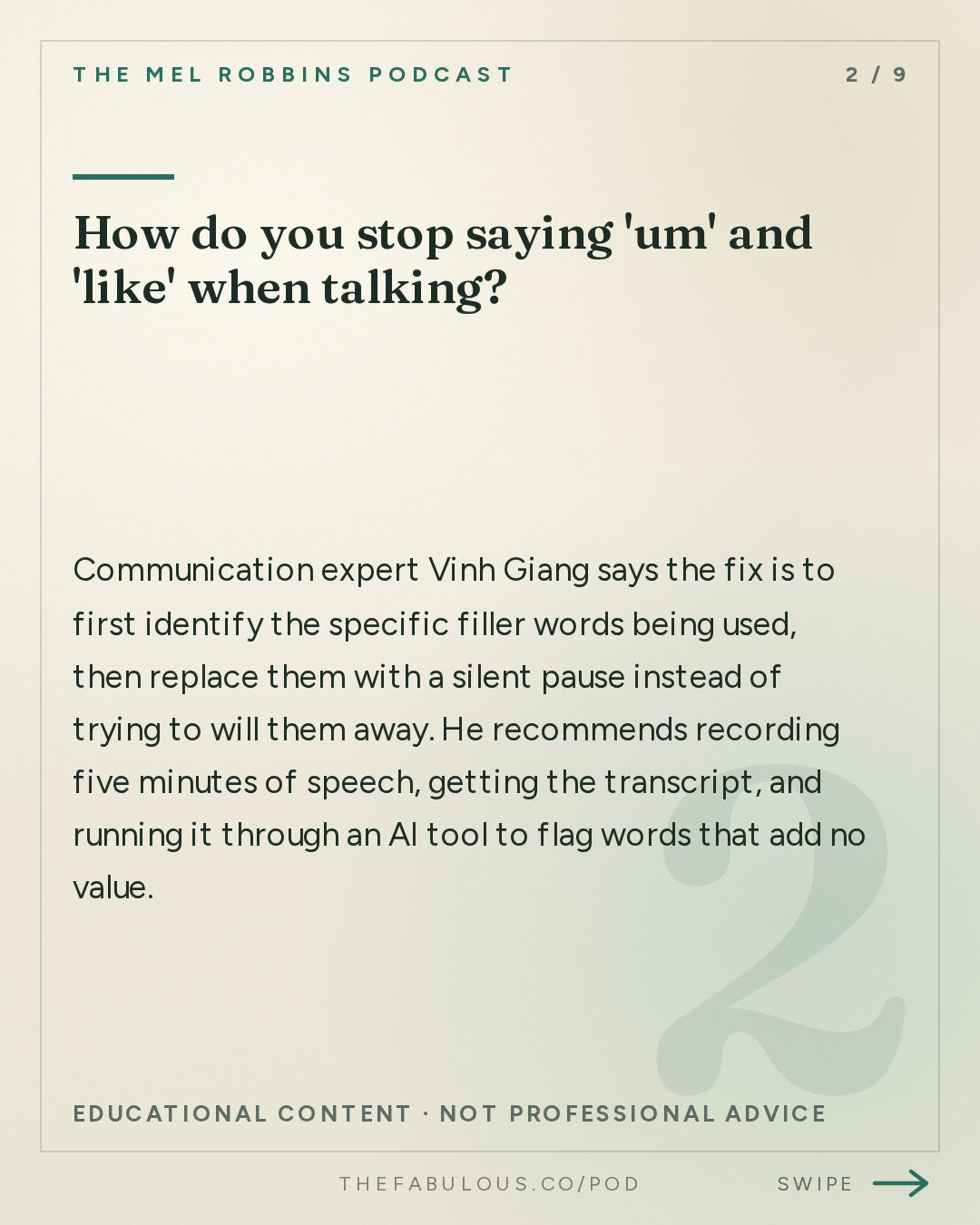
How do you stop saying 'um' and 'like' when talking?
Communication expert Vinh Giang says the fix is to first identify the specific filler words being used, then replace them with a silent pause instead of trying to will them away (05:38). He recommends recording five minutes of speech, getting the transcript, and running it through an AI tool to flag words that add no value (08:51).
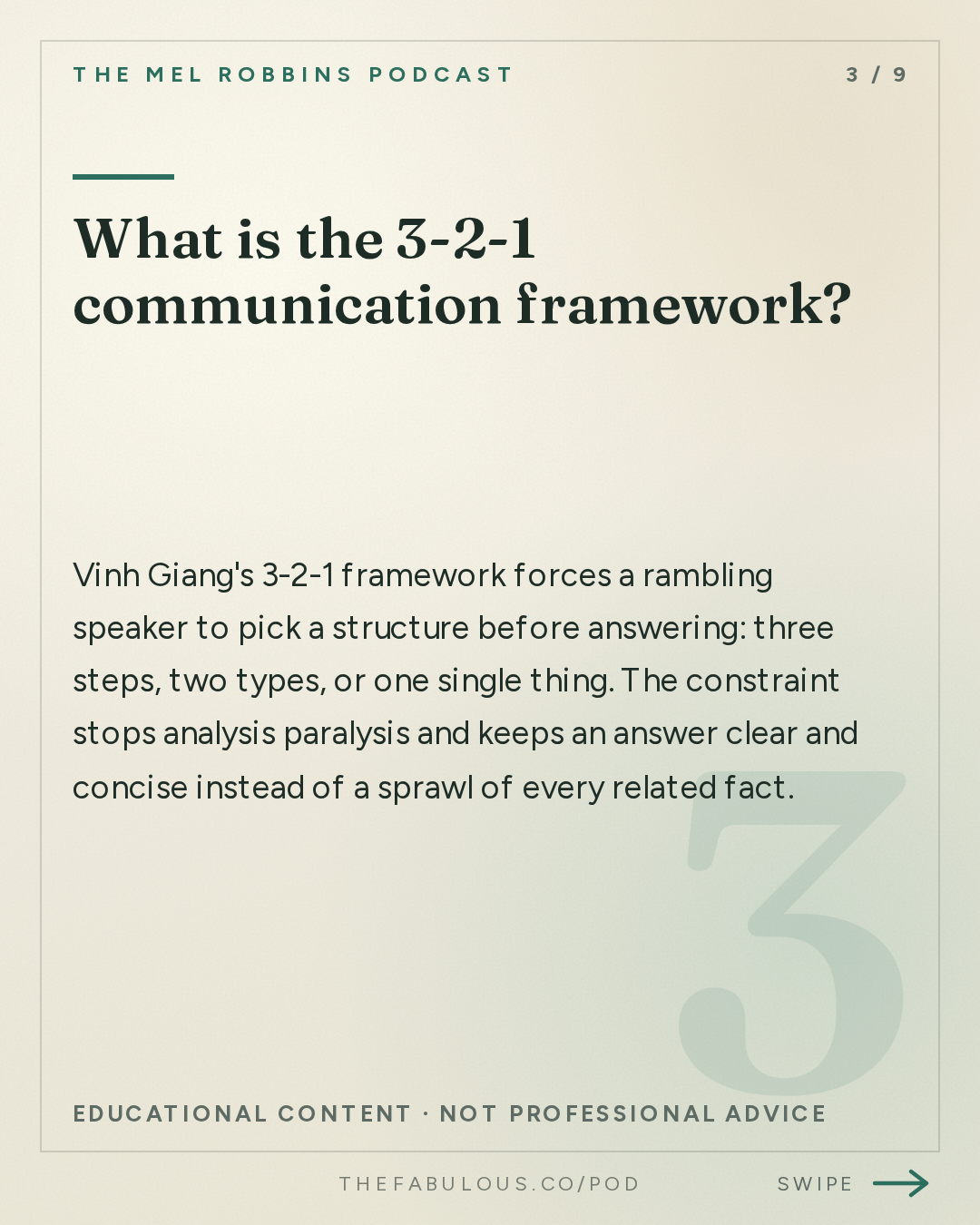
What is the 3-2-1 communication framework?
Vinh Giang's 3-2-1 framework forces a rambling speaker to pick a structure before answering: three steps, two types, or one single thing (31:46). The constraint stops analysis paralysis and keeps an answer clear and concise instead of a sprawl of every related fact (36:54).
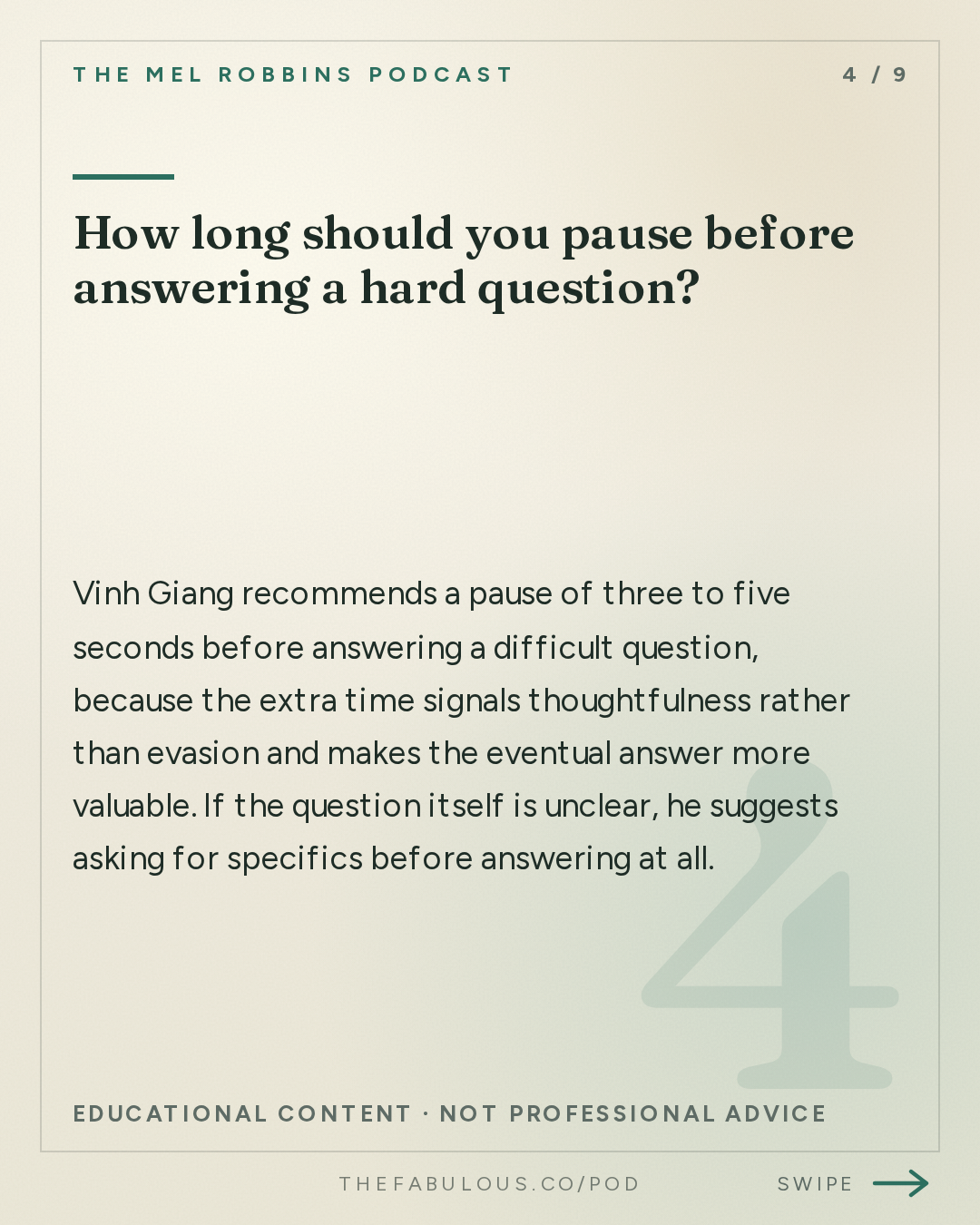
How long should you pause before answering a hard question?
Vinh Giang recommends a pause of three to five seconds before answering a difficult question, because the extra time signals thoughtfulness rather than evasion and makes the eventual answer more valuable (43:26). If the question itself is unclear, he suggests asking for specifics before answering at all (44:17).
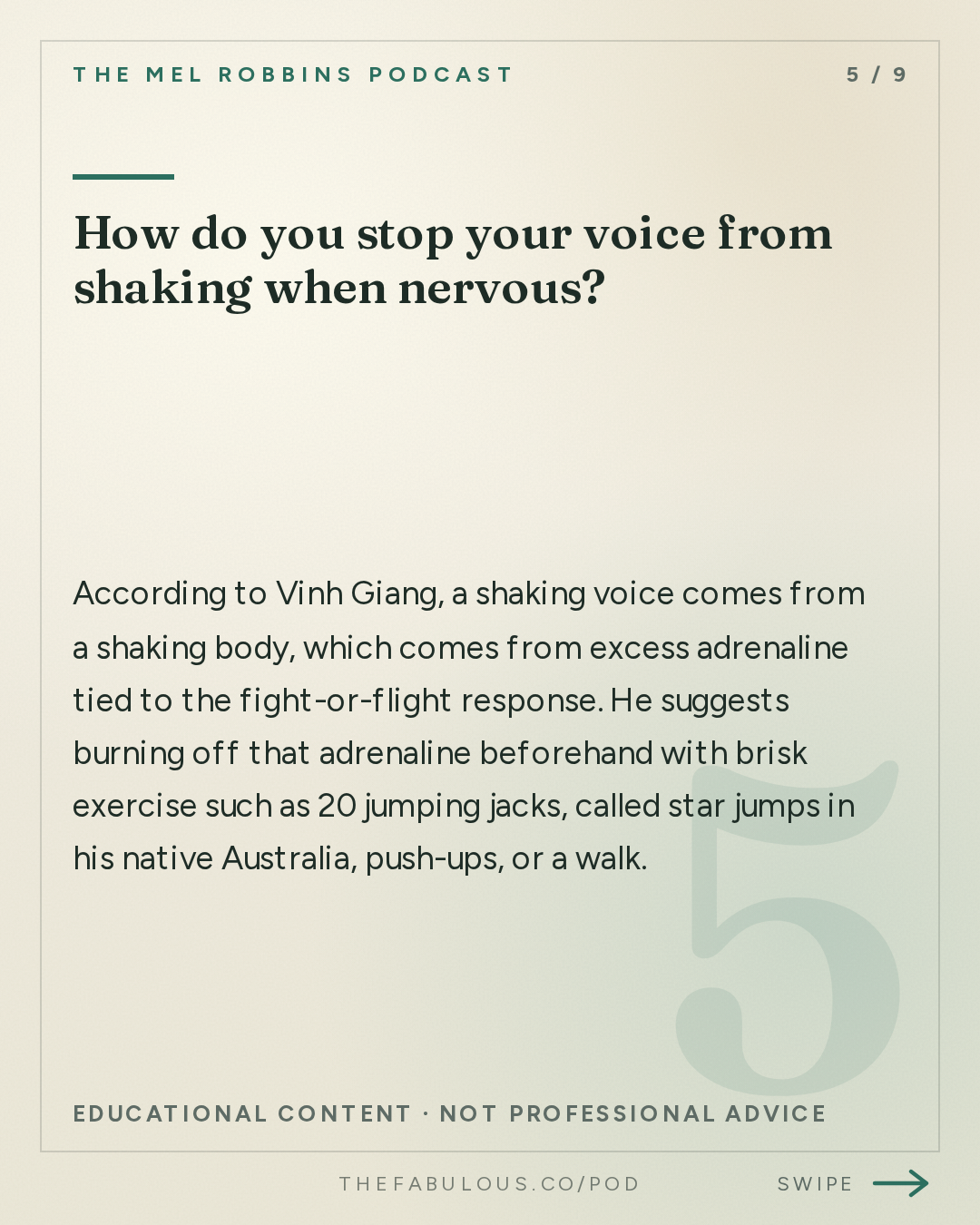
How do you stop your voice from shaking when nervous?
According to Vinh Giang, a shaking voice comes from a shaking body, which comes from excess adrenaline tied to the fight-or-flight response (50:04). He suggests burning off that adrenaline beforehand with brisk exercise such as 20 jumping jacks, called star jumps in his native Australia, push-ups, or a walk (50:23).
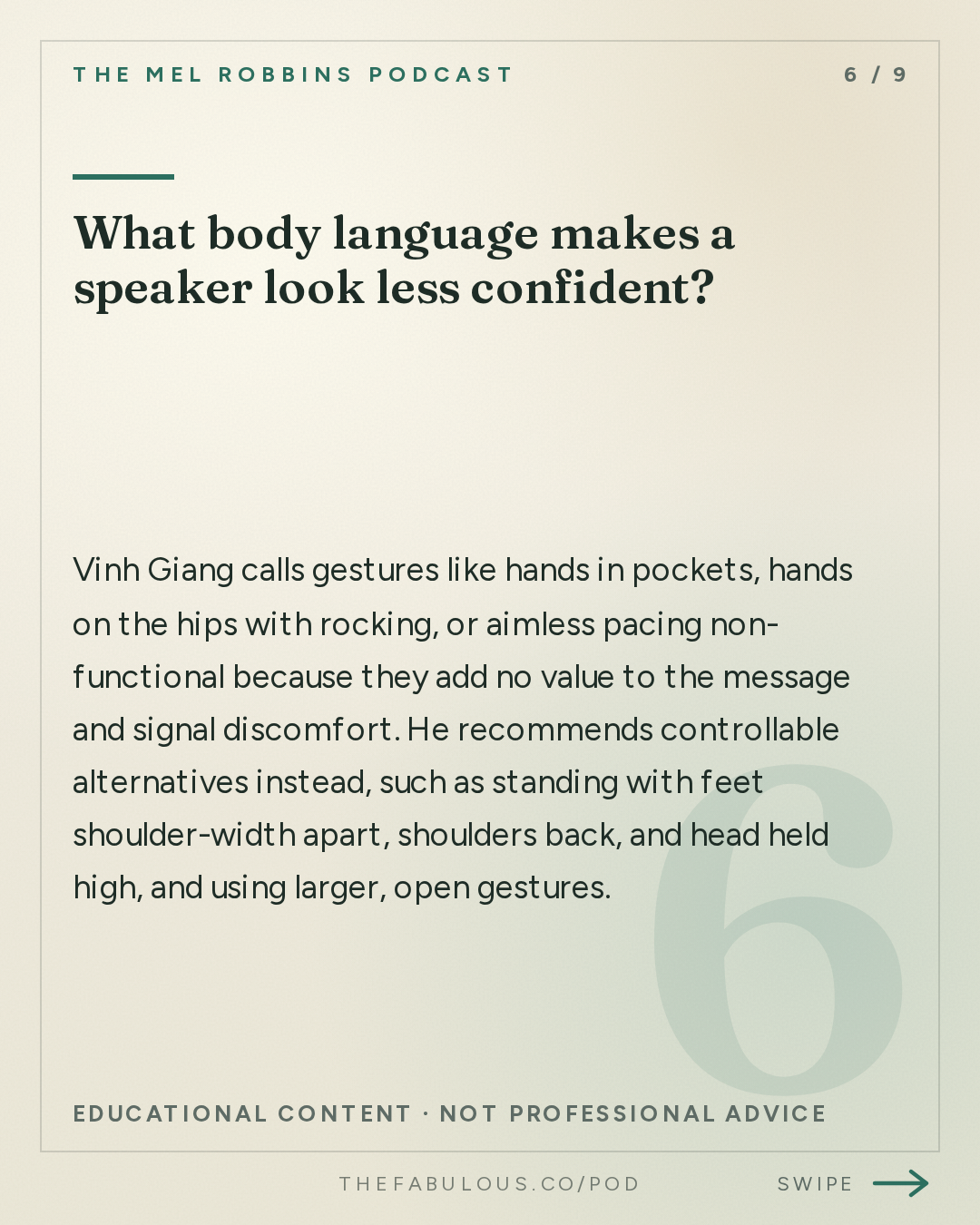
What body language makes a speaker look less confident?
Vinh Giang calls gestures like hands in pockets, hands on the hips with rocking, or aimless pacing non-functional because they add no value to the message and signal discomfort (46:48). He recommends controllable alternatives instead, such as standing with feet shoulder-width apart, shoulders back, and head held high, and using larger, open gestures (51:35).
The full read, in cards
Go deeper
- Before We Forget How to Connect — Vinh Giang's book on communication, which opens with his family's escape from Vietnam as the reason the skill matters
- Vinh Giang's first TEDx talk — His first public speech, which he calls a 21-minute panic attack of nonstop pacing on stage
Mentioned
Vinh Giang · Mel Robbins · Before We Forget How to Connect · David Griggs · Pulau Bidong · Virginia Satir · John Wooden · Steve Martin
More from this show and category
PMOS vs PCOS: New Diagnosis Criteria Explained
OBGYN Dr. Thais Aliabadi argues that PCOS (now renamed PMOS), endometriosis, and PMDD are routinely misdiagnosed as anxiety or stress. She traces each to a physical mechanism, insulin resistance, immune dysfunction, hormone-sensitive brain circuits, and gives exact diagnostic criteria and treatments, including a new blood test and a window-dosed SSRI protocol.
Tyrer-Cuzick Breast Cancer Risk Calculator Explained
OB-GYN Dr. Thais Aliabadi shows how a free two-minute risk calculator and annual pelvic ultrasounds can catch breast and ovarian cancer early. She shares her own breast cancer diagnosis, explains the Tyrer-Cuzick tool, genetic testing by age 25, fallopian tube removal to cut ovarian cancer risk, and decade-by-decade screening protocols for heart disease and dementia.
An 89-Year-Old's Don't-Wait Life Advice
Judy Robbins, Mel Robbins' 89-year-old mother-in-law, decided to backpack across Europe for a year starting at 90, inspired by a friend's sudden death at 62. The episode argues that waiting for comfort or permission is the real risk, since good health and time are not guaranteed, and that staying curious about others keeps a person interesting at any age.
How to Stop Doing Everything for Everyone
Pastor Dr. Eric Thomas and Mel Robbins show why the family caretaker is often its least healthy member, and how to step back without guilt. Thomas, drawing on his wife Dee Dee's multiple sclerosis diagnosis, offers a principles-over-feelings decision framework and a simple test: drop one task, see who steps up, then use the freed time for yourself.
